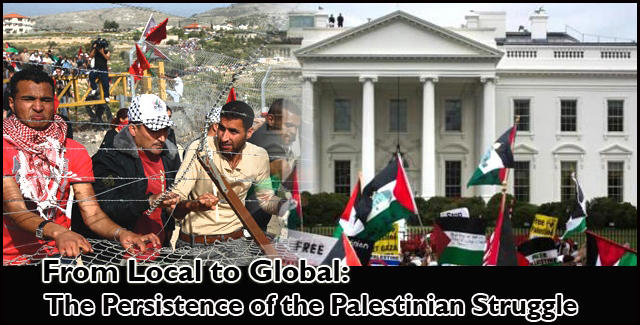
From Local to Global: The Persistence of the Palestinian Struggle

Panel I: “Palestinian Refugees: Waiting to Return”; Panel II: “BDS: Activism and Strategy for Change”; Panel III: “U.S Mediation in the Future of Palestine”; Panel IV: “Jerusalem: A Core Issue”

Nakba Day Killings: The Scoop the New York Times Didn’t Want?

By Yousef Munayyer

Last week I passed on to the New York Times some obvious questions that could lead to a scoop and it seems that they missed the opportunity. After two Palestinian kids were killed on Nakba Day, the New York Times had erroneously reported their ages. I contacted the relevant folks covering and editing these stories at the Times about the error and to their credit they eventually made the correction.

A History of Money in Palestine: The Case of the Frozen Bank Accounts of 1948

Sreemati Mitter, Ernest May Fellow at Harvard University, discusses the freezing of Palestinian bank accounts during the Nakba and use it as a prism through which to explore how the fact of statelessness, which is generally thought of as political condition, directly affects the economic and monetary lives of ordinary people.

A Pattern of Nakba Passivity at the New York Times

By Yousef Munayyer

Last week I wrote about the use of the passive voice in describing the Nakba in the New York Times. This device allows for a sense of ambiguity as to who did what and specifically, who destroyed Palestinian villages. However, on May 16th this is how Jodi Rudoren described it: After two young Palestinian men were killed Thursday by Israeli security forces during a demonstration commemorating the Nakba — Arabic for “catastrophe,” and the word used to describe Israel’s destruction of Palestinian villages as it became a state in 1948 — two Israeli journalists said they were nearly “lynched” by a Palestinian mob.

Israel, Passive Aggression & the New York Times

By Yousef Munayyer

Arab villages were destroyed. The state of Israel destroyed Arab villages.

Do you see the difference there? The first sentence is in the passive voice and absent of any agency. Who destroyed the villages? We are not told in the first sentence. All we are told is that the villages “were destroyed.” The second sentence does not suffer from this ambiguity. It makes clear who the active agent is, in this case, the state of Israel, and that it “destroyed Arab villages.”

Palestine’s Scarred Landscape

By Yousef Munayyer

You might be thinking what can the chalk outline of a body and some rural green landscape possibly have in common. The answer: these images both depict crime scenes. If that seems very obvious for the picture on the right, but not for the image on the left, that is precisely the point. A great deal of effort has gone into hiding the crime on the left.