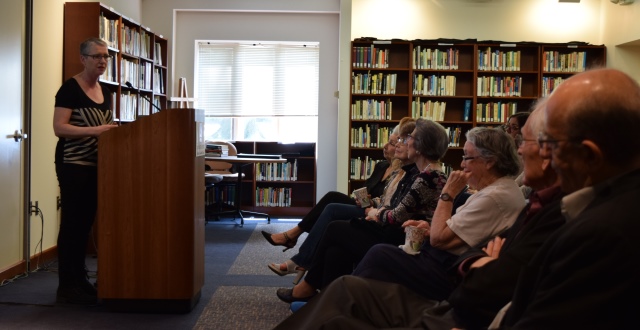
The Role of Palestinian Liberation Theology: A Conversation with Reverend Naim Ateek

This panel focuses on the unique views of Jerusalemite Christian theologian and activist, Reverend Naim Ateek in conversation with author and commentator Max Blumenthal and director of Friends of Sabeel North America (FOSNA), Tarek Abuata. Panel explores Ateek’s view that the religious faith of the people of Jerusalem – and anyone who reveres Jerusalem as a beacon of hope and peace – can overcome those who use religion to advance power agendas. 

I Want This Poem to End: A Nakba Commemoration

In commemoration of the Palestinian nakba, ongoing for the past 70 years, and in light of the wide-spread nakba that now defines the Middle East, Zeina Azzam, Zein El-Amine, Sharif Elmusa, and Kim Jensen read from their own works  in combination with a variety of Palestinian resistance poets–Darwish, Zayyad, Al-Qasim–and more contemporary poets–Naomi Shihab Nye and Dareen Tatour.

Interview with Dorit Naaman about “Jerusalem, We Are Here”

By Palestine Center Interns

Dorit Naaman, film and media professor at Queen’s University, directed and produced an interactive documentary called, “Jerusalem, We Are Here”. The purpose of this project is to restore the lost or stolen homes, mainly in Jerusalem, of pre-1948 Palestine, if not physically then through the communicative power of art and new media. Until this day, houses are being demolished in Palestine adding another facet to the fact that the Nakba never ended. Acknowledging the existence of Palestinian homes, as this project does, is a form of resistance against cultural erasure. This interview highlights the importance of recognizing the past in Palestine, how it lives in the reality of our present, and challenges our future.

“Jerusalem, We Are Here”

Presented by director and producer Dorit Naaman, Jerusalem, We Are Here is an interactive documentary that digitally brings Palestinians back into the Jerusalem neighborhoods from which they were expelled in 1948. Focusing primarily on the neighborhood of Katamon, Palestinian participants probed their families’ past and engaged with the painful present.

Summer Film Series: “1948 – Creation and Catastrophe”

This documentary tells the story of the establishment of Israel as seen through the eyes of the people who lived it, with the aim of enhancing global understanding of what happened 1948. It is also the last chance to hear first-hand accounts of what took place in Haifa, Jaffa, Dayr Yasin, Acre, Jerusalem, Ramle and Lydda from the Israelis and Palestinians who personally fought in and fled from this land, including interviews with veterans, refugees, survivors and historians of the war collected in Palestine, Israel, Jordan, Lebanon, the United Kingdom, Canada and the United States.

What is the Value of Palestinian Cinema?

By Samirah Alkassim

When we consider what is most commonly encountered as Palestinian cinema, it is useful to borrow an analogy from linguistics. Double marking is when grammatical marks are placed at the heads of words, modifiers, and phrases as well as on their endings to indicate things like gender, case, and other distinctions. It occurs in both Modern Standard Arabic and Classical Arabic, as well as in other languages. Likewise, Palestinian cinema is doubly marked.

Nakba Never Forgotten

The Nakba Museum began as the Nakba Museum Project of Memory and Hope, a series of travelling exhibits presented throughout the United States. It is comprised of artwork, photography, oral history, and graphs. All artwork is made by Palestinians living in the West Bank.

Palestine and the Palestinians: Media, People, Politics

The Palestine Center’s 2015 conference examines multiple aspects of the current situation, focusing on the context and representation of Palestinians in the media, regional and international politics, and the United States. Internationally renowned scholars, activists, journalists, and practitioners analyze factors on the ground and larger policies in four panels.

Erased from Space and Consciousness: Israel and the Depopulated Palestinian Villages of 1948

Noga Kadman  is an Israeli researcher in the field of human rights and the Israeli-Palestinian conflict, whose main interest is to explore the encounter between Israelis and the Palestinian presence in the landscape and history of the country. She is also a licensed tour guide who deals mostly with the hidden Palestinian layers of the landscape in Israel. Kadman is co-editor of Once Upon a Land: A Tour Guide to Depopulated Palestinian Villages and Towns (in Hebrew and Arabic).