
Palestine and the Palestinians: Media, People, Politics

The Palestine Center’s 2015 conference examines multiple aspects of the current situation, focusing on the context and representation of Palestinians in the media, regional and international politics, and the United States. Internationally renowned scholars, activists, journalists, and practitioners analyze factors on the ground and larger policies in four panels.
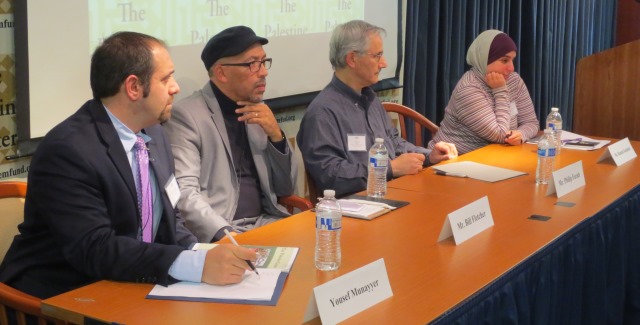
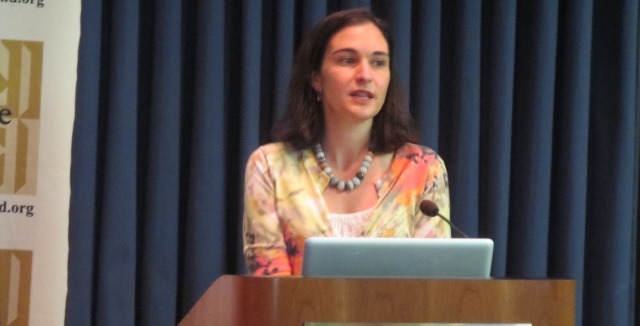
The 2014 Palestine Center Annual Conference – Panel II

As the Israeli occupation deepens, despair over what to do to advance Palestinian rights grows. Boycott, Divestment and Sanctions (BDS) provides an answer that has mobilized and energized many. This panel looks at BDS activities and initiatives globally and in the United States at the community level, as well as specifically through U.S. churches and universities. What is the status of these initiatives, how can they grow and what is next for the BDS movement?

Back Stories: U.S. News Productions and Palestinian Politics

Studying how journalists work in Jerusalem, Bethlehem, Ramallah, and Nablus, and on the tense roads that connect these cities, Amahl Bishara demonstrates how the production of U.S. news about Palestinians depends on multifaceted collaborations, typically invisible to Western readers. She focuses on the work that Palestinian journalists do behind the scenes and below the bylines.

Apartheid Ambiguity

Yousef Munayyer: When an Israeli newspaper recently ran a front page article entitled “Most Israelis support an apartheid regime in Israel,” it was not surprising that it drew considerable criticism from Zionists. But one does not need a poll to directly ask about it to determine that most Israeli Jews support Apartheid. Apartheid is a system of policies already practiced by successive Israeli governments.

How Many Is Too Many?

Yousef Munayyer: Demographic engineering is central to Zionism and has been through every stage of Zionist history. I suppose when a political movement seeks to transplant millions of non-natives into a land of indigenous Arabs, to borrow “father of Zionism” Theodore Herzl’s phraseology, demography must become a central obsession.
