The New York Times: On Holiday in Israel/Palestine

By Yousef Munayyer

The state of Israel marked two holidays this past week that come in succession. One is Israeli memorial day, the other is Israeli “independence” day. Of course for Palestinians, including the 20 percent of Israel’s very population, these holidays are not seen the same way the state sees them. For Palestinians, Israeli “independence” day in particular marks the foundation of their plight.

Two important headlines emerged around this theme this week. One was the release of the iNakba app by Zochrot, an Israeli organization that works to document and remember the Nakba. The second was the mass rally of Palestinian citizens of Israel in Lubya, an ethnically cleansed Palestinian village.
Explaining Max Fisher’s Missing Maps

By Yousef Munayyer

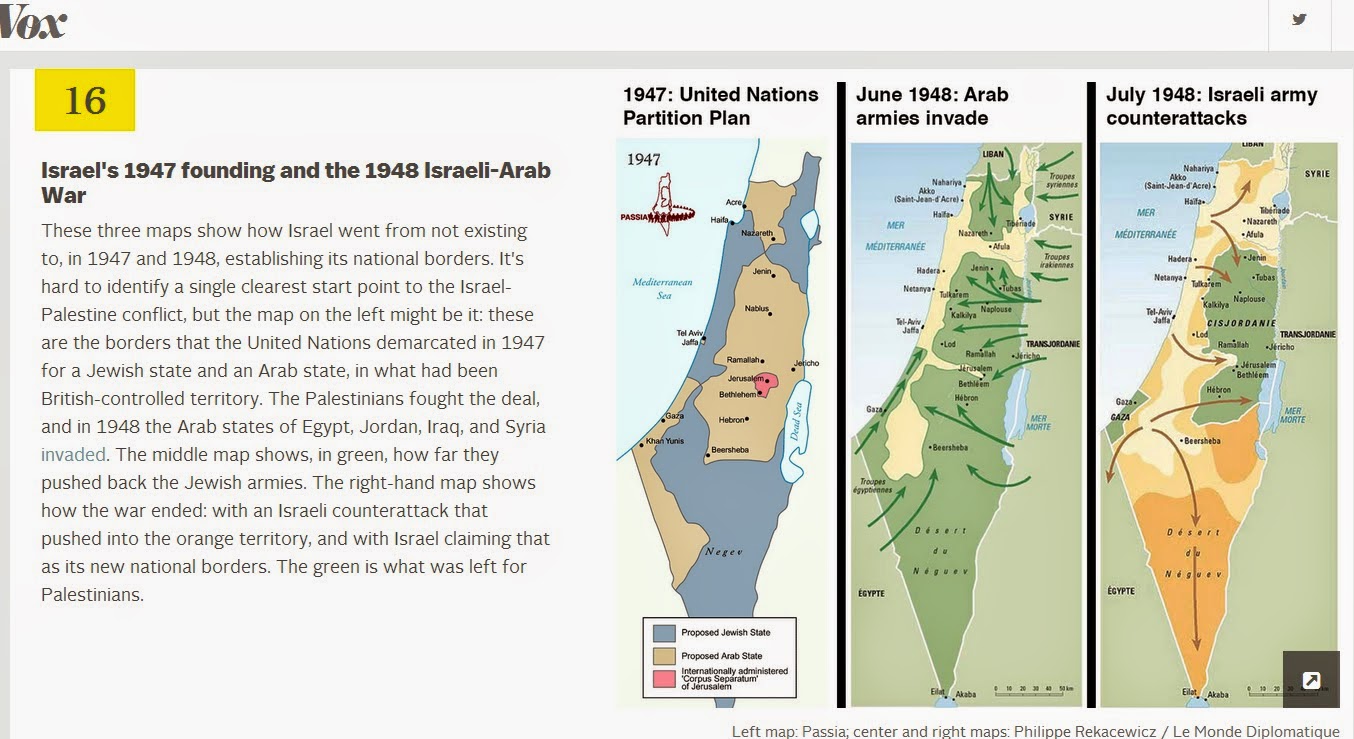
Over at Vox, blogger Max Fisher has a post up entitled “40 Maps That Explain the Middle East.” If such a title makes you cringe, you are not alone. Often these types of posts which attempt to provide context do more to obscure reality and explain the creator’s biases more than anything else. I am not going to dwell on each map. I won’t claim to know enough about the nuanced political and historical geography in every one of these maps to offer a detailed critique here. However, one thing I do know very well is the nuanced political and historical geography of Palestine and particularly the events around the Nakba. These events are supposedly represented by map number 16 on Max’s “explanatory” list entitled “Israel’s 1947 founding and the 1948 Israeli-Arab War.”

Why the Prawer Plan Is Just a Continuation of the Nakba

The Nakba is not a moment in time. The Nakba is an ongoing process. The Nakba is an experience of dispossession that transcends both time and space. Indeed the depopulation of Palestine of most of its native inhabitants from 1947-1949 did not merely become dispossession when an individual was forced from his home or his land. Rather, the dispossession became cemented when, after hostilities, a new state, the state of Israel, enforced this dispossession by…

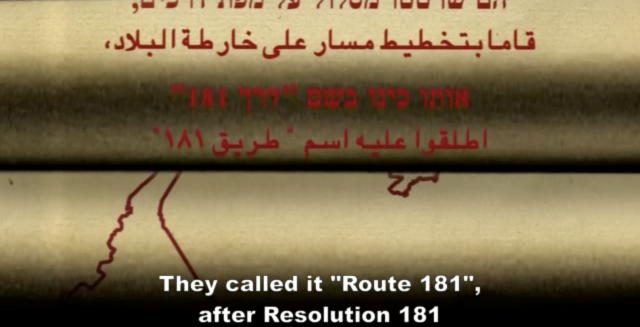
Daytime Film: “Route 181: Fragments of a Journey in Palestine-Israel” by Michel Khleifi and Eyal Sivan

A three-part documentary, the film “Route 181” follows the borders drawn up by UN Resolution 181 which was adopted by the UN on 29 November 1947 to separate Palestine into two states – one Jewish and one Arab. 56 percent of the territory was attributed to the Jewish minority while 43 percent was given to the Arab majority, with a small central area given over to international supervision. Fifty-five years later, the journey of these two filmmakers along Route 181 traces a border which never actually existed.

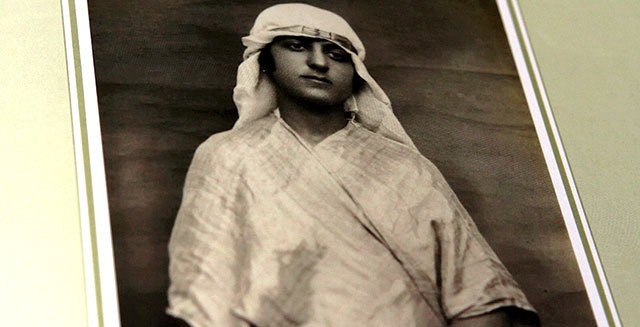
Evening Films: “Restored Pictures” & “Kings and Extras”

Short documentary “Restored Pictures,” 22 mins by Mahasen Nasser Eldin followed by “Kings and Extras,” 62 mins by Azza El-Hassan. Both films touch on the significant contributions Palestinians have made to their own documentation, respectively in the periods of pre-Nakba and post-Nakba.

Blaming the Victim

Yousef Munayyer: In the wake of the commemoration of the Nakba this month, several Zionist commentaries appearing in both several Israeli publications and American publications have highlighted a similar and disturbing trend; they blame the victims of the Nakba for their fate.