The Movement and the Middle East: How the Arab-Israeli Conflict Divided the American Left

The Movement and the Middle East offers the first assessment of the controversial and ultimately debilitating role of the Arab-Israeli conflict among left-wing activists during a turbulent period of American history. Michael R. Fischbach shows how, as the 1970s wore on, the cleavages emerging within the American Left widened, weakening the Movement and leaving a lasting impact that still affects progressive American politics today.

A Pattern of Nakba Passivity at the New York Times

By Yousef Munayyer

Last week I wrote about the use of the passive voice in describing the Nakba in the New York Times. This device allows for a sense of ambiguity as to who did what and specifically, who destroyed Palestinian villages. However, on May 16th this is how Jodi Rudoren described it: After two young Palestinian men were killed Thursday by Israeli security forces during a demonstration commemorating the Nakba — Arabic for “catastrophe,” and the word used to describe Israel’s destruction of Palestinian villages as it became a state in 1948 — two Israeli journalists said they were nearly “lynched” by a Palestinian mob.

Israel, Passive Aggression & the New York Times

By Yousef Munayyer

Arab villages were destroyed. The state of Israel destroyed Arab villages.

Do you see the difference there? The first sentence is in the passive voice and absent of any agency. Who destroyed the villages? We are not told in the first sentence. All we are told is that the villages “were destroyed.” The second sentence does not suffer from this ambiguity. It makes clear who the active agent is, in this case, the state of Israel, and that it “destroyed Arab villages.”

Explaining Max Fisher’s Missing Maps

By Yousef Munayyer

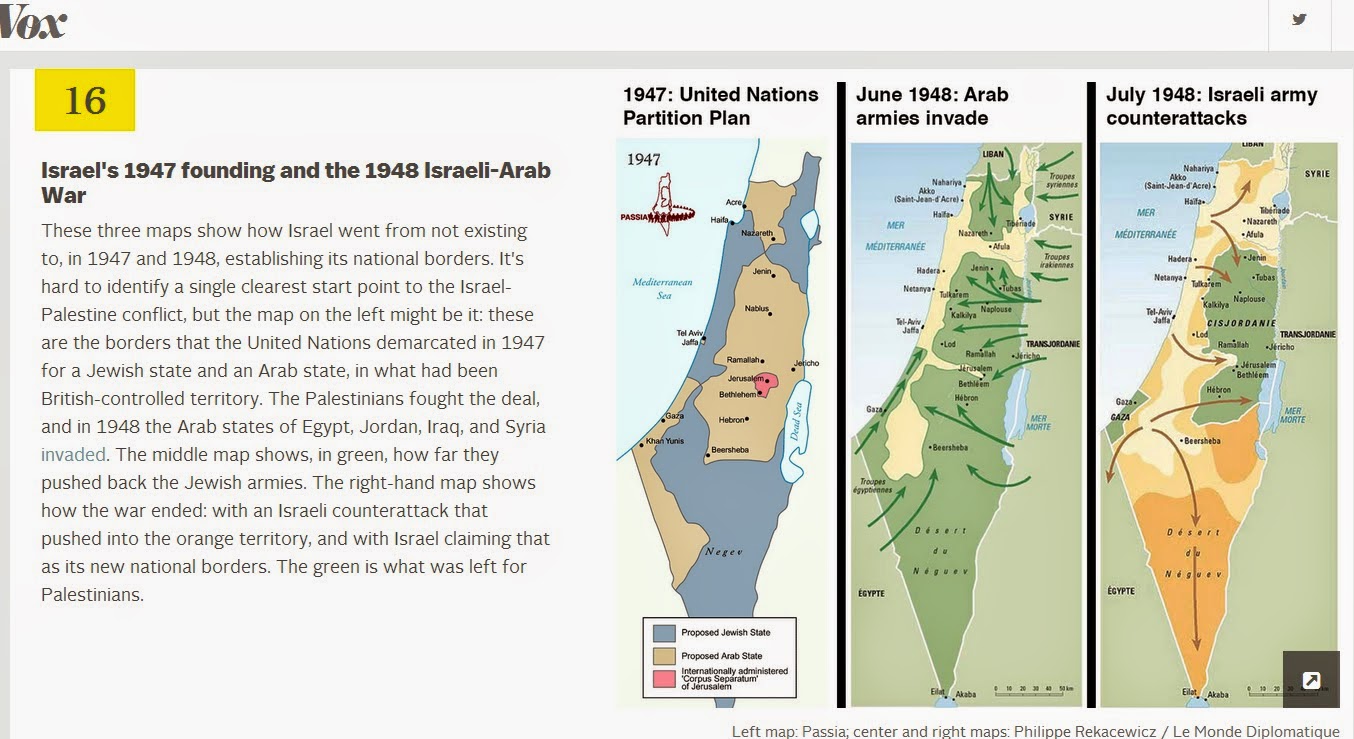
Over at Vox, blogger Max Fisher has a post up entitled “40 Maps That Explain the Middle East.” If such a title makes you cringe, you are not alone. Often these types of posts which attempt to provide context do more to obscure reality and explain the creator’s biases more than anything else. I am not going to dwell on each map. I won’t claim to know enough about the nuanced political and historical geography in every one of these maps to offer a detailed critique here. However, one thing I do know very well is the nuanced political and historical geography of Palestine and particularly the events around the Nakba. These events are supposedly represented by map number 16 on Max’s “explanatory” list entitled “Israel’s 1947 founding and the 1948 Israeli-Arab War.”

Are Israeli Apartheid Laws Affecting US Media?

By Yousef Munayyer

Given the recent statement made by Secretary Kerry about apartheid and Israel and the subsequent walk back, there was a great deal of discussion around the issue in the mainstream media in the last 48 hours.

You’d think the media might want to speak to some Palestinians, you know, those people suffering from the very system in question here, whatever you want to call it. It would be odd, for example, for network news shows to talk about racism without talking to people of color or talking about misogyny without talking to any women. Well, let me revise this, this would be odd in most places but Fox News, where we’ve come to expect such things.

The New York Times and the Peace Process Blame Game

By Yousef Munayyer

Well folks, April 29th is finally here and you know that must mean two things 1) The deadline for the 9-month US-mediated peace talks convened last summer has arrived and 2) The New York Times has published its definitive write-up of why the talks failed.

The Painstakingly Slow Evolution of Roger Cohen

By Yousef Munayyer

Roger Cohen is catching on. Slowly, ever so painfully slowly, but still it seems to be happening. Today Cohen blasts through one of the oft told myths in the Liberal Zionist narrative. But, staying true to Liberal Zionist form, he fails to prescribe the obvious and necessary solutions to the problem he identifies.Cohen addresses the “myth” that the Israeli occupation is unsustainable. This myth is central in Liberal Zionist lore. Jeremy Ben-Ami, J Street Founder and President writes in his book “Our voice must speak the truth as loudly and clearly as possible: The present path that the state of Israel is on is unsustainable.”