
The Plight of Child Prisoners: Israel’s Glaring Human Rights Violations
By Palestine Center Interns — Sarah Dickshinski and Mirvat Salameh 

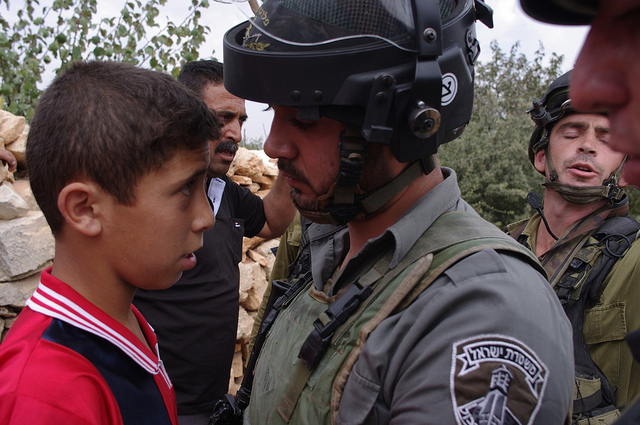
In February 2016 there were 438 Palestinian minors being held in Israeli prisons and since this time the number of Palestinian child detainees in Israel has barely decreased. Victims of abuse and subject to harsh Israeli military laws that deprive them of their basic rights, Palestinian children find themselves part of larger system of inequality and oppression imposed by Israel in Palestine. Although Israel has been called out time and time again for violating international conventions protecting minors, its military forces continue to wage war against a defenseless portion of the Palestinian population.

 

Is it an occupation or an “occupation”?

By Zeina Azzam

One is hard pressed to ask, what is the problem in calling the Occupied Palestinian Territories just that, territory occupied by Israel in the 1967 war? This is the exact terminology of Amnesty International. Oxfam uses Occupied Palestinian Territory. The Israeli human rights organization B’Tselem employs Occupied Territories. The United Nations Office for the Coordination of Humanitarian Affairs has adopted occupied Palestinian territory (oPt). Even the US Department of State refers to The Occupied Territories.

Progressive Jewish groups make New York Times parody issue to protest newspaper’s ‘biased Israel-Palestine coverage’

Activists from progressive Jewish human rights groups created a very convincing-looking fake edition of The New York Times to protest the leading newspaper’s coverage of Israel. The parody publication is written from a left-wing, anti-racist, anti-Islamophobic perspective that criticizes Israel’s violations of international law and Palestinian human rights, along with what the groups say is the Times’ failure to adequately address these crimes.

The Palestinian body finally achieves the approving gaze of the settler

We don’t think the picture below, of a young man killed in occupied Hebron by Israeli forces and surrounded by illegal settlers, would ever show up in the New York Times. And while you can say that it is too grisly for the paper of record, it has already gotten wide attention from people who care about Israel’s occupation because of the attitude it documents.

The New York Times blows it again: Why its Israel-Palestine coverage gets it so wrong

The causes and intensity of the violence in Israel-Palestine cannot be explained in a headline. But that is exactly what the New York Times tried to do in its front-page story last week entitled, “Leaderless Palestinian Youth, Inspired by Social Media, Drive Rise in Violence in Israel.” Apart from giving the weird impression that Facebook and Twitter has somehow prompted knife attacks (something akin to the claim rap music causes drive-by shootings), the headline obfuscates the fact that the violence is not in Israel, but rather on either disputed land or in the Occupied Territories.

Nakba Day Killings: The Scoop the New York Times Didn’t Want?

By Yousef Munayyer

Last week I passed on to the New York Times some obvious questions that could lead to a scoop and it seems that they missed the opportunity. After two Palestinian kids were killed on Nakba Day, the New York Times had erroneously reported their ages. I contacted the relevant folks covering and editing these stories at the Times about the error and to their credit they eventually made the correction.

Dennis Ross Authors The Same Old Piece

By Yousef Munayyer

Dennis Ross has an op-ed in today’s New York Times on what the Obama administration should do regarding the Middle East “peace process.” The piece comes after news that “peace process” envoy Martin Indyk is packing up shop and two Palestinian children were killed by Israeli fire in demonstrations against the occupation.

Israel, Passive Aggression & the New York Times

By Yousef Munayyer

Arab villages were destroyed. The state of Israel destroyed Arab villages.

Do you see the difference there? The first sentence is in the passive voice and absent of any agency. Who destroyed the villages? We are not told in the first sentence. All we are told is that the villages “were destroyed.” The second sentence does not suffer from this ambiguity. It makes clear who the active agent is, in this case, the state of Israel, and that it “destroyed Arab villages.”

The New York Times: On Holiday in Israel/Palestine

By Yousef Munayyer

The state of Israel marked two holidays this past week that come in succession. One is Israeli memorial day, the other is Israeli “independence” day. Of course for Palestinians, including the 20 percent of Israel’s very population, these holidays are not seen the same way the state sees them. For Palestinians, Israeli “independence” day in particular marks the foundation of their plight.

Two important headlines emerged around this theme this week. One was the release of the iNakba app by Zochrot, an Israeli organization that works to document and remember the Nakba. The second was the mass rally of Palestinian citizens of Israel in Lubya, an ethnically cleansed Palestinian village.
