Rudoren Misses Context in Crackdown Coverage

By Yousef Munayyer

Rudoren has a new article up published yesterday about the search for three missing Israeli settlers. There is so much lacking in the general coverage of recent events in Occupied Palestine, particularly in the under-reporting of the wide-ranging and brutal Israeli crackdown, that it is hard to know where to start. For this reason, I’m just going to point out one thing in the piece that is actually representative of a bigger problem with Rudoren’s coverage of the area.

Who’s Who in the New PA Government

By Palestine Center

Last week, a new Palestinian Authority (PA) government was announced after a reconciliation agreement between the PLO and Hamas decided to establish a consensus government of independents and technocrats to pave the way for new elections.

Nakba Day Killings: The Scoop the New York Times Didn’t Want?

By Yousef Munayyer

Last week I passed on to the New York Times some obvious questions that could lead to a scoop and it seems that they missed the opportunity. After two Palestinian kids were killed on Nakba Day, the New York Times had erroneously reported their ages. I contacted the relevant folks covering and editing these stories at the Times about the error and to their credit they eventually made the correction.

Wolf Lets Oren Howl at CNN Colleague’s Work

By Yousef Munayyer

Last week CNN stooped to a new low in coverage of Israel/Palestine. Wolf Blitzer, the former AIPAC employee turned host, decided to cover the deaths of two Palestinian teens in the occupied Palestinian West Bank. You’d think this is a step forward until you see how it was don

A Pattern of Nakba Passivity at the New York Times

By Yousef Munayyer

Last week I wrote about the use of the passive voice in describing the Nakba in the New York Times. This device allows for a sense of ambiguity as to who did what and specifically, who destroyed Palestinian villages. However, on May 16th this is how Jodi Rudoren described it: After two young Palestinian men were killed Thursday by Israeli security forces during a demonstration commemorating the Nakba — Arabic for “catastrophe,” and the word used to describe Israel’s destruction of Palestinian villages as it became a state in 1948 — two Israeli journalists said they were nearly “lynched” by a Palestinian mob.

Israel, Passive Aggression & the New York Times

By Yousef Munayyer

Arab villages were destroyed. The state of Israel destroyed Arab villages.

Do you see the difference there? The first sentence is in the passive voice and absent of any agency. Who destroyed the villages? We are not told in the first sentence. All we are told is that the villages “were destroyed.” The second sentence does not suffer from this ambiguity. It makes clear who the active agent is, in this case, the state of Israel, and that it “destroyed Arab villages.”

The New York Times: On Holiday in Israel/Palestine

By Yousef Munayyer

The state of Israel marked two holidays this past week that come in succession. One is Israeli memorial day, the other is Israeli “independence” day. Of course for Palestinians, including the 20 percent of Israel’s very population, these holidays are not seen the same way the state sees them. For Palestinians, Israeli “independence” day in particular marks the foundation of their plight.

Two important headlines emerged around this theme this week. One was the release of the iNakba app by Zochrot, an Israeli organization that works to document and remember the Nakba. The second was the mass rally of Palestinian citizens of Israel in Lubya, an ethnically cleansed Palestinian village.

Explaining Max Fisher’s Missing Maps

By Yousef Munayyer

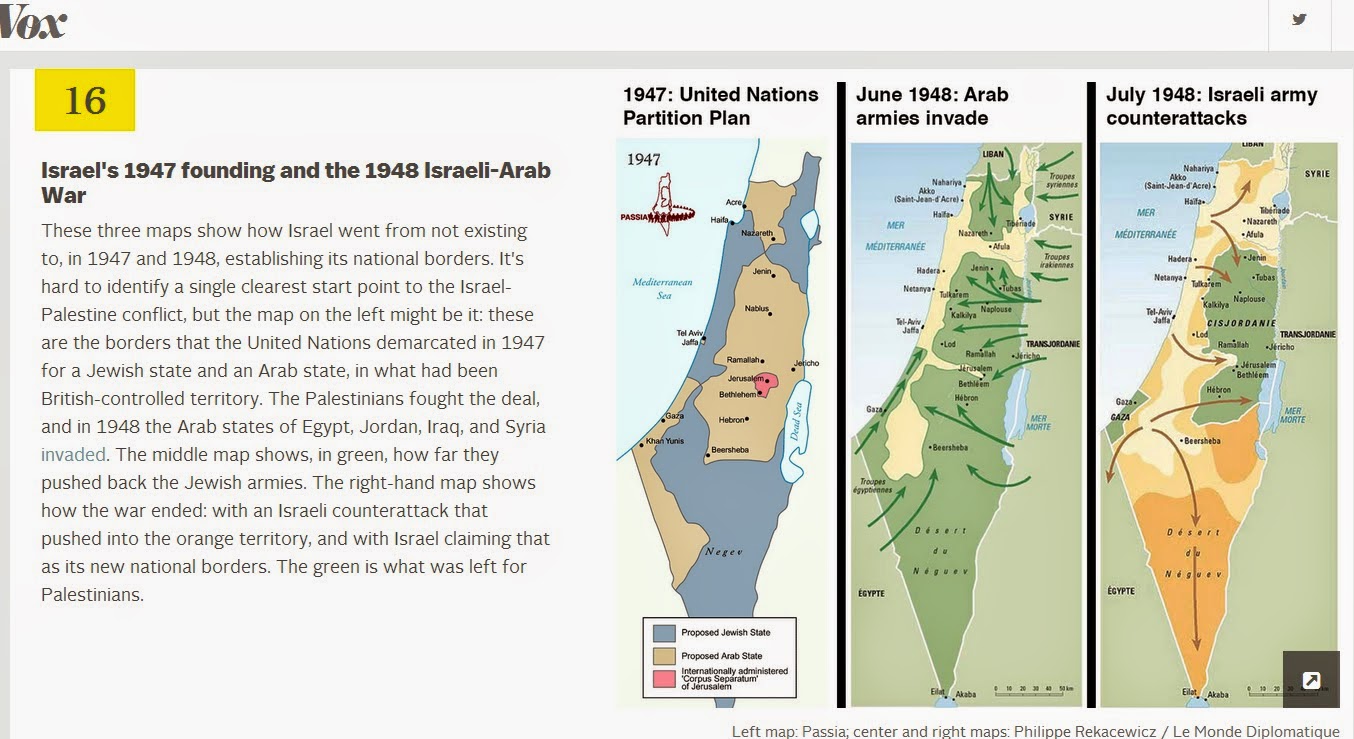
Over at Vox, blogger Max Fisher has a post up entitled “40 Maps That Explain the Middle East.” If such a title makes you cringe, you are not alone. Often these types of posts which attempt to provide context do more to obscure reality and explain the creator’s biases more than anything else. I am not going to dwell on each map. I won’t claim to know enough about the nuanced political and historical geography in every one of these maps to offer a detailed critique here. However, one thing I do know very well is the nuanced political and historical geography of Palestine and particularly the events around the Nakba. These events are supposedly represented by map number 16 on Max’s “explanatory” list entitled “Israel’s 1947 founding and the 1948 Israeli-Arab War.”

Are Israeli Apartheid Laws Affecting US Media?

By Yousef Munayyer

Given the recent statement made by Secretary Kerry about apartheid and Israel and the subsequent walk back, there was a great deal of discussion around the issue in the mainstream media in the last 48 hours.

You’d think the media might want to speak to some Palestinians, you know, those people suffering from the very system in question here, whatever you want to call it. It would be odd, for example, for network news shows to talk about racism without talking to people of color or talking about misogyny without talking to any women. Well, let me revise this, this would be odd in most places but Fox News, where we’ve come to expect such things.