Permission To Narrate

– Edward Said

The late Palestinian scholar, Edward Said, remarked that Palestinians had been denied permission to narrate their history and speak of the day-to-day experiences of life in the margins. Here, we reclaim that permission to narrate our own stories.

“The Poet and the Poem”

WASHINGTON, D.C. (March, 25 2016) — Executive Director, Zeina Azzam, was interviewed by poet Grace Cavalieri in a 30-minute segment for the Library of Congress’s “The Poet and the Poem” audio podcast.

The Eye of the Blossom

“Growing up in a garden of flowers … literally, as a child I was fascinated, taken by its diversity in shape and color, and feasted my eyes and never ignored…. As a photographer I always carried my camera with me and always on the lookout for flowers.  No matter what assignments I had I always noticed the flower everywhere. 

Classical Calligraphy by Nawaf Soliman

Calligraphy is more than beautiful Arabic handwriting. It is the imaginative expression of individual creativity, the area of aesthetics where skill meets genius. Primarily a means for worshipping the Creator, the Arabic language is organically linked to the Qur’an. Thus both words and the forms of words take on power greater than their individual entities. It is from this that ornamental calligraphy stems.

Explaining the New Violence in Palestine

United Nations secretary general Ban Ki-moon made some illuminating remarks about Israel-Palestine last month. After a ritual condemnation of Palestinian violence, he added a comment that enraged Israel’s government and politicians. Such crude descent into causality was troubling for Israel. For the head of such an important institution to attribute blame to the country for the current wave of attacks can only be met with claims that the secretary general is a terrorist sympathizer.

The 100 best nonfiction books: No 8 – Orientalism by Edward Said (1978)

Next to the suicide bombings, the air strikes, and the beheadings, a closely argued 300-page monograph devoted to a radical post-colonial thesis might seem to suggest a modest literary intervention. Yet in the ongoing, brutal clash of Islam and the west, Edward Said’s analysis remains the book to which no combatant can be indifferent.

Listen: Threats fail to curb student boycotts of Israel

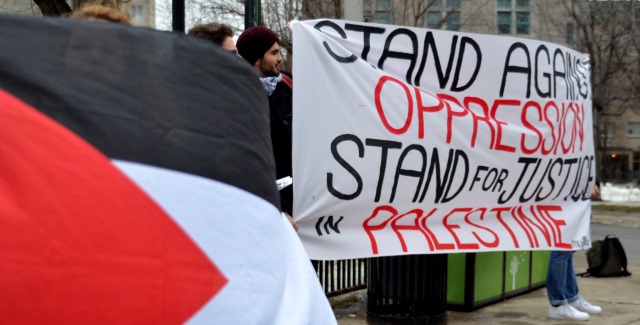
Students from a wide coalition at the University of Minnesota recently launched a divestment campaign to urge the administration to pull its investments in four companies that profit from Israel’s violations of Palestinian rights. Meanwhile, funds for student activities at Vassar College were threatened by the college’s board of trustees if a boycott amendment was passed. And in New York City, a major Zionist group is pushing local lawmakers to ban chapters of Students for Justice in Palestine.

AIPAC’s Anti-BDS Campaign

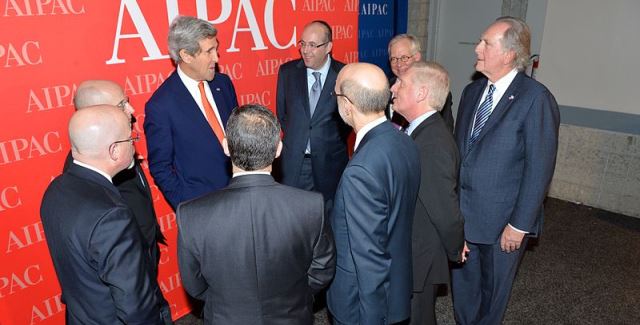
When the American Israel Public Affairs Committee (AIPAC) comes to town this week for their annual policy conference, high on the agenda of issues they’ll be pushing Congress to support are bills designed to ‘fight the boycott of Israel.’ This campaign to combat efforts to ‘boycott, divest, or sanction’ Israel (BDS) has become a full-fledged national movement with AIPAC-supported initiatives moving forward not only in Congress but in two dozen state legislatures, as well. These bills, both federal and state, are all variations on a theme designed to punish, by blacklisting or sanctions, any governments, businesses, organizations, or individuals who boycott, divest funds, or impose sanctions on Israel or Israelis or products emanating from Israel or ‘Israeli controlled territories.’