Palestinians Are Fighting for Their Lives; Israel Is Fighting for the Occupation

Yes, this is a war, and Prime Minister Benjamin Netanyahu, with his mandate from the people, has ordered its intensification. He does not listen to Palestinian President Mahmoud Abbas’ messages of conciliation and acceptance in calmer times, why should he listen to them now?
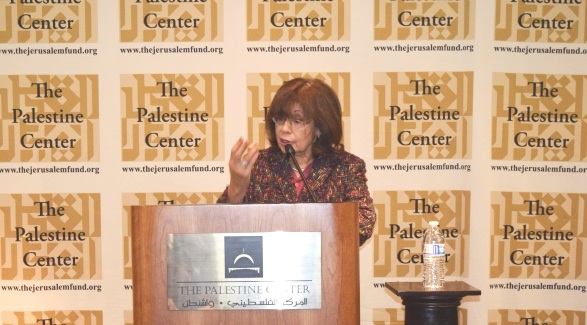
“Return: A Palestinian Memoir” with Dr. Ghada Karmi

Dr. Ghada Karmi reads selections from her recent memoir, taking us on a fascinating journey into the heart of one of the world’s most intractable conflict zones and one of the major issues of our time. Visiting places she has not seen since childhood (in the West Bank), her unique insights reveal a militarized and barely recognizable homeland, and her home in Jerusalem, like much of the West Bank, occupied by strangers. Her encounters with politicians, fellow Palestinians, and Israeli soldiers cause her to question what role exiles like her have in the future of their country and whether return is truly possible.

Palestine’s Intifada: the Process of Liberation is Irresistible

Yes, there is violence in the streets. It is the violence that fixates the viewer. Its context is set aside. Why are they using knives or why do they throw stones – that is the horizon of the question. The Western media is always surprised by the paroxysm of violence from the Palestinians – why do they resist?

Panel I of The 2015 Palestine Center Annual Conference

In Panel I “Covering Palestine: U.S. Media, the Israel Lobby, and Public Opinion,” Ali Abunimah, Philip Weiss, and Said Arikat discuss how the U.S. media chooses to cover events dealing with Palestine and the Palestinians and the extent of the influence of particular interests, such as the Israel lobby, on this coverage. They also consider how the grassroots landscape, including voices of activist Americans, Palestinians, Palestinian Americans, Jewish Americans, and others, is transforming public opinion.

Panel III of the 2015 Palestine Center Annual Conference

On this panel, entitled “Palestine in Regional and International Politics,” speakers Manal Jamal, Fouad Moughrabi, and Yousef Munayyer discuss the context of the Palestinian situation at present, following the “Arab Spring” upheavals of the last few years, with a focus on the effects of regional politics on refugee populations in the Arab countries nearby. Panelists also consider international efforts in Palestine, like United Nations initiatives, the International Court, and US policy toward Israel and Palestine.

Panel IV of the 2015 Palestine Center Annual Conference

This panel examines the situation in Gaza at present as understood by the Palestinians in Gaza themselves and by the nongovernmental organizations and international donors working in reconstruction and relief. Speakers also address the short-term and long-term social and political challenges on the ground, including Israel’s accountability for the invasion and what the international community should be doing to avert another war in Gaza.

Talking BDS with Chris Hedges

By Palestine Center Interns

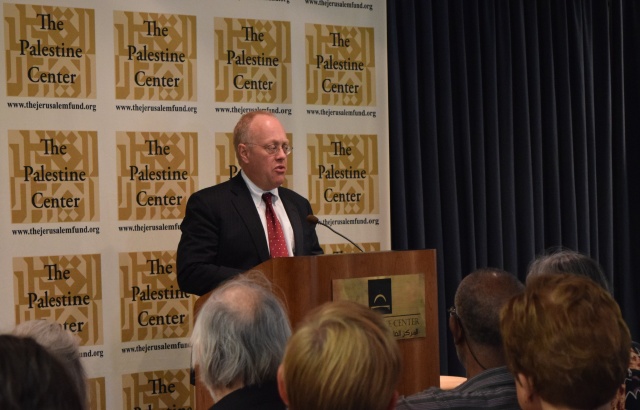
Last week, the Palestine Center hosted its first speaker of the fall, author and Pulitzer-prize winning journalist Chris Hedges. In a lecture entitled “Building the BDS Movement for Justice in Palestine,” Hedges asserted that the boycott, divestment, and sanctions (BDS) movement is the only remaining avenue by which activists can effectively advocate for the rights of Palestinians.

By the Numbers: Mapping Settler Violence in Summer 2015

By Palestine Center Interns

Harassment and violence are daily concerns for Palestinians living in the West Bank and Gaza. Dating back to the beginning of Israeli occupation in 1967 (see our last blog post on settler violence), the Israeli Defense Forces and Israeli settlers have attacked Palestinian civilians on a routine basis. Reports of settler violence against men, women, and children from all areas of the West Bank continue to pour into databases. Recently, a Palestinian home was set on fire by Israeli settlers in Duma, Nablus, killing 18-month-old Ali Dawabshe and hospitalizing the Dawabshe family. While multiple news outlets covered the attack, most instances of settler violence go unreported.

In memory of Dr. Mujid S. Kazimi

WASHINGTON, D.C. (6 July 2015) – The Jerusalem Fund for Education and Community Development is saddened by the loss of Dr. Mujid S. Kazimi, Professor of Nuclear Engineering at MIT, one of the world’s foremost educators and researchers in nuclear technology, and one of the pillars of our community, who died suddenly on Wednesday in China. He suffered a heart attack while visiting Harbin Engineering University to participate in an international advisory committee.