Permission To Narrate

– Edward Said

The late Palestinian scholar, Edward Said, remarked that Palestinians had been denied permission to narrate their history and speak of the day-to-day experiences of life in the margins. Here, we reclaim that permission to narrate our own stories.

2016 Summer Intern Panel: “Restrictions on Mobility: Structural Mechanisms & Physical Barriers”
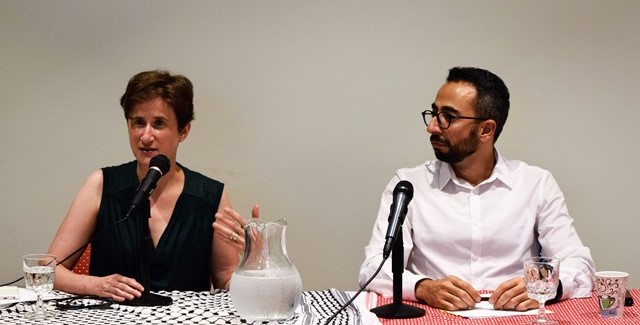
This panel with Dr. Shira Robinson and Mr. Minem Maroof examines the policies behind the restrictions on Palestinian movement, both physical and legal, and how these mechanisms limit Palestinian freedom of movement and allow Israel to maintain a matrix of control over the Palestinian population.
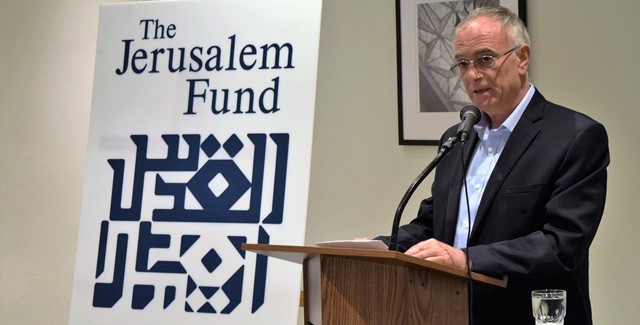
Cultural and Educational Development: A Pathway to Resilience and Hope

Ziad Khalaf, Director General of the A.M. Qattan Foundation, sheds light on the Foundation’s experience in Palestine and elsewhere, as it has become one of the major organizations developing programs for culture and the arts, education, and childhood in Palestine. Among other things, Khalaf discuses the Foundation’s fourth core program, the Public Program, and the Science Studio project, a multi-year pilot project which will form the nucleus for launching an interactive science center in Palestine that aims at developing science education at the national level.

Using stolen water to irrigate stolen land

The recent reports on water crisis in Palestinian areas of the West Bank were accompanied by a story of another water shortage: this time in Israeli settlements. Let’s get one thing straight — there has never been a ‘water shortage’ in the settlements. When settlers open up the tap at home or in their garden, the amount and quality of the water is identical to that which comes out in most homes to the west of the Green Line.

This Palestinian Writer’s Diary From Gaza Should Be Required Reading

When it comes, it brings with it a smell, a fragrance even. You learn to recognize it as a kid growing up in these narrow streets. You develop a knack for detecting it, tasting it in the air. You can almost see it. Like a witch’s familiar, it lurks in the shadows, follows you at a distance wherever you go. If you retain this skill, you can tell that it’s coming—hours, sometimes days, before it actually arrives. You don’t mistake it. Harb. War.

‘I Am a Human Being’: A visit with Dareen Tatour

At about 3:00 am on October 11, 2015, Israeli police and border guards kicked open the door of the Tatour family home and hauled her off in her pajamas, without even her hijab. The police had no warrant and offered no explanation for the shocking pre-dawn raid. Tatour was terrified and “had absolutely no inkling” as to why they were taking her away. Her father Tawfiq asked the police to let him accompany his daughter. They refused. The family was left in a state of panic and confusion.

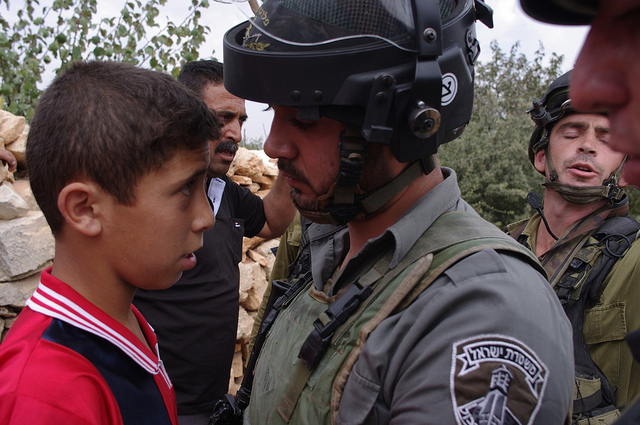
The Plight of Child Prisoners: Israel’s Glaring Human Rights Violations

By Palestine Center Interns — Sarah Dickshinski and Mirvat Salameh 

In February 2016 there were 438 Palestinian minors being held in Israeli prisons and since this time the number of Palestinian child detainees in Israel has barely decreased. Victims of abuse and subject to harsh Israeli military laws that deprive them of their basic rights, Palestinian children find themselves part of larger system of inequality and oppression imposed by Israel in Palestine. Although Israel has been called out time and time again for violating international conventions protecting minors, its military forces continue to wage war against a defenseless portion of the Palestinian population.


“Crossing the Line” – Middle Eastern Artists Explore Middle East-U.S. Border

WATCH- Reported by The Guardian, ‘Can I Jump’ is the first episode produced by 10 Middle Eastern artists exploring the ideological boundaries between the Middle East and the United States, or as they say, “the most contested border of our time.”

2016 Summer Intern Lecture: “Conceptions of Mobility”

Dr. Julie Peteet explores mobility as an intended consequence of military occupation in a keynote lecture that opens the 2016 Summer Intern Lecture Series, “Mobility: Israel’s Structural Restrictions and Palestine’s Resistance” on July 11, 2016. She argues that Israeli policies of closure and separation through physical structures and bureaucratic requirements constrain Palestinians’ mobility. Dr. Peteet’s presentation draws from her research, fieldwork in the West Bank, and expertise in space and mobility, Palestinian culture, and resistance. 

Khalida Jarrar: A lifelong quest to heal Palestine

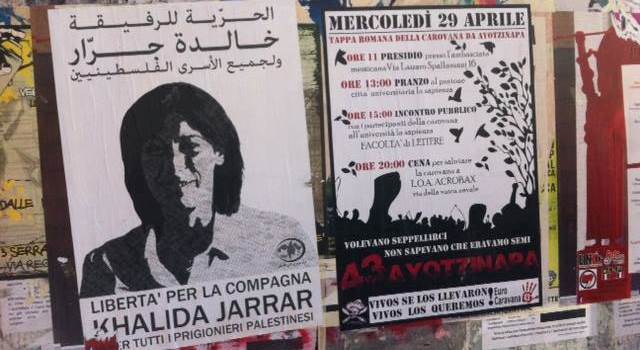
Ramallah, occupied West Bank – The morning after Palestinian parliamentarian Khalida Jarrar, 53, was released after 15 months in Israeli prison, she had an important meeting to attend. The Palestinian Legislative Council (PLC) was meeting to discuss a number of laws, and Jarrar refused to miss it, even though her months in detention had taken a toll.