Against Israel’s Colonial Tide: Palestinian Initiatives to Shape Their Future

This panel examines the intersection of Israeli policies of occupation and containment which prevent Palestinian self-determination, with a focus on the experience for Palestinians of living under occupation in Jerusalem and Gaza and the ways Palestinians and their supporters are organizing politically, economically and culturally to protect their human rights and work towards a different future.


Report: Recent rise in deportations result of Israeli strategy to stifle solidarity with Palestinians

An analysis of UN data show that a recent surge in reports of deportations of individuals attempting to transit through Israel to work with Palestinians is apparently the result of an official strategy implemented by the Israeli government beginning in January of this year, announced the Euro-Mediterranean Human Rights Monitor today.

Women’s flotilla to Gaza is more than mere symbolism

Amal and Zaytouna, a flotilla of two boats with all-women crews and passengers, set sail from Barcelona en route to besieged Gaza in another maritime attempt to break Israel’s illegal blockade on the tiny strip of Palestinian coastal territory. As with previous civilian voyages to Gaza, these boats are carrying prominent international figures who hope to use their stature to focus international attention on continuing Israeli crimes against Palestinians.

Gaza’s Children And The Israeli Offensive Of 2014: Two Years Later

By Zeina Azzam

“During Israel’s 2014 assault on Gaza and its 1.8 million inhabitants, Palestinian poet Khaled Juma penned a moving poem titled ‘Oh Rascal Children of Gaza’. The first few lines were about the chaos and mischief that the children had perpetrated in their neighborhoods before the war, but the wistful ending laments, ‘Come back/and scream as you want/and break all the vases./Steal all the flowers./Come back./Just come back…'”

‘Gaza In Context’: Introducing Israel’s Settler-Colonial Ambitions to the American Classroom

By Palestine Center Interns — Sarah Dickshinski, Abby Massell, Zoë Reinstein, and Mirvat Salameh

Gaza in Context challenges squarely the U.S. and Israeli dominant narrative. By including Palestinian narratives, it counters the perception of Israeli victimization in the American educational system; therefore, the project is a crucial academic project that contextualizes Israel’s involvement in Gaza and situates Israel’s continuous aggression and siege within its broader settler-colonial ambitions. The project as a whole attempts to shift the discussion of the Israeli-Palestinian conflict in American classrooms away from Israeli hasbara and to nuance discourse on Palestine as an entity under Israeli military occupation.

Cultural and Educational Development: A Pathway to Resilience and Hope

Ziad Khalaf, Director General of the A.M. Qattan Foundation, sheds light on the Foundation’s experience in Palestine and elsewhere, as it has become one of the major organizations developing programs for culture and the arts, education, and childhood in Palestine. Among other things, Khalaf discuses the Foundation’s fourth core program, the Public Program, and the Science Studio project, a multi-year pilot project which will form the nucleus for launching an interactive science center in Palestine that aims at developing science education at the national level.

The Situation in Gaza: An Interview with Brian Barber

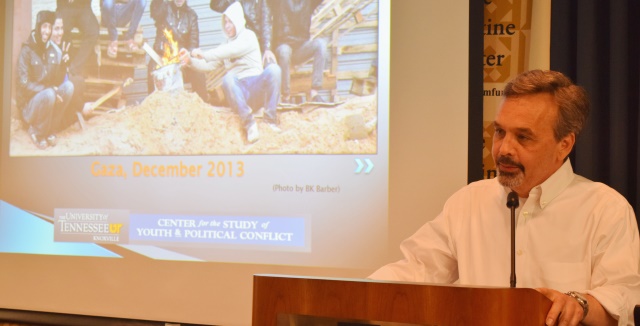
Brian K. Barber, PhD, is a New America Fellow in Washington, DC, a Professor of Child and Family Studies, and Founding Director of the Center for the Study of Youth and Political Conflict at the University of Tennessee. His prime field of research has been Palestine, and he has based his work on long residencies and visits with families in and near refugee camps in the Gaza Strip since the early 2000s. Zeina Azzam, Executive Director of The Jerusalem Fund and Palestine Center, interviewed Brian Barber on February 5 2016, shortly after one of his research visits to Gaza. The information was updated in early April 2016. 

Whither the “Children of the Stone”? An Entire Life under Occupation

The storied generation of shabab (youth) who brought global attention to Palestine through their historically unparalleled activism during the first intifada are now adults – and nothing they fought for has come to pass. Dr. Brian K. Barber examines this situation by posing a series of questions about the first generation of Palestinians to live their entire lives under occupation.