
After Zionism: One State for Israel and Palestine

Mr. Antony Loewenstein and Mr. Ahmed Moor discuss the possibilities for a one-state solution to the Palestinian/Israeli conflict.
– Edward Said
The late Palestinian scholar, Edward Said, remarked that Palestinians had been denied permission to narrate their history and speak of the day-to-day experiences of life in the margins. Here, we reclaim that permission to narrate our own stories.
Browse by category
Mr. Antony Loewenstein and Mr. Ahmed Moor discuss the possibilities for a one-state solution to the Palestinian/Israeli conflict.
Yousef Munayyer: At the recent Democratic National Convention, the party platform being adopted was slightly different from the 2008 version when it came to Israel and Palestine. A sentence, with boilerplate language on the status of Jerusalem, had disappeared. Then hilarity ensued.
Yousef Munayyer: Last week I wrote about the racism involved in Zionism’s constant planning of demographic engineering in Israel and how common such a racist principle is in the mainstream discourse. Three hours after the piece was posted, a lynch mob in Jerusalem ganged up on three Palestinian Arabs and beat Jamal Julani within an inch of his life. Police said it was a miracle he didn’t die.
Yousef Munayyer: In seven days this month, at least eight places of worship associated with Middle Easterners or South Asians have been targeted in the United States. A Sikh temple in Oak Creek, Wis., was the site of a massacre where six people were murdered. Later that evening a mosque in Joplin, Mo., was burned to the ground. In the following days, mosques were targeted in Rhode Island, Southern California, Oklahoma City and at two sites in Illinois. In Dearborn, Mich., an Arab-American church was targeted with vandalism.
Yousef Munayyer: Demographic engineering is central to Zionism and has been through every stage of Zionist history. I suppose when a political movement seeks to transplant millions of non-natives into a land of indigenous Arabs, to borrow “father of Zionism” Theodore Herzl’s phraseology, demography must become a central obsession.
Yousef Munayyer: Yes, Mitt Romney’s ‘analysis’ of the economic disparities between Israelis and Palestinians was racist on multiple levels. ”There is just something about those Jews; they are so good at making money.” Most people in the modern world would dismiss such a statement as anti-Semitic. But when the presumptive Republican candidate for president insinuates the same in the pursuit of pandering for pro-Zionist support it seems excusable.

More than a romantic idea, Palestinians’ cultivation of their land contains the seeds of resistance. Walk the fields through Vivien Sansour’s photographs, experience this relationship of farmer to land, see how the old ways of planting and harvesting, of cooking the old recipes, form an historical continuum, the fruits of their labors feeding the body and the soul of Palestine today.
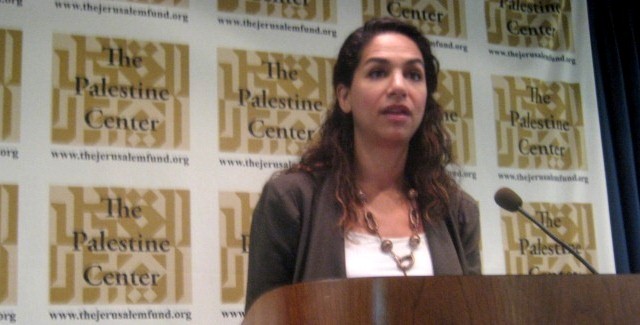
Noura Erakat examines the viability and legitimacy of the current Palestinian leadership. This is the final installment of our annual lecture series, a study of the extent to which Palestinian leadership represents Palestinian interests, and how their national objectives are at all manifest.
Yousef Munayyer: Levy is right, this isn’t occupation. Well, not JUST occupation. When an Israeli panel appointed by Benjamin Netanyahu to investigate the question of outposts issued its findings (that there was no occupation and the settlements were legal), most sensible people responded with contempt.

Through educational events, humanitarian support, and cultural preservation, the Jerusalem Fund is helping build the movement for Palestinian liberation.
Connect
The Jerusalem Fund
2425 Virginia Ave NW
Washington, DC 20037
(202) 338-1958