Permission To Narrate

– Edward Said

The late Palestinian scholar, Edward Said, remarked that Palestinians had been denied permission to narrate their history and speak of the day-to-day experiences of life in the margins. Here, we reclaim that permission to narrate our own stories.

Panel II of the 2015 Palestine Center Annual Conference
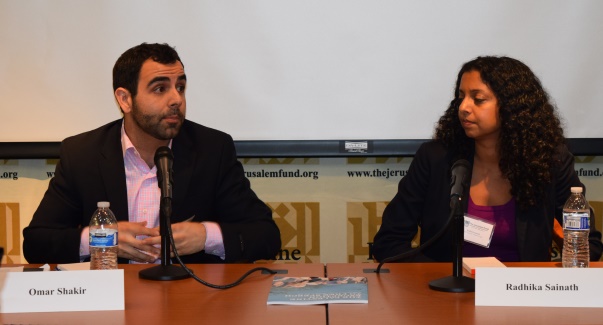
On this panel, entitled, “Palestinians and Palestinian Americans in the United States” speakers Andrew Kadi, Radhika Sainath, and Omar Shakir explore the efforts by individuals and organizations to defend the rights of Palestinians to free speech, academic freedom, and nonviolent activism. Highlighted are the challenges that the Boycott, Divestment, and Sanctions movement faces as well as the defense of students and faculty as they experience the criminalization of dissent on university campuses.

Panel III of the 2015 Palestine Center Annual Conference

On this panel, entitled “Palestine in Regional and International Politics,” speakers Manal Jamal, Fouad Moughrabi, and Yousef Munayyer discuss the context of the Palestinian situation at present, following the “Arab Spring” upheavals of the last few years, with a focus on the effects of regional politics on refugee populations in the Arab countries nearby. Panelists also consider international efforts in Palestine, like United Nations initiatives, the International Court, and US policy toward Israel and Palestine.

Panel IV of the 2015 Palestine Center Annual Conference

This panel examines the situation in Gaza at present as understood by the Palestinians in Gaza themselves and by the nongovernmental organizations and international donors working in reconstruction and relief. Speakers also address the short-term and long-term social and political challenges on the ground, including Israel’s accountability for the invasion and what the international community should be doing to avert another war in Gaza.

Palestine and the Palestinians: Media, People, Politics

The Palestine Center’s 2015 conference examines multiple aspects of the current situation, focusing on the context and representation of Palestinians in the media, regional and international politics, and the United States. Internationally renowned scholars, activists, journalists, and practitioners analyze factors on the ground and larger policies in four panels.

Erased from Space and Consciousness: Israel and the Depopulated Palestinian Villages of 1948

Noga Kadman  is an Israeli researcher in the field of human rights and the Israeli-Palestinian conflict, whose main interest is to explore the encounter between Israelis and the Palestinian presence in the landscape and history of the country. She is also a licensed tour guide who deals mostly with the hidden Palestinian layers of the landscape in Israel. Kadman is co-editor of Once Upon a Land: A Tour Guide to Depopulated Palestinian Villages and Towns (in Hebrew and Arabic).

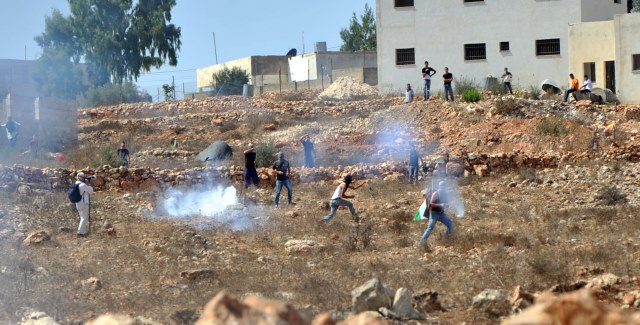
Coming soon: a third Intifada?

By Zeina Azzam

At the United Nations General Assembly last week, as Israeli Prime Minister Benjamin Netanyahu focused his fears on an external threat from Iran, the internal situation in Israel and Palestine started to boil over. The dramatic scene he made during his speech served to deflect attention from his government’s decades-long military occupation policies in the Palestinian territories.

The Task Force on AAA Engagement on Israel-Palestine

By AAA

Recent years have seen increasing pressure in the American Anthropological Association (AAA) and many other professional academic associations to discuss alleged Israeli violations of academic freedom and human rights, and to move toward sanctioning Israel. More than 1,100 anthropologists, many of whom are AAA members, have now signed a petition asking the AAA to undertake a boycott of Israel.

September 2014

I have just returned from viewing Here and Elsewhere at the New Museum in NYC. The show reflects the concerns of 45 artists living in the Arab world or the diaspora, as well as addressing the dilemma of culturally defined art, and art as representation of an expected political or cultural stance.