Blind Spot: America and the Palestinians, from Balfour to Trump

Author Khaled Elgindy presents his new book which discusses a critical political history of US-Palestinian relations.

Author Khaled Elgindy presents his new book which discusses a critical political history of US-Palestinian relations.

By Palestine Center Interns
Connected by the similarities of their situations and a strong desire for liberation, Black Americans as well as the Irish have long stood in support of Palestine. Though people worldwide have supported the Palestinian struggle, the solidarity from these two groups is unique. Black Americans recognize that their struggles against state-sanctioned violence and institutionalized racism in the U.S. are quite similar to Palestinians resisting such actions perpetrated by the Israeli state and military. The Irish draw ties to Palestine based on their shared experiences of settler colonialism
WATCH- Reported by The Guardian, ‘Can I Jump’ is the first episode produced by 10 Middle Eastern artists exploring the ideological boundaries between the Middle East and the United States, or as they say, “the most contested border of our time.”

By Mohamed Mohamed
The US has repeatedly tried to portray itself as an “honest broker” of peace between Israelis and Palestinians, but actions speak louder than words. Allowing US citizens to participate in Israel’s occupation and oppression of Palestinians blatantly contradicts this self-proclaimed title.
In the wake of the formation of the new Israeli government and as the Vatican formally recognizes the the state of Palestine, the debate about Israel/Palestine in the United States is shifting. As many look past a two state solution that seems increasingly difficult to achieve, more fundamental debates about Zionism, partition and equality are gaining greater prominence.

By Yousef Munayyer
Most observers agree that if the Israeli-Palestinian “peace process” is still alive it is on life support with the plug half hanging out of the socket. Last year’s vote at the United Nations, when most of the world opposed the United States’ position and voted for Palestinian statehood, was an international referendum on U.S. mediation. It is undeniable, more than two decades after the Oslo accords, that new thinking is urgently needed.
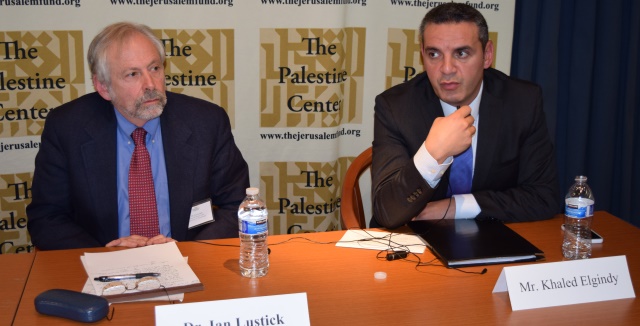
Washington has insisted that any Israeli-Palestinian peace process must go through it. At the same time, it has failed to produce Israeli-Palestinian peace. Can U.S. mediation succeed? What needs to change? If not to Washington, where should Palestinians look to advance their goals? Can Palestinian liberation be achieved without Washington, Israel’s biggest supporter, involved?
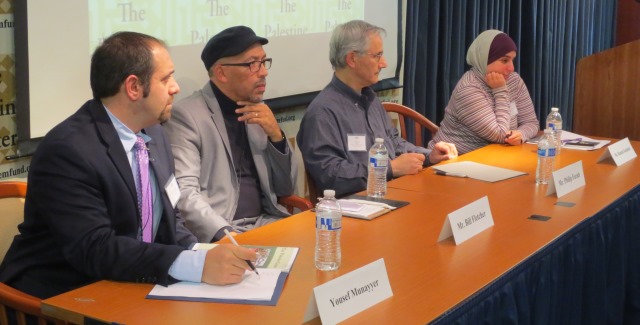
As the Israeli occupation deepens, despair over what to do to advance Palestinian rights grows. Boycott, Divestment and Sanctions (BDS) provides an answer that has mobilized and energized many. This panel looks at BDS activities and initiatives globally and in the United States at the community level, as well as specifically through U.S. churches and universities. What is the status of these initiatives, how can they grow and what is next for the BDS movement?
By Yousef Munayyer
The US and Europe are increasingly taking a backseat in resolving the Palestinian-Israeli conflict.

Through educational events, humanitarian support, and cultural preservation, the Jerusalem Fund is helping build the movement for Palestinian liberation.
Connect
The Jerusalem Fund
2425 Virginia Ave NW
Washington, DC 20037
(202) 338-1958