“Colored Water: Dixie Through Egyptian Eyes”

This memoir offers uncommon and thought provoking cross-cultural observations on segregation, the “American Dream”, race, identity, science, sexuality, love, academia, religion, tradition, personal freedom, social status, and class from the perspective of Dr. Ashraf El-Bayoumi, who was living in America for the first time in 1950s, pursuing his post-graduate studies in chemistry in Florida.

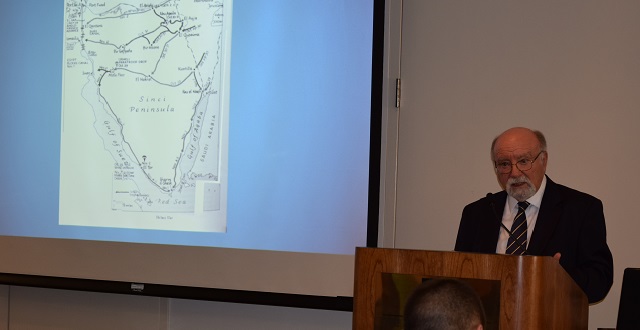
Egyptian Policy in Palestine: A Downward Spiral

By Palestine Center Intern

The government desperately wants not only to secure its northern border, but to remove Hamas from power. Recent talks between Cairo and Hamas regarding Mohammed Dahlan’s return to politics in Gaza reveal that the Egyptian government would rather see the man once accused of murdering Yasser Arafat in power than the democratically elected government.

Assessing the Impact of the 1967 War on the Palestinians 50 Years Later

Professor Shibley Telhami articulates the path that the 1967 war set for the Palestinians and why it has been enormously challenging for them to overcome even after 50 years of occupation. The lecture ties the current state of affairs to the diplomatic efforts on the Israeli-Palestinian conflict proposed by the Trump administration.

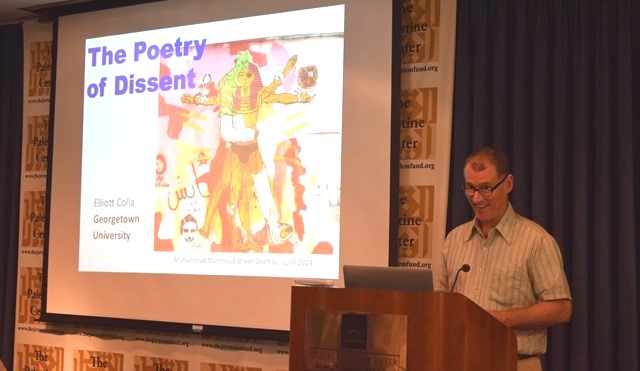
The Poetry of Dissent

Elliott Colla, professor of Arab and Islamic Studies at Georgetown University, gave a lecture on 25 June 2015 at the Palestine Center entitled “The Poetry of Dissent.” Colla discussed the use of poetry in Egypt’s 2011 revolution and subsequent political unrest, as well as the strands of protest politics in the country.

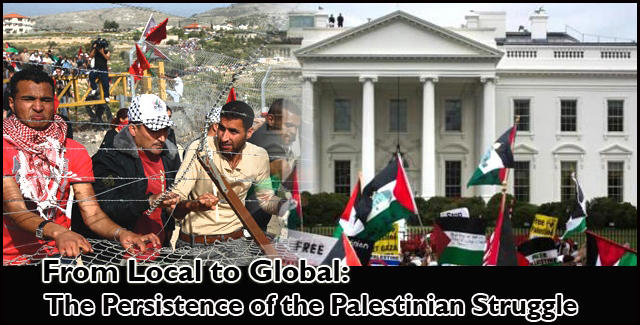
From Local to Global: The Persistence of the Palestinian Struggle

Panel I: “Palestinian Refugees: Waiting to Return”; Panel II: “BDS: Activism and Strategy for Change”; Panel III: “U.S Mediation in the Future of Palestine”; Panel IV: “Jerusalem: A Core Issue”

Which Way Forward? U.S.-Middle East Relations After the Election

Panel I – Revolution: Where It Came From and Where It Is Heading, Panel II – Palestinian National Strategy: Evaluating and Re-Evaluating, Panel III – Covering the Uprisings: Perspectives, Biases and the role of the Media, Panel IV – U.S. Foreign Policy toward a Revolutionary Region: Opportunities and Responsibilities