Permission To Narrate

– Edward Said

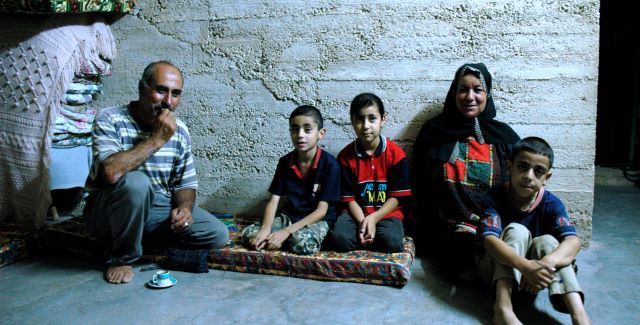
The late Palestinian scholar, Edward Said, remarked that Palestinians had been denied permission to narrate their history and speak of the day-to-day experiences of life in the margins. Here, we reclaim that permission to narrate our own stories.

The Situation in Gaza: An Interview with Brian Barber

Brian K. Barber, PhD, is a New America Fellow in Washington, DC, a Professor of Child and Family Studies, and Founding Director of the Center for the Study of Youth and Political Conflict at the University of Tennessee. His prime field of research has been Palestine, and he has based his work on long residencies and visits with families in and near refugee camps in the Gaza Strip since the early 2000s. Zeina Azzam, Executive Director of The Jerusalem Fund and Palestine Center, interviewed Brian Barber on February 5 2016, shortly after one of his research visits to Gaza. The information was updated in early April 2016. 
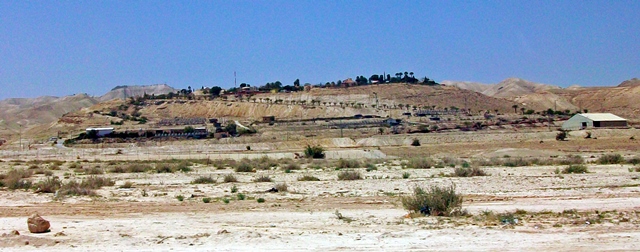
A Window Into the West Bank’s ‘Wildest, Most Violent’ Areas

YISHUV HADAAT, West Bank — With shoulder-length hair tumbling from beneath his knit skullcap, Hanamel Dorfman, a radical young Israeli settler, explains matter-of-factly on camera how hilltop settlement outposts like his own will continue to proliferate across the West Bank. From there, he says bluntly, Israelis will cross the Jordan River and start building on the other side.

Surfing in Palestine: everyday life in the occupied territories

Palestinians were baffled when Tanya Habjouqa first explained her photographic project to them. ‘They felt a political obligation to talk about their suffering,’ she says. ‘They were startled when I asked about pleasure. They would slowly ask, ‘Pleasure? We don’t usually discuss pleasure.’ While my pictures may seem light and easy, I had to foster their trust to convince them I was not working to show that things were actually ‘hunky-dory’ under occupation.’

Leading Israeli rights group to stop cooperating with the IDF

A quarter century of experience working with the army “has brought us to the realization that there is no longer any point in pursuing justice and defending human rights by working with a system whose real function is measured by its ability to continue to successfully cover up unlawful acts and protect perpetrators,” the organization wrote in an 80-page report that accompanied the announcement.

5 Palestinian Contemporary Artists You Should Know

Khalil Rabah, born in Jerusalem in 1961, currently lives and works in Ramallah. There may be few artists who embrace the make-believe as imaginatively and passionately as Rabah. If the hallmarks of a modern state include a national airline carrier and museum, then Rabah has brought the United States of Palestine to life.

The Catastrophes of Today and the Catastrophe of 1948 in Syria

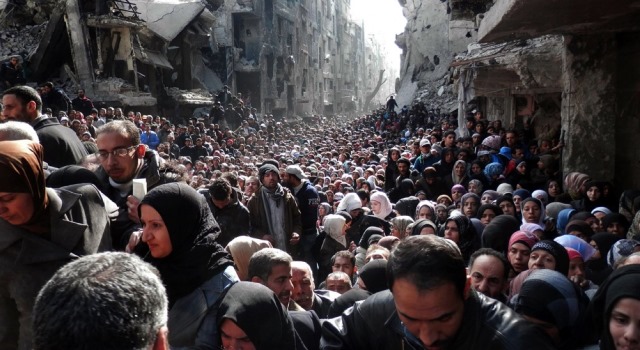
Yarmouk Camp in Damascus is today unrecognizable even to those who knew the camp’s every alleyway and corner.
The rubble, the ruins of bombed buildings, tired and hungry people, and haunted alleyways and streets are the
painful remains of a shattered community. Yarmouk is not the only Palestinian locality in Syria, of course, but
it was in many ways the Palestinians’ social, cultural, political, and even symbolic heart.

Do You Think Palestine Has the Right to Exist?

On a Facebook page, a colleague accuses me of hate speech. He accuses me of ‘questioning Israel’s right to exist,’ which he says ‘crosses a line and, is I believe, tantamount to anti-Semitism.’ This is a serious charge. Have I denied Israel’s right to exist? Certainly not. Israel exists. It is a member state of the United Nations. Its factual basis is undeniable. Even Hamas does not ‘deny’ Israel’s right to exist.