Permission To Narrate

– Edward Said

The late Palestinian scholar, Edward Said, remarked that Palestinians had been denied permission to narrate their history and speak of the day-to-day experiences of life in the margins. Here, we reclaim that permission to narrate our own stories.

Palestine after the US Elections: Discipline and Dissonance
While it may be too dismissive to declare that the US presidential election does not impact the question of Palestine, it is quite reasonable to conclude that the identity of the occupant of that office is of little relevance when it comes to Palestine. No other foreign policy issue is characterized by the intransigent and bipartisan consistency that shapes the question of Palestine and the United States’ relationship to Israel.


Allegorical Still Lifes

“Responding to an Iraq he finds unrecognizable, this figurative artist turns to still lifes painted as snapshots of life in the absence of figures, resulting in partial views of  brooding environments. Yet the blossoms and leaves of Shayota’s floral bouquets reach toward the  edges of paintings, refusing to submit.”

Amnesty International Urges President Obama To End Military Aid To Israel Over Human Rights Abuses

Recently, Amnesty International USA sent a letter to President Barack Obama asking that he use the power of his office to address three key issues in international human rights abuses before he leaves the White House in January. Besides urging the recipient of the Nobel Peace Prize to close Guantánamo and end indefinite detention, and to grant temporary protected status for El Salvador, Guatemala, and Honduras noting that ‘Stark homicide rates, ineffective legal structures, and corrupt law enforcement officials have forced many people to flee their homes…to seek refuge in Mexico and the United States,’ the letter called on the US to end military aid to Israel with the exception of purely defensive weapons.

Why Is the Plight of Palestine a Total Non-Issue This Election?

In 2006, Hillary Clinton sat down with the editorial board of the Jewish Press. Asked about the elections in the Occupied Palestinian Territory, Clinton said that she was unhappy with the result because Hamas came out as the winner. “I do not think we should have pushed for an election in the Palestinian territories,” she says in a tape recording released a few days ago. “I think that was a big mistake.” Clinton wanted Fatah, the more reliable partner, to win, not Hamas, whom the US considered a terrorist organization. The entire US establishment wanted Fatah to win, so there is nothing too surprising about Clinton’s views. But then she said something that should stop any democratically minded person: “And if we were going to push for an election,” she said, “then we should have made sure that we did something to determine who was going to win.”

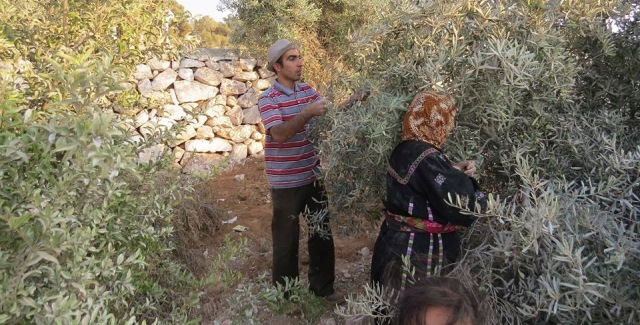
Palestinians mourn final Cremisan Valley olive harvest

Bethlehem, occupied West Bank – The rocky terraces of the Cremisan Valley are mostly overgrown and wild these days, as local landowners say they have lost all hope of keeping control over the more than 300 hectares of olive trees and orchards along the sloping mount, confiscated by the Israeli government earlier this year.

Palestine in Focus: A Freedom Theatre Multimedia Show

Members of the multimedia program at The Freedom Theatre of Jenin discuss the role of creative work as a means of resisting the Israeli occupation, and their work with the Theatre in introducing young Palestinians to a variety of artistic forms, including music, photography, filmmaking, and writing. They view these forms as necessary creative outlets in an environment that is often violent and oppressive.

“You cannot occupy a people for fifty years and call yourself a democracy”

“For the past 49 years – and counting – the injustice known as the occupation of Palestine, and Israeli control of Palestinian lives in Gaza, the West Bank, and East Jerusalem, has become part of the international order. The first half-century of this reality will soon be over. [I] implore you today to take action. Anything short of decisive international action will achieve nothing but ushering in the second half of the first century of the occupation.”

Interview: Inside ANERA’s Projects in Palestine

By Jada Bullen and Marie Helmy

For almost two decades, Mohammed Abu Rajab and Rabah Odeh have been working in infrastructural development in the West Bank and Gaza as field staff for American Near East Refugee Aid (ANERA), which focuses on meeting the development and humanitarian needs of Palestinians in the Occupied Territories and refugee camps in Lebanon since 1968. On their recent trip to the United States to attend the annual ANERA dinner in Washington, D.C. on Oct. 7th 2016, Mr. Abu Rajab and Mr. Odeh were able to visit the Palestine Center.