
May 2011
Breaching the Wall, an extraordinary exhibition by 11 artists from across the United States and Canada, will open in the Gallery on May 20.
– Edward Said
The late Palestinian scholar, Edward Said, remarked that Palestinians had been denied permission to narrate their history and speak of the day-to-day experiences of life in the margins. Here, we reclaim that permission to narrate our own stories.
Browse by category
Breaching the Wall, an extraordinary exhibition by 11 artists from across the United States and Canada, will open in the Gallery on May 20.
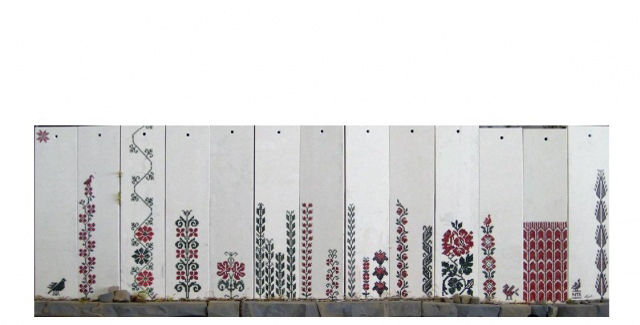
A wide range of Gallery artists share their thoughts and feelings about the Separation Wall in Palestine through sculpture, paintings, photographs and film.
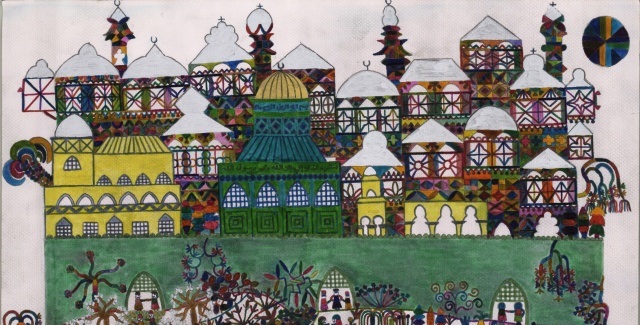
Exhibiting for the first time in the United States, Syrian artist Adib Fattal’s graphic works at the Jerusalem Fund Gallery colorfully interpret the Arab world. People, architecture and nature are fitted together in an intricate mosaic of color and form that creates an image of life and movement greater than the sum of its parts.

One of the leading authorities on Palestinian costume, Widad Kamel Kawar offers a beautifully photographed compendium of rarely seen examples of Palestinian garments and jewelry and a valuable history of Palestine through interviews with the women who made them.
While DC collectors are slowly coming out of the recession, the art fair world has been making strong showings, outperforming galleries again. This holds true especially for the Middle East.
This month the Gallery is hosting the first exhibition related to a grant made by The Jerusalem Fund for Education and Community Development. Our grant partially funded a project by an NGO called Zakira (“Memory “in Arabic).

Photojournalist Ramzi Haidar launched the project Glimpse to bring together photographers, journalists and artists with children ages five to twelve in Palestinian refugee camps in Lebanon. The children worked with these volunteers for one year to learn the basics of photography.

Malkit Shoshan’s atlas may lead those unfamiliar with the geography of this conflict to experience an epiphany like the one that led the author to undertake this impressive work.
The tribute to Edward Said compiled is a bounteous offering of information on and perspectives about this Renaissance man.

Through educational events, humanitarian support, and cultural preservation, the Jerusalem Fund is helping build the movement for Palestinian liberation.
Connect
The Jerusalem Fund
2425 Virginia Ave NW
Washington, DC 20037
(202) 338-1958