
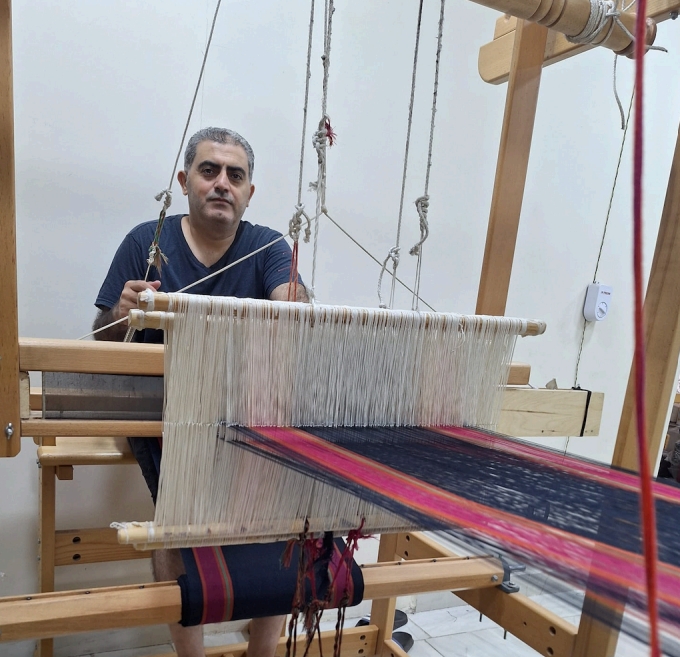
“My name is Hossam Rafiq Mahmoud Zaqout, and I specialize in the handmade weaving of Majdalawi fabric.”

(Object 2025.99. The Tatreez Institute Collection, Washington, DC. Photo: Wafa Ghnaim)

(Object 2025.81. The Tatreez Institute Collection, Washington, DC. Photo: Wafa Ghnaim)
Al-Majdal Before 1948: A City of Looms
Located in Occupied Palestine near Gaza, al-Majdal was once known as the leading textile city in Palestine. According to Hossam, almost every house in the city had a loom. His family history is inseparable from this tradition: his grandfather owned a workshop, called al-Kaa‘a in the Majdalawi dialect, where he and Hossam’s father worked side by side.
By the end of the Ottoman period, al-Majdal had around 500 looms. By 1940, that number had risen to approximately 800, and during World War II it reached nearly 3,000. All of this weaving was done by hand, each textile piece fundamentally unique. Al-Majdal supplied fabrics to all of Palestine: cotton and silk textiles, keffiyehs, thobe fabric, cloth for men’s dress, carpets, and towels. In 1934, al-Majdal won first prize in textile manufacturing at the Arab National Exhibition in Jerusalem.
Weaving in al-Majdal was a familial practice. The father worked the loom. The mother wound threads and prepared spools. Children trimmed woven carpets, arranged colors, and prepared yarns. Each member of the household had a role. Entire Majdalawi families, like the Zaqout, Maleiha, al-Madhoun, Saalha, al-Hennawi, and Abu Sharikh, were known for weaving before the Nakba and after, and this knowledge passed from one generation to the next
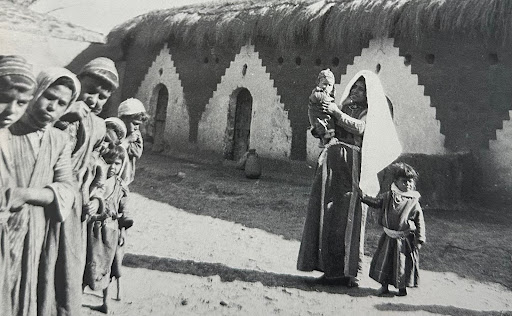
(Weir, pg. 94, Photo: Matson Collection, Library of Congress)
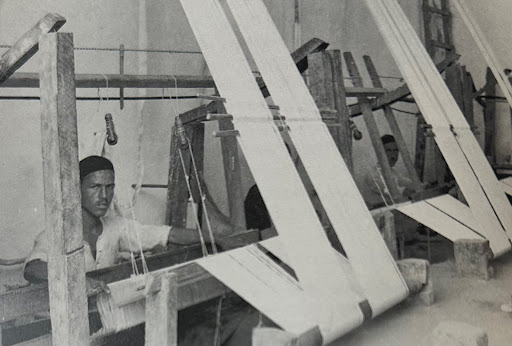
(Weir, pg. 28, Photo: Matson Collection, Library of Congress)
The Nakba and Forced Displacement to Gaza
With the zionist occupation of al-Majdal on November 4, 1948, its people were forcibly displaced, many fled to Gaza and its refugee camps: Jabalia, al-Shati’, and Khan Younis. Hossam’s family ended up in Jabalia Camp. Like most Palestinian refugees, they left with nothing. No looms. No tools. As displaced Palestinians didn’t think they’d be expelled from their homes for a prolonged time.
When life in the camps endured, Majdalawi families returned to what they knew: textiles. Hossam’s father rebuilt a loom in Jabalia and began weaving again. For a time, the craft survived and sustained Majdalawi refugees.
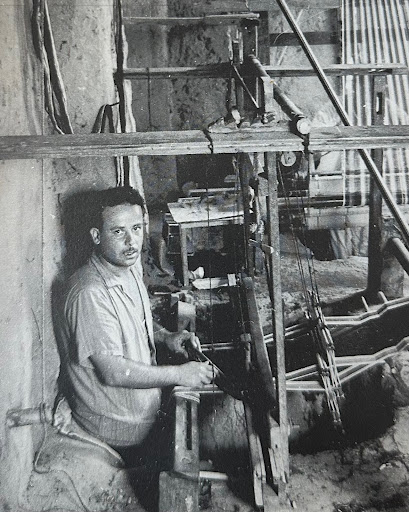
(Weir, pg. 30, Photo: Shelagh Weir)
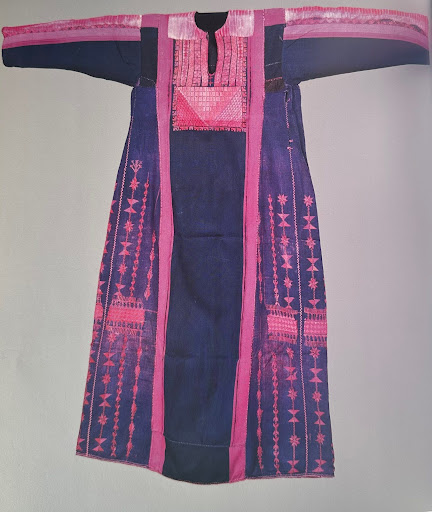
(Munayyer, fig. 11.35b, pg. 460)
Weaving Under Siege: Survival in Jabalia
But the occupation tightened its grip and escalated its siege in an attempt to further suffocate Palestinians living in the Gaza Strip. Raw materials were restricted. Imported, machine-made clothing flooded the market. Handmade textiles were expensive, demand fell, and traditional fabrics were replaced by modern garments. Weavers shifted toward carpets and rugs, but even that became unsustainable.
Hossam remembers his father weaving carpets until it was no longer profitable. Eventually, his father dismantled the loom and stored it at home, preserving it when many others could not. Many Majdalawi wooden looms wore out or were discarded. But his father held on.
In the late 1990s, the Gaza municipality launched the Arts and Crafts Village to preserve endangered Palestinian crafts. They searched for someone who could work the Majdalawi loom and found Hossam’s father. He returned to the loom with passion, building missing parts of their looms by hand. He was an expert and knew every stage of the process: carpentry, warping, dyeing, and weaving.
Hossam’s father attempted to pull Hossam into the workshop, but Hossam was a student at al-Azhar University and wanted to focus on pursuing his education. Yet his father persisted, finding ways to bring him into the workshop: keeping him company, opening the workshop, any way to draw his son to the tradition. Slowly, through the beauty of the Arts and Crafts Village and the public importance of Majdalawi weaving, the craft pulled him in.
In 2000, Hossam’s father passed away.
The workshop was closed and the loom was put into storage.


Hossam’s father spinning and working at the loom.[7, 8]
Inheritance and Return to the Loom
After his father’s death, Hossam felt the desire to continue his family’s legacy. The loom became a responsibility to continuing his people’s heritage. He rebuilt it at home in Jabalia and sought knowledge from elderly weavers, men in their seventies, eighties, and nineties, who were astonished and joyful to see someone young asking to learn this craft.
They gave him tools. They taught him techniques. He failed, tried again, and failed until he mastered the craft.
His siblings joined him. Together, they worked a loom at home, taught their children, expanded production, and eventually opened a shop. By September 2023, five looms were installed. Majdalawi fabric was weaved, thobes were sewn, and women embroidered. The art and history of Majdalawi fabric lived again.
But their workshop never had the chance to officially open.


Preparation, arrangement, design, and assembly of threads in Gaza.[9, 10]
A Workshop Interrupted
In October 2023, the genocide in Gaza and the siege on the Strip escalated.
Hossam and his family were displaced to the south of the Strip in the first week. News followed that their home in Jabalia as well as their home in the Sheikh Radwan neighborhood was hit by tank shells, and then completely destroyed by an F-16 Fighter Jet. Their shop in the Sheikh Radwan neighborhood was also destroyed when a nearby mosque was bombed. The looms inside his shop were shattered.
One of the looms destroyed was brought from al-Majdal to the Gaza Strip by a member of the Saalha family. Who risked his life after the Nakba to return to Occupied al-Majdal and bring a loom back to the Strip, on his way back from al-Majdal, he had to bury and hide the loom in the ground and then return to retrieve it days later in order to evade the occupation.
Later, amid shortages of wood and gas in the midst of the current genocide, the broken looms were taken and burned for survival. Hossam and his family were deeply affected by the news of losing their home, shop, and looms–their livelihoods. Despite their loss, Hossam believes, “the survival of people, or rather, the survival of those who made looms, is paramount, but the needs of people and their survival were more important.”
The zionist occupation not only destroyed his workshop, but is responsible for the destruction of irreplaceable pieces: vintage looms, fragments carried from al-Majdal to Gaza in 1948, and dresses woven and embroidered before the Nakba, including garments carried with refugees when they fled al-Majdal.
“These pieces,” he says, “were very, very precious to me.”
Eventually, the family was displaced from Gaza to Egypt.
Rebuilding in Exile: Majdalawi Weaving in Egypt
In September 2024, Hossam reopened his workshop in Cairo, but everything had to begin from scratch. Materials were unfamiliar. Tools unavailable. Hossam searched for carpenters who could understand the loom and Majdalawi weaving practices. He adapted the Majdalawi system to smaller, enclosed workshop spaces. Only dyeing remained external.
He found one of Egypt’s oldest dye shops, Salama’s in Darb al-Ahmar, where Hossam began spinning yarn, dyeing it there, then weaving it back in his workshop. Slowly, Majdalawi fabric re-emerged in exile once more.
Hossam’s dream is to return to Gaza, and one day to al-Majdal, and revive this craft where it began.
His family is among the last still practicing Majdalawi weaving. In the face of the hardships Hossam and his family has endured and the difficulties in weaving and producing Majdalawi fabric, he is proud of being able to continue this craft and preserve his people’s heritage.
He has already begun passing the tradition to his children. His eldest son, Muhannad, has started learning the loom. His nephews in Gaza know the craft too.
Despite al-Nakba, the siege on Gaza and the ongoing genocide in the Strip, and displacement to Egypt, production persisted.
Heritage as Resistance
In all attempts of the Zionist occupation to erase Palestinian identity, history, and culture, the art of Majdalawi weaving and the production of Palestinian textiles and costume has continued. It has continued in the face of ethnic cleansing, genocide, and displacement, and it has resisted colonial powers. When the occupation goes to any length to erase Palestinian history and existence, the continuance of our heritage and the production of our culture becomes resistance.
“God willing,” Hossam says, “we will return, and we will revive this craft.”


(Left to Right): Jaljali fabric, Talhami fabric, and Jannah wa Nar fabric[11-13]. All Majdalawi fabric hand woven at Hossam’s workshop. Hossam sells his fabrics on his Instagram page @Majdalawifabric and his Whatsapp +972567626566.
Written by a Spring 2026 Intern
The views expressed in this article are solely those of the author and do not necessarily reflect the views of The Jerusalem Fund.
Citations
[1]Ghnaim, Wafa. Everyday Thobe of Al Majdal and Asdud, Object 2025.99. The Tatreez Institute Collection, Washington, DC
[2]Ghnaim, Wafa. Gaza Thobe, Object 2025.81. The Tatreez Institute Collection, Washington, DC
[3-5]Shelagh Weir. Palestinian Costume. Northampton, Ma, Interlink Books, 2009.
[6]Hanan Munayyer, and Nathan Sayers. Traditional Palestinian Costume : Origins and Evolution. Northampton, Massachusetts, Olive Branch Press, An Imprint Of Interlink Publishing, 2020.
[7-13]Hossam Rafiq Mahmoud Zaqout
