
This past week, I had the privilege of speaking with Paul Biggar, Founder and CEO of the organization Tech for Palestine, a self-described “catalyst for the reformed tech industry, aimed at abolishing apartheid and promoting human empowerment and development.” More concretely, Tech for Palestine is an “incubator for advocacy projects:” advocates team up with engineers and investors to create apps to help pro-Palestine advocates, and sometimes Palestinians themselves, navigate around complicity in Israel’s genocide or even Israel itself.
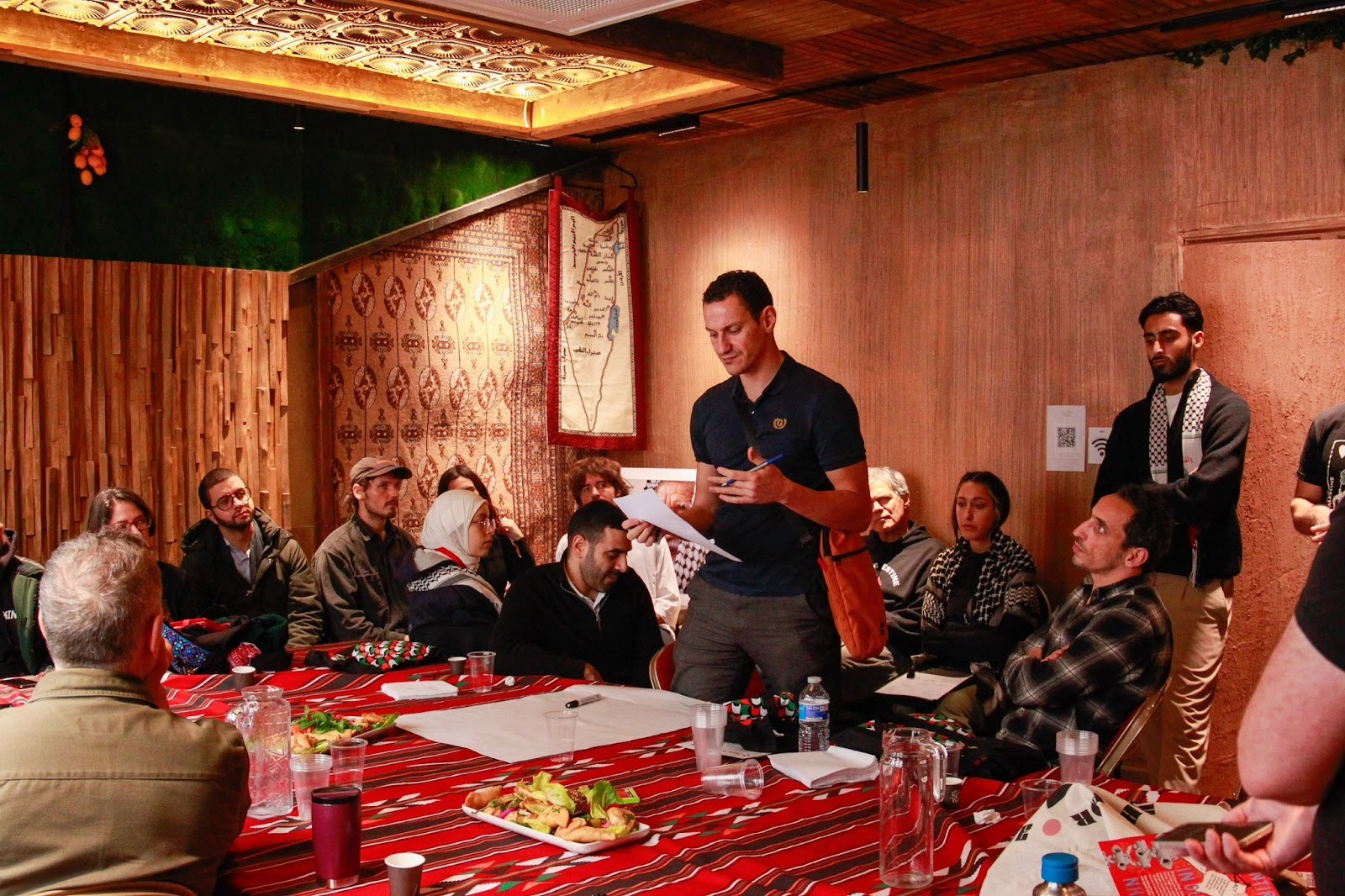
Paul and I briefly discussed the relation to Israel as seen within tech companies. My main question going in was, what makes big tech and startups in America so eager to partner with the IDF (and vice versa)? (Above Image: The first event hosted by Tech for Palestine, in November of 2025).
February 12th, 2026
Paul:
[In big tech,] you could say absolutely anything positive that you wanted about Israel. And people were fundraising for weapons and helmets and that sort of thing for the IDF within Meta. So there’s sort of like a difference of standards, but that was very much enforced by the power structures internally.
And the way that this happens is that Israel has a startup culture that it has built over the course of 20, 30 years at this point. They call it Startup Nation. They’re very proud of it. It’s probably the largest concentration of startups outside of Silicon Valley. And those companies often get acquired by… American companies and those companies are often predominantly founded by members of Unit 8200, which is like the Israeli NSA (National Security Agency).
So you have these people who are functionally spies, like literally spies. They then go to found startups. Those startups are funded often by American VCs (venture capitalists). They’re doing something that often is related to what they were doing in the army, which is typically spying on Palestinians. And they take that technology. and then they sell it to, you know, often American companies. And in some cases there have been… allocations.
There was this big bribery scandal in Israel about two years ago where one of the major investors was accused of giving money—it seems he certainly did—to CISOs (Chief Information Security Officers) of Fortune 500 companies in America to buy his company’s products.
And so you’ve just got this, whole sort of system. You go from the army to startups. The startups go to big tech. And then in big tech, you’ve got a ton of employees. Who are now Israeli, who are Zionist, who are within big tech and who are able to, in some cases, like Meta, shift policy. So the person at Meta, Guy Rosen, who… you know, he lives in Tel Aviv, and he’s responsible for all policy across Meta.
So you can see that people end up in positions of power, or they end up in a place where they can feed information to positions of power. And then the whole cycle continues as they acquire more Israeli companies and that brings more spies into big tech.
Leo:
Interesting. So it seems that these, it could either be Israeli engineers or startups, essentially, they’re always… tied to this unceasing demand for technology and specifically military technology. And because of that, they rise to the top. And so Israel or Israeli citizens end up getting a huge market share, basically, of the tech industry, or at the very least, a very credible presence.
Paul:
I mean, I would say credible presence. Tech is really not designed to be attacked from… influence. It’s a very open culture where people internally can do a huge amount of damage by organizing within the system without really any protections in place within the companies.
Leo:
And from what you’re saying, and from the news cycle, I’m assuming that all this disproportionately affects Arab engineers now.
Paul:
Yes. I haven’t seen any specific information on this, any specific numbers or anything like that. But I suspect. One of my suspicions over the last number of years is given how zealous the Zionists are, that you can’t help but believe that there was an underground system of not hiring Arab and Muslim people over the last few decades.
Leo:
But it’s not something that’s reported on.
Paul:
I’ve never seen that reported on, and I don’t have any information about that. I just see how zealous Zionists are, and it is not a secret, and it’s certainly known by Zionists, that the vast, vast majority of Muslims or Arab people support Palestine.
Leo:
Yeah. Well, my next question is, I guess, about AI. Would you agree that we’re currently in an AI boom?
Paul:
Sure, sure.
Leo:
In economics, every bubble busts. So would you say that there’s a possibility that this boom could end at some point? Is essentially the profitability of AI dependent on use in Israel? Or is there something else that we’re missing?
Paul:
No, I wouldn’t say that it’s dependent on. on use in Israel. Certainly, there’s… If you look at the spend on sort of like the war machine by Israel, they’re not even spending the vast majority of their money on AI. They’re spending it on more sort of boring parts of cloud computing like storage and computers.
Leo:
Hardware, as it were.
Paul:
Hardware, exactly. And so the reason that these contracts like Project Nimbus have continued at Google is not necessarily because of the money, but because… it is part of a strategy of becoming every government’s cloud provider.
And so, you know, Israel is itself a pretty small country with relatively small budgets. But if they can turn that into being the default cloud for much larger countries, then that is phenomenal amounts of money available. And of course, there’s lots of countries out there as well. So Israel was one of the first countries to… go fully cloud enabled. And that’s one of the reasons that these contracts are so important.
In terms of the AI boom itself, the boom will pop or it will deflate like previous booms have. AI will remain a generally useful tool. I think it will remain sort of like a… a fundamental part of how everyone is doing things, even if the capital bubble bursts specifically. But I don’t think that it necessarily is relying on Israeli spending to keep it up. Not at all.
Leo:
So AI and especially the relation between AI companies and governments is dependable even if it’s not exponentially profitable.
Paul:
Yeah, I mean, the, you know, capital tends to lie with governments. And in part, the tech industry has been shifting. And this is a big influence of Marc Andreessen from Andreessen Horowitz, where they started pivoting towards defense. Seven years ago, I want to say. And, you know, one of the reasons for this is just that, like, there’s a lot more money. And once they became more proximate to power… they had more ability to shift defense spending, which is just an unlimited bucket of money into their startups, which leads to them making more money themselves. That’s even before the ideological component, which is pretty significant.
Leo:
Okay, thank you. It seems we’re approaching the end of our time, so I would like to end on a positive note. You’re the head of Tech for Palestine, essentially, and Tech for Palestine has… published software such as A Ween Rayeh or other apps which help Palestinians navigate the West Bank, or [software that] helps activists navigate the internet and avoid being tracked by governments all the time and I was wondering if you could speak about the role of AI and tech in helping Palestinians in the diaspora and in Palestine specifically.
Paul:
So I would say that it’s not so much that AI or tech are helping Palestine. The tech industry as a whole is basically not helping Palestine at all. The technologies that exist can be used by anyone and to an extent that is somewhat limited by capital… AI is very expensive.
And so people who have limited capital, such as Palestinians, they’re not quite excluded from the AI boom, but there’s the potential for them to be excluded from the AI boom. Now we’re at the stage where for students it used to be that getting a, you know, getting access to a computer was a challenge. Now the challenge is: can they get access to the AI services to help with their coding?
Because coding with AI is now just this huge enabler and it’s going to completely transform and has transformed in literally the last six months how software is being written. And now that threatens to leave Palestinians in debt because they can’t afford the… credits on the AI providers. And even if they could, sometimes they are just not allowed to use those services because they’re in Palestine.
by a Spring 2026 Intern
The views expressed in this article are solely those of the author and do not necessarily reflect the views of The Jerusalem Fund.
