
When Aaron Busnell, a US airman, committed the act of setting himself ablaze outside the Israeli Embassy in Washington, D.C., his final declaration was a refusal to “be complicit in genocide.” As flames consumed him, his cries of “Free Palestine” pierced the air, marking an act of ultimate sacrifice. The act of self-immolation, a path fraught with excruciating pain, has historically been a profound form of political protest, notably during the Vietnam War era, when nearly 100 cases were documented across Asia and the United States in the 1960s and 1970s.
Aaron’s sacrifice echoed the inner turmoil and frustration of millions globally, who have been seething with rage and despair for months, witnessing the ongoing tragedy in Gaza. This genocide, supported by Western powers, continues unabated, while the world’s top political, legal, and humanitarian institutions’ continue to be unable to halt the carnage in Gaza killing fields.
In the United States, a palpable sense of extreme frustration is emerging due to the political system’s inability to effectively address the Palestinian issue, particularly the Gaza genocide. As Americans gain deeper insights into the historical and current context of the situation in Palestine, they increasingly feel a moral obligation to advocate for change. Americans bear a unique responsibility, given that $4 billion of their taxes annually support the Israeli military, in addition to millions, if not billions, of dollars funneled to Israel from the United States under the guise of philanthropy and tax-exempt charity, perpetuating the settler-colonialism of Palestinian lands.
The rise of social media has played a crucial role in informing Americans and fostering a growing grassroots movement in support of Palestinian rights. This movement has gained momentum in recent years, finding voice on college campuses, within faith communities, and through a cultural and discursive shift in the narrative surrounding Palestinians, whose voices are now louder and more influential, especially among younger generations.
As Israel launched its genocidal campaign in Gaza, support for Palestine within the United States manifested in large-scale protests across American cities, including two major national marches in Washington, D.C., within three months. A significant portion of US public opinion now favors a ceasefire in Gaza, as indicated by a Reuters/Ipsos poll, which highlighted that only 32% of Americans believe the US should support Israel, a decrease from 41% in a previous poll, while 68% agree that Israel should call a ceasefire and attempt to negotiate. This sentiment reflects a bipartisan perspective, with substantial support for a ceasefire among both Democrats and Republicans.
This popular demand for a ceasefire has slowly permeated Congress, with forty members now calling for an end to the violence, signaling a growing political momentum towards halting the genocide in Gaza. This shift comes after months of protests by Congressional staffers and public statements urging policymakers to adopt a new direction. Merely four months ago, “ceasefire” was virtually a taboo term on Capitol Hill.
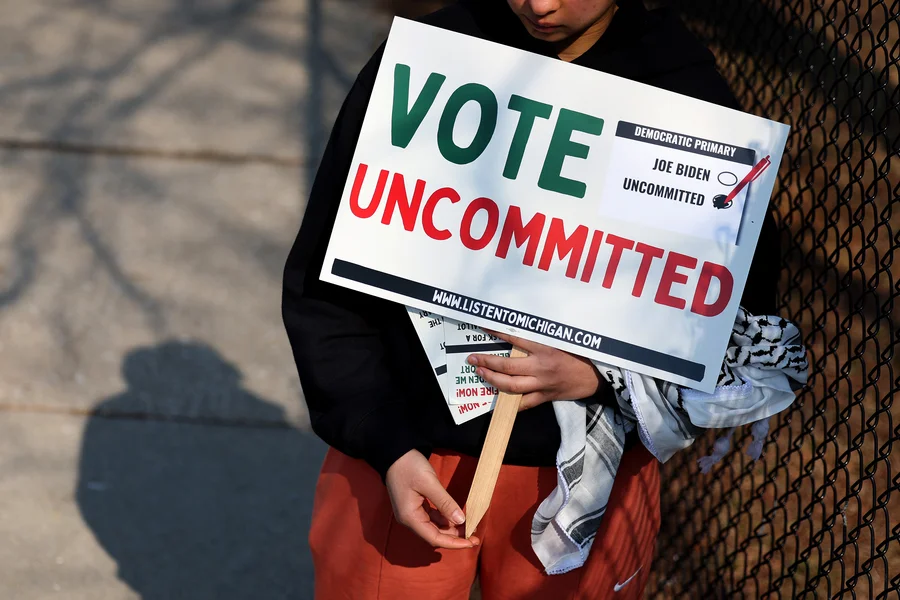
The zenith of internal pressure within the Democratic Party was reached on February 27th in Michigan, where voters in the Democratic primary sent a resounding message by selecting “uncommitted” on their ballots. This unprecedented move suggests a potential withdrawal of support for President Biden in the forthcoming general elections.
Yet, despite these significant developments, the US administration and political establishment remain staunch in their support of Israel’s genocidal actions. For the average American, the threat of losing a critical general election does not seem to suffice in compelling policymakers to reassess their stance on Israel. If polls, protests, and petitions fail to influence US policy on this issue, what will? In his final words, Aaron Busnell lamented the normalization of the Gaza genocide by the ruling class, encapsulating the profound disillusionment of American citizens with a government that, over the past five months, has shown that grassroots pressure and majority opinion are seemingly disregarded.
The ongoing genocide in Gaza serves as a critical test of the resilience and effectiveness of the international order, including its political, legal, and humanitarian institutions, as well as a test for Western democratic institutions’ ability to reflect and act upon the will of their citizens. To date, the response from Western ruling classes has been marked by hypocrisy, disdain, indifference, and complicity in the atrocities committed by Israel. The implications of these actions on institutions and governments might not be immediately apparent, but they are bound to have long-term repercussions that are yet to unfold.
