
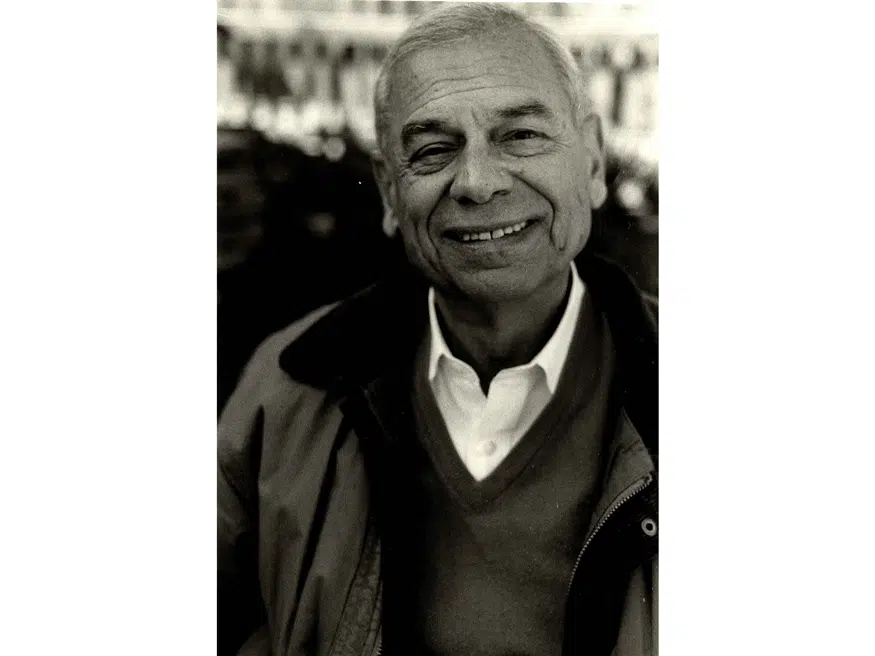
As I sit in the metro, heading from Foggy Bottom towards Dunn Loring’s metro station, I cannot help but think about Hisham Sharabi’s train adventures in Palestine 70 years ago and what they had led to. As an intellectual, philosopher, writer, and activist, Palestinian Hisham Sharabi expressed his support for Palestinians’ liberation in multiple registers. His activism spanned more than half a century and a vast territory. Stern and formidable, he was an intellectual beyond his writings.
Sharabi, who was twenty-one years older than the Israeli occupation, lived his childhood traveling between three major Palestinian cities: Yafa, Akka, and Ramallah. He then continued to complete his education in Beirut and earned his Bachelor’s in Philosophy from the American University of Beirut (AUB). It was the unjust practices of the British Mandate against the Palestinians during the 1930s and 1940s, followed by the forced expulsion of his family from their city of Yafa, Palestine, by the Israeli forces in 1948 that pushed Hisham Sharabi through the doors of activism. He began his activism work after he joined the Syrian Social Nationalist Party (SSNP)—led by Antun Sa’ada in 1947.
After the establishment of the so-called state of Israel on the Palestinian territories, Sharabi became the editor of SSNP’s monthly magazine, Al-Jil Al-Jadid (The New Generation), until June of 1949—when the Lebanese regime cracked down on the SSNP, putting most of its members in prison and executing Sa’ada. The execution of Sa’ada by the Lebanese government was so unsettling to Sharabi, who decided to move back and resume the rest of his life in the United States. He earned his M.A. in Philosophy and Ph.D. in the history of culture from the University of Chicago. He was then appointed as a history professor at Georgetown University, Washington D.C. Thus, his life of independent action was launched.
Sharabi sprang to Middle Eastern fame as an intellectual, with Al-Muthaqqafun al-Arab wa al-Gharb published in Beirut in 1971. It was a translation of Arab Intellectuals and the West published in 1970 in the United States. The book issued an understanding of the origins of the ideological and intellectual trends in the Arab world. Embers and Ashes: Memoirs of an Arab Intellectual, published in 1978, and Images of the Past, published in 1993, served as templates for his own story and activism that transcended Beirut and Washington D.C.’s borders. Moreover, Sharabi wrote Neopatriarchy: A Theory of Distorted Change in Arab Societies (1988) in which he developed a theory of social change that demystifies the setbacks in the Arab World, exhorted Arabs to liberate themselves and their countries from internal and external ills and exploitation.
Images of the Past was also my own introduction to Hisham Sharabi. It combined stories of Palestinians’ freedom pre-1948 occupation, the SSNP’s activism in Beirut, and the American University of Beirut (AUB). Sharabi wrote about his childhood which, in my opinion, is every Palestinian’s dream—including mine. To my surprise, Palestinians utilized different transportation methods pre-1948 that included, but were not limited to, trains. Sharabi mentioned how he used to take the Jerusalem train to travel from his city, Yaffa, to visit his grandparents in Akka, then head on the same train to Beirut for vacation. Images of the Past serve as proof that Palestinian cities were thriving prior to Israel’s occupation of the land and the culture and refute the Israeli claim that the land was a desert before the creation of the so-called Israeli state.
To support the movement for Palestinian liberation, educate the Americans about the Palestinian cause, and support community development in Palestine, Hisham Sharabi founded The Jerusalem Fund in Washington, D.C. in 1977. It became the epicenter of Arab intellectuals at a time when Israel was trying to rein in Palestinians, and the Arab authoritarian dictators were trying to rein in Arab intellectuals.
The Palestine Center, a program of The Jerusalem Fund, functions as a site of knowledge-building and dissemination through its conferences attended by Arabs and Americans, mainly from new generations. Through the Palestine Center, The Jerusalem Fund hosts monthly public seminars, welcoming journalists, writers, intellectuals, and political activists across the spectrum, from feminists to leftists and Islamists–women and men prominent in their professions and public life– to engage in debate on the burning subjects of the day. In an increasingly polarized atmosphere, it is amazing that these gatherings happen at all. They are edgy and contentious.
As an intern at The Jerusalem Fund, I have had the privilege to access some of Sharabi’s original documents. I realize the importance of what the organization has been trying to do to preserve his important contributions, including the digitization and archiving of his work and that of other intellectuals’ valuable work. This will ensure that these documents are properly preserved, available, and accessible to students, researchers, academics, and others.
With every train ride I take in Washington D.C., to and from The Jerusalem Fund, I cannot help but think about the day I’ll be able to ride trains from my city, Ramallah, to Sharabi’s city Yafa, and Beirut, like Sharabi used to do.
This article was written by Aseel Tork, an intern at The Jerusalem Fund. She holds a BA in Political Science and Economics from Lycoming College. The views in this article are those of the author and do not necessarily reflect those of The Jerusalem Fund.
