
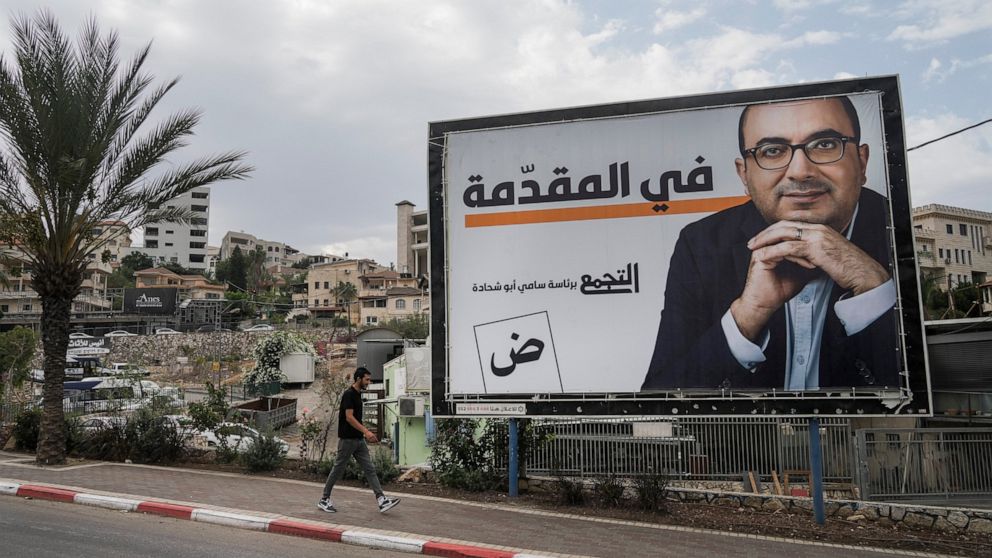
Before the dismal results of Israel’s fifth national election cycle in the past four years that was held last week became clear, Israeli political parties were scrambling to secure votes that might give them a place in a ruling coalition in the Knesset, the Israeli parliament. Israel’s unicameral parliamentary system requires parties of the 120-member Knesset to form a governing coalition, often made up of a variety of larger and smaller parties that together are able to constitute a majority. Throughout Israel’s multiple chaotic election cycles in recent years, it seems that there is always discussion among Israeli politicians and major news outlets—both Israeli and non-Israeli—about the importance of “Arab parties” to forming coalitions and the support and mobilization of “Arab voters.” “Arab voters” most directly refers to Palestinians who hold Israeli citizenship and who live within Israel’s 1948 borders, having not fled or been exiled from their homes during the 1948 Nakba.[1] Constituting a population of about 150,000 in 1948 and now almost 2 million people, Palestinians make up a significant potential voting bloc that is key for any governing coalition in Israel trying to come to power.
Media narratives on Palestine and Palestinians leave much to desire but do seem to be shifting slowly. While AP News referred to Palestinians with Israeli citizenship in a recent article about the Israeli elections as “Arab voters” in the title (though, to be fair, AP does use the term “Palestinian” later in the article), several other major news outlets have also covered Palestinian dynamics in the Israel election and are specifically referring to this group of Palestinians as Palestinian. This includes publications more sympathetic to the Palestinian cause, such as Aljazeera, but also even the Washington Post and the New York Times. What does not seem to be shifting, though, is the narrative on Palestinian participation in Israeli elections. At least in the past several election cycles, major news outlets always seem to warn that despite their potential voting power, Palestinians with Israeli citizenship are considering abstaining from voting, describing this as a novel development each time it happens.
In reality, this is not new. Though confident about its chances at gaining some seats in the Knesset, the United Arab List party had expressed concerns as to its ability to maintain much power if voter turnout among Palestinians does not surpass a low 48 percent. Palestinian voter turnout did manage to surpass this threshold, clocking in at about 55 percent. Regardless, both are low numbers—yet this phenomenon is not new. Voter turnout among Palestinians with Israeli citizenship has been low for years—in elections for the Prime Minister in 2009, voter turnout among this subset of Israel’s citizens was 53.4 percent, and just 56.3 percent in 2006. In other words, though voter turnout of this demographic has been declining, it has already hovered at low levels for almost two decades in comparison to turnout in the 1990s, for example, and especially in comparison to Israel’s overall voter turnout levels.
Media reports have cited disillusionment with public works project failures in Palestinian towns, rising religious nationalist extremism among the Israeli far-right, and distrust of leadership as reasons for Palestinian skepticism towards elections in Israel. As something that is not novel, though, there must be other explanations for Palestinian disillusionment with the Israeli political system. One of the most seemingly obvious reasons is the nature in which Palestinians who remained in the 1948 borders have been treated by the State of Israel since its establishment. Upon the foundation of Israel as an exclusionary state based on a Jewish identity, Palestinians who remained in what became Israeli in 1948 were placed under military law, to which they were subject until 1966, despite claims that they have been treated as full and equal citizens of the State of Israel since its founding. Palestinians in Israel have long been subject to political and economic violence at the hands of the Israeli state. Palestinian Land Day protests that began in 1976 were in direct response to the murder of six Palestinian citizens of Israel protesting Israeli closure and expropriation of Palestinian lands in the Galilee by Israeli security forces.[2] During mass demonstrations that marked the beginning of the Second Intifada, Israeli security forces shot and killed 13 Palestinian citizens of Israel. Adalah notes that “despite the Or Commission finding no justification for the deadly force, not a single officer has been indicted for the killings.” As of 2018, Palestinians in Israel lived in poverty at rates almost twice as high as Jewish Israelis. Adalah has published a report of 65 laws in Israel that discriminate not only against Palestinians living in the Occupied Territories and East Jerusalem but also against Palestinians living in Israel, such as the 1960 Israeli Lands Basic Law that privileges Israeli Jews in terms of land ownership and transfer. In July 2018, the Knesset passed the Jewish Nation-State Basic Law, which states that the right to self-determination within Israel is unique to the Jewish people, despite the almost 2 million Palestinian citizens of Israel who do not share the same national identity. Arabic was also downgraded from its status as a national language of the state, despite its wide usage and cultural significance among a significant sector of Israel’s citizen population.
When Israel adopted a dual-balloting system in 1996 that made it more viable for small, sectarian parties, like those representing Palestinian interests, the lack of agency this change gave Palestinians “cast into stark relief the insurmountable obstacles that face Palestinians seeking real representation and actual power in the Israeli system.”[3] As Palestinian politicians tried to work more intensely on issues pertaining to Palestinian communities in Israel in the 1990s alone, without allying with non-Palestinian parties, right wing Israeli politicians were easily able to stigmatize Palestinians as politically deviant. When Palestinians under this new system that in theory could have given them more agency in Israeli politics voted overwhelmingly for pro-peace process Ehud Barak for Prime Minister in 1999, the Palestinian community in Israel “received no official visits form him, nor were its representatives invited to his office,” despite being his “most loyal constituency.”[4] Partially in response to Barak’s blithe unconcern for Palestinian communities during his term as Prime Minister, Palestinians overwhelmingly boycotted the 2001 elections for Prime Minister.[5] While it is true that these elections were different than the 1999 elections as well as the most recent Israeli elections given that they were only for the Prime Minister, Abu Baker and Rabinowitz write that “the dynamic that produced this boycott, in which members of the Stand-Tall Generation, families of victims of October 2000, and various NGOs, was most significant,” in that “for the first time ever, the Palestinian citizens of Israel decisively turned away from the Zionist left, signaling that they have had enough of settling for lesser evils, indicating they can no longer be expected to vote only so as to stop a right-wing candidate.”
There is a case to be made that Palestinians with Israeli citizenship have long been systemically treated as second-class citizens—or worse, with their agency and views structurally and categorically excluded from the Israeli political system. If this is true, it should be relatively simple to understand why many Palestinians have been so unmotivated to vote in the elections of a state that does not view them as equals—to place overwhelming confidence in the functioning of a state that placed them under martial law, whose security forces have killed them with impunity, whose economic policies have kept many of them in poverty, and whose political system has stripped them of power and agency. This all should also serve as a rebuke to the notion that Palestinian citizens of Israel should have taken more responsibility for stopping Zionist extremists like Ben Gvir from coming to power in Israel, as some have suggested in online discussion spaces like Haaretz’s comment section, given how limited the power the Palestinian community in Israel holds is.
This article was written by Maxwell Levine, an intern at The Jerusalem Fund and a graduate student at Georgetown University Walsh School of Foreign Service. The views in this article are those of the author and do not necessarily reflect those of The Jerusalem Fund.
[1] Plonski, Sharri. Palestinian Citizens of Israel: Power, Resistance and the Struggle for Space. London: I.B. Tauris, 2018, 26.
[2] Rabinowitz, Dan, and Khawla. Abu Baker. Coffins on Our Shoulders: the Experience of the Palestinian Citizens of Israel. Berkeley: University of California Press, 2005, 9.
[3] Ibid, 96.
[4] Ibid, 97.
[5] Ibid, 139.
