
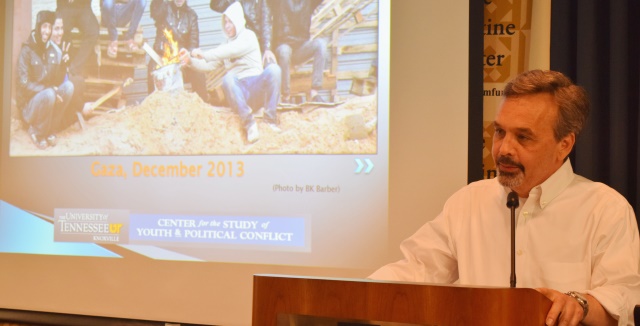
Dr. Brian K. Barber
Samirah Alkassim
Thank you all for coming to today’s lecture at the Palestine Center, and thank you to the Institute for Palestine Studies and Michele Esposito for partnering with us on this event. I’d like to say that I am Samirah Alkassim, I am the program manager here.
Today’s event is titled, “Whither the ‘Children of the Stone:’ An Entire Life Under Occupation” and our guest speaker is Dr. Brian K. Barber who is currently a New America fellow in Washington, D.C. as well as a founding director of the Center for the Study of Youth and Political Conflict at the University of Tennessee. Today, Dr. Barber will discuss what happened to the “shabaab” (youth) who brought global attention to Palestine who brought historically unparalleled activism during the first intifada. They are now adults and nothing they have fought for has come to pass. Dr. Barber will examine the situation by posing a series of questions about the first generation of palestinians to live their entire lives under occupation. He will look at how the occupation has shaped their lives historically and at present and how they feel about their present and futures. To do this, he will draw on two sources. The first derives from intensive interviews that he has conducted over the past two decades among the youth in Gaza. These narratives form the basis of a forthcoming book that he is writing during his fellowship at New America tentatively titled, Imprisoned for Life, Coming of Age in the Gaza Strip. The second source for his presentation uses excerpts from his comprehensive, ongoing study on the wellbeing and life stories of 1800 men and women of this generation who come from the West Bank, East Jerusalem, and the Gaza Strip. The findings of this unprecedented study have been most recently published in the Journal of Palestine Studies, copies of which are for sale and can be purchased after the talk at the table by the door.
As mentioned, Dr. Barber is a New America fellow in Washington, D.C. He is also a professor of child and family studies and, as mentioned, founding director of the Center for the Study of Youth and Political Conflict at the University of Tennessee. His prime field of research has been Palestine beginning with long residencies with families in or near refugee camps in the Gaza Strip after the end of the first intifada, where he has made many visits since. Dr. Barber is the editor of the 2009 Oxford University Press volume called Adolescents and War: How Youth Deal with Political Conflict. There is a display copy of that up at the front desk. His work on Palestinian Youth has been published in many book chapters and scholarly articles including the Lancet, Social Sciences and Medicine, Journal of Traumatic Stress, Global Public Health, Child Development Perspectives, Journal of Child Psychology, Psychiatry and Human Development. His writings on Palestine have also appeared in Medium, New American Weekly, Muftah, Informed Comment, Alternet, and Open Democracy. Please join us in welcoming our speaker.
Dr. Brian K. Barber
Good afternoon, everyone. Thank you for taking the time to come. Thank you, Samirah, for that nice introduction. I’m really happy to be here. I’ve been looking forward to this talk for some time now, and I need to start by acknowledging and thanking crucial partners. First, Zeina Azzam, who unfortunately can’t be here today, and Michele Esposito for jointly sponsoring this project and all of their associates who have worked so hard to put this together. I want to also thank the Journal of Palestine Studies, my associate editor, who is here, has agreed and exacted the rigor necessary to publish a lengthy version of some of the findings I will present here today, which I am very proud to see here and available. I have crucial partners that have supported this work over the past two decades. Most prominently, I want to thank the Jacobs Foundation of Switzerland who gave generously both in terms of funds and flexibility to conduct the project that I will talk about today. There have been the University of Tennessee and Brigham Young University, where I have been the last 20 years, Social Science Research Council, The Jerusalem Fund, The Rockefeller Bellagio, New America, and the Foundation for Middle East Peace.
I have always worked with very big teams doing this research and I want to mention some of them. Clea McNeely at the University of Tennessee would like to be here today, and she’s been a critical partner all throughout the project I’ll describe today. Then there are key advisors, many of whom you may know from Palestine: ?? Rita Jakaman ??, Mahmoud Daher, Yed Alsaraaj, Cairo Arafat, Mohamed Abu Malweh, and Khelil Shekaki and his Palestinian Center for Survey Research, which was our partner in data collection. So, when I present the findings that I do today, all of those data were collected by his trained field workers in Gaza, East Jerusalem, and the West Bank, of course done in Arabic and otherwise appropriately done. Mostly, I want to thank the many Palestinians who have participated so eagerly and openly in these projects. If we count those who have participated in the formal research, that number very nearly reaches 10,000. I personally know hundreds and many very intimately, and it’s been a singular privilege for me in my life to be able to come to know these people who continue to be tragically misunderstood by the outside world. It’s been transformative at all sorts of levels. I think you’re an audience that doesn’t need me to advocate for the need to pay attention to Palestinians, so I won’t spend my time doing that. I assume you have those sensitivities and that you work in various ways on behalf of bringing better understanding of this people. Today, I’m going to invite you to try and enter a different realm of trying to understand and assist, and that is the realm of a researcher. That is obviously where I have spent my time.
As was mentioned in the introduction, the work has been very visible in academic outlets. These are some of the journals that we have recently published in, and that’s the book. I could very easily talk about the personal transformative, very interesting, and compelling stories about what it’s like of a upper-middle class, Los Angeles WASP to go to Palestine and end up becoming a bit of an expert on a region that 21 years ago I could not have even pinpointed on a map. That’s enough. That would be very fulfilling, but it’s been extra specially satisfying for me to be able to have those experiences while at the same time fulfilling my professional role rigorously and being able to contribute, I think measurably, to various disciplines, when it comes to doing research and understanding people’s lived experiences.
So you need just a bit of background. I won’t be telling those stories, but I am happy to answer questions as you like about how it got started and what it was like to live for long periods of time in Gaza in refugee camps and homes of families. This is a picture of the first family that I lived with in the beginning of 1996. That’s an earlier version of me in the center, and that is the entire family. The man to the right, the boy to the right is one of the subjects of the book that I am writing and will briefly describe to you. Just so you can see a current view, that is Hamam, the boy to the right, taken ten days ago in Gaza at his home where I still stay when I go to Gaza. This has been a very long term relationship and an important set of experiences. Why I went — I am not going to belabor that, but it was not planned, it was not expected, it was serendipitous in every way, but i took it seriously in the end and dove in as deeply as I could. I hope that has given me some little bit of authority to talk from the outside about a people who are certainly foreign to my culture.
The basic research question for me — I am a social scientist interested in Youth. The reason I was reluctant to go to Palestine when first invited in 1994 was because I was engaged in studying youth in 10 cultures around the world already. I didn’t have time, I didn’t think. Frankly, I didn’t have an interest in the Middle East, so I will confess that reality of the day. My interest has always been young people, what makes them thrive, what stresses them, how do their contexts help them maximize their potential or get in the way. I studied that at every levels: the family context, social context, neighborhood, and so forth. That has been the basic driving question for this research: what is it like for these youth to have lived six years of their formative teenage years in frequent and intense conflict? What is that like? Why do they do that? What do they think about? Why do some not do that? What are the effects on them? What are the benefits? What are the costs of that? And then, most importantly, what are the long term impacts? My profession, researchers, are in some ways too much like journalists. My apologies to any journalists in the room. We go from drama to drama. We want to study things that feel important and crucial, so most of the research that is done by myself previously and my colleagues is to do a study of a youth population at crisis, try to capture their suffering and well being and so forth and then move on to the next hotspot. But as you know, the large majority of young people survive war with their lives and a surprisingly most with their mental health. So then the question becomes, what becomes of them? How have these experiences during their formative years impacted their lives as they moved forward? Is there impact on the transitions to adulthood on the achievement of cultural norms like marriage, completing education, having children, and so forth. These were the background questions that I had been wrestling with for many years.
I have two parallel efforts on that front. One, I will be talking about very briefly is this book I am trying to write. This is a narrative nonfiction, so it is a new style for me to write, and it is enormously difficult to do but very fulfilling. It’s progressing. I am happy to talk to you about that. It is essentially an entry into Gaza for most of the world who will never go. I tell it through the lens of a set of families that I have known quite well for the last 20 years including Hamam as well as Hussan. These are main characters because I know them very well, and they are a very interesting juxtaposition. They are both Gazans, obviously, both raised in neighboring refugee camps. Hussan still lives in the same home in the same refugee camp that I first interviewed him in 20 years ago. They both have been fortunate enough to pursue their education, and they both have PhDs, both in educational leadership. They are both still in Gaza, and they both couldn’t be more different at various levels. Intriguingly, one level is their behaviors to the First Intifada.
Hussan — as late as last night I was going to include an excerpt from the writing, but I do know that I can’t cover everything — at 13 years old was asking himself, “Whose land is this? Are the Israelis right; are the Palestinians right?” He went to libraries and researched this. He’s a scholar by birth. He made the commitment as a young teenager that, yes, this is the Palestinian land, and therefore — he’s a logical guy — his role was to try to achieve his land in whatever ways his people sought to pursue that. He was an activist leader of the PFLP in his camp, he was imprisoned three times, and there were just lots of stories that I will be telling in this book about Hussan.
Hamam shares to every degree what we call the “master narrative” that any Palestinians in the world share and that is the desire to be recognized as a people and to have a territory which can be called home. But Hamam made the opposite decision. Also as a young boy, he committed to himself that he would never engage in any confrontation with the Israeli soldiers. Why? He was as committed to the master narrative as Hussan, but he is then, and still is to this day, reeling from the agony of not having a father present in his very young years. His father, Fouad, was a political prisoner when he was a young boy, and this was excruciating for Hamam such that he decided he would never take the risk that his son repeat that experience.
Personality-wise, they couldn’t be more different. Hamam is boisterous, he’s laid back, he’s energetic, he’s fun-loving. Hussan is the scholar, logical, programmed, very intelligent. So the story of them, their parents, their spouses and children are going to be the core of this book that I am going to try to do. Hopefully that is enough of a teaser to get a repeat invitation to come talk about the book.
The other track, I said there were two tracks, is this very large, very complicated research project that the Jacobs Foundation funded us to do, and that’s where I want to spend most of my time today. These data were collected in 2011, so we just understand that they are already dated. We have been publishing them in various places. Those of you who know Palestine very well will know that everything I present here has logically progressed over the past 5 years. The hardships are predictably worse, and the strengths are likely even to be increased. I’m not that uncomfortable that these data are 5 years old, but we do need to recognize that much has happened since 2011, especially in Gaza where there have been two further wars in 2012 and 2014, the latter of which was cataclysmic in its impact on the Gaza Strip. I neglected to bring you fresh greetings from Palestinians in Gaza. I was just there last week. I am happy to talk at length with you about what conditions are like on the ground, but I will leave that to your curiosity later.
This is that generation. These are the kids you remember seeing on our T.V. screens. This is a photo of them back some 20 years ago. These are the young people that are now 40 years old-ish, late 30s, early 40s. We studied them in 2011 as adults. We wanted to know the long term: what are they doing? How is life as an adult after you spend your youth in such chaos? We also then pieced together their major life events from 1987-2011. We have through, a very systematic methodology, which I am happy to talk about later, been able to piece together the trajectory of their lives since the First Intifada and how their lives have been played out, timing of their marriages, their children, their involvement in political violence, their activism, you name it from 1987-2011, that 25 year period. We all know that that is an important generation. Historically it is still unique. There has not been a population documented that I know of where youth have participated as actively in political matters than the Palestinians of the First Intifada.
I wanted to show you a little bit of the data, and I’ll try and walk you through this. These are that generation retrospecting on the degrees of activism across their lives. The first two bars are summaries of West Bank-ers combined with East Jerusalem, and later I will explain why we couldn’t separate out East Jerusalem in this case, and then the second bar Gazans. You see in the first two bars that there is a slight higher activism in Gaza than in the West Bank and East Jerusalem, but more importantly are the absolute values. If you take the third bar, these are males in East Jerusalem and the West Bank, 75% were engaged in some way in some activism, and later I can talk to you about what those are, but this is a catch-all of a dozen different types of activism that they could have done. 75% during the First Intifada, and this bar is not yet females. I put males here again so the 75% and the 43% and the 46% are if you ever did anything during those periods, even one thing like throw stones or demonstrate. This fourth bar is those males that did it very often or very regularly, and that is an astoundingly high figure, 40%, Typically the maximum figure that I’ve seen of a youth population who ever does anything let alone anything frequent, is about 25%. So you’ve got 40% of males here doing it very often. Here you see it goes way down during the Oslo period, as you’d expect, but then it goes back up to 18% in the Second Intifada.
These are new data. We have some data from the First Intifada in various outlets, but there haven’t been good data about the Oslo period and there after. They are in the sample if there age during the First Intifada included 3 years of their adolescence. During the First Intifada, they had to be a teenager. These data were collected now, or in 2011, when they were 40. It is a whole generation. [Inaudible from audience]. No, these are the same individuals.
Noteworthy here is the last bar, which is the female participation rate. You know cultural norms, and women, you expect in a culture like Palestine, are more inside not front stage, but at least 42% were doing something during the First Intifada and also up to 20% during Oslo, even as many as 20% in the Second Intifada. My main message for this chart is, yes, this was a generation of young people who were indeed very active in not just the First Intifada but also significant proportions of them thereafter. This political activism has really been apart of their lives for the whole of their lives.
I want to engage you in an exercise. I’d like to ask you to think about two people you know very well and one of whom who is doing pretty well in life and the other is not doing well. I’d ask you to describe those people literally, and you’d answer with kinds of archetypes. I’d say, no, I want specific people that you know, and so forth. The first question that we had to face as researchers when our task was to understand the adult function of this young group of long term activists was, “what is it that we want to measure? How do we capture the quality of life? What is the quality of life in Palestine or Gaza?” So that was the method that we used. We literally asked young people from West Bank, East Jerusalem, and Gaza, refugees, non-refugees, males, and females, al fateh and hamas this very grounding questions so that we understand what it is that they understand as a good life and a bad life. I want to race along a little more quickly than I planned to.
The take away is that it revealed a dimension of quality of life that we don’t ever study. We as public health people or mental health people, it is not surprising to find that these people nominated more than anything else by far some element of political context in their descriptions on whether someone on a day-to-day basis was doing well. That’s profound for all sorts of audiences and reasons. I can’t spend as much time on it as I wanted to, but this is our conceptualization of that. It’s published in Social Science and Medicine, a very highly respected journal, and the fact that they would give this much space to a Palestinian population is itself rewarding. The take away here is that if we really are concerned about improving the lives of this population, it really is the political context that matters. We can tweak it with economic aid; we can tweak it with mental health therapy. They tell us — this is their analysis, not my report— that what really determines whether they are having a good day or a bad day, if they’re suffering or not suffering, is some element of this political relationship that they have with Israeli Occupation Forces.
How do they suffer? We are all rightfully concerned about any population’s mental health that experiences stress, and if we had more time I would probably ask you, What do you think? How do they feel? What do they most worry about, and how do they suffer? We’ve talked about depression and PTSD. These are concepts which are debated as to their cultural relevance because they are Western concepts, but they are relevant in certain ways to even this population.
Just one of the quick excerpts that we found interesting and we coded to capture this type of mental suffering, and we wrote the new items to measure this in the big survey of nearly 2,000 people of the same age group. Empirically, this has worked wonderfully and is about to be published. I’ll talk about implications in a minute, but I want to give you this overview, again, of prevalence because these are new data though they are from 2011. So, here are the broken and destroyed constructs. These are the same people, again the group of nearly 2,000 40-year-olds reflecting on how often in the last two weeks that they felt these ways. If you were the respondent, the question would be, “How often in the last two weeks have you felt broken or destroyed?” These bars represent people who said ‘often’ or ‘regularly’ in the last two weeks. The first bar is the West Bank, the middle is East Jerusalem, and the last bar the Gaza Strip. These are astonishingly high numbers. Four in ten people report feeling broken or destroyed often in the last two weeks, if you think that through. Here are the levels of depression somewhat lower. Another important takeaway from this chart is notice that it’s often the West Bank which is higher. One mistake that we make too often in our love for Gaza is to overlook the fact that Palestinians in East Jerusalem and the West Bank have very severe suffering as well for somewhat different reasons. That is important; we cannot neglect that. I should say, this is not in last two weeks, feeling fearful, it is ever. It’s higher because of that reason, but still astonishingly high.
I want to drive that home even more clearly. This is the same question, but this is documenting those who said that they felt it at least once in the last two weeks. So everyone other than who said never. Fully, 94% of Gazans said they experienced it, felt broken or destroyed, at least once in the last two weeks. This is in 2011. You can imagine what it might be now after the war in ‘14. I have to move on, but these are astonishingly high figures, very worrisome figures, and they have only increased in severity, I can promise you. I am trying to get funding to do a follow up of this study, and we will then verify it, but I can promise you they are only more severe.
One other question we asked is— we focus a lot in social and medical sciences on violence. We all know that violence is not ideal and difficult, but we don’t often ask the question, “are all violent exposures the same?” “Is it equally as risky to be close to a bomb when it goes off as it is to have soldiers come and raid your home in the middle of the night? Are those equivalent — they’re both political violence. So, one analysis that we have just done, which was just published in Social Science and Medicine just a month ago, was to tackle that question about looking at specific types of political violence then tracking their impact over time.
First, let me just show you the prevalence figures again. There are no data like these, but you can see there are types of political violence that they report having experienced. This would be anytime since 1987 and could be as little as once. You have virtually 90% of West Bankers and Gazans, 9/10 people having had that experience once in their life. A psychiatrist would worry about even one event being a trauma. You could imagine then, if you follow that logic, you know I could tell you that many of these people have experienced that multiple times.
Just going through… Home raiding. Home raiding occurs in the middle of the night usually around 2:00 a.m., soldiers break down the door, come in, and roust a young boy out of his bed and do various things to him in front of his parents and often yank him off to prison or detention for a while. We all know that this happens. It happens everywhere. Every army does this. The United States army does this. We know that it happens a lot in Palestine, but now we know much more clearly how much. To me, it is astounding that 8 in 10 people have had that experience, even just once in their life, to have the sanctity of your home violated in such a rude way.
Then you go down, of course the prevalence of these are different, but still half or more people having been shot at, being hit or kicked, being imprisoned. These are gender specific. These last three are mostly males and relatively few females experience this, but fully 25% of this generation who are now 40 have been imprisoned for some length of time, one in four people. So that’s prevalence.
The question is further, “what are they effects of these? Does one matter more than the other?” Let me just say that the essence of this paper, which just got published, has really, really turned the tables on the understanding of the relative injury to a person with exposure to various types of violence. Typically, we think the more dramatic, the more physically impactful like being hit, being tortured, or being imprisoned are going to be the worst traumas. What becomes very clear in these data is that the worst traumas, the people who have been suffering the most, are those who have been humiliated, which means being verbally abused, in this case, or seeing someone close to you humiliated. We’ve now documented that, so I won’t confuse you with the complicated table, but I might say it is very meaningful because finally, we will acknowledge professionally. The violation of a person’s dignity and worth and identity, which is the strategy of humiliating treatment, is over the long term much more difficult to handle than having been tortured or imprisoned and so forth. Therefore, you can imagine the policy implications of that realization.
There is some heartening news. These are levels of reported family functioning. Satisfaction levels with family are very high. Quality of marriages are reported to be very high. Virtually 80% of the samples are married and have children. This brings to fore the often quoted paradox in Palestinian experience, the dramatic levels of suffering and hardship, yet at the same time really impressive social tightness. This figure is less than we hoped, but still more than half of people in 2011 felt a sense of community belonging, which isn’t anywhere near the ideal would be, but it is something that there is integrity left in the society.
I’m going to close very quickly on these questions. How do they think about their past? These are now 40-year-olds, 2,000 of them roughly. When we asked them to retrospect on the meaning of several things in their life including the role of the First Intifada, so they are reflecting back 25 years now. What do you think about this? Still, 91% credit that experience as being valuable and worth it, and very few regret having participated in it despite the obvious fact that it has not produced virtually any positive results for them. They view it as having been enhancing. They also view it as having some negative impact on their lives of course. And then their perspectives on the future. Of course this is 2011, again, but still minorities expecting success, smaller minority willing to participate, fairly pessimistic, and I highlighted just because i want to end on a positive note here that still 70% of this beleaguered generation, shall we say, are hopeful that they can manage whatever is coming their way. This is a good way to challenge us all again with this paradox of how this illustration of this remarkable population can endure experiences that are troublesome, chaotic, violent, humiliating, etc. and still feel the power and energy, the wherewithal to move forward. This is kind of magical. I can promise again that if we were to redo that survey today that those rates would be somewhat lower, and in Gaza maybe dramatically lower, but I would still guess a small majority. Let me leave it there, and thank you again very much for your presence and attention. I am really happy to try to answer anything that you might want to ask.
