
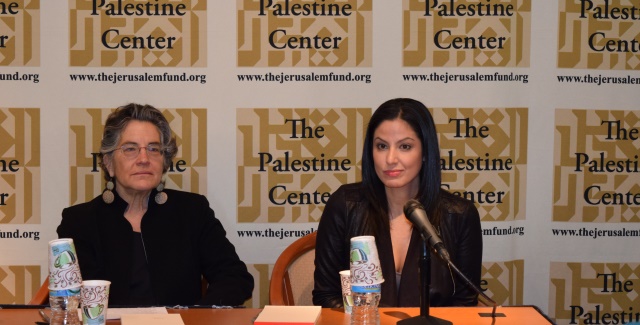
Phyllis Bennis & Rania Khalek
Good afternoon and welcome to The Jerusalem Fund and the Palestine Center, we are really delighted to have all of you with us today. My name is Zeina Azzam and I am the Executive Director here. We are also very, very pleased to have two important voices on Palestinian-Israeli affairs, Phyllis Bennis and Rania Khalek. Their regular analyses and writings have benefited our understanding of current and historical challenges deeply. Since October 2015, the world has witnessed an especially deadly escalation of fighting between Palestinians and Israelis. The news tells us that over 170 Palestinians and 27 Israelis have been killed. The violence began with tensions in East Jerusalem and spread quickly throughout the West Bank and Gaza and Israel, as soldiers employed shoot-to-kill tactics, claiming that their assailants, many of them youth at checkpoints, were threatening them with knife attacks. These extra-judicial killings of Palestinians have horrified the world community. It is clear that a neglected generation of Palestinians has grown up post-Oslo with no prospects for an end to Israel’s military occupation; they are feeling deep anger and despair. Our speakers today will analyze the context and causes of these events as well as the growing shift to the right by Israel’s government and Israel’s society. They will also consider U.S. and global responses.
Hello everyone, thank you for coming today. This is such an important topic and it has not been getting very much attention, largely because everything is dubbed. The elections are dominating everything – the debates – there are crazy Republicans running around talking about banning Muslims and building walls. But this is interesting because that is sort of what Israel is like; it is a place run by people who are very much like Donald Trump, and to the right of Donald Trump, and that has a lot to do with why we are seeing things escalate the way we are in the past few months. Like Zeina said, since October 1st there has been more than 170 Palestinians killed in, basically, street executions by Israeli soldiers and police officers and settlers, taking guns with them where they are going and killing people vigilante style. Human rights groups are calling this a clear pattern of extrajudicial executions and this is being incited from the top. Israeli leaders are encouraging this. They are encouraging their citizens to shoot Palestinians that may look suspicious, and that is what soldiers are doing, it is what police are doing and, in some cases, what settlers are doing. The vast majority of these people who have been executed have posed no threat when they were executed. In some cases they have been armed or they tried to stab soldiers with sharp objects, from potato peelers to scissors and knives. This has not been the case every time, but even in the cases where they were armed, it has been determined that most of them posed no threat when they were killed. So you have got this policy of shooting first and at any sign of danger.
With Israelis, a Palestinian just walking is dangerous and can sometimes be a reason to shoot them. Over the weekend there were six Palestinians killed. Two, or maybe three of them were minors. And a lot of people, when they are killed, are actually dying because of lack of medical care. That is another part of this policy that has been put into place from the top; denying access to medical care. So, if somebody is shot and they are bleeding on the ground, you just let them bleed out, and you obstruct paramedics, stop them from getting to them. And this has been the case several times. Human rights groups are starting to raise concerns about this and demand that people [should] be able to access medical aid after they are shot. We have seen a lot of these shootings on film too. It is like Israel has almost turned into this ‘snuff-film factory’ where every couple of weeks there is another video of a Palestinian being shot dead, and it is really disturbing. And I guess one question that I want to get into is why are young people, a lot of these people who are doing this, who are taking up knives against soldiers, what is possessing them to risk their lives to try and stab heavily, heavily armed occupying forces? It is an act that will likely lead to death; you are probably going to be shot and killed. The Israeli government is trying to push hard the idea that the reason this is taking place is because of Facebook, young Palestinians are being inspired to abandon very normal and lovely lives to stab soldiers because of Facebook posts. I am a journalist, and so I get the Israeli Government Press Office’s reports to the media. Their press releases, are often times, what they are trying to jam, [is] this idea of “It’s Facebook,” “It’s social media incitement,” – this is why Palestinians are doing this.
But that is not the case at all. The fact of the matter is, this is a generation of people who have grown up in the post-Oslo era and all they have seen is further entrenchment of the occupation without any prospects for a normal future. All they see are the walls being built around them. They are being ghetto-ized. They are being corralled into ghettos and being cut off from each other, not just from Israelis but from each other as well. Their land is being taken away. Their families are being brutalized and humiliated and harassed on a daily basis. I think the most important aspect of this is just the sheer hopelessness. These are acts of extreme desperation. When you have a thirteen year-old going up against a soldier with a machine, with nothing but a sharp object, that is a sheer act of desperation. This speaks to how grim the situation on the ground is for Palestinians right now. They have been completely abandoned, for the most part, by the international community and they understand that for Israel there is no two-state solution anymore. This is a complete illusion and they get that, along with [the notion that] the occupation is indefinite for Israel, that is what Israeli leaders are saying. They are seeing their loved ones being killed; they are seeing their friends being killed.
We are in an era right now where we have the Palestinian Authority, which is an arm of the occupation, right? Mahmoud Abbas calls security coordination with Israel sacred – that is the word he used. So, the Palestinian Authority has played a really great role in pacifying Palestinians in the West Bank. So, there really are no other avenues for even resisting the occupation at this point. Non-violence does not work, weekly protests haven’t done anything: nothing has happened other than media and international people come and they tour and clap. But people are being killed by tear-gas; they are being tear-gassed every Friday; they are being brutalized and their land is still being stolen. So Israel is still getting its way. There is no chance of a coordinated armed revolt in the West Bank because it has been so pacified, especially by the Palestinian Authority. So, you have these acts of desperation by lone individuals, who have had it up to here; they are done. And in a lot of ways, I do not condone violence against civilians, but in this case they are going after military targets and this is very brave. Nothing is going to come out of it, but you have people who are literally risking their lives because they have had it up to here. It is also a reaction to growing extremism in Israeli society.
One quick note on the issue of resistance. There is also the issue of hunger strikes. There is a hunger strike taking place right now, and it would be wrong not to mention Muhammad al-Qiq, who is currently on his 86th day of hunger strike. He could die any moment. He is a journalist and he was arrested and indefinitely detained for supposed incitement. There is no evidence against him that he can be charged with so they are just indefinitely detaining him. He launched a hunger strike and he says it was because Israeli interrogators threatened to rape him and his family. So, three months later, he still has not eaten, Israel is not budging and I think that it is really, really remarkable that his case has been largely ignored by the international press, especially in the U.S. at a time when, a few days ago, the Jerusalem Bureau Chief of the Washington Post was detained by Israeli authorities for supposed incitement. They released him a little bit later, like thirty minutes later, but they detained a Western journalist of a mainstream news organization without any real grounds to detain him and then apologized, and still the Washington Post has barely covered the case of a Palestinian journalist hunger striking for eighty-six days. That is truly remarkable to me and just speaks to how the mainstream press in this country really does not cover – I mean we understand the bias, but it is just utterly shocking, as another journalist it is sort of like you have been detained too. If you were a Palestinian journalist, you’d be in the position of that guy, you’d think that there would be a little more empathy there, and maybe there is, but the Washington Post itself doesn’t matter. They have barely covered the issue and, if anything, they white washed the detainment of their own journalist. I just wanted to throw that in there because hunger-striking is another avenue of resistance that Israel is not allowing to take place. There is somebody who went on hunger strike for forty-three days recently and nobody knew about it because Israel withheld that information from Palestinians, like from the Palestinian groups that they are supposed to tell about that.
These acts of desperation are extreme but they are a reaction to rising extremism in Israeli society. There really is, right now, in a way that there has not been before, this sort of growing, sort of Fascist, sadism coursing through Israeli-Jewish society and it is being incited from the top and is trickling down to below. Last week is a great example. Netanyahu last week announced that he plans to surround Israel – all of it – with a wall. So he wants to turn Israel into this huge Jewish ghetto in a way. He wants this big wall around Israel. And he said the reason for this big wall is to keep out wild beasts, which he said referring to Palestinians, [and] to Arabs in neighboring countries. This is normal talk in Israeli society; this genocidal rhetoric, calling people wild beasts, referring to them as animals – not to be confused, by the way, with ‘Arab droves’: those are the Arabs that live inside Israel, so inside the walls, as Netanyahu referred to them last year when he was running for Prime Minister again. But Netanyahu is a person that- he really occupies the center of Israeli politics, [but] he is not the most extreme person in Israel. So, the fact that somebody who is in the center of politics is talking about Arabs as wild beasts, it tells you something about the kind of rhetoric and language that is normal in Israeli society, and it tells you something about the people to his right because they are even further extreme.
He is not the first person to call Palestinians animals, or Arabs animals. You have Eli Ben Dahan – the Deputy Defense Minister of Israel and he is a man who, a few years ago, referred to Palestinians as “sub-human beasts.” So, this rhetoric is normal and we have been hearing it a lot more lately. Then you have got Ayelet Shaked, she is the Justice Minister of Israel. This is somebody who, during the 2014 bombing campaign on Gaza, referred to Palestinian children as “little snakes,” – also a very genocidal rhetoric. The Deputy Foreign Minister of Israel, Tzipi Hotovely – this woman will regularly cite religious texts to assert Jewish ownership over all of historic Palestine. This is the person who is the Deputy Foreign Minister of Israel. So, clearly the idea of two states is out of the question for these people; they want everything, they want greater Israel. And then you have got Education Minister, Naftali Bennett, who is like a rising star in Israel: he is in charge of the Jewish Home Party, which is basically an ultra-nationalist, proto-fascist party, very pro-settler. He, in 2014, when Gaza was being bombed, went on CNN, in an interview with Wolf Blitzer, and accused Palestinians of committing self-genocide to make Israel look bad. So at least he is admitting that there is some sort of genocide taking place but he has got the wrong culprits.
Naftali Bennett, as the Education Minister – the Education Ministry has already been pretty extreme in Israel and Naftali Bennett has taken it and cranked it up a notch. A few months ago there was a book that the Education Ministry banned. It was a novel, and they banned it because it depicted a romantic relationship between an Arab and a Jew, and their reasoning was that this threatens Jewish identity. Last week it was actually reported that the Education Ministry – there were several authors of a civics textbook in Israel that is taught to high-schoolers there – removed the names of the authors of several chapters because they said that the Education Ministry had re-written the chapters to the point that they were not recognizable anymore. And they had re-written them in a way where they added a nationalistic slant. This is the direction Israel is headed; it is this nationalistic, really supremacist, exclusivist, war-mongering mentality and this is what is being taught – injected into civics programs in school. This is really frightening when you think about what that means for the future because eventually these kids are going to grow up and they are going to be in charge.
All of this incitement from the top is – we are already starting to see what it looks like on the ground. You see a lot of these lynch-mobs forming in Israel, especially whenever an Israeli is killed, or even attacked. There will be “death to Arabs” lynch mobs. “Death to Arab” needs to be Israel’s new anthem because regularly, very frequently there will be these mobs in the streets chanting “Death to Arabs,” sometimes “Death to Leftists.” In October I think it was, when things got really crazy after there were several Palestinians killed and there were some stabbing attacks, there was a “Death to Arabs” mob that was chasing a young man named Fadi Aloum in East Jerusalem, and he was 19 years old. They were chasing him and calling him a terrorist and he was running for his life, and then they saw a police officer and they told the police officer to shoot him. This was all caught on video. They told the police officers to shoot him and they all opened fire on him. This young man was killed right there. No one has been held accountable for this because Israel can kill Palestinians with impunity – and it was all caught on video. After he was killed, this mob of people started celebrating. They were celebrating this guy’s death, saying “Yeah you got him.” This is really disturbing behavior that is kind of reminiscent of the Jim Crow South in a lot of ways. A few months ago there was an attack at a bus station in Israel, where a Palestinian-Israeli came in and he shot at mostly soldiers. There was an Eritrean refugee that was in the bus station, and one of the security guards at the bus station assumed, because he was darker skinned, that he was the attacker and shot him. So, this guy is crawling on the ground for help – and this was caught on security footage – and everybody in the bus station started to assume that he was the attacker and so a mob made up of Israeli police officers and soldiers surrounded this guy and started kicking him in the head, throwing chairs and benches at him, and started chanting at him to die. This is not the only video like this where people are chanting at someone who is injured to die, and the guy did, he ended up dying later. And this was just a bystander who, like everybody else, was trying to get away from someone who was shooting, and he is dead now. This is like the new normal in Israel and it is being completely incited from the top.
At the same time, in the Israeli Knesset, you have got these laws that are being proposed that are very authoritarian, the NGO law for example. There is an attempt to try and ban Palestinian-Israeli lawmakers who had visited with the families of Palestinians whose bodies are being withheld by Israel – there are dozens of Palestinian bodies that Israel refuses to return, so even dead bodies are not free from Israeli occupation – and they are trying to ban them right now. So, this is just the atmosphere of incitement that we are seeing play out on the ground and it is really disturbing. And I think the most disturbing aspect of it all is that it is being enabled, and I think Phyllis is going to talk about this a little bit more, but it is being enabled, and it is being rewarded. The Obama Administration has just decided that it is going to increase the amount of yearly aid Israel gets by a billion dollars. So, Israel is going to be getting four billion dollars instead of three billion dollars in military aid every year. And for what? This is just rewarding this behavior, there are no consequences whatsoever for this free fall into fascism and it really is the logical outcome of unchecked Zionism, unchecked settler colonialism. If there are no consequences for it, there is no reason to stop. Israel is just going to be moving further and further to the right until somebody puts a stop to it. And until there is political will to do that, unfortunately the reality is that it is probably going to get more violent. So, I guess, not to end on too much of a grim note, that is why I think BDS is really important because it is one of our only avenues here to doing anything to put some sort of obstacle in the way of what is taking place in Israel-Palestine right now. Thank you, and I guess Phyllis is going to talk more.
Phyllis Bennis:
Well, thanks Rania for an extraordinary sort of rundown of developments on the ground right now. Thank you all for being here this afternoon. It’s always great to be back at the Palestine Center. It’s great to be with Zeina leading it. I love having three women being here, not least because I do not have to adjust the microphone. That is always very good.
You know, not too long ago, four five days ago, the U.N. Secretary General, Ban Ki Moon, did something he doesn’t do often. He made rather an extraordinary statement about conditions of life for Palestinians living under occupation. He said that occupation is a “potent incubator of hate and extremism.” And he said that it was human nature to react to such a condition. And that was unusual. This is a man who has made his career out of being very careful, very cautious, virtually never challenging U.S. defined international diplomatic consensus on all things Israeli, and others; but, for the moment we’ll leave it at that. So, when even Ban Ki Moon is moved to that kind of obvious, but rarely spoken statement, we know that conditions are getting worse and worse. In two years, the Nakba, the dispossession of Palestinians, will be 70 years on. In one year, next year, we will see the 50th anniversary of the occupation of the West Bank, Gaza and East Jerusalem, and the Golan Heights. In legal terms, in international law, the notion of occupation is mainly looked at in the context of what are the obligations of an occupying power. That’s in some ways the easy part. We know the litany of Israeli violations, of their failure to meet these obligations, starting with “an occupying power has the obligation to provide the basics of life: clean water, food, education, etc.” Israel doesn’t do any of that, as we know. But, what we face now is something very different because all that international law stuff, Geneva Conventions and others, is all based on the idea that occupation is a temporary phenomenon. That it’s something that’s going to end, something that happens after wars. The winning side gets to occupy the other for a while until things, you know, figure out how to get everyone home. And then, the occupation is over.
Well, not so much in this case. We’re looking at what maybe in need of uhh, it’s a new violation, in need of articulation in international law, perhaps. The idea of permanent occupation, this is a whole different phenomena. We heard this from Rania that people are understanding in the occupied territory now that this isn’t something that’s going away. This two state idea, whatever one thinks about it originally, and one could imagine a two state arrangement where both states were based on international law, human rights and equality for all within and between the two states, one could imagine that. But, that was a long time ago. That was when we were talking about two states, where one of the states was made of the entire West Bank, all of Gaza, and all of East Jerusalem in some method of being viable and contiguous, and all those things. That hasn’t been on the agenda for years, not for years. So whenever anybody is talking about a two state issue, this occupation is not a temporary phenomenon. We’ve heard it from BiBi Netanyahu. We hear it from all these guys that there’s not going to be a Palestinian state. They’re very clear about it. In Washington and in Brussels and at the U.N., you would think that no Israeli Prime Minister had ever said that there won’t be a two state solution. They keep going as if this is the obvious only solution.
A few years ago, I went to head to head, sort of unexpectedly with Ben Rhodes – you know the young speechwriter in the Obama, we’ll he’s not so young anymore, in the Obama White House. He’s a brilliant speech writer, this guy. But as a strategist, maybe not. He kept repeating, how would I say, he kept repeating this notion “there is no alternative. Of course, we’re talking about a two solution.” There were 300 young Palestinians in the room, saying really? And I was sort of sitting up there with him, taking the mic and saying “but Ben,” you know. But, I think they really believe it. They really believe that one, there is no alternative; two, it is viable; three, this language always said very quickly as if it’s all one word, “two state solution with swaps.” That you can’t ever separate them, “two state solution with swaps” actually has some basis in reality that we will, of course, annex all of the major settlement blocs to Israel because of the other key word here is, “everyone knows, everyone knows that the key settlements will be annexed to Israel. Everyone knows that in the final solution, in the final settlement, in the final arrangements, Israel will annex, will have, those major settlement blocs.” And I was the one who raised my hand and said, “Um, excuse me. Did anybody ask the Palestinians who used to own that land, who used to live on that land? Do they know that?” Who’s the “everybody” we’re talking about when we say “everybody knows,” right?
But that’s one of the problems we face. There’s this global illusion at the level of diplomats, not necessarily at the level of people outside of the United States at least, but among diplomats, people really believe this stuff, that you can have a state that is made of something like 40 percent of the West Bank, divide it into tiny, I want to say bantustans, but let’s be polite and call them cantons, that have no connection to each other. It was one of the great things, remember Ariel Sharon? It’s been a while, but you know, remember him? He said one thing that was really quite brilliant. He invented this new concept that he called “transportational contiguity.” It was a brilliant concept. The idea was if you can drive from here to here, you can call it contiguous even if you had to go up the sky in some kind of giant bridge, or down under the ground in a tunnel, or take a helicopter from one place to another. If you can get from one place to another, you can call it contiguous. I thought it was brilliant. But, as a reality on the ground, it doesn’t work so well. That’s what we are talking about with this permanent notion of occupation.
So, the events that are going on today that Rania so brilliantly articulated, these have nothing to do with the idea of a temporary occupation that’s about to end and in the meantime we need, you know, maybe better food or more clean water. That’s not what’s at stake here. This is an entirely different reality because in a temporary occupation there’s the expectation, or at the very least the hope, that the occupation is going to end. Right now we’re looking at a generation of young Palestinians who have grown up under an occupation, whose parents were born under occupation, and who have absolutely no reason in the world to believe that this occupation is going to end, certainly in their lifetimes. And that’s a very different phenomenon when we look at what resistance looks like. You know as Rania said, these kind of personal attacks, individual attacks, one, to the degree they are carried out against the individuals, against the civilians, are indeed in violation of international law. International law allows the right of resistance, even the right to military resistance, to a population that is under military occupation. But that resistance is not unlimited. It prohibits still attacks on civilians etc. There are restrictions. But, it’s not surprising, these are not youth that have come together and determined what their strategic approach should be, how international law affects them when living under permanent occupation that may have not been imagined when the Geneva Convention.. you know. That’s not what’s going on here. This is reaction. This is individual desperation and why are we surprised? Ban Ki Moon is not even surprised when he says it’s human nature to react. It’s human nature to resist.
When you don’t have a leadership that is creating a strategic resistance, a collective resistance, what you find is not no resistance. You find individual often illegal and always ineffective resistance, in the sense of it’s not effective at changing the conditions. That’s the tragedy of this. That’s the tragedy of this. It’s absolutely predictable, absolutely predictable. And if we don’t understand that, we will never be able to sort of understand what Palestinian young people in particular are facing, whether it’s refugees that are now looking at the refugee crisis in the region as a whole, because remember Palestine’s neighborhood right now is not exactly a place that they can look to for succor and look to outside their own borders to say “well maybe the Arab states are not going to be what comes to our aid. But maybe people in Syria and Lebanon and Jordan and Turkey, our neighbors, maybe they will be part of what will end this occupation.” They can’t say that anymore. They never could rely on it. But now, you’re talking about Lebanon where one out of every four people in the country is a Syrian refugee. It would be the equivalent in this country, maybe some 85 or 90 million Canadians somehow landed in the United States with nothing but the clothes on their back, with no housing and no education and no way to feed their kids and no water. What would we do? That’s what Lebanon is facing today. So the Palestinians know that. They know they can’t look to Lebanon. They can’t look to the region for this kind of support.
The nature of the occupation hasn’t changed. It’s just expanded. It’s gotten worse. The settlements are more than ever. There are now more than 650,000 illegal Israeli settlers who are violating international law every morning just by getting out of bed because their house is built on illegally expropriated land. The siege of Gaza has not changed. There has been no rebuilding of the hospitals, the schools, the houses of Gaza. There still are no jobs in Gaza. Sick people still can’t get medical care by going out of Gaza because they still can’t get out. Now, Egypt is doing the same thing as Israel in keeping the gates closed. You know, Bibi Netanyahu can talk all he wants about walling off all of Israel, making it one big unity. But there are already gated communities from the outside. We’re talking about Gaza. We’re talking about the wall that surrounds Gaza, as well as the West Bank wall.
And in all of that context, we’re looking at a scenario where the cost is being born by the Palestinians, while the Israelis are profiting from the occupation. You know, we hear in this country that this can’t go on forever. The status quo is not sustainable. It’s one of the most popular lies out there because frankly this status quo is absolutely sustainable if you’re on the Israeli side. Yes, there have been some Israeli civilian deaths. That’s tragic at the human level; but it’s nothing remotely resembling an existential threat to the state of Israel. It’s nothing that the Israeli state can’t deal with. And indeed, it gives credentials to the most right-wing militaristic factions of Israeli society, who say, “Well you see, they’re killing individual people and therefore we need to militarize all of our policies.” We need our Justice Minister to say, not only to identity Palestinians, as Rania said, that Palestinians are equated to little snakes – she went on to say we should kill the mother snakes before they breed more little snakes. The language was nothing if not reminiscent of the language of U.S. generals in the Indian wars who had the famous statement, “Nits make lice. Kill them all. They will grow up to be Indians. Kill them all when they are babies.” When they were asked, “Do we kill the babies,” the answer was “yes.” So this shift in Israeli politics to the far right, as we heard Bibi Netanyahu is very much a centrist in the Israeli political scene; he is accountable to three parties to his right. We might call it the right, the far right, the extreme right and the fascist right. You know, you can go as far as you want. They’re not done yet, in my view. They are not done yet.
But, for each new generation of Palestinians, the occupation is experienced as new. The fact that it’s been going on for almost 50 years doesn’t mean that it’s experience for 50 years for a fifteen year-old Palestinian girl, for a seventeen year-old Palestinian boy, who have known nothing else, who are suddenly growing up into this reality and are facing the lack for any strategic collective intifada. I do not call this an intifada. I don’t think an intifada is an individual act. The inherent use of the word “uprising”, “intifada”, reflects the idea of collective action, strategic action. Some more successful than others, but collectivity, and collective involvement is the root. That’s not what’s happening here. But I think what we are seeing if we look at the difference at what happens to a twelve year-old Palestinian kid and a twelve year-old Israeli kid who both live in the West Bank and both are caught by the police throwing stones. Let’s look at what happens to each one. The Palestinian kid is arrested, maybe, taken to court, to a juvenile court, where the courts are very much like the courts here, doesn’t work much here as well. But, in theory, just like in Israel, in theory, children are brought in front of the court where the goal is the rehabilitation of the child. The child’s rights are primary. It’s not primarily about punishment. It’s primarily about getting the kid back on the right path, get her back to school, get him a part-time job, whatever it takes to get the kid away from the criminal activity that they’re doing. It may involve being in a juvenile detention center for a few days, hopefully, not. But the goal is the protection of the child and that’s how Israeli kids are treated, as they should be. That twelve year-old settler kid in the West Bank should be treated exactly like that. The twelve year-old Palestinian kid on the West Bank who is caught throwing stones is brought before the juvenile military’s court. Israel is the only country in the world that has a juvenile military court system, created in 2009. This is unheard of anywhere in the world. At fifteen, that same Palestinian kid will be before the regular military court. But between twelve and fifteen they have – they said “well, yes, we have to have special attention for children,” so they’re taken to the juvenile military court. Talk about an oxymoron, but that’s how it works. If you have two different populations in one territory governed by one governing power, where the division between the two population groups is determined by race, national origin, religion, language, etc…that’s the definition in international law of apartheid. That’s not some “let’s just use the word because it freaks people out.” That’s the legal definition according to the International Covenant against the Crime of Apartheid passed by the United Nations General Assembly 1976. That’s the definition of apartheid.
So when we talk about Israeli apartheid that is what we are talking about. It is not some made up term. It is because there are fifty laws inside Israel that explicitly require discrimination between Jews and non-Jews, that privilege Jews, where a Jew like me – it starts with what they call “the law of return” – I can go into Israel at any time, well probably, in theory, if I was a better girl I could go to Israel any time I want and claim citizenship. We know some of my Jewish friends, Richard Falk and Noam Chomsky and others have been kept out – I haven’t been, so far. But, the point is, Jews globally – my family had no connection to Israel, nobody in my family ever went to Israel, but I could go and claim my citizenship at any time. Palestinians who have themselves been expelled and still hold the key to their house can’t come back. Palestinians don’t have the same rights even if they are Israeli citizens, in terms of the rights of residency, the rights to marry who they want, all those things, the right to buy property, all of those things are discriminatory. So what we’re seeing now in the occupied territory, in the ‘67 territory, every generation resists in its own way.
It’s not new to think about the nature of resistance. But we have to look at, what are the consequences of all of this? Beyond the immediate impact, it’s putting it back on the agenda – with all of the talk about what’s going on in Syria, in Libya, which is an absolute global crisis, I mean we have not seen a refugee flow like this since World War II. It dwarfs the Palestinian refugee flow of 1947-48 in sheer numbers. And the danger, of course, is that we will be now looking at a permanent refugee population in the millions. The 750,000 Palestinians who were expelled from their homes in 1947-48 have grown as a global community. There are now something like three and a half to four million Palestinian refugees outside. We don’t know how many there will be among the four and a half million Syrian refugees who are already outside of the country, and more are coming every day. So, beyond this immediate impact we are looking at a scenario where young people are growing up seeing a failure of earlier strategies of their own leadership, a failure of the negotiation/Oslo strategy that has been in place for twenty-five years. We see the enabling that we already heard about of the United States, not only at the economic level, where we were hearing that it was going to go to five billion dollars a year, it looks like it may only be four billion – oh and we are supposed to be grateful I suppose that it is not going all the way to five billion a year – in direct U.S. military aid to Israel, keeping in mind Israel is the 26th wealthiest country in the world.
One might ask, why are we giving them any money, let alone billions of dollars of our tax money every year that goes directly into the military, when our own State Department reports every year, documents the consistent pattern of human rights violations carried out by that military? And the Lehi law, among others, is very specific in saying that you are not allowed under U.S. law – forget about international law – under U.S. law it is illegal to transfer weapons to any country that is consistently violating international law and human rights. That should be a no-brainer. Our own State Department reports, you don’t have to look at Palestinian reports, you don’t have to look at B’Tselem, you can look at the State Department. They’re pretty good every year actually at documenting it. It just does not matter, it just does not have any impact on the decision making.
So we have seen in this country – and you all know how it works, the Palestine Center has been a huge part of it – we’ve seen the change in discourse on this issue, it’s been massive. At the public level it’s astonishing how much it has changed. Even the press, as bad as it is now, it has changed significantly – I wouldn’t say as dramatically as the public, but it has changed. You see Palestinian voices in the New York Times. Yousef Munayyer, who used to be the Executive Director here, has had op-eds in the New York Times in the last couple of years – about 5-6 times now. You see an organization like IMEU that is placing Palestinian voices throughout the press. So it’s happening, it is changing, not where it needs to obviously, but it’s not what it once was, where Palestinians did not exist in the U.S. media, there was no public recognition of another people beyond Israelis in that territory. But, there has been no policy shift as a result of that. So, all of the talk about the Obama-Netanyahu squabbles – remember back in 2010, that summer, where it was so tense; “oh my god Obama is throwing Israel under the bus” – well there were no buses, nobody was throwing anybody anywhere. But there was a political spat over settlements. So, it became a request by the U.S.: “Please stop building settlements, you’re making it hard for us.” And the answer was: “No.” “Pretty please, stop building settlements?” “No.” “Please I’m begging you, stop building settlements?” “No.” And then they stopped asking. If there had been real pressure, it would have looked very different, we would have seen a request: “Please stop building settlements.” Answer: “No.” “Okay, you are an independent country, you can do what you want, but you know that 3.1 billion dollars a year (that is soon to be four billion) that we give you every year no questions asked, you can kiss that goodbye. And you know how we protect you in the United Nations so that no leaders in Israel, whether political or military, are ever held accountable for potential violations of human rights and international law? We’re not doing that anymore.” That’s the beginning of what pressure looks like. There was no pressure. The checks kept coming. That never changed.
So, in that sense, Palestinians have recognized, Palestinian civil society has recognized, that it’s going to take a global mobilization. That’s why BDS is so important. But I would say that for us in this country BDS has a match, and the match is our challenge to U.S. military aid to Israel as well as our challenge to U.S. political protection of Israel in the United Nations. Those two things, and I would argue the protection is even more important than the money – the money is way important but Israel would still be an occupying power if the U.S. did not pay them four billion dollars a year. They would not be an occupying power if the U.S. stopped protecting them in the United Nations and, whether it was in the international criminal court or another means, Israeli officials, military and political alike, were sent to prison for their actions. Then we would see the beginnings of an end to occupation. Right now we’re not seeing the beginning of an end, we are seeing the continuity. So I think that’s what we need to look at, there are no talks under way, there is nothing for young people to look at and say, “Well maybe those talks will come somewhere, maybe they’ve learned their lesson that those talks have never moved forward.” The French have said, “Well maybe we need some new talks, and by the way, if those talks don’t work then we’ll recognize a Palestinian state.” Well that’s a good thing, it just doesn’t change anything on the ground. Recognition of the Palestinian state is important to the degree that the Palestinians take advantage of it to do things like joining the International Criminal Court and getting that system operating against Israeli violations. That would mean a lot more than simply the statement of recognition. If France said, “We’re not going to allow any more arms sales to Israel, we’re not going to buy any more Israeli arms,” that would mean a lot more than recognizing a Palestinian state. And that is exactly what the BDS campaign in France is doing.
So we have a lot of work to do here. It’s not about BDS alone; it’s BDS in the context of what is the particular role of our government that enables such enormous U.S. power. So I want to end with just the sense that it’s ultimately going to be the Palestinian National Movement, it’s not going to be any of us in the solidarity movement, it’s going to be Palestinians themselves, Palestinians inside Israel, Palestinians inside occupied territories and Palestinian refugees in the far-flung diaspora who are going to have to decide for themselves what the trajectory of struggle is. Is it still to create a state somewhere or not? Is it a struggle for equal rights in the context of one large area of territory now under one government with two separate legal and political systems? What we have to do, those of us who are not Palestinian or Israelis, we have an obligation to work on our own government to change, as part of that global movement, to change the global dynamics that allow Israel to continue carrying out these policies that lead directly to the scenes that we are seeing, these horrific scenes that we are seeing on the ground today, where a young Palestinian carrying a vegetable peeler can be accused of being about to attack someone and is shot dead in the streets. That is our job. Thank you.
