Discrimination, Police Brutality, and Racism: The Struggle of Arab Palestinians in Israel
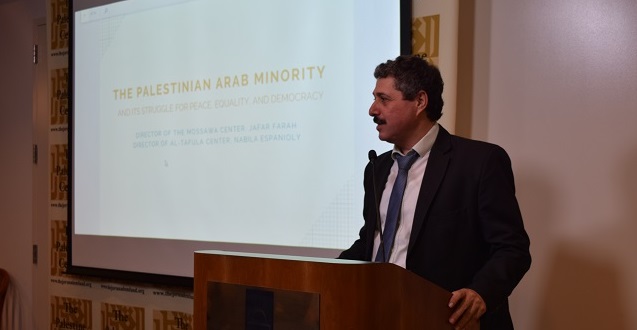
Jafar Farah and Nabila Espanioly, co-founders of the Mossawa Center discuss the advocacy work and programs of the center. Their presentation highlights how Al Mossawwa Center develops programs to promote a democratic society, and acts against all forms of discrimination based on race, nationalism, religious affiliation, social status, gender, and disabilities.
“Prisoners of History: The Story of Dalia, A Palestinian”

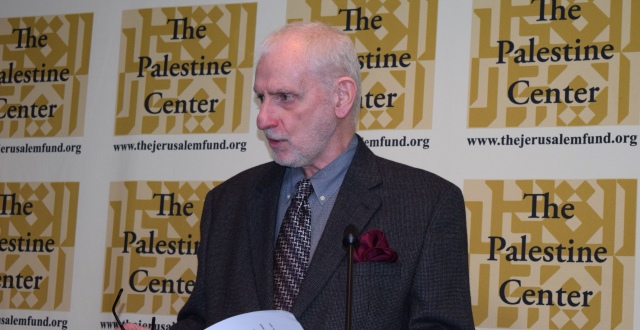
Author Charles Sutherland discusses the issues shaping his new book, “Prisoners of History: Dalia, a Palestinian”, which is a non-fiction novel of contemporary events. It is about a girl, one of over 1,000,000 Palestinian children trapped as prisoners in the military Occupied Territories of Gaza and the West Bank, and her struggle for food, electricity, education… and freedom. The short fact-based narrative is based on official Israeli policies, secret police tactics, real-life events, and authentic episodes experienced by actual people.

Structural Injustice: How Trials of Palestinians in Israeli Military Courts Lead to Misperception

by Palestine Center Interns

Despite the fact that most Palestinians who are convicted have committed no crime and engaged in no violence, the military court system creates a notion that legal due process is happening in Palestine. While this is the opposite of the truth, it still affects global perceptions of Palestine and Palestinians. This can be seen especially in the United States, where major media organizations might play up the alleged charges against a Palestinian while neglecting to mention the circumstances of their situation. This essay will attempt to demonstrate the injustice of these structures and systems of the Israeli military court and prison system, which has negatively impacted the lives of Palestinians and created false perceptions of their lives, character, and actions.

Trump’s cut to funding for Palestinian refugees could lead to disaster

Having survived Britain’s recent cabinet reshuffle the international development secretary, Penny Mordaunt , is confronted with the biggest headache of her short ministerial career: the fallout of the US intention to cut funding to United Nations Relief and Works Agency for Palestine Refugees in the Near East (UNRWA), which constitutes one of the most serious challenges to UK policies in the Middle East.

“The Way to the Spring: Life and Death in Palestine”

Ben Ehrenreich discusses and shares passages from his recent book, The Way to the Spring, which chronicles what he witnessed and experienced while living in the West Bank from 2011 to 2015. During that time, he lived in different cities of the West Bank, staying with Palestinian families, and writing major stories for American outlets including a cover story for The New York Times Magazine. He was also gathering material for this book, which places readers in the footsteps of Palestinians.

2016 Palestine Center Annual Conference: Keynote Address by Ambassador Riyad H. Mansour

Ambassador Riyad H. Mansour, Permanent Observer of the State of Palestine to the United Nations, delivers the Keynote Address of the Palestine Center Annual Conference.  He discusses the work that lies ahead despite the outcome of the U.S. elections.

Summer Film Series: “Roshmia” by Salim Abu Jabal

The film follows an elderly couple, Yousef and Amna, in their final stand-off with Israeli authorities to keep their rustic home, a shack in the Roshmia valley in Haifa. A friend encourages them to leave and works to secure municipal compensation for the couple, but tensions grow between Yousef, who refuses to leave his home, and Amna, who seeks to move on.

Segregation of Palestinians and Jews in maternity wards becomes an issue in Israel

Last week a controversy broke out in Israel over the segregation of Palestinian and Jewish mothers in Israeli hospitals. ‘Israel Radio… reported on Tuesday that various hospitals around the country have been separating Jewish and Arab women in the maternity ward.’

Why should Palestinians in Jerusalem be loyal to their occupiers?

A new bill to be introduced in Israel’s parliament, the Knesset, next week would permit the cancellation of a person’s permanent residency on grounds of “disloyalty” to Israel. Last October, the prime minister’s office announced that the government had decided to revoke the residency of “terrorists,” a policy that would almost exclusively affect Palestinians living under military occupation in East Jerusalem.