
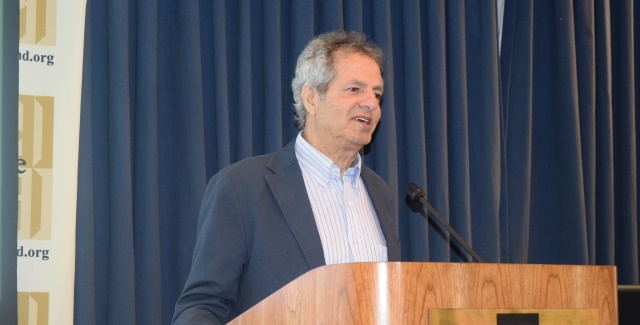
Sharif S. Elmusa
Zeina Azzam:
My name is Zeina Azzam and I’m the Executive Director here and I’m really pleased to see all of you here with us today. Today, we are featuring an important new anthology, titled Being Palestinian: Personal Reflections on Palestinian Identity in the Diaspora. It was published in 2016. And it contains over 100 contributions of Prose and Poetry by men and women, spanning several generations, most of whom are living in exile in the U.S. and the United Kingdom. The editor, Yasir Suleiman, explained diaspora, “not out of choice, but because of bitter necessity. As exiles they dream of returning home one day, or having their home back; but they’re not allowed to exercise this right of return. One of the contributors also writes, “Being Palestinian, I learnt from a young age, means being hammered on an anvil… [It] is waking up to displacement, lunching with diaspora and going to bed with dispossession.” We have copies of the book for sale in our conference room after the event today if you’re interested in purchasing a copy. We’re so fortunate that one of the contributors to this volume is Sharif Elmusa, a dear friend and a colleague from a long time ago, and he lives between the D.C. area and the Arab world. And he has kindly accepted our invitation to introduce the book to us and explore the many themes in it.
Sharif Elmusa is a poet, a scholar, and writer. His own collection of poems was published in 2008. It’s titled Flawed Landscape Poems 1987-2008. He’s also co-editor with Greg Orfalea of the classic anthology Grape Leaves: a Century of Arab American Poetry. Sharif Elmusa’s articles and essays have been published in major newspapers in Egypt and the United States, as well, as several anthologies, including Seeking Palestine and Gaza Unsilenced. He holds a PhD from MIT and is professor emeritus at the American University in Cairo. He has also taught at Georgetown University, both here and in Doha in Qatar and at Yale University. Sharif is a recipient of several grants, including a Fulbright grant in Jerusalem. He describes himself as Palestinian by birth and American by citizenship. I’ve asked Sharif to speak for about 40 minutes, after which we’ll take questions and have a discussion here and our online audience can also send us questions by tweeting @PalestineCenter. So, please join me in welcoming Sharif Elmusa.
Sharif Elmusa:
Thank you Zeina for this kind introduction and thanks for Samirah for making all the arrangements. I’m delighted to be here. I spoke here a few times before. So this is a familiar place for me and I come very often to your events. So, I feel at home here. Thank you. I have here… actually, I know many of you here… I feel kind of embarrassed to tell you what it means to be Palestinian because you know more than I do probably. I have here members of family who usually don’t come to my talks: my cousin Abed and my wife, Judith, and my daughter Karma, who works for IMEU and I think she is more known than I am in this region. So, ahlan wa sahlan.
This is part of being Palestinian, as many of the contributors attest actually, the warmth of the family, relations and connections. I was talking with my friend, Thomas, before I made the –before I started, somehow the name of Alaa Adeeb, a book reviewer in Egypt, he died recently. But he used to call his reviews “aseer al kitaab” – “The Juice of Books.” So, I’ll try today to give you the juice of books. Usually if we are to say what kind of juice a Palestinian book would be, it would be orange juice, kind of sweet and tart. It’s always sweet and tart. So, I think this book is kind of sweet and tart.
Last year I also presented another book. It was called Seeking Palestine. It had 17 authors. I mentioned then that I used to advise my students never to review an anthology because it has so many authors [that] by the time you get to 6,000 words or 4,000 words, you barely can mention the name of the authors. It was never a very good idea. Today, I’m repeating, even making a worse mistake and trying to present a book with 101 authors. This is, you know, a terrible mistake, I think. But then, in my DNA analysis it indicated that I do not learn from mistakes. I thought, I probably share this very much with the president of our authority, Mahmoud Abbas. But, I hope…I hope this trait is not very widespread among Palestinians as a whole because that would be a disaster.
So, okay. The anthology is a kind of gathering of voices. Israel has fragmented us and continues to do so. So, the book is a kind of act of resistance to this fragmentation. This is extremely important at this time after the practical demise of the PLO, which used to be some kind of a rallying point, a locus for Palestinian identity, and being Palestinian. It is also in the spate of the Palestinian struggle, which always percolated from the grounds up from 1936 until now. All the uprisings, all the movements kind of started from the grassroots, from the grounds up. So it’s good to bring everybody together to establish a presence, basically, in the absence of an official presence today.
I thought I’d be reading one story after same story and get quickly bored. But to my pleasant surprise, I couldn’t stop reading. Once I began an essay, I really wanted to know what happened. They were all irresistible to finish. Mostly beautifully written, some lyrical, some reasoned, some very intimate, some very passionate, some angry, some lonely, some… It’s really a very rich variety of writing and for just that irrespective of [whether] it is Palestinian or not, I would read it. I think it is likely to become an important source, the book, for those who study identity also, “What does it mean to be somebody or something?” So, people use often different kind of words. All the people here, as Zeina said, are ironically from the U.K, which enabled the creation of Israel, or its formally colonies, the U.S., Canada, Cyprus even, Australia. – all kind of from the English speaking world. And they used the word, different words, to describe this condition of Palestinian exile. Some say exile. Some say diaspora. Some say shataat in Arabic. Shataat is a kind of scattered, some say ghorba, which means estrangement, not exactly. Each one of them has a nuance, or nuances that don’t get captured. So, I think one could use a plurality of words, since words aren’t always just a very precise thing that you can hold onto.
All of them are accomplished, it seems, in their fields or are very promising… You have academic doctors, poets, writers, computer programmers, entrepreneurs, whatever, all kinds of people who seem to have the ability to write. Nonetheless, I still think the book is not representative because these are people who can write, and who can express themselves, part of the, you know, the elite. So, I hope the next book will be interviews with Palestinians who don’t like to write or who are totally forgotten or who do not read or who do not have the privileges that a lot of these people have or have access to. So, I hope someone goes around and does this kind of book too. And we will see what it means.
So, what does it mean to be Palestinian? This is a difficult question, more difficult than one thinks. Try to write 100 words and see, about yourself because this is about identity. Identity is about selfhood. “Who am I?” Try to talk to yourself, “who am I,” even as a human being, as an American, as South American, as wherever you come from. And you find that it is difficult and the reason is that there isn’t something, you know, that is like here. You can’t carve yourself out and say “This is me. This is being human.” There isn’t any physical thing like this or something metaphysical either. There isn’t, you know… You always hear about national character – “the Germans are this.” There isn’t really anything like that in reality. Identity is something very difficult.
Here I have a quote from Dina Matar who is a Senior Lecturer in political communications at the School of Oriental Studies in London. Here is what she says, the difficulty encountered:
“The more I tried writing down my thoughts the harder it became to provide a coherent reflection that is true and meaningful. I could not think where to start, as writing about being Palestinian is not merely about belonging or longing, or home or homeland, nor is it an argument about the uniqueness of the Palestinian experience and story, but rather a complex narrative of multiple experiences, memories, feeling and senses that shift and change according to various situations.”
So, I think I made this point. Many people talk about becoming Palestinian rather than being, which I think it is more accurate in many ways. We change overtime by age, by place, by temperament, by what we come to know in the world. We are a becoming, not a being, just a given. We evolve, right, for good or for bad. I’m not making judgements here. So, all you can hope for when you are talking about your “Who am I,” about yourself, in my opinion, is that you can approximate. Each time you try to say who you are, it is an approximation. It is an iteration. You will never-kind of- eventually say “Ah eureka. This is me.” So, keep trying. It is an interesting thing to get in touch with yourself. And this is what the writers do, actually, from sentence to sentence, from paragraph to paragraph, trying to approximate who they are.
I thought to give you a flavor of the book as a first approximation or iteration, I will read some of the titles of the essays, the 101 essays. You can get an idea just from the titles here:
“Without My Jaffa, Other Seas,”
“Becoming Palestinian,”
“Resident of Both, National of None,”
“A Journey in Progress,”
“Being Nobody,”
“Embracing Uncertainty”
“Things We Carry With Us,”
“Breathing Politics,”
“Presence in Absence,”
“The Pain and Beauty of Dispossession”
“Buffeted By How Others See You”
“Home is Where the heart Is, But Where Is Home?”
“From Ajjur to America: Rootedness in the Diaspora”
“Rolling Grape Leaves on a Map of the World,”
“In, but not Of,”
“Entry Denied,”
“Barricaded,”
“Ties That Bind, Ties that Sustain,”
“A Mission to Explain.”
-And on and on- you can tell what really goes in the minds of these writers just from the titles.
The linchpin that seems common to all is the event of ‘48, catastrophe. Most use the Arabic word, Nakba to describe it. You’re all familiar with that moment – that moment when Palestine was dismembered and its people were dispossessed and dispersed, and their culture and heritage were threatened with oblivion. The authors of the book describe an identity in limbo, in a liminal space between that traumatic moment and a future time when that wrong will be set right, when justice will be beaten out. So it’s a kind of “inbetween”. It’s as much [about] looking into the past, as much as looking towards the future. It is, in general, a hopeful book. I mean, people end of up on hope. I didn’t see anyone giving up in the book.
So how do the Palestinians in this book construct their identities? How do they say they become Palestinian? First, those Palestinians who lived in Palestine and migrated had first-hand experience of people. We even have some people here who were born in 1930 or …so they lived that experience from even before ‘48. They have memories. They have had rootings in the landscape and in the geography and in the culture. So this is one of them. Selma Jayyusi, maybe you know of her, a prolific anthologist and literary critic. She says,
“When all was finally over and the whole of my extended family became refugees, I found myself in the grip of estrangement and I slowly developed a feeling of permanent loss. What can one do to endure this parting, this tearing away of a whole life, of a whole intimacy with a place?”
So you have the family and the place. This is all you have in the world, right.
For others, especially those who did not have that experience and we have many who were born out of Palestine and many, also to parents, maybe one of them is Palestinian and the other is not. So, it is much more intricate that way. I mean you don’t say, your identity is just constructed by you. Your identity is also authored by others. The first one is nature, your parents. I mean we do not choose our parents, who our parents are, where we were born. So nature first gives you….I can’t say I’m a Guatemalan. I would like to be, but I can’t be a Guatemalan. So you are given by nature to some extent. This is the first step, it doesn’t do anything for your identity still but it is an important step.
But then there are, in our case, the big others. The others are Israel of course, and you can count on Israel to keep reminding you [that] you are Palestinian with its constant assaults, wherever they are, in Gaza, in the West Bank, even here in the media, everywhere, at AIPAC, wherever you want to look for it. So that is always a constant reminder of who you are. And the media, of course, and the American politicians and the American political system, these are very present in their reflection. But I won’t talk about them because we talk about them all the time. So I am not going to talk about the media or what people say of the media or the American government.
Identity is really felt and lived in the everyday, without kind of intending it. And a number of authors here grapple with the question of being asked “where are you from?” People ask you “where are you from?” Now they ask me “where is your accent from?” People respond differently, but many find it very confusing, partly because the geography has been confused. Ibtisam Azem, a novelist living in New York writes,
“Where are you from? I hate this simple question. My confusion as I attempt to answer it does not indicate any confusion in the identities I carry. It rather means that many of those that I encounter see official maps and identity as identical with reality. It also means I have to explain and elaborate on what it means to be a Palestinian with an Israeli passport.”
It is difficult, you know, suddenly you get involved. She says “and to do so without denying the other who denies my very existence.” So you have to go into a whole explanation, almost you have to go back to ‘48 again to explain anything. So that is a difficult question.
Then there are the gatekeepers at the borders, when you try to go from one country to the other. One of the stories that I really like, and the way the person expresses this, is this Omar Aysha. He is a computer-science graduate from the American University in Cairo, where I used to teach, I never met him there. He is a video-game developer, originally with a – this is the document’s name – Palestinian Refugee Travel Document it is called, a standard Lebanese issue that made airports nightmarish for him. He says,
“it also made me think that being Palestinian was a mark of shame. It was something to be hidden; being Palestinian only caused you problems.”
Then he goes to England and acquires a British passport, and then, he says,
“Airports weren’t scary anymore, I just showed my British passport and they waved me through. I didn’t even have to get a visa…freedom of movement is amazing. Then I noticed that I began doing something wonderful. When I met someone and they asked me where I was from, I’d say I was Palestinian! I also felt that it’s much easier to be loud and proud about your identity if you feel comfortable, because you are fundamentally safe.”
I think this is a message to the Arab governments who kept the Palestinians in refugee camps, denying them any privileges, because they argued that they will forget Palestine. I think you are likely to remember if you are in a stronger position.
On the other hand, I’ll give you a few, you know, how people have discovered their identity, or when it hits them or if it comes gradually. On the other hand, Salah Ehmoud, an anthropologist of Mexican mother and a Palestinian father, her identity comes almost as epiphany, as a sudden realization, what she calls her Palestinian Revolution. This happened when she was doing research while at a café in Managua, Nicaragua. She met a former Sandanista fighter who suddenly was talking to her and talking about the PLO and how the Sandanistas identified with the Palestinian movement as an anti-colonial movement. So she hears this story and finds a great affinity, this story gets repeated, with other South American movements, in El Salvador and in others. And this is when she becomes Palestinian. She begins to feel Palestinian, and starts engaging and directing her research towards Palestine.
Leila Abdul Razzaq, who is the author and an undergraduate, she’s the illustrator of Baddawi. Probably, Karmah, you promoted the book right? So when you reach the crossroads, she says, at one point, you have to decide who you are. This is what she calls the crossroads. So she says,
“So when you reach the crossroads, what can you do but set aside an official form of identification? You forget passports and state IDs and say, ‘I am Palestinian.’ You say, ‘My mother is white, my father is Arab, I grew up in Chicago and Seoul, and all of these things are precisely what make me Palestinian.’ This is the realization that it is because of diaspora, not in spite of it, that you are Palestinian. At least you see that just because others are confused about your identity doesn’t mean you have to be confused about it also.” And this kind of “You are Palestinian precisely because you are exiled,” has been repeated by a few of the authors.
Samer Abdelnour, who is the co-founder of Al-Shabaka, of course he comes from Palestinian parents and he heard about Palestine, but the moment when he really becomes Palestinian—he says,
“As an undergraduate student, I first met other Palestinians outside my family and church. From different places we came together to explore shared politics and culture. I was ashamed at my inability to command our language, and envious of the others who knew my family and places of origin back home. Yet these anxieties faded to be replaced by powerful unspoken connection. Together we celebrated being Palestinian. Palestine: duty and pleasure, love and burden.”
So, for the most contributors, it seems like it is a gradual thing, by accretion, by accumulation, this and that, like Selma Dabbagh, who is a lawyer and now fiction writer in England, whose mother is British and father Palestinian, who, despite her critique of the Palestinian middle class social conservatism and mores and resistance to being embroiled in Palestinian life, somehow ends up stuck with Palestine for the rest of her life, through going to Jerusalem and interning in a law office and that’s it, then you get stuck.
So what does it mean to be Palestinian? I was talking about how you can discover it or how you come to realize or embrace your identity. Victor Kattan, father Palestinian, mother British, born in Sudan where his grandfather was buried and he has family in Chile, France, Honduras, Italy, Jamaica, wherever. Today he is on the faculty of law at the National University of Singapore, another former British colony. He says,
“I view my Palestinian identity not in a cultural, ethnic, or religious sense, but emotional. I self-identify with other Palestinians and with the cause, and I avidly follow contemporary political events in Palestine as if I lived there.”
Izzat Darwazeh, who hails from Nablus and on the faculty of engineering at the University College of London, he says,
“There is this strong sense of belonging among Palestinians living in exile. It feels like a huge extended family spread across the continents, where everyone looks out for everyone else. To me, this is perhaps one of the warmest aspects of being Palestinian.”
Ramzy Baroud, a journalist and writer originally from Gaza and he lives in the West:
“Being a Palestinian is like a perpetual political argument, and a heated one at that, and I learnt—”I learnt,” because this is a British book so it’s not “learned,” “I learnt”—very early that I needed to explain and at times to defend myself for being Palestinian. Identity is not always a matter of course, it can be a constant struggle.”
Anonymous—I like this Anonymous, you know, because he’s kind of almost this topic that describes a world of dystopia. At one point in the article, he describes himself as, “I’m a middle-class nobody.” But then, at the end, he says,
“And so perhaps the best answer to the question of being Palestinian in the diaspora is simply being a person, like any other, from anywhere else around the world. As such, as abused people, the fact that of realizing it we are, after all, typical human beings, is perhaps the best answer to what it means to be Palestinian, no matter where they may be.”
But of course, as I was saying at the being, it doesn’t solve the problem just to say I am a human being, but what does it mean, right, to be a human being? But it is an interesting take.
Randa Farah, on the faculty of the University of Western Ontario—today, it’s called “Ontario”: “Today, I’m sliced into two: an internal world of memory and Palestinian ways of being, and an external life, which I mechanically navigate, often unsuccessfully, in a Western society. It is still bitter cold and I walk faster, I am eager to reach my house, so I can listen to the news and live virtually in the Arab world. Who knows? I might be a day closer to return.”
It’s kind of like the Yemenis chew qat, the Palestinians chew news, really, it’s our own qat.
Ghada Kanafani, writer, poet, speaker—I wish we could have shown that, because her name is Ghada and she writes it in Arabic, yeah you saw it:
“My name is Ghada but live exiled from my own name. My name lives in a past I don’t want to remember, yet the voice carrying me home is the voice that says Ghada. What of a name but the familiar, the voice of a lost beloved and what a parent had in mind. My name is buried in a new place and is lost to a new people.”
Fouad Moughrabi, who spoke here last year, in the conference: he’s a professor emeritus at the University of Tennessee in Chattanooga, and he was one of the founders of the AAUG, the Arab American University Graduates. He said,
“For Palestinians of my generation, Palestine has always been a sentence. Everything in one’s life is subjected to the overwhelming business of defending and promoting the cause of the Palestinian people… Unlike other sentences that one suffers grudgingly, this one was in fact welcomed gladly. It gave meaning to one’s life. In reality, if Palestine wasn’t the cause, I most probably would have spent my youth fighting against apartheid in South Africa or some other similarly noble cause.”
Which brings me to near the finish of this talk
That is, one of the things about identity is really: human identity is moral. Many times, a person you know, or yourself, you find yourself doing something and say, “I don’t know myself, I don’t recognize myself doing that,” so [you] yourself suddenly becomes someone else rather than you. So the moral aspect of identity is very important. One of the manifestations of this morality or moral identity, for a number of Palestinians who contribute here, is empathy with the marginalized, with the wronged, with the underdog. Here is Ishaq Abu-Arafeh, he’s a pediatrician in Scotland: “Being Palestinian allows me to see the big picture of all people who suffer at the hands of racists wherever they are… Being Palestinian has taught me to appreciate the impact of prolonged human suffering and has guided me into wider issues of social justice, civic responsibilities and human rights.”
I have here also Aida Audeh, she says, that the social and economic dislocations in the US basically has taught the Americans what it means to be living under a powerful control system that sees them as indispensable:
“Across the country, people are starting to fight back, I can stand in solidarity with that.”
But I’m going to end with Lisa Majaj, her father is Palestinian, her mother is American. She lived here for a long time—she is a poet—but she married a Greek man and she lives in Cyprus. And I will leave the last word to Lisa Majaj. Here is Lisa. She says:
“I write my way forward, because being Palestinian means, above all, that we belong on this planet. Notwithstanding the devastations of history, it means holding on to hope. It means believing that one day, being Palestinian will be a metaphor not for tragedy and despair, but for the simplicity of ordinary life, like spices wafting across a kitchen, promising a future.”
This is where I’ll stop.
