
by the Palestine Center Interns
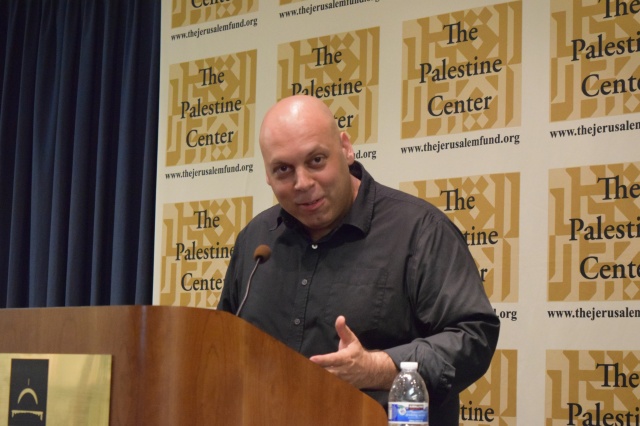
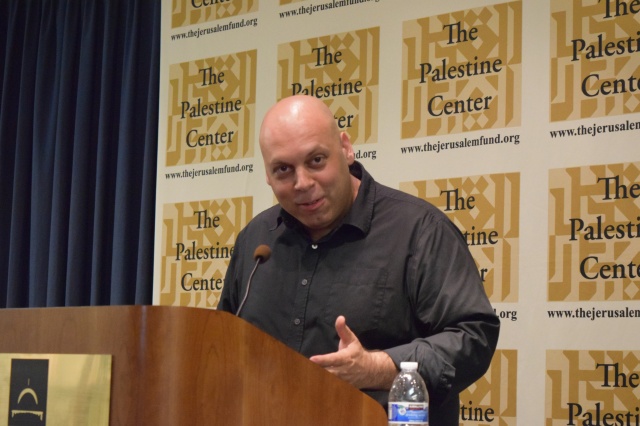
Amer Zahr speaks at The Palestine Center on 3 June, 2015.
This Friday, 5 June, Amer Zahr will be the first Palestinian-American comedian to perform at the Kennedy Center for the Performing Arts. Zahr stopped by The Palestine Center this past Wednesday and gave a talk entitled “Comedy and Palestine.” He discussed his experiences as a Palestinian American comedian. Although it was not a comedy routine, Zahr’s talk certainly elicited quite a few laughs from the audience. After his talk, the Palestine Center’s summer interns sat down for an interview with the renowned entertainer, asking him about a range of topics.
Below are excerpts from the interview, which have been condensed and edited from the original.
You have an MA in Middle East Studies and a JD in Law, both from the University of Michigan. How would you say your educational background shapes your comedy and activism?
I would say first of all, they all kind of relate to my activism. Since I was a teenager, being Palestinian, I felt that getting a deeper understanding of our part of the world is important. That’s why I did the MA, and Law, obviously becoming an effective advocate. That’s a lot of what you learn about in law school–problem solving and putting across a point concisely and effectively. As a comedian, you also have to compact everything. Even in class now as a law professor, I’m performing just like I would on stage. Communicating effectively, it’s all the same thing. So I would say they all kind of inform each other and they all relate to each other, and I learn how to take from each and give to the other.
Do you think that your career in comedy has helped you in law and being a professor?
Performing on stage helped me in the classroom. Whether it’s just being comfortable in front of a room full of people I’ve never met before: that’s comedy, that’s every night. I throw in a little humor in the classroom, too. They all inform each other a little bit, and so I think that I don’t view myself as doing something that different than when I’m on stage as when i’m in the classroom. When I’m on stage, my goal is to make people laugh every minute or so. In the classroom, it’s obviously not the same. But I’m still trying to communicate effectively, concisely and confidently and that’s kind of what I’m doing in both places.
How do you think comedy and law intersect?
Comedy and law intersect in the sense that as a lawyer you’re advocating, right? Usually for somebody else or for a cause. As a comedian you’re advocating for yourself. You’re advocating for your own point of view–that’s what you’re really communicating to people: your point of view of the world in the hope that it’s kind of funny. And so that sort of advocacy, whether you’re doing it for yourself or somebody else, it’s kind of the same. I think that there is a cool intersection there. It’s about performing and narrating. The skills that I think that make a good lawyer are not that different from the skills that make you a good comedian.
How important would you say your identity as a Palestinian-American is to you in your comedy? And do you identify more as a Palestinian, American, or both?
I kind of view it like this: I’m a Palestinian and I’m an American all at once. I’m not half this or half that. They mean different things and they complement each other in different ways, but I view it like this: I’m kind of like green paint. If you have blue paint and that’s being Palestinian, and you have yellow paint and that’s being American, when you put them together, it’s not half blue paint and half yellow paint. It’s green paint. And once it’s green paint, you can’t separate it again and make it blue paint and yellow paint.
So it’s all together all the time. I’m not sometimes this, sometimes that. Being American and being Palestinian informs everything that I do, all the time. So I’ll view things through that lens. I’m an American. I’ve lived here my whole life. This is the society that I know. But at times I don’t feel very welcome here. I’m a Palestinian. I’ve almost never lived there, but when I’m there, I feel like that’s where I’m supposed to be. So if somebody can explain that psychosis to me, then I’m willing to listen, but that’s just the way that I feel.
Times in the Arab world are tough. How difficult is it to find things to laugh about when times can be so trying?
Well, like I said in the talk, laughter and crying are not that different. They’re very similar. I think where you can find tragedy, you can probably also find humor. That doesn’t mean something is funny; it just means that it can create humor, even if it’s out of some sort of therapeutic thing. Do you just want to be sad and depressed all the time or do you want to try and find the humor in the stuff that happens to us? And I think that when you do that, not only can you send a message better, but it’s therapeutic.
If you can make it funny, it makes it seem less crazy. And it kind of makes it not as damaging to your psyche. That doesn’t mean you live with it and accept it, but you find ways to compute it that become effective to you. And actually when you can make it funny, that hurts the oppressor, right? I mean, if you’re saying, “Your oppression is just funny to me,” it’s not making me depressed, it’s just funny. And it didn’t start out like that for me.
When you go to the “VIP room,” the interrogation area when the enter the airport in Tel Aviv, you’re there for eight hours. The first time it happens to you, you’re angry. You’re like, “This is a violation of my rights, what are you guys doing, this is terrible, where’s my ambassador,” etc. And then the second time they did it to me, I was just annoyed. I was like, “You’re wasting my time, your time, we all know you’re going to let me in. We all know that, it’s just a waste of time, just wasting my time.” So I was annoyed, not angry, annoyed.
The third time I actually brought a book, because I knew it was going to happen, and I just sat there, and I started to feel sorry for them. I started to laugh at them. This is what you do? This is your profession? This is what you live your life doing every day? This is what you go home and talk to your wife about? How terrible that you’re living your life like this. And it’s not working! Because now I’m here for the third time. If your point was to try to piss me off so I don’t come back, you’re very bad at it.” Now I’m just like, “Okay, I feel sorry for you.” Like, the guy that strip searches Palestinians when they leave Tel Aviv airport… What a terrible job! That’s his job. Think about that for a second. That’s his job. When he looks at his paycheck, he thinks, that’s what he did that week to get that money. That’s what he talks to his wife about. I think it’s about flipping it, and it’s not that hard in our context.
You have traveled to and performed in quite a few countries. Which has been your favorite to perform in, and why?
At the risk of sounding cliche, Palestine, just because that is where everything comes from for me, and I feel the most comfortable when I am performing there. The laughs that I get there, even when I am not talking about Palestine, are much more organic; I feel like people are laughing. Also, Palestine has a long tradition of art which has come from oppression over the last 67 years. So it’s not like other places that I go where comedy and performing live is something completely new, where people laugh at anything and you do not know if they think you are funny or if they are just laughing because you are there. In Palestine you don’t have that luxury. If you are not funny, then they won’t laugh. If you are not good, then they won’t clap. So the fact that they do means something. I feel like in Palestine there is really that appreciation, and of course the connection with it.
What role do you think Arab-Americans and American Muslims play in portraying an accurate view of Middle Eastern culture? How do you accomplish that?
First let me say, I don’t use the term Middle Eastern. That is a white term made up by white people to describe us. We don’t call ourselves Middle Eastern, and especially in our own language, we don’t use that word at all. Middle Eastern: East of what? East of white people?
Sometimes in our community, people expect every Arab or every Muslim to be a spokesperson or stand-up, and I don’t really expect that of everyone. Sometimes it’s just like he’s an engineer and that is what he does, and he just goes to work everyday, and that is cool. Now I will tell those people though, people who look at you, they know that you are an Arab or a Muslim and trust me, they view you that way. So yes, you do have a responsibility, whether you like it or not. If you do not want to go out and be an activist, I totally understand, but you do have some sort of gravity to your existence because of who you are in the world that we live in. So I would just ask every Arab or Muslim to recognize that. At the very least, be a good person because it really matters much more if you are Arab or Muslim. If you are a white guy then it doesn’t really matter because people don’t hold it against all white people. But if you are an Arab or a Muslim, people will hold it against the rest of us. That is just the truth.
There are opportunities everyday no matter what job you are in. I bet you that no matter what job that you are in, your coworkers probably have some misconceptions about Arabs or Muslims. I bet for many of them, you are the first one that they have met. They might think that you are Mexican or whatever. So there is some opportunity there to educate somebody.
If you can change one person it can really have an effect. They will go tell people, “Hey I met a Muslim today.” If we go back to Edward Said and orientalism, the essence of it is they don’t see us for who we actually are. They don’t meet us and they do not take the time to talk to us. Instead, they see us for what they imagine us to be through the news, and that happens to everybody. People say it to us all the time: “Oh, you’re Arab? You don’t look Arab.” And it’s a totally messed up thing for people to say, but they say it. And that’s because we are the last group that you’re allowed to say anything against and not get in trouble for it. And they do. It proves that racism is not dead in this country. It proves that people are just aware of who they can and can’t be racist against. Because if they knew they could be racist against black people, they still would, but they aren’t because there’s a price to pay for being that way. But there’s no “price” for being racist against Arabs or Muslims, so they still do it.
Herman Cain, who was running for president a couple of years ago, gets on TV and says, “If I become president, there will be no Muslims in my cabinet.” And the next day, he was still running for president. Nobody told him he had to resign, or anything like that. It was just a little news story. When John McCain was running against Obama in 2008, some lady walks up in a town hall meeting for John McCain and says, “I’m not voting for Barack Obama, because he’s an Arab.” And John McCain grabbed the mic from her and said, “No ma’am, he’s not an Arab. He’s a decent family man.” That’s it. And that was the story on the news that day. MSNBC said, “Look at McCain. He says Obama isn’t an Arab.” And that was the news.
Barack Obama, still to this day, has to actively deny that he is a Muslim. And never after seven years as he said “I’m not a Muslim, but so what if I were?” He still hasn’t said that, and he’s president of the United States. But he knows he can’t say that. It’s out of bounds for him politically. And that would be so humanizing for us, to hear, “I’m not a Muslim, but so what if I were?” And he still hasn’t said that. “Why are you so racist to make that accusation?” It’s not just a simple misidentification. It’s an accusation. This is why we’re upset.
You’ll be performing at the Kennedy Center on Friday. What does it mean for you to be at the Kennedy Center? Your pamphlet says, “First Palestinian American to perform at the Kennedy Center.”
Well, they weren’t sure that we were the first Arabs to perform at the Kennedy Center. But they were sure that we were the first Palestinians to perform. To do something like this at the Kennedy Center puts it on the different level. To be in the most prestigious performing arts center in America, with that sort of gravitas, telling the Palestinian story there? It’s really important for us, and a step forward.
When you’re in the Kennedy Center, nobody can say you’re on the fringes anymore. You’re in the American public. And that’s one of the points of doing the show there. We’re saying, “Hey, we’re just like everybody else.” And we should be able to have access to the same media channels and everybody else. And I hope there are a lot of people in the audience who have never met a Palestinian before or seen Palestinian artists perform before. While I hope a lot of Palestinians and Arabs are there, I want there to be a lot of non-Arabs and non-Muslims there, so we can create that bridge. When you’re laughing as a white guy, and the Palestinian next to you is laughing, you say, “Hey, look at that, we’re both laughing.” For something like that to happen is really important.
The views expressed in this interview do not necessarily reflect those of The Jerusalem Fund.
