
by Zeina Azzam
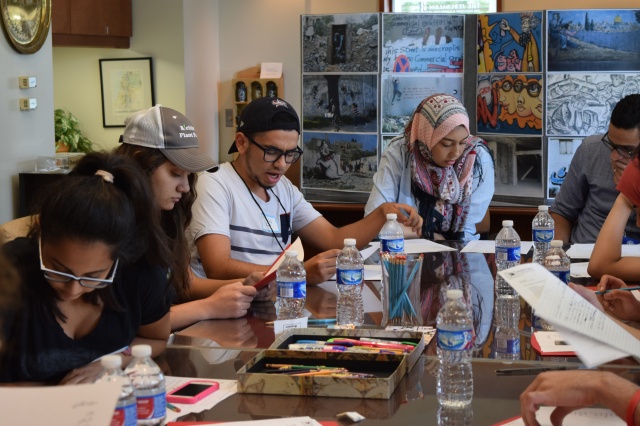
On Friday, 19 June, Executive Director Zeina Azzam and Gallery Al-Quds Curator Dagmar Painter organized a three-hour session with ten high school students from Gaza who had spent the academic year in the United States. They were participating in the State Department-funded Youth Exchange and Study (YES) program, living with host families in different cities throughout the U.S. and studying in local high schools.
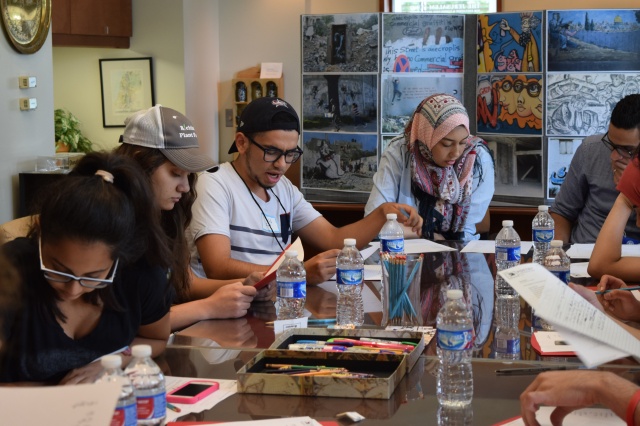
Painter gave them a tour of the exhibition “Creative Dissent,” currently on show at the Gallery, and introduced them to the art of graffiti. She said to the group, “You don’t have to be an artist to make graffiti; you just have to have something to say.” Painter encouraged the students to produce some graffiti works to add to the Galley’s exhibition, and several completed pieces that are now hanging in the current exhibition space.
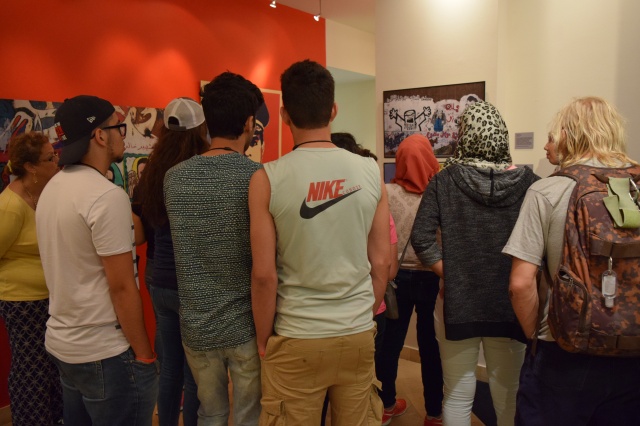
As the students toured the Creative Dissent show, they commented on the power of the wall paintings and photographs that young people in Egypt, Libya, Syria and Tunisia created during the first days of the Arab Spring. They were especially interested in the videos of the songs, chants and puppet shows created during that time, and the role that social media can play in disseminating dissent. Painter concluded with a short talk on the history of graffiti on the walls in Gaza, from the calligraphy schools held in the early days of Hamas rule, to the latest Banksy incursions. They viewed graffiti on the gallery walls created by interns and other young visitors, and thus encouraged, produced some expressive works of their own.
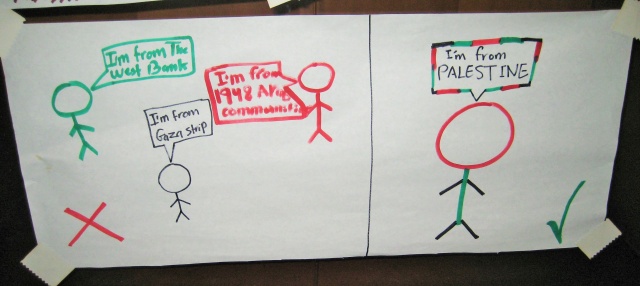
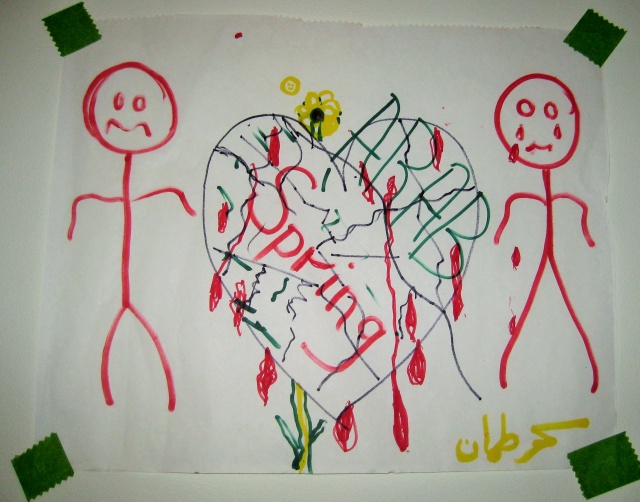
Azzam conducted a session on poetry with the group, focusing on American poet Langston Hughes and several Palestinian and other poets. The group also wrote poems based on the session and shared them with each other. One of the exercises was to write a poem with a similar structure as Langston Hughes’s “Harlem” (see http://www.poetryfoundation.org/poem/175884) –that is, starting and ending with a question, and exploring possible answers within the poems itself. Below are some of the poems they wrote. Note that the students were given about ten minutes to write these poems, so they had no time to revise or work further on them. We are quite impressed with their profound ideas and writing, despite the short time frames.
1
What if there wasn’t hate in this world?
Would it still be so hard to live?
Or would you peacefully go and stand up
for yourself?
Would you be still complaining
about how the world is so unfair,
or would you actually go and make a change?
Maybe it’s so easy not to hate.
But not many people are willing to participate.
Will you be strong enough
to be the change?
–Tala
2
What happens to my patience when I’m forced to wait?
Does it hope death for me
like my body does:
Or does it cry silently
till it gets out of breath?
Does it commit suicide,
or tries to stop me from doing the same?
Maybe it loves me and wishes me the best.
Or it’s not just something to think about
because aren’t we both just one?
–Yahya
3
When do we fade away?
Is it when we give up
Like a coward in a battlefield?
Or is it when we lose faith
And act like Judas and his traits?
Is it when we talk
But act as adolescents?
Maybe we always just fade away,
Even if you are a martyr or a stinking corpse.
Maybe!
–anonymous
4
What happens when a flower dies?
Does it ever hear the music of a singing bird?
Or does it sway in the morning sky?
–anonymous
Many said that they were deeply transformed by their experiences in the United States. To that end, Azzam gave the students another exercise: to write a poem similar to Shel Silverstein’s “What a Day” (see http://www.qu-i-x.com/aday.html), except to title it, “What a Year.” Here is a sampling of the poems they produced:
5
What a year,
Oh what a year!
My heart at first was so afraid.
It wasn’t until now I realized a dream was just made.
And from one splits two the family
Home as well side by side.
Friends, experience with tremendous amount
We used to say: 1, 2, 3, don’t stop the count!
I am 17 years old.
Now I am going home.
Oh what a year!
–Mohammed
6
What a year,
Oh what a year!
Like waking up from a dream.
All the memories just fade away,
and now life is from where it stopped last year.
Oh it is gonna be the same?
Or it’s just the fear of yesterday.
I’m 16 years old
and I’ve felt my heart
for the first time in my life.
I’ve seen it grow!
Oh what a year!
–Marah
7
What a year,
Oh what a year!
My life transformed from sky to another sky.
My heart doesn’t know if it will again fly.
And now my life will not be the same again.
I’m 16 years old
And feeling trapped between my own sky and their sky.
Oh what a year!
–Dalia
8
What a year
Oh what a year!
My ignorance ran away from me.
My new thoughts kicked out the old.
And now my world will not be all black.
I’m 16 years old
and feeling proud.
Oh what a year!
–Tala
9
What a year
Oh what a year!
My small innocent mind ran away.
And now my thoughts will not be the same.
I’m only 17 years old
but it seems like that’s very old.
Oh what a year!
–Reema
10
What a year
Oh what a year!
I got myself out of that dark box.
I knew myself better.
And now my dreams will no longer wait.
I’m 17 years old
and shaping my life just the way I want.
Oh what a year!
–Yahya
11
What a year,
Oh what a year!
My hatred left my heart.
My heart full of light.
And now my mind will not be deceived.
I’m 17 years old
and feeling proud.
Oh what a year!
–Iyad
The group seemed to enjoy these exercises as they spent some time in Washington, DC, before returning to their homes in Gaza. The YES program’s aim was to give them a few days of transition time to reflect on their academic year and prepare them to “re-enter” their country of origin. This session at The Jerusalem Fund allowed these students to bond with each other and to approach their experiences from an expressive and creative angle.
