
Exhibition
20 May – 24 June 2011
For millennia, artists have used their talents to express thoughts and emotions deeply personal, as well as reflecting their reactions to the world around them. In light of this, The Jerusalem Fund Gallery invited artists from around the U.S. and Canada, including Rajie Cook, Mona El-Bayoumi, Najat El-Khairy, Elena Farsakh, Adib Fattal, John Halaka, Michael Keating, Ellen O’Grady, Ammar Qusaibaty, Mary Tuma and Helen Zughaib to create a work of art reflecting their perceptions of the separation wall in Palestine. Interpreted in painting, sculpture, video, photography, porcelain and other media, each artist’s work speaks in a unique voice to this issue.
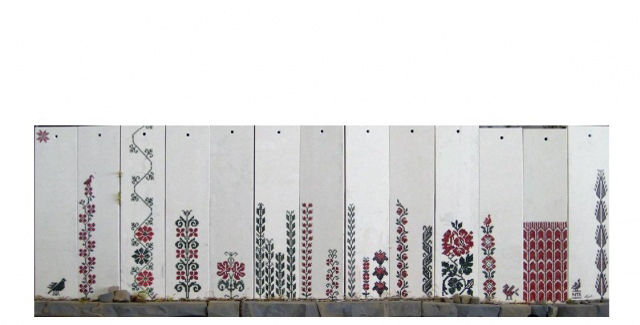
About her piece, porcelain artist Najat El-Khairy states, “The depiction of the Palestinian soul, returning to engrave its identity on the wall, attests that the wall itself was built on Palestinian land. No matter how high, no matter how imposing, this wall will be unable, indeed incapable, to prevent Palestine’s growth. Her flowers rise onto the wall, empowering it with cross-stitched Palestinian designs that graced her beautiful, traditional village dresses for centuries.”
Helen Zughaib creates a wall of beauty, composed of 20 individual 6”x6” canvases, both abstracting and memorializing those most vital signifiers of Palestinian villages now isolated or lost, their unique embroidery patterns.
Mona El-Bayoumi’s painting embodies her thoughts, “For years we have seen how the wall has been used as a canvas for the Palestinian Artist. Art has always superseded history and given us a glimpse of what can be. Daring to dream is the first step to achieving. And like many artists around the world, I dare to dream a more just world, a more just America, a more just Arab world, and a free Palestine with walls of art on the walls that don’t separate and humiliate.”
San Diego artist John Halaka says of his painting Apartheid Mind / Divided Heart, “I view this diptych as a double portrait of the hearts and minds of the occupied and their occupiers…To breach the apartheid wall, we must heal the divided hearts of the people with forgiveness.”
Rajie Cook has given us one of his most dramatic constructions, measuring four feet across, symbolizing the wall, settlements and a village surrounded, yet, with the image of an infant, breaching the wall. Also exhibited (above), a film titled Tear Down This Wall by Rajie Cook and Thomas Francisco.
Mary Tuma’s Twisted Rope was made from old scraps of traditional Palestinian dresses, kaffiyas, and other fabrics found on both sides of the wall. These scraps were twisted into sections and interlinked to form a rope measuring 60 feet, the length that would allow one person on each side of the wall to climb simultaneously and meet at the top. Rope is meant to reflect the desperation of those living near the wall to be with family and friends on the other side or to simply climb to the top to view the horizon, their once-familiar landscape, now cut from view.
Ammar Qusaibaty’s abstract Weaving Threads uses color, Palestinian black and white, Israeli blue and white, separated by a red barrier, the duality of blood and fear.
Michael Keating’s photograph, Abu Dis—The Wall at Dusk is a haunting image of the size and isolation the wall engenders, while Adib Fattal’s depiction of the wall see artists using their brushes to bring it down with messages of peace.
Ellen O’Grady’s Bethlehem Wall depicts in watercolor the wall cutting through the landscape and the men waiting at the checkpoint to go to Jerusalem for work. Elena Farsak’s photographic installation of Checkpoint creates a wall of 50 images the size of bricks, with the message of restriction illustrated.
Foreign Policy in Focus wrote up a review of the current exhibition here.
The Washington City Paper published an article profiling artist Helen Zughaib and the “Breaching the Wall” exhibit at the Jerusalem Fund Gallery. You can read the article by clicking here.
