
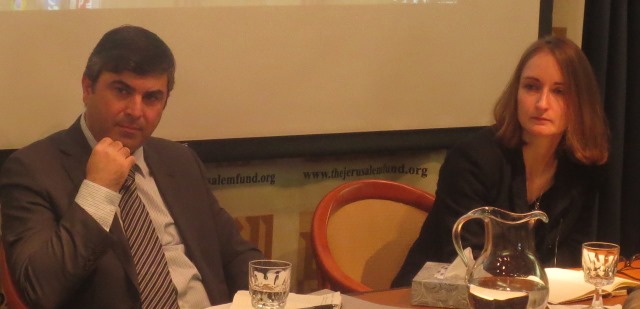
Nidal Sliman and Valentina Azarov
Transcript No. 401 (4 March 2014)
“Activating Palestine’s UNESCO Membership”
with
Nidal Sliman
Al-Shabaka Policy Member
with
Valentina Azarov
Al-Shabaka Policy Member
Yousef Munayyer: Getting to our event today, as you know, Israelis and Palestinians are in the midst of negotiations being mediated by Washington and the nine month timeline for negotiations comes to a close at the end of April, April 29th. The Palestinians have stated clearly that if there is no progress in the negotiations by the end of that timeline they will continue with what has been called the alternative strategy, a strategy of seeking statehood through the involvement with international institutions and courts. So, this is a very timely event given those circumstances and as we know one of those international institutions to which Palestine was welcomed as a state party in recent years was UNESCO. So the topic of our conversation today is activating Palestine’s UNESCO membership and we are very happy to have Nidal Sliman and Valentina Azarov with us here to talk about that. They wrote a fantastic paper on this topic. Nidal has more than fifteen years of experience in international law, human rights and international development. He’s worked as a legal advisor at the negotiations support unit which is a part of the PLO’s side of the negotiations and he’s advised UNESCO and the Palestinian authority on legislative reforms to protect Palestinian cultural heritage. Valentina was the program head of the human rights and international law program at Al-Quds Bard College, Al-Quds University in Palestine, where she is currently a lecturer on leave. So, I will turn it over to them at this point for the presentation. Thank you.
Nidal Sliman: Thank you, Yousef. It’s important to be here and especially at the Palestine Center to talk about such an important topic, which is how would Palestine activates its membership in UNESCO. I would like to thank the Palestine Center for hosting me and my colleague, Valentina. I also would like to thank Al-Shabaka Palestinian Policy Network for facilitating this event.
About two and a half years ago, Palestine gained full membership in UNESCO. This new status was due in part to pressure from Israel and the United States. The UNESCO precedent is significant in the quest to fulfill Palestinian human rights and to apply relevant international law instruments to the case of Palestine. UNESCO membership is far more important than winning another vote at an international organization because it provides Palestine with significant practical advantages including reasserting its sovereignty over its land and sea and obliging states to hold Israel accountable to its obligations.
I will start by providing a quick overview of UNESCO and the conventions that Palestine has ratified. I will also introduce two of the main conventions that were ratified by Palestine, namely the 1954 Convention for the Protection of Cultural Property During Armed Conflict and the 1972 Convention for the Protection of the World Cultural and Natural Heritage. My colleague Valentina will give more examples of how to operationalize the UNESCO membership after I finish my presentation.
This is the outline of the presentation. I will start by discussing why UNESCO is important and then I will go to the obligations of the 1954 Convention and the 1972 Convention as well and I will talk a little bit about the limited gains that Palestine has achieved by the urgency of dealing with the situation. It’s important to recognize that UNESCO was a very important precedent. UNESCO is the first UN body that admitted Palestine as a non-member state so it wasn’t really a full membership of the United Nations. This precedent will enable Palestine to join other international organizations and will open the door for its eligibility to ratify a list of international treaties to which the UN Secretary General is a depository. Equally important is the standing that this membership will afford Palestine in dealing with other third party states and international actors to demand Israeli compliance with its international obligations. It is also important to note that almost immediately after Palestine was admitted, Israel announced the construction of almost 2,000 settlement homes, although we all know it doesn’t need an excuse to grab more Palestinian lands. The U.S. also suspended its financial contribution to UNESCO citing domestic legislation that is in contravention of its international binding legal obligations. It shall also be noted that UNESCO has always been an important forum for upholding international law in relation to Israeli unlawful practices, including in Jerusalem. We all remember what happened in 2010 when Israel attempted to include some of the cultural heritage sites located within the West Bank on its national list and UNESCO in 2010 condemned that and described it as a violation of international law at UNESCO conventions and also UN resolutions.
In addition to agreeing to the UNESCO constitution, which every member that joins the organization must agree to, Palestine has ratified eight conventions and protocols since it joined the organization in 2011. All these instruments are legally binding of Palestine as well as the 195 members of the organization. They include the 1954 Convention, which is especially important in the context of Palestine because it’s under occupation, as well as the 1970 Convention on the Means of Prohibiting and Preventing Illicit Import, Export and Transfer of Ownership of Cultural Property, the 1972 Convention on the Protection of the World Cultural and Natural Heritage as well as the 2001 Convention on the Protection of Underwater Cultural Heritage. By the way, we all remember that a few weeks ago, a fisherman in Gaza discovered a very important piece which right now we don’t know where it is located but this only provides an example of why it also important to protect underwater cultural heritage. There’s also the 2003 Convention for the Safeguarding of Intangible Cultural Heritage and the 2005 Convention on the Protection and Promotion of the Diversity of Cultural Expressions.
I will now introduce quickly one of the conventions important to the Palestinian situation which is the 1954 Convention for the Protection of Cultural Property in the Event of Armed Conflict, which by the way complements previous important international treaties that protect cultural property during armed conflict. In its PM bill the convention emphasizes that damage to cultural property belonging to any people whatsoever means damage to the cultural heritage of all mankind. It includes a broad definition of what constitutes cultural property, “movable and immovable property of great importance to the heritage of every people, archaeological sites, other objects, buildings,” and quarters of old cities like in the case of Jerusalem. The convention of courts prohibits theft, pillage or misappropriations of, and any acts of vandalism directed against cultural property. It doesn’t permit any occupier to appropriate or export cultural property outside the occupied territory of course and it limits the role of the occupier to supporting the competent international authorities of the occupied country in safeguarding and preserving its cultural property. It should also be noted that illicit or illegal trade in cultural property originating from an occupied territory is also prohibited by the 1970 Convention.
Another important convention I think in the context of Palestine is also the 1972 World Cultural and National Heritage Convention, which describes the deterioration or disappearance of any item of the cultural or national heritage as constituting a harmful impoverishment of the heritage of all nations of the world. Therefore the convention was concluded to establish an effective system of collective protection of the cultural and natural heritage of outstanding universal value organized on a permanent basis in accordance with modern scientific methods. State partners according to the convention are also obliged to identify and delineate cultural property in their territories and recognizes the primarily responsibility of each state to ensure identification, protection, conservation, presentation, and transmission to future generations of cultural and natural heritage. It should also be noted that the convention established UNESCO Committee for the Protection of World Cultural and Natural Heritage which in 1981 and 1982 inscribed the Old City of Jerusalem and its walls on the list of World Heritage in Danger and also on the list of World Heritage. It’s very important in the context of Palestine.
I want to discuss briefly here the limited gains despite the urgency of activating the membership of UNESCO. Utilization of UNESCO is still lacking despite the continuous appropriation and destruction of Palestinian cultural heritage. Since 1967, Israel has damaged and destroyed historical, cultural, religious and natural sites. Immediately after the occupation, the Israeli authorities for example razed the Moroccan quarter in the Old City of Jerusalem and seized historical and religious buildings such as the Palestine Archaeological Museum, which is now known as the Rockefeller Museum. An equally shocking example was the Simon Wiesenthal Center’s construction of the Museum of Tolerance in Jerusalem, which until excavation of ancient Mamilla Cemetery in Jerusalem. Israel is also continuing with its plans to complete constructions of the Wall. We know that the International Court of Justice announced that plan to be illegal. However, some of the plans include completion of the construction of that wall in the vicinity of the village of Battir, threatening to destroy the natural landscape and historical terraces that are proposed for inclusion of the World Cultural and Natural Heritage list. Palestinian and Israeli sources estimate that between 1967 and 1992, about 200,000 artifacts were removed annually. And another 120,000 were removed each year since 1995, which is a huge amount of artifacts. Despite the urgency to take prompt actions, Palestine has only made a few but tangible and concrete gains. It listed the first World Heritage Site, the Church of the Nativity in Bethlehem in 2012 on the World List. However, twelve more sites remain on the tentative list.
Despite all the facts that I described, it should be noted that Palestine’s right to reparations is enshrined in international law. UNESCO and other international organizations have repeatedly condemned unlawful practices under Israel’s occupation. States are responsible for their international wrongful acts and must make full reparations for the injury caused by the acts. The aim of the reparations must, as far as possible, wipe out all the consequences of the illegal act and reestablish the situation which would have existed if the act had not been committed. Reparations include restitution, compensation, and satisfaction. It is also important for the Palestinians to raise the issue of reparations during the negotiations for all of Israel’s wrongful acts. It’s important to note that experiences all over the world show that without reparations no real reconciliation can happen between the two peoples. It’s important that Palestine did join UNESCO and did ratify its conventions. But statehood status and accession to international treaties can afford protection for rights but they also entail obligations on the part of the state party.
Thus Palestine is required to modify its national legal system and relevant institutions in accordance with its obligations under the UNESCO Constitutions and the eight conventions it has ratified. There are at least two draft laws that are currently in place, and the idea behind the draft legislation is to modify what is currently enforced in the OPT, which as we know, the legal system in the West Bank and Gaza in Palestine is composed of Ottoman, British Mandatory and Jordanian law in the West Bank, Egyptian law in the Gaza Strip, and Palestinian Authority Laws and Israeli military orders, which don’t adequately protect Palestinian cultural heritage. The laws are fragmented, subject to Israel’s whim and do not really meet international standards. The role and mandates of the bodies officially responsible for protecting cultural heritage aren’t really well defined. Therefore, it is important for the Palestinian Authority to pass the necessary legislation in line with international standards. The draft laws could, if enacted, significantly enhance Palestine’s national legal framework, deter domestic violations, and further Palestine’s standing in third countries and international institutions to contest, prevent, and take measures against unlawful Israeli conduct.
We have a few recommendations and conclusions. UNESCO offers a framework of control, protection, and cooperation with other states to protect cultural heritage. UNESCO as a precedent opens doors for accession to international treaties and Palestine should demonstrate its good faith acceptance of its obligations by bringing its domestic laws and institutions into compliance. Adequate legal protection of cultural heritage on the national level will support Palestine’s efforts to reclaim possession of lost cultural properties. Local and international civil society organizations we believe should play a more active role in calling upon all parties to uphold international law. The issue of protecting cultural heritage must be separated from the politics of the peace process. I’ll leave it right here and I’ll open the floor to my colleague Valentina to talk more about operationalization of UNESCO.
Valentina Azarov: Thank you again to Yousef Munayyer and everyone for coming. So my particular task, I hope to be successful in, is to look at how some of these obligations in international law, which is often subject to political discretion and political whims that are not in our favor, can be operationalized nevertheless by looking at third state responsibility in particular and I’ll unpack the concept of third state responsibility because I imagine not all of you are lawyers.
I’ll try to do two things. One: start by looking at essentially how certain UNESCO laws can be utilized to promote Palestinian heritage protection, by again asking the question of how to make international law work, and how to use, in particular, third state responsibility to bring about compliance not only by third states, be it a European country or North American country, mostly a law abiding country, and I’ll get back to that, but also by Israel in this particular case. And Israel clearly is violating systematically many of its international obligations including obligations under the instruments that Nidal just discussed, which of course overlap with many other human rights and international humanitarian law obligations. And secondly I’ll try to provide actual concrete examples of where UNESCO law operates within the legal order of specific states and where we can, as civil society, use those internal obligations to bring about both protection for specific elements of Palestinian cultural heritage, as well as general compelling action by these third states vis–à–vis Israel and its illegal territorial regime in the West Bank and Gaza.
So to start with a few prefatory comments about the value of international law, which it seems is often overlooked to some extent. This will be quite straightforward; international law is useful in terms of a universal standard. Most often we use it in order to document violation, expose state behavior for not complying with those standards and use it to raise the public’s awareness and to name and shame those states and whoever is complicit or involved in their wrongdoing.
But that doesn’t usually lead to enforcement or compliance. So how would enforcement or compliance potentially be brought about? Well first recognizing in this that international law is not real law. It’s not the domestic law, it’s not a traffic offense or a criminal offense. There’s no enforcement body there’s no centralized authority that either determines what a violation is, let alone sanction those who commit them. So the question is how to overcome the political discretion which goes hand in hand with international law compliance and enforcement. And here’s where this political discretion is also common in international organizations and we’re talking about here UNESCO as the organization which first and foremost entrusted with the enforcement and monitoring of compliance with the instruments that Nidal listed.
So the question that I just phrased has actually been looked into quite carefully over many years by the Mattin Group that I work with also at the moment, being on leave from the university. Some of you may be familiar with Charles Chammas. For a number of decades he’s been working on EU-Israel relations front and the guidelines that came out in 2013, excluding Israeli entities that based or operating in settlements from any R&D funding from the EU as one of the measures that is based on this doctrinal conceptual understanding of international law and how it operates. So namely, this concept of third state responsibility in international law means a very simple thing. It means that any state cannot recognize, aid or assist the wrong doing of another state. But that obligation, as many obligations in international law, is very vague and unspecific and again discretionary and subject to political will.
But the basis for operationalizing that obligation in a vigorous way is found in many cases in the domestic or internal order of those third states. In other words, international law has been incorporated into many third states, again law abiding states in particular, The European Union and its member states, as an important case and point. And those obligations, which include the general obligation to respect international law in the exercise of the European Union’s powers, but also obligations within specific areas of internal law, not to recognize certain unlawful conduct. I’ll come back to that principle when we look at specific examples. Those obligations are enforceable because they’re domestic and they’re enforced within the system of the specific state or international actor and the basis for their enforcement, as opposed to international law being political, is the necessity for that state actor to ensure the integrity of their rule of law and to ensure certainty of their ability to apply certain law. Again it’s bringing international law to the level of the traffic offense or the murder or whatever other civil wrong.
So the EU guidelines again are a perfect example of this because essentially what the European Union did is it realized that there was an oversight in the way that EU-Israel cooperation in research and development was structured. In other words, there was no provision in EU law and that agreement or in the relative financial instrument for this research and development program, 1.6 billion euros, to exclude entities that were operating or established in Occupied Territory under Israeli law. Because in Israel it defines Israel as one thing and the EU and the rest of the world for that matter defines it as another thing. But there was a very serious oversight in that agreement. It allowed Israel that leeway to define entities established under Israeli law according to its understanding. And therefore for some years the EU ended up funding entities in settlements. I guess we can come back to that in the discussion.
How does this translate into UNESCO law framework? There are two ways, again the general enforcement level concerning sovereignty rights and general non-recognition of Israel’s illegal territorial regime. And there’s the specific which means protecting specific cultural property and bringing about accountability for Israeli wrongdoing. I’ll give my three examples according to those two categories from the general to the specific, looking first at the example of UNESCO as a normative actor, so upholding certain international standards that translate into commitments in the third state’s domestic legal order, and I’ll get into the details about that. Two, triggering enforcement by third states looking specifically at the illicit transfer and restitution of artifacts under the convention that Nidal mentioned. So this would concern primarily museums and tour operators, and I’ll get into that. And thirdly the individual criminal responsibility aspect, which we’re all familiar with but which we also know is subject to a lot of political discretion on the European front for some years now where states had even changed their legislation as a result. The reason for that goes back to initial comments about when it’s international law, then there’s always discretion, even when the international law is part of domestic law. The universal jurisdiction law to prosecute war criminals from any state is still international law. It’s still discretionary even though it is part of the UK’s, Spain’s or Belgium’s laws.
The first example is basically the fact that UNESCO, as Nidal mentioned, is a lawmaking body to some extent. It makes the normative determinations with regards to which state or non-state actor violates its law. And it has a very rich body of law. The conventions that were listed here are a fraction of the actual richness. In the resolutions, in the listings on the World Heritage List, in the potential for suspending aid to certain states, there are certain normative actions that the organization can take. They are important on the international level, when they happen they are obviously welcomed. But they also translate into understandings by the states that vote that engage in these normative processes. The states that make those assertions that contribute to their determinations are also committed internally in their legal order not to recognize, again under third state responsibility and to refuse commentary in Israel to the extent that Israeli law and Israeli institutional practices are the result of those unlawful acts that were condemned. What does that mean in practice? While it means that any structured or ad-hoc engagement or exchange in the cultural, social, educational, scientific domains between specific states or between international organizations in Israel would be subject to that standard as well or do that determination. In other words, if Israel is not complying with certain legal obligations, those states cannot allow that engagement to be based, be implemented on the basis of those unlawful practices, on the basis of unlawful Israeli laws, be it the fact that the Israel Antiquities Authority or national parks or tour operators, which we’ll get to, are operating in occupied territory as if it is part of Israel. Those are specific elements of the general, illegal regime.
It also entails certain consequences for Israel’s good standing in those international organizations. That’s a more arduous process of getting that activated but there are very good stakes there. And of course the reassertion of sovereignty, especially in the case of Gaza where up to 24 nautical miles could be obtained as territorial waters, could have certain potential. Again the definition of territorial water, Nidal could probably say more about that, and the processes that were and are being taken UNESCO but it has its own political limitations as well. Second example, going from the more general fluffy stuff to some specifics, is my favorite one. The museums and tour operators: essentially, this is where third states can really get themselves into trouble, by allowing artifacts to enter and freely circulate on their market. The museums, art dealers, auction houses, private individuals, whoever it is. Because that concerns certain legislation that most states have, that certainly all European countries have, that pertain to the legality certain property was attained in another country.
It doesn’t matter what the property is but if it has importance on the international level, it matters even more. Essentially what I’m listing out here is the process by which the relevant national authority in a specific country, say the UK, it’s relevant criminal law enforcement authority would be addressed by Palestinians in the society or individuals, whoever it is, with the documentation that would show that either Israeli museums or art dealers who are transferring artifacts to the UK, have potentially, this is where we raise suspicion rather than conclusively determine something, obtained those artifacts from occupied territory. Why, because there is a rapid practice, systematic practice of unlawful transfer because a lot of these artifacts are held by private individuals in Israel and have been circulating beyond Israel by private individuals and because generally, if a museum in the UK says, “We got this from Israel, Israeli authorities confirmed this came from Israel.” The way Israel defines itself is very different than the way the UK or the EU would define Israel. If Israel says it’s Israel doesn’t mean it’s Israel. There’s a very serious suspicion there to be raised in particular countries that have established relations and auction houses and museums, whether Israeli museums or any other dealer. Here there’s quite a bit of fact finding that needs to be done.
If that suspicion is raised, at a best case scenario the national authority in the UK would have to clear any dealer or museum who brings in anything from Israel. Why? Because suspicion is up and it needs to be reversed to make sure that it is not an artifact, out of the millions, that have been pillaged. Of course, in parallel to that, there is UNESCO’s restitution committee, but again there things are slightly more political and there are stories to be told about how successful or not these processes have been. The tour operator example is based on the fact that Israeli tour operators and tourist sights are based in the West Bank. Again, existing there and registered and administered by Israeli laws as if they were inside Israel. Many tour agencies, at least to my knowledge in the EU, are advertising their itineraries to include the West Bank as if they’re still in Israel. Hebron, Jericho, all these destinations are misrepresented and that’s an issue of concern in protection law. In fact the European Union has harmonized the law that protects consumers from deceptively being misrepresented in the destination of the itinerary. The package holiday must have a clearly stated destination. So there is actually this pretty incredible project that is looking at 120 different operators across seven different EU countries and the inconsistencies are incredible, the maps are incredible, the itineraries are completely overlooked. Those are the kind of interventions where international law can actually be enforced effectively from within.
I will quickly mention the individual criminal accountability bit, which Nidal alluded to in two instruments that Palestine is now a state party to those references to individual criminal responsibility. It’s basically like war crimes in the Geneva Conventions: very similar but specific to cultural heritage protection for excavation, destruction, and removal of artifacts. Any individual, political or military officials involved in that, or even private individuals be it the Israeli Antiquity Authority bringing in, and this is a very interesting area to look at fact wise. Who is the Israeli Antiquity Authority, what universities other private actors from around the world are coming to dig with them? Because I’ve seen these brochures, “Come and dig with us in this and this place.” And that would entail to a certain extent potential complicity, at least. Of course, the prosecutions as we know have not been very successful, I did this I’ve worked with Al Haq for two years, and the results were not favorable and of course some have blamed the Palestinian civil society involved in those efforts for having caused the law to be changed in at least three jurisdictions in the EU. So now the political forces are now even more involved in opening these war crimes investigations.
But the question of prosecution is not the only one when it comes to individual criminal accountability and this came up in settler violence discussions. The other avenue, which has yet to be explored fully, is an issue in good standing but here it’s individual good standing. And that good standing, when it comes to involvement in war crimes, is translated into travel restrictions. So here we’re not talking about just trial but also risk aversive measures that European countries and potentially the EU general level could take vis–à–vis certain individuals by essentially blacklisting them or restricting their travel. It’s a pretty standard thing that states do, when you enter the country you have to check a box to say, “I haven’t been involved in any terrorist activity, I haven’t been involved in any international criminal law violations.” And of course the good staff officer for archeology should be at the top of that list.
I think I’m going to repeat some of the things that Nidal said here very quickly. I think the first two points in terms of take away from what I said are my highlights. One, that you need to look at the normative regularity order of the state or non-state actor international organizations. In particular they were trying to comply with international law because it’s their order and their commitments, their voluntary commitments, which are the basis for enforcement for their necessity to comply. And so, having civil society for many years, saying, “This must be done because it’s the law,” or “This state should comply with the law, this state should stop selling arms,” while those are potential objectives but the way to reach them would be to invoke international law as the sole basis of the obligation and actually look for the basis of the obligation in international law. And I think the museums and tour operator example really brings that to life. Of course, the value of the technical approach, which is part of the same thing, the way not to politicize the approach is to show that it is part of the approach to the rule of law.
Just to reiterate, we do need a more coherent and comprehensive approach to international law and engagement to international strategy. The other thing that I think of, that I was saying in between over and over, is the capacity we need for fact finding on the issue. And the way we need to be smart about it is if we get the UK criminal law authority to be suspicious of any artifacts coming from Israel generally, anyone dealing with those artifacts or exhibiting them. We can also get them for the purpose certainty and lack of risk enforcing UK law to demand a pretty standard procedure to demand that Israel cooperate through law enforcement and provide the UK or any other country with information about the artifacts. That information, no one has. In my discussions with the ministry of antiquity, there is no per se registry for Palestine cultural heritage that has been illicitly transferred. That information can be gained through the third state approach. I think I’ll end there.
Valentina Azarov was the program head of the Human Rights and International Law Program at the Al-Quds Bard College, Al-Quds University, Palestine, where she is currently a lecturer on leave. She formerly worked as a legal researcher with Al-Haq, whom she continues to advise, and with HaMoked – Center for the Defence of the Individual. She obtained an LLB in European Legal Studies (Honours) from the University of Westminster in London, and a Certificate of Transnational Law from the University of Geneva. She is currently working on a PhD at the Irish Centre for Human Rights, National University of Ireland Galway, and is an associate with Mattin Group, a human rights-based consultancy in Ramallah.
