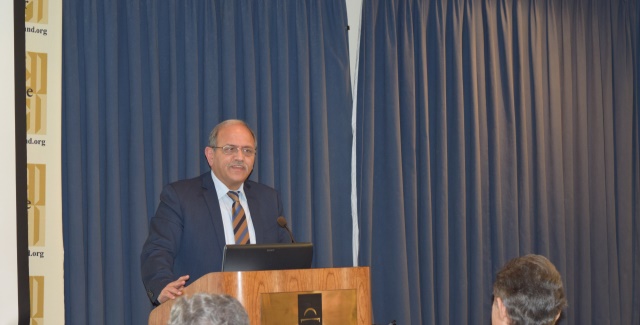
Video and Edited Transcript Hani Al-Masri Transcript No. 426 (12 March 2015)
Dr. Subhi Ali: We are privileged today to have a speaker from Palestine, probably one of the most prominent independent thinkers that we have currently. I emphasize the word “independent”. It does not represent any faction among the Palestinians, whether the [Palestinian] Authority or other divisions, and I personally have had probably (I’ve been here fifty-four plus years), I really have enjoyed his writings as refreshing, independent, and enlightening. I believe that you will probably agree with me at the end of the presentation today.
Dr. Hani Al-Masri is a policy advisor at Al-Shabaka Palestinian Policy Network, with which some of you are familiar, and Director General of Masarat, which, in Arabic, translates to “pathways”, which is a Palestinian center for policy research and strategic studies. He founded and was Director General of the Palestinian Media Research and Studies Center, Bada’el, between 2005 and 2011. He has published hundreds of articles, research and policy papers in Palestinian and Arab magazines and newspapers including, Al-Ayyam and Al-Safir. He previously served as General Manager of the Printing & Publication Department at the Ministry of Information and as a member of the Committee on Government in the Commission of Dialogue held in Cairo in 2009. He is also a member of the board of trustees at the Yasser Arafat Foundation.
Today, Dr. Al-Masri will discuss the dangers and threats facing the Palestinian issue – and God knows there are quite a few – as well as what opportunities and strategic alternatives there are to the present situation. His examination will provide an in-depth analysis of future options and what needs to be done towards long-term growth and prosperity for the Palestinian people. Please join me in welcoming Hani to talk to us today. He will present, and then later we will take some questions and provide, hopefully, some answers. It’s an interesting audience here today as well as, of course, our online audience. We will take some questions from the online audience if provided. Dr Al-Masri.
Hani Al-Masri: Thank you, Dr. Ali. Thank you for the invitation, thank you for the audience, thank you for this opportunity for me. It is a very interesting opportunity, especially to speak with you here in Washington about a very important issue.
I will be talking today about the Palestinian issue, threats challenges, and how can we transform them into opportunity? The Palestinian cause has reached a critical point. The so-called “peace process” has reached a dead end and it transformed into a process without peace. It is used by Israel as a cover-up for creating settlements, occupation and the racist realities on the ground that makes the Israeli-proposed solution the only visible and doable option. We have conducted similar workshops in Ramallah, Nablus, Hebron, Beirut, London, Nazareth, Amman, Jerusalem, New York, and here, in Washington in order to explore thoughts, suggestions and opinions from a large number of Palestinians and audiences about the Palestinian issue and how we face our challenges and our dangers. This is very important because now the Palestinian issue is at a critical point, as I had mentioned before. So what are the challenges facing the Palestinians?
The first challenge is the challenge of Zionist colonial settlers and apartheid occupation. The challenge pertains to being a colonial regime whose expansionist nature doesn’t accept compromises or propose solutions. This regime was established based on accruing the largest possible area of land and expelling the largest number of indigenous population and would not recognize any of the legitimate rights of Palestinians: neither the right of self-determination nor the right of return, or even the right to equality in one state, or the right to establish a Palestinian state on 1967 borders. The recognition of a Palestinian state by some Israeli figures, politicians and political parties comes with restrictions on a scale of Israeli interests. The state of Israel wants Palestine with no sovereignty, no Jerusalem, no control over its borders or airspace, no control of its natural resources: a state established based on a final status that denies the right of return and announces the end of conflict, which will revoke any possible demands, in the return of Palestinian recognition; not for Israel as an existing entity but a recognition of a state for Jewish people. Any concession that gives up the Palestinian historical narrative and recognizes the Israeli Zionist narrative will make the Palestinians a minority in their own homeland subject to Israeli consent and approval which can be provoked and declined at any point when and if the right conditions prevail.
From a historical point of view, the reasons that prevented the expelling of the rest of the Palestinians in 1948 onward, was the lack of “convenient political position of the international front.” If that is achieved or reached, Israel will not hesitate past the blink of an eye to expel the remaining Palestinians because they view Israel as the national home of the Jewish people and the God-promised holy land and [they] believe they have to protect the purity of their state. Protection from the demographic threat, which Israelis keep calling the “demographic bomb” that might explode in the future if the Palestinians inside Israel keep giving birth and get equal rights, which would make Israeli Jews a minority and Palestinian Arabs a majority in only a few years.
What pertains of this challenge are the many dangers threatening Palestinian culture, identity, and historical narrative that might jeopardize the Palestinian present and our future. The second challenge is split between the Palestinians: it is an internal challenge, but it is important to say this happened because there is no one leadership for the Palestinians, no one institution which unites the Palestinians, no one charter that has support from the Palestinians, no one political program which has support from the Palestinians, because of that we face a split – and it is a very dangerous split because we helped Shimon Peres (he is a well-known political leader of Israel). He [Peres] states the split is of equal importance to the state of Israel and the defeat of Arabs regarding the 1967 borders. The continuation of the split is a very important challenge and without solving this, we can’t work for a new direction. The third challenge is the effect of Arab transitional and regional variables on the Palestinian issue. It is well known that what happened in the so-called Arab Spring or Revolutions had very negative effects on the Palestinian issue because Arabs concentrate on their internal issues, and the whole world concentrates on Syria and Iraq – this makes the Palestinian issue “go back” [on the back burner]. So how can we face these challenges and transfer them to opportunities? It is very important to speak not only about the difficulties and dangers, but also how to deal with these challenges and how to change our situation.
I will present the summary of the third strategic report issued last year by the
Palestinian Strategy Group (PSG). This group includes a large number of Palestinian politicians and academics, with representation of the wide Palestinian political spectrum. This program started since 2007 and produced three strategic reports.
The third strategic report was issued by the Palestinian Center for Policy Research and Strategic studies, Masarat, the think tank I am privileged to be the Director General of, and the Oxford Research Group (ORG), the British organization headed by Gabrielle Rifkind, and Professor Oliver Ramsbotham, who heads their program on the Middle East.
This report was composed and drafted by the drafting committee composed of two other experts in addition to myself, Mr. Khalil Shaheen, my deputy and Director of Research and Policies at our institution and think tank, and Mr. Husam Zomlot, who serves as a Director at the International Affairs Committee of Fatah.
Bridging the gap in the focus of the gradual transition strategy proposed by the Palestinian Strategic Thinking Group in the third report to reach the turning point towards the alternative framework of the struggle.
In order to complete the requirements of the shift in the strategic course, the report proposes gradually reshaping the fundamental strategic direction within the medium range period, during which the requirements to reach the turning point are to be built by formulating a new strategy for the national liberation project.
My talk will be structured as follows, as I will attempt to answer three questions: Where do we stand now? Where do we want to go? How will we get there? Then after that, I will address the transformation strategy options and approaches to re-capture the initiative.
Available Scenarios
First, “national liberation through exercising the right of self-determination including achieving independence.” This scenario worked for a long time from signing the Oslo Accord until now. But we didn’t achieve anything. The occupation continued and settlements increased. Now there are more than 700,000 settlers in the West Bank and the Israeli government plans to increase this number to one million within three years – not ten or twenty. So this scenario did not work. Israel refused to accept the withdrawal from the West Bank to let the Palestinians establish their Palestinian state. Israel refused the right of return, so this scenario failed completely. I think if we continue with this scenario we will make not just a mistake, but a fatal mistake. We exercised this scenario and we faced a big failure.
The second scenario is “failure to achieve national liberation or to exercise the right of self-determination.” This scenario may evolve towards one of the following five scenarios, or may move from one to another, or be a combination of some of them: A) the continuation of the status quo; B) a final agreement that detracts from the Palestinian rights; C) a provisional Palestinian state; D) the collapse of the negotiations and a political and field confrontation; E) Israeli unilateral steps. All these scenarios were refused by the Palestinians because they don’t achieve or implement any minimum rights. Our right is to prevent these scenarios from being implemented. The Israelis do not want to solve the struggle, they want to manage the struggle. This has been a peace process without peace, without any achievement.
What is the alternative strategic option? Blocking the way to the first scenario, and the Palestinian rejection of the second scenario, place the Palestinians at a turning point, from the settlement framework that led them to the existing impasse between the accepted/impossible and the rejected/available, to an alternative framework that would redefine the objectives of the national project, and the means and mechanisms to accomplish them. In the separation space between the two frameworks, the Palestinian strategic thinking should focus on crystallizing a bridging strategy that enables the Palestinians, wherever they are, to continue their struggle for their historical and natural rights as long as there is no acceptable national solution. We must be ready for a shift, for a turning point. We can’t continue waiting forever to achieve a two-state solution. It is a waste of time. It is a waste of our rights. It is a waste of land. We need gradual steps toward a turning point. It is a blockage that opens the way, on the other hand, for a turning point towards restoring the alternative framework for the liberation struggle, by adopting a strategy that focuses on providing the requirements for a shift towards a new strategy for the national liberation project based on achieving the goal of liberation from, and dismantling of, the colonial settler occupation regime, and self-determination, without the settlement scenario that is based on the principle of partition and the idea of an independent Palestinian state.
This is the new strategic space that is opened by the fact of Israel aborting the possibility of realizing the first scenario which is based on the principle of partition (the “two-state solution”), and the Palestinians’ rejection of the second scenario in its forms ranging between maintaining the status quo, or incomplete sovereignty state, or a state within temporary borders, or Israeli unilateral steps. The strategy reflects the pre-defined plans to achieve a specific goal on the long term, in view of the available potentials or those that could be obtained. The strategy, in its simple concept, seeks to answer three questions: Where do we stand now? Where do we want to go? And how will we get there? The answer to these questions connects the starting point, which is the undesired status quo for the Palestinians on one hand, and the end-point which represents the desired status, on the other.
Within the context of connecting between the starting and the ending points, there emerges the importance of providing a set of requirements, options, and means of implementation that are capable of changing the status quo through a cumulative and gradual process within a transitional strategy path that belongs, in this case, to the change strategies mode, in terms of its focus, in many cases, on the reconstruction with respect to the objectives, options, requirements, and means of implementation.
Where do we stand now? The answer to the question: where do we stand now summarizes the characteristics of the status quo which involves problems and obstacles, and undesired scenarios, and also poses opportunities that help in opening up a track for change. It is very important to know the status quo can’t be continuous because Palestinian leadership can’t pursue the same strategy, the same policy, the same Oslo Accord because it limits legitimacy and loses supports from the Palestinians. Most Palestinians refuse the continuance of this situation.
Where do we stand now? Palestinians find themselves now stuck in the closed circle of the second scenario, which indicates depriving them of their right to national liberation and self-determination. Hence, they are facing a very serious situation since the failure of the negotiations, in view of the prices that will be paid regardless of future scenarios, while the scenario of highest cost will be stuck in the loop of bilateral negotiations. Under the cover of these negotiations for a “two-state solution,” Israel, with U.S. support, is actually negotiating under the roof of its preferred second scenario, for the purpose of using the bilateral negotiations as a cover for maintaining the status quo through an endless negotiation process as it has been doing for quarter of a century, and/or reaching an agreement regarding the second possibility: a temporary pseudo-state under ongoing Israeli control.
Where do we want to go? The answer is determined by reaching at the turning point which is represented in adopting the new strategy for the national liberation project. The report focuses on an interrelated set of options, requirements, and means of implementation that determine how to achieve the objective of this strategy from the point at which we are standing now; that is to say that the content of the report recognizes the current situation (status quo) and deals with it in order not to perpetuate it, but to change it. Therefore, these requirements and options belong to the strategies of change to achieve the goal of transition in the strategic path since the Palestinian options that have been followed since 1988 have failed in opening a new path towards the national liberation. Where do we want to go? (1) Following new ways to exhaust the opportunities available for the first scenario; (2) Foiling the second scenario with all its possibilities; (3) Opening the way for the alternative framework within the liberation struggle system.
How do we get there? The methodology of this report starts from dealing with the de facto situation in order to change it according to possible scenarios, even with a possible resumption of the bilateral negotiations, but on the basis of the conclusion that this option is unable to reach a negotiated settlement that guarantees the establishment of an independent Palestinian state on the entire territory occupied in June 4, 1967, and the refugees exercising their right of return to the homes from which they were expelled.
Transforming strategy options
First, stopping and termination of the option of the bilateral negotiations. Second, rebuilding the national unity – this is a priority. This is the most important factor, it is a necessity, not an option. Third, gradually exiting the “Oslo” path. Why do we say gradually? We can’t jump immediately in the status quo into the future. We suggest to our leadership and to our people to change the situation step by step but with a clear vision and clear goals; not what we see in official Palestinian policy. We need to change the balance of power. The so-called peace process was based on unbalanced principles, we need to change this process completely, not just improve it slightly. Fourth, development and expansion of the comprehensive national resistance in its various forms – resistance is alike for any people under occupation. This right is supported by international law – not just peace, but military resistance. This is under international law. The Palestinians must resist – sometimes they can use, sometimes they need to use military, especially when everyday there is aggression from settlers and Israeli armies. More than 750 instances of violence against cars, houses, mosques, streets from the settlers against the Palestinians. We advise the Palestinian in his home – some settlers came with weapons to attack him – he has a right to defense! They destroy anything in the way, and they declare it in the media. This is not a secret issue. We need resistance. There are many benefits to the occupation – we need to raise the cost of occupation to let Israel pay more than it benefits.
Fifth, adopt a strategy that includes scenarios and approaches to gradually join the international agreements and UN agencies. This is important to what we notice in the last few years. There are many mistakes in this new strategy. First they use it as a tactic and try to compromise our rights, like what happened in the last discussion at the Security Council when the Palestinians and Arab submitted a resolution which undermined Palestinian rights. They did not have the votes needed to pass the resolution and after that, Abu Mazen joined the ICC. We need to join ICC and all international agencies. It is very important to change the balance of power. They don’t have weapons like Israel; they don’t have U.S. support, so they have to use their cause. It is a just and moral cause. They can use the dimensions from Arabs and freedom fighters all over the world: it is a revolution, a national cause. It is not two equal parties fighting each other – we need to review the struggle – we are under occupation. There is a colonial occupation that uses its powers to achieve Greater Israel and she does that step by step.
Sixth, adopt a strategy to deal with Arab and international developments; seventh: adopt mechanisms to influence the public opinion among Jews in Israel and around the world. Our enemies are not the Jews. Many Jews support the Palestinians inside Israel and all over the world. Our enemy is occupation. Our enemy is colonial settlements and what the Israeli government does against Palestinians. We need support from the Jews inside Israel and all over the world. The eighth strategy is to boycott: boycott by all means. Boycott is a very important and influential strategy. It is very important for the Palestinians. In this last year, especially after the Israeli aggression against Gaza, very important steps have been made in this field inside the United States, Europe, all over the world, inside Palestine, because Palestinians now believe more than before the importance of boycotting Israel. It is a very peaceful resistance and it has a big influence inside Israel and all over the world.
This is a summary of our situation. If there are any questions or observations I would be pleased to hear from you. Thank you.
Hani Al-Masri is a Policy Advisor at Al Shabaka Palestinian Policy Network and Director General of Masarat, the Palestinian Center for Policy Research & Strategic Studies. He founded and was director general of the Palestinian Media, Research and Studies Centre, Badael, between 2005 and 2011. He has published hundreds of articles, research and policy papers in Palestinian and Arab magazines and newspapers including Al-Ayyam and Al-Safir. He previously served as General Manager of the Printing & Publication Department at the Ministry of Information and as a member of the Committee on Government in the Commission of Dialogue held in Cairo in 2009. He is also a member of the board of trustees at the Yasser Arafat Foundation.