
The Poetry of Dissent by Elliott Colla
Monday June 25, 2015
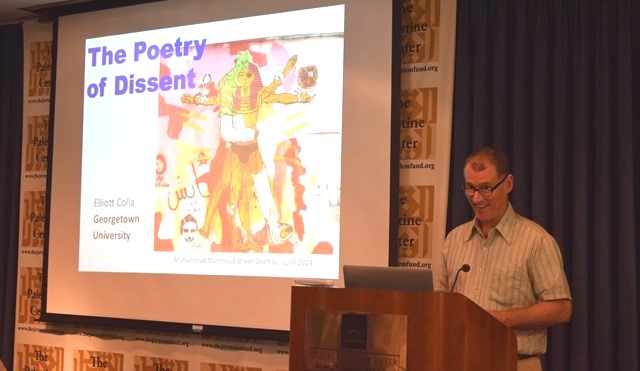
Elliott Colla, professor of Arab and Islamic Studies at Georgetown University, gave a lecture on 25 June 2015 at the Palestine Center entitled “The Poetry of Dissent.” Colla discussed the use of poetry in Egypt’s 2011 revolution and subsequent political unrest, as well as the strands of protest politics in the country.
From Colla’s perspective, the Egyptian Revolution achieved more culturally than it did politically. Following Mubarak’s ouster in February 2011, many works of creative non-fiction, novels, short story collections, and memoirs were published, recounting the experiences of the revolution. Some of them, especially fictional works, employed a style of narrative that had been used for decades, while other genres displayed much experimentation and innovation. One advent was the emergence of collective authorship. Such a trend made sense, given that stories of the revolution did not evolve from one person or group.
Slogan-writing as an enterprise is much more involved than many think, Colla pointed out. Slogans are hardly spontaneous; they are the product of much creative thought. Activists in Egypt will often sit in cafes with a pen and paper and jot down phrases that would make good slogans. Slogans can be a form of poetry, especially in Arabic, as many of them are rhymed couplets. Additionally there is a certain beat a slogan has to follow, congruent with traditional Egyptian cultural rhythms. The content of the slogan is often not as important as the number of people chanting it. Slogans are quickly discarded as changing circumstances make them less powerful. But some poetic slogans embody movements as a whole, and remain relevant both historically and contemporaneously.
Following Mubarak’s resignation, the Supreme Council of the Armed Forces (SCAF) began administering the country. However, SCAF cracked down on protests even more forcefully than Mubarak. Slogans and protest rhetoric, hence, were laden with invective, in contrast to the more open, sincere sentiment of the January 25th movement. As a result, many people with whom an inclusionary message may have resonated did not connect with the belligerent tones of the summer of 2011 and onward.
Slogans generally conformed to the characteristics of traditional Arabic poetry, namely, rhyme, meter, and purpose. Two genres of sloganeering emerged during the revolution: Hamasa and Hija’. The former involves encouraging one side in a conflict and building on the communal sentiments of bravery and resolve. . The latter is more aggressive and insulting, seeking to disrupt and divide. The “F**k SCAF” slogan, ubiquitously spray-painted on city walls during SCAF’s reign, is a prime example of Hija’.
Colla noted that these breaks with politeness and civility in a way overturned the rules of language. Colla expressed how vital poetry was in uniting and motivating Egyptian revolutionaries. Poetic output in Egypt was site-specific, in that the sentiments of the revolutions motivated the poetry and the poetry buttressed the momentum and activism. The two are indivisible in this sense.
This lecture was part of a series held in conjunction with Gallery al-Qud’s exhibition, Creative Dissent: Arts of the Arab World Uprisings.
Meet the Artist
Elliott Colla is a prominent translator of modern Arabic fiction, including novels by Ibrahim al-Koni, Raba’i al-Madhoun, Ibrahim Aslan and Idris Ali. He is the author of a study of Egyptology in modern Egyptian thought, Conflicted Antiquities: Egyptology, Egyptomania, Egyptian Modernity, and a crime novel, Baghdad Central. He teaches Arabic literature at Georgetown University in Washington, D.C., where he has served as chair of the Department of Arabic and Islamic Studies.
About Creative Dissent
This exhibition is designed to immerse visitors in the creative vitality of the continually evolving uprising movement commonly referred to as the Arab Spring. Visitors will experience how freedom of speech merges with artistic expression – capturing the anger, elation, frustration, and hope of these revolutions in the form of graffiti, video, blog postings, cartoons, music, photography and even puppetry. Drawn primarily from protests in Egypt, Tunisia and Libya, Creative Dissent demonstrates the varied responses to the protest in the Arab World beginning in late 2010.
Presented by the Arab American National Museum (AANM) and the University of Michigan – Ann Arbor, Creative Dissent: Arts of the Arab World Uprisings is guest-curated by Associate Professor of Islamic Art Christiane Gruber of the University of Michigan – Ann Arbor, and Nama Khalil, an artist and anthropology PhD student at UM.
Exhibition Dates: June 13 – August 6, 2015
