
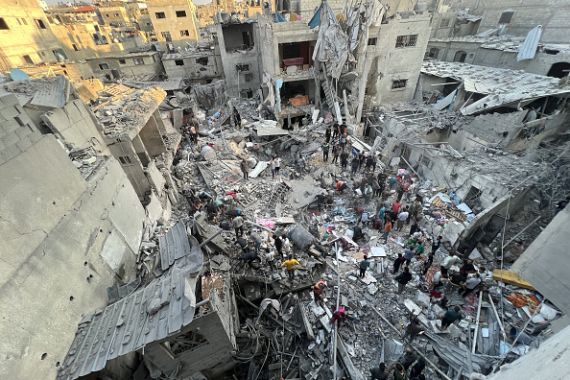
The window for a ceasefire in Gaza is rapidly closing, with unimaginable consequences on the horizon. Netanyahu, with the staunch support of the Biden Administration, appears unyielding in his pursuit of the genocidal campaign Israel launched in Gaza. This stubbornness persists even as Israel fails to meet any of its publicly stated objectives, notably the elimination of Hamas. The focus now shifts to Rafah, Gaza’s southernmost city, home to 1.5 million Palestinians—most of whom are displaced due to the current war.
In a recent revelation by the Wall Street Journal, Egypt is reportedly constructing an “8-square-mile walled enclosure in the Sinai Desert near the border.” This preparation anticipates the fallout from an Israeli incursion into Rafah, potentially driving hundreds of thousands of Palestinians into the Sinai. Netanyahu’s insistence on targeting Rafah, which he labels the “last bastion” of Hamas, sets the stage for a grim scenario. Egypt’s move to accommodate an expected surge of Palestinian refugees comes in response to Israel’s misleading assurance at the war’s outset, proclaiming Rafah a “safe zone.”
Israeli assurances have proven to be nothing short of deceptive, their military narratives riddled with falsehoods. The assault on Rafah, forcing Palestinians into the Sinai, is a calculated attempt by Israel to craft a narrative of victory for its beleaguered populace. The envisaged scenes of Palestinians fleeing into Egypt, mixed with the horrors of an intensified offensive in Rafah—where population density exceeds 22,000 person/1 KM2—serve Netanyahu’s agenda, appeasing the voracious appetites of his right-wing coalition, which has long harbored aspirations for a second Nakba.
It is critical to acknowledge that Israel’s campaign in Gaza was never strategically designed to confront Palestinian factions, particularly Hamas. From its inception, the strategy has been one of expulsion, aimed at depopulating Gaza and resolving Israel’s so-called “Gaza question” definitively. The people of Gaza, keenly aware of these intentions from the outset, have therefore resisted calls for mass relocation to Egypt, even temporarily. The prospect of resettlement in Sinai, a notion consistently rejected over decades by Palestinians in Gaza, remains a red line for them. Despite facing severe adversity—killing, starvation, dehydration, and homelessness amid the harsh winter—Gazans have shown remarkable resilience.
As Israel devastates Gaza City and annihilates the fabric of life in towns such as Beit Hanoun and Beit Lahia, and now wages a destructive campaign in Khan Yunis, Palestinian factions resiliently reassert their presence. These actions debunk the feasibility of “eliminating” resistance, exposing Israel’s true ambition: to obliterate Gaza as a bastion of defiance, a social incubator for resistance, and permanently disrupt the living conditions forcing its inhabitants to flee and never return.
Yet, even with Rafah under attack and potential expulsions to Sinai, the resolve among Palestinians remains unbroken. They, along with Palestinian factions, continue to defy Israeli claims of dominance by making unexpected comebacks in purportedly subdued areas.
Israel and its allies fail to recognize that the march of time is irreversible. There is no turning back to October 6, 2023. The region is evolving in unforeseen ways. Despite persistent advocacy from Palestinian voices for a ceasefire, their pleas have been dismissed by a US administration betting on an Israeli victory. While Israel may have laid Gaza to waste, even US officials admit that the objective of quashing resistance remains unachievable.
Signs of growing disillusionment within the US administration are evident, highlighted by President Biden’s acknowledgment of Israel’s excessive response in Gaza. Yet, such admissions ring hollow as the US continues to unequivocally support an Israeli campaign with no clear endgame, revealing Israel to be more of a liability than the regional deterrent it has long claimed to be. The United States has supplied Israel with a considerable stockpile of munitions for its conflict in Gaza, encompassing ‘bunker buster‘ bombs, various other bomb types, and artillery shells. These supplies feature ground-penetrating bombs capable of breaching fortified structures prior to detonation, alongside a significant quantity of bombs and artillery shells delivered mainly via military cargo aircraft. This assistance occurs amidst persistent hostilities and has sparked debates concerning the use of such powerful armaments in areas with high population densities.
As Israel finds itself mired in Gaza with no clear exit, the path it chooses—marked by further massacres and the forced displacement of Palestinians—may well catalyze a broader regional escalation. This development could complicate dynamics further, particularly on the northern front, potentially prompting US leaders to reconsider their stance on a ceasefire. But by then, it might very well be too late.
