
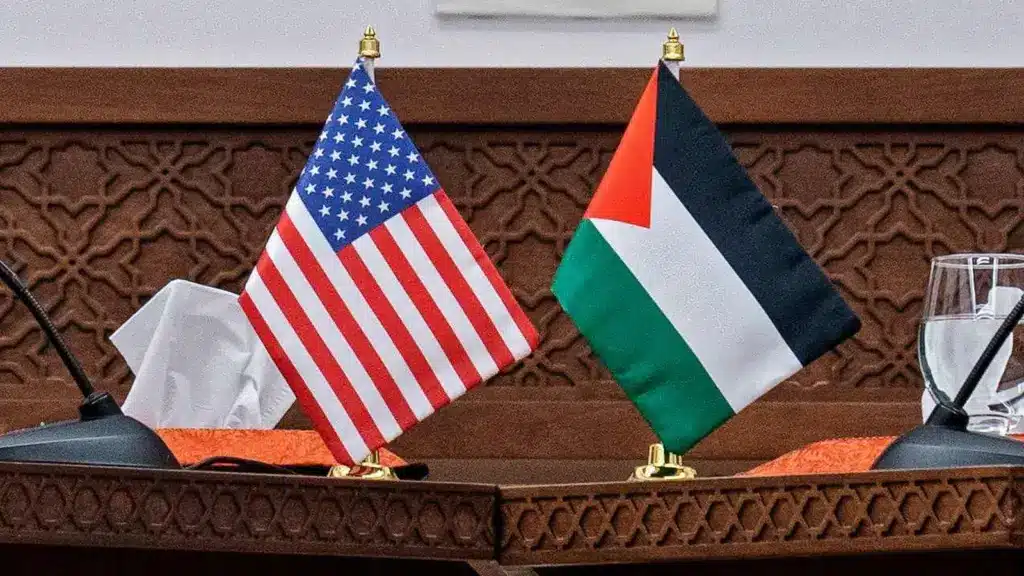
The Biden administration has announced the inclusion of Israel in the Visa Waiver Program (VWP). This arrangement, allegedly, will permit US and Israeli citizens to enter both destinations for up to 90 days without the need for a visa. The State Department suggests that this further “strengthens the security, economic, and people-to-people ties between the United States and Israel.” However, as recent events have shown, not all people will benefit equally. Palestinian Americans, many of whom have deep-rooted familial ties, properties, businesses, and a lineage tracing back to generations in historic Palestine, will still face discrimination under the VWP.
Before the effort to designate Israel into the VWP was even launched, Palestinian Americans expressed concerns that Israel might not fully honor the reciprocity principle. This means that while Israelis can enter the US without any restrictions on their movement, Palestinian Americans might face unequal treatment when visiting their ancestral lands.
A notable instance involves Palestinian Americans who hold Palestinian identity and are registered in the Palestinian population registry — controlled by Israel — as residents of Gaza. Although many Palestinian Americans with connections to Gaza can now arrive at Israel’s Ben Gurion airport and tour cities like Haifa, Jaffa, and Acre, they’re often prevented from taking a short drive to Gaza City via the Israeli-controlled Erez crossing to see their families.
Those identified by Israel as Gaza residents confront a myriad of challenges, additional procedures, and significant bureaucratic hurdles when trying to reconnect with their roots. For instance, a US citizen of Gazan descent, not currently in Gaza and who hasn’t used the Erez crossing in the last year with a US tourist approval, must seek a special Israeli return permit to enter Gaza via the Erez crossing. This typically involves applying to the Palestinian Civil Affairs in Gaza, an office managed by the Ramallah-based Palestinian Authority. Once the entry permit is secured, the individual has a window of 24 hours from crossing the Allenby Bridge to reach Gaza. This level of scrutiny isn’t mirrored for Israeli citizens visiting the US.
Furthermore, Palestinian Americans from other regions of Palestine, without identification cards linking them to Gaza, are typically denied entry to Gaza altogether. Beyond the Gazan context, there are reported incidents of Palestinian Americans facing aggressive treatment in the West Bank as well.
The Arab American Anti-Discrimination Committee (ADC) and several US citizens have initiated a lawsuit against the U.S. government. They declared that it endorses discrimination against Palestinian and Arab Americans as Israel joins the VWP.
Anas Shawkat Museitef is one of the plaintiffs. As reported by Haaretz, while traveling with his children in the West Bank, Museitef was detained, blindfolded, and handcuffed for 11 hours over an alleged invalid visa. After enduring extended mistreatment, he was released once officials recognized the validity of his visa.
Another plaintiff, Mohammad Ahmed Abujayyab, despite being a US citizen, was denied entry at Ben-Gurion Airport. Israeli authorities referenced his Gazan identity card as the reason for this denial.
The plaintiffs have told Haaretz their belief that this system is “flawed and illegal.” Despite assurances from the Department of Homeland Security and the State Department about Israel’s policy modifications, concerns remain about differential treatment based on background, identity, and ethnicity.
The Biden administration acts, fully aware that Israel’s government faces strong condemnation, not just from Palestinians subjected to daily injustices, but also from numerous Jews and Israelis. This is a government where ministers brazenly talk of ethnically cleansing Palestinians, outrightly reject Palestinian rights, and demand a “decisive” end to the Palestine question.
The US had a clear opportunity to leverage both internal and global criticism of Israel’s current policies, pressing them to cease their aggression against Palestinians and demand accountability. Instead, this administration has chosen, yet again, to stand unequivocally with Israel, driven by narrow-minded political agendas and muddled geopolitical reasoning.
–
Jehad Abusalim is Executive Director of The Jerusalem Fund/Palestine Center. The views in this article are those of the author and do not necessarily reflect those of The Jerusalem Fund.
