
Mohamed K. Mohamed:
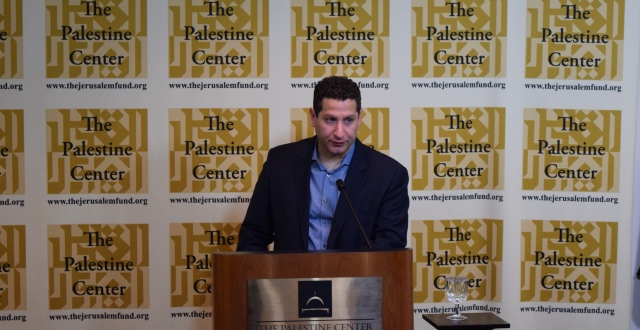
Good afternoon everybody, thanks for coming. Again, as we always say, please if you could silence your cell phones so we can avoid any interruptions. My name is Mohamed Mohamed. I am the executive director here at The Jerusalem Fund and Palestine Center. On behalf of everyone here — our board of directors, our staff — it’s a pleasure to welcome you all here, as well as everybody that’s here online. It’s also an honor to introduce and welcome back our distinguished speaker, Dr. Osamah Khalil, who will be speaking about his latest book, which is called America’s Dream Palace: Middle East Expertise and the Rise of the National Security State.
In T.E. Lawrence’s classic memoir, Seven Pillars of Wisdom, Lawrence of Arabia claimed that he inspired a dream palace of Arab nationalism. What he really inspired, however, was an American idea of the area now called the Middle East that has shaped U.S. interventions over the course of a century with sometimes tragic consequences. America’s Dream Palace brings into sharp focus the ways U.S. foreign policy has shaped the emergence of expertise concerning this crucial, often turbulent and misunderstood part of the world. America’s growing stature as a global power created a need for expert knowledge about the different regions. When it came to the Middle East, the U.S. government was initially content to rely on Christian missionaries and orientalist scholars. After World War II, however, as Washington’s national security establishment required professional expertise in Middle Eastern affairs, it began to cultivate a mutually beneficial relationship with academic institutions. Newly created programs at Harvard, Princeton, and other universities became integral to Washington’s policy-making in the region. The National Defense Education Act of 1958, which aligned America’s educational goals with Cold War security concerns, proved the boon for Middle Eastern studies. But charges of anti-Americanism within the academy soon strained this cozy relationship. Federal funding for area studies declined, while independent think tanks with ties to the government flourished. By the time the Bush Administration declared its global War on Terror, Dr. Khalil writes, think tanks that actively pursued agendas aligned with neoconservative goals were the drivers of America’s foreign policy. Copies of the book will be available for purchase after the event, so please get one after Dr. Khalil finishes his talk.
Just a little bit about Dr. Khalil. He is an associate professor of history at Syracuse University’s Maxwell School of Citizenship and Public Affairs. He is serving as the interim director of Syracuse’s Middle Eastern Studies program. He is also the author of America’s Dream Palace, which was named by Foreign Affairs as the best book of 2017. He is the co-founder and board member of al-Shabaka: the Palestinian Policy Network. He has been a frequent media commentator and contributor, including for the Huffington Post, Los Angeles Times, The Hill, Al-Akhbar, The National, and Al-Jazeera. Dr. Khalil will speak for 30 to 40 minutes, after which we will have a Q&A session. Again, as always, please wait for the mic to come to you if you have a question so that everyone online can hear as well. For the online audience, you can tweet your questions to @PalestineCenter. Please join me in giving a warm welcome to Dr. Osamah Khalil.
Dr. Osamah Khalil:
Thank you, Mohamed. Thank you for that very generous introduction. Thank you all for coming today. I just want to take a moment to thank Dr. Subhi and Dr. Eid and all the members of the Palestine Center’s board, not only for the invitation to speak here today but for all the great work that they do. I also want to thank Mohamed again and Samirah for their help in coordinating the talk. So, let me just say that The Jerusalem Fund and Palestine Center are essential institutions for Palestinians here in the United States, in Palestine, and around the world, and it’s an honor to be here today.
So as Mohamed mentioned, he gave you the blurb about my book, America’s Dream Palace, and this relationship to T.E. Lawrence, better known as Lawrence of Arabia. There’s this idea that he, as he claims in his memoir, that he inspired what he called “the dream palace” of Arab nationalism. But as I talk about in the book, this dream palace, what he actually inspired, was this idea, and it’s kept by American scholars and policymakers and national security experts to shape the area that we now call the Middle East in America’s image. Palestine was and remains at the center of these efforts, and the dream palace of today’s talk refers to the efforts of Americans to bring peace to the Holy Land, that phrase you often hear in the media, often by policymakers. And this was not just about bringing peace to the Holy Land, but their attempt to reconcile Washington’s commitment to and its special relationship with Israel and its proclaimed goal of security and stability in the Middle East.
Now, for seven decades, the Palestinians, especially Palestinian refugees, and the issue of Palestinian self-determination have been a consistent challenge to achieving the goal of regional security and stability. The U.S.-managed peace process excluded the Palestinians for over two decades, from roughly 1948 to 1968, and what Washington decided to do was to treat the Palestinians as a humanitarian issue rather than as a political issue. The United States then attempted to ignore or undermine the Palestinians, especially the Palestine Liberation Organization, the PLO, for about the next 25 years. But since 1993 and the Oslo Accords, the United States has co-opted the PLO with willful support of the Fatah movement and, in particular, PLO chairman Yasser Arafat and his successor Mahmoud Abbas. So, here we are almost 25 years after the initial Oslo Accords were signed, and peace and a Palestinian state have not been achieved.
As Mohamed mentioned, the book covers a century of American involvement in the Middle East and the attempt to develop expertise about the region, from World War I to the global War on Terror, and how America’s interests in the Middle East were basically shaped by Middle East expertise. So, today’s talk is going to focus on the latter half of the book in which I examine the essential role played by think tanks and their close alignment with U.S. government agencies and interests in the Middle East and globally. So initially these efforts focused largely on the arbitrary peace process. Some of this has been lost over time, has been forgotten about, so hopefully some of this will be a refresher for some of you and will remind you.
In the ensuing four decades, the prevalence and influence of think tanks has grown dramatically. This reflected a growing rift between the government and academia during the Vietnam War. So, during the Vietnam War period, a new generation of scholars emerged at leading universities that were increasingly reluctant to cooperate with U.S. government agencies or conduct research that was viewed as supporting U.S. foreign policy, and this included America’s growing relationship with Israel. Well-funded think tanks that actively embraced U.S. foreign policy and national security establishments filled this breach and offered the seemingly impartial expertise that Washington desired. In today’s talk, I’ll focus on three think tanks and their involvement and influence on the Arab-Israeli peace process: The Brookings Institution, the American Enterprise Institute, and the Washington Institute for Near East Policy. At the end of the talk, I’ll discuss where we are today, both with think tanks and the peace process, and I’m happy to discuss other aspects of the book for those of you who are familiar with the arguments and the evidence in the Q&A.
Speaking at the 50th Anniversary celebration of the Brookings Institution in July 1966, President Lyndon Johnson declared, “If you did not exist, we would have to ask someone to create you.” Johnson’s remarks focused on the domestic impact of the Brookings Institution’s research and analysis. But less than a decade later, in 1975, Brookings would make a major foray into the foreign policy arena with its report, “Toward Peace in the Middle East.” Now, the Brookings report sought to build on the disengagement agreements in the Sinai Peninsula between Israel and Egypt after the October ‘73 war, and it would inform efforts by the Carter Administration to resolve the Arab-Israeli conflict and contribute to the 1979 Camp David Accords. However, it also had the unintended consequence of inspiring the actions of a fledgling think tank in the mid-1980s, this time not to promote the peace process, but to slow it down if not hinder it altogether.
The term “think tank” was used by the U.S. military during World War II to refer to a secure room or location where strategy and plans could be discussed, and it was first applied to the Rand Corporation in the 1950s. Originally a subsidiary of Douglas Aircraft, Rand was spun off into an autonomous unit after the war, and initially relied on the U.S. government for funding. Its research was focused largely on the military. Overtime, Rand’s funding and research diversified and expanded, and it became a model, if not the model, for think tanks to emulate. If you look around at think tanks today, you can see a lot of similarities to what Rand was doing initially and since. So as the number of think tanks expanded in the late Cold War era, so did their influence on policy. However, the external experts were never completely impartial, as future contracts remained an ongoing concern. In addition, think tank staffers were recruited to serve in different administrations, and members of the foreign policy and national security establishment went on to serve in think tanks. So, there’s a revolving door that I discuss in the book, between think tanks and the government that essentially replicated this revolving door that existed in the 40s, 50s, and 60s, between academia and the government. So, although Rand is not a focus of this talk, they do play a role in the peace process after the outbreak of the Second Intifada, which I can discuss in the Q&A.
Like Rand, the Brookings Institution is another established and prestigious think tank. Founded in 1916 as the Institute for Government Research, funding was initially provided by several prominent individuals, including John D. Rockefeller, banker J.P. Morgan, and businessman Robert S. Brookings, who the institute was renamed after in 1927. Brookings has generally been regarded as moderate or even a liberal think tank (liberal in the U.S. phrasing of it). But its policy positions have been historically more nuanced. For example, it initially supported and then opposed the New Deal. It also assisted with the formation of the UN and the development of the Marshall Plan to rebuild Western Europe. Unlike Rand, Brookings did not initially conduct contract research, nor was the government a major source of revenue. During the Cold War, at least the early Cold War, Brookings’ foreign policy analysis largely focused on the Soviet Union. But in 1975, it expanded to the Middle East and the Arab-Israeli peace process.
This new focus for Brookings grew out of the Trilateral Commission. How many here have heard of the Trilateral Commission? It’s interesting, the Trilateral Commission is kind of lost to history, so I can see a smattering of hands. But it was formed in 1972 by David Rockefeller, who was then chairman of Chase Manhattan bank, and Henry Owen of Brookings. The Trilateral Commission was an attempt by business, academic, and political elites to strengthen ties between the United States, Europe, and Japan. The Trilateral Commission was also critical of the detente policies pursued by Presidents Nixon, Ford, and Secretary of State Henry Kissinger. A key figure was Columbia University’s Zbigniew Brzezinski, who recently passed away. So, Brzezinski was not just a cofounder, but also a critic of detente, and served at the commission’s first director. Now, the commission sponsored a number of meetings, as some of you will remember, and reports related to the world economy. But it was also concerned with what it termed “shared security challenges” that the United States, Europe, and Japan had related to the Middle East. One attendee at Trilateral Commission meetings was Georgia governor and Democratic Presidential candidate Jimmy Carter. In his memoirs, Brzezinski recalled that Carter attended a commission meeting held in Japan and spoke forcefully and clearly on behalf of a fair Middle East settlement as very much in the U.S. national interest, and this will inspire the 1975 Brookings report.
So, Henry Owen, who was director of foreign policy at Brookings and a Trilateral Commission cofounder, as I mentioned, will lead this effort. And it’s going to recruit a number of prominent academics, so this is going to be kind of the model that Brookings will establish that will then attempt to be copied with several major changes, as I’ll talk about. So, the academics that were recruiter for the study included Brzezinski out of Columbia, William Quant, who was a former NSC staffer and then was a Brookings fellow, UCLA’s Malcolm Kerr and Steven Speigel, and Harvard’s Nadav Safran. So, these were all kind of leading figures in Middle East Studies in the 1970s. Now, according to William Quant, one of the main drivers of the Brookings study was the belief that the high-profile shuttle diplomacy adopted by Secretary of State Kissinger after the October War that emphasized — or rather, his emphasis on — interim agreements between the parties had exhausted itself.
So, what did Quant mean by that? And here I think it’s important to take a step back and examine the regional and international conditions that led to the Brookings study. So, when Richard Nixon entered office in January of 1969, the United States was in the midst of a losing war in Vietnam. Only 18 months early, Israel had defeated Egypt, Syria, and Jordan, occupying the West Bank, Gaza, East Jerusalem, Sinai, and Golan. In his first term, Nixon and Henry Kissinger — so it’s important to remember that in the first term, Henry Kissinger was national security adviser, not Secretary of State, which will come back — Nixon and Henry Kissinger focused on ending the Vietnam War, first militarily, and when that failed, diplomatically. Nixon and Kissinger did not consider the Arab-Israeli conflict a priority and, based on the available evidence that we have as historians and scholars, they actively sought, with the assistance of Israel, to scuttle plans by Nixon’s first Secretary of State William Rogers.
So, what was Rogers trying to do? William Rogers is a friend of Nixon’s, he has a very limited portfolio inside State, much of this is being consolidated in the White House by Nixon and Kissinger. And Rogers decides to try and solve the Arab-Israeli conflict using UN Security Council Resolution 242, which had what was called the land-for-peace framework. So, for those in the room who know, the resolution called for Israel to withdraw from the territories it had occupied in the June war in order to have peace with its neighbors. Rogers is going to target two states: Egypt and Jordan. But, he’ll be undermined by the White House and by Israel.
By mid-1973, as Nixon has been re-elected and with America’s involvement in Vietnam over, Egyptian President Anwar Sadat had grown frustrated by being ignored by the United States and Israel. With Syrian President Hafez al-Assad, he sought to shake the status quo with the October ‘73 war. As many will remember, Egypt and Syria have initial gains that are then decisively countered by the Israelis and the ceasefire is declared. And here Kissinger recognizes two opportunities, not just by the conflict, but also the ceasefires. First is to separate the Soviet Union from Egypt. Now, he had this opportunity before, as many in the room know. Sadat and Egypt had made several entreaties to the United States as well as to Israel that they were interested in negotiations, significant negotiations, which were ignored. The other opportunity that Kissinger recognizes is to separate Egypt from the combined Arab negotiating position, this unified Arab negotiating position which demanded a comprehensive settlement. Instead, what Kissinger wants to do is focus on bilateral agreements and negotiations rather than a comprehensive one. And this of course aligned with Israel’s preferences as well. Kissinger’s very public shuttle diplomacy was very successful, so he achieves disengagement agreements between Egypt and Israel and Sinai, and between Syria and Israel and the Golan. But Kissinger will spend the next year focusing on a very limited disengagement agreement in Sinai—what becomes known as Sinai II—at a very heavy political cost.
There’ll be high tensions between the United States and Israel in mid to late 1975 and even though an agreement is signed—a Sinai II agreement is signed—the Ford administration, particularly Ford and Kissinger, will decide this is not working. So, this is really what brings us back to Quant’s statement about the interim agreements and high-level diplomacy had exhausted itself. Now, when it was released, the 1975 Brookings study group report “Toward Peace in the Middle East” was deemed controversial. Yet, four decades later, its main recommendations seemed moderate, even unremarkable. But several aspects—and that’s important as I’ll talk about—were influential. The major recommendation of the report was that the United States should pursue a comprehensive settlement to the conflict, and it cautioned that the interim agreements negotiated by Kissinger had not addressed the underlying causes of the conflict. Now these were not generally controversial. What was controversial was the recommendation for Palestinian self-determination, and Brookings argued this would be achieved as part of a larger agreement in which Israel was recognized and an independent Palestinian state would be created or, as an alternative, a Palestinian-Jordanian Confederation.
Now, the report did not explicitly call for Washington to negotiate with or recognize the PLO. Two things to keep in mind: this is 1975, and the year before both the UN and the Arab League have recognized the PLO as the sole legitimate representative of the Palestinian people. The PLO has also attempted over the previous two years to establish relations with the United States that have not really advanced very far. Now, another factor is that, as part of the Sinai II agreement, initialed at roughly the same time the Brookings report is released, the United States has signed a secret memorandum with Israel in which it agreed not to recognize or negotiate with the PLO until it accepted UN Security Council Resolution 242 and its sister Resolution 338. Now, the Brookings report had several other—that’s kind of the broader underlying pieces, some of the negative reaction to the Brookings report—the report had several other aspects that would become recurring features of the peace process and subsequent proposals over the next three decades. This included: phased implementation of the agreement and stage withdraws by Israel to the June ‘67 border. So, as you look back to ‘75, you can see some of the outlines of what will become the Oslo agreement, as well as some of the pitfalls.
Now the Brookings report was shared with Carter and Cyrus Vance, a Trilateral Commission member who became Secretary of State. So even though as I’ll talk about a lot of focus on the Brookings plan and the Brookings report, the Trilateral Commission arguably has more influence on Carter and on his administration. A number of members of [Ford] administration including Vance, Brzezinski will become members the administration. William Quant will return to the NSC, and although Carter and Vance read the report, Quant later wrote that it would be an exaggeration to say that the report served as a blueprint for the policies of the Carter Administration.
Now even though it may not have been a blueprint, “Toward Peace in the Middle East” appeared to set the parameters for the Carter Administration’s attempts to resolve the Arab-Israeli conflict. Shortly after taking office, the Carter Administration identified the Middle East as an urgent priority and pursued a comprehensive resolution to the conflict, including outreach to the PLO. Carter also made public statements about the need for a solution to the Palestinian problem, including his use of the term Palestine homeland. This led to an immediate backlash from members of Congress and skepticism in the press. Now, the Administration’s plan brought renewed attention to Brookings and the Brookings report and, in particular, in Israel the initiative and the Brookings report were linked to and criticized for their similarity to the William Rogers plan—Nixon’s first Secretary of State. So the U.S. Embassy in Tel Aviv will report back to Washington that Carter’s proposal and the Brookings report—the Carter proposal was seen as lying, the origins of what were seen as lying in the Rogers plan and the Brookings report, the first of which the Rogers plan is viewed here in Israel, is totally rejected here in Israel, and the latter, the Brookings report, is regarded with grave suspicion. So, it’s important to remember, what did the Rogers plan call for? Land for peace based on UN Security Council Resolution 242, and that is totally rejected in Israel in ‘75-76. These criticisms were repeated by leaders of the American Jewish community. For example, Rabbi Arthur Hertzberg of the American Jewish Congress, who’s a former colleague of Brzezinski’s at Columbia, criticized the Brookings report and interviews as well as in meetings with the Carter Administration.
Now several Arab states, in contrast, expressed interest, not just in the report, but were actually — as the Tunisian Foreign Ministry says—impressed by it because it reflected some of their own proposals to ending the Arab-Israeli conflict. Now, Carter’s going to face—as many in the room know—a number of challenges, including Sadat’s reluctance to accept full normalization with Israel, the PLO’s rejection of UN Security Council Resolution 242, and then the main one will come with the May 1977 Israeli election in which the Likud party comes to power and Menachem Begin becomes Prime Minister. So, although Begin eventually signed the Camp David Accords with Egypt, a broader agreement was unfulfilled, and Begin was unwilling to embark on a comprehensive discussion and was unwilling to negotiate with the PLO. Now a limited provision of limited autonomy provision was included in the Camp David Accords, as many know, but was never implemented nor did subsequent administration’s follow Carter’s example. Yet, as we demonstrated, other think tanks sought to replicate the perceived influence of the Brookings Institution.
Now, one of the earliest think tanks to copy Brookings was the conservative American Enterprise Institute (AEI). Shortly after Ford’s defeat in the ‘76 election, his Secretary of the Treasury, William Simon, explained to the Washington Post that AEI could play a key role for the Republican Party in the 1980 election, only three years away. Simon told The Washington Post while the Democratic Party “had Brookings, Republicans ought to use a AEI, and we will over the next four years.” President Ford joined AEI after leaving office and was joined by other members of his administration, and this included the new head of AEI, William Baroody Jr. Baroody’s father had served as the previous director. Now, although AEI emerged as a conservative competitor to the Brookings Institution, its policy analysis related to the Middle East initially reflected the bipartisan support for the Arab-Israeli peace process and the Camp David Accords. So, one of the major figures responsible for this was Harold Saunders. Now, Harold Saunders was a former Assistant Secretary of State for Near East and South Asian Affairs. He joins AEI as a research fellow, but when he was at State, Saunders worked with Kissinger on the disengagement agreements, he worked on the Camp David Accords, and he also contracted AEI in Brookings to develop assessments on the Palestine issue. And after the Camp David Accords were signed, Saunders is going to contract with AEI to develop a proposal for autonomy elections in the West Bank and Gaza Strip.
So, this may be surprising to some in the room, but the AEI of the late ‘70s – early ‘80s is not the AEI of today, as will become apparent in a bit. At AEI, Saunders was joined by Judith Kipper, another Research Fellow, and into the 1980s, during Reagan’s first term, Saunders and Kipper advocated for a resolution to the Palestine issue including contact with the PLO. Now, as you can imagine, a change is coming. After Ronald Reagan’s sweeping 1980 victory over Carter, staffers from conservative think tanks were welcomed into the new administration. Within a few years, Brookings was competing with AEI and The Heritage Foundation for attention in the press and policymakers. Although the conservative think-tanks attempted to copy Brookings, the Reagan Administration did not attempt to copy Carter, and they did not want extensive involvement in the Arab-Israeli peace process. In addition, key members of Carter’s foreign policy and national security staff remained outside of government. This included Brzezinski. Quant, and Saunders. Instead, U.S. foreign policy toward the Arab-Israeli conflict during the Reagan Administration—and arguably since—was dominated by conservative and neoconservative elements with close ties to Israel. Indeed, under Reagan, strategic cooperation between the United States and Israel was expanded. This included greater military and intelligence coordination and collaboration, and this will be a trend as I’ll talk about.
This enhanced relationship between the United States and Israel was reflected in two think tanks, one established and one new, that both emerge, that both basically come to this point during Reagan’s second term. And it was during Reagan’s second term really by ‘85 – 86 that AEI moved further to the right. One of the key figures responsible for this shift was Irving Kristol. Now, for those who don’t know, Irving Kristol, during the 1950’s, served as executive director of the Congress for Cultural Freedom. How many of you have ever heard of the Congress for Cultural Freedom? Okay, alright. So, the Congress for Cultural Freedom, as I talked about in the book, was an organization that received funding from the CIA with the goal of influencing intellectuals and artists to join the fight against communism. They’re kind of targeting left and progressive intellectuals and artists, but anti-communist intellectuals and artists. So, one of the things they are going to do is they’re going to fund a number of journals, a number of exhibits, and one of those journals will be a journal called Encounter. There’s another one that’s an Arabic language journal called Hiwar that I talk about in the book. And Encounter of course is co-edited by Irving Kristol. But by the mid ‘60s the CIA funding is exposed, and the CCF shuts down, and number these journals shut down, if not all of them. Kristol will later go on to join commentary, and in the late ‘70s – early ‘80s he becomes affiliated with AEI, and then leads and starts to recruit other neoconservatives to the think tank. So, in the same way that Kristol recruits neoconservatives to AEI, he recruits neoconservatives from the Democratic Party to the Republican Party in their support of Reagan in the ‘80 and ‘84 elections.
So, as I discuss in the book, like the Trilateral Commission, neoconservatives were also opposed to the Nixon-Ford-Kissinger detente policy, and a number of neoconservatives were campus radicals during the 1960s and members of the new left movement, but they split with the new left—and effectively with the left—over criticism of Israel. AEI’s neoconservative shift was aided by the oust of its director, William Broody Jr., and Broody was forced out—many will say—over fiscal mismanagement, which was may have been true, but also for criticism of Israel at an event sponsored by the Institute during his tenure. And after Baroody left, research fellows Saunders and Kipper also left. And into the 1990s, the new neoconservative AEI became a sharp critic, if not opponent, of the Oslo Accords and promoter of regime change in Iraq. As I discussed in the book, during the Clinton Administration, AEI was an early advocate for reshaping the Middle East by invading Iraq and overthrowing Saddam Hussein.
So, the establishment and influence of the Washington Institute for Near East Policy was another example of this growing tie between the United States and Israel during the Reagan Administration in the second term. So WINEP, as it becomes known, was founded in February of 1985 by the influential pro-Israel lobby, the American Israel Public Affairs Committee (AIPAC). But this overlap between AIPAC and the Washington Institute was not superficial. Martin Indyk, former deputy director for research at AIPAC, served as WINEP’s first executive director. Other AIPAC officials were among WINEP’s founders. The organization grows rapidly and develops strong links with Washington policy circles very quickly. And this is demonstrated in only two years, Secretary of State George Shultz speaks at a WINEP sponsored conference. So, this conference is in September 1988, in the midst of the first Palestinian Intifada. So, as many here know, the First Intifada correspond with a period of unprecedented international criticism of Israel. Now the PLO’s leadership, which at this point was based in Tunis, is still attempting to establish relationship with the United States, and it views the Intifada as an opportunity to do this, as well as this criticism of Israel, but it’s rebuffed by the Reagan administration. And in his speech to the Washington Institute, Shultz asserted that peace could not be achieved through the creation of a Palestinian state. But he offers hope: if the PLO renounce terrorism, recognized Israel, and accepted UN Security Council Resolutions 242 and 338, Washington would consider it for participation in the peace process.
Now, as we all know, the PLO met those conditions two months later, and discussions with the Reagan administration and the Bush administration begin, but they don’t lead to a breakthrough in either U.S.-PLO relations or the peace process. So, in effect, the PLO trades away some key negotiating cards in terms of recognition and gets nothing in return. Now, coinciding with Schultz’s speech, the Washington Institute published a study based on its own study group. So here they’re deliberately trying to copy the example of the Brookings 1975 Study Group, with several major differences. Instead of focusing on academics, the Washington Institute targets former policy makers and elected officials from both the George W. Bush campaign and the Mike Dukakis campaign — Governor Mike Dukakis of Massachusetts. Now, Martin Indyk will explain that the Brookings plan was precisely what we were trying to replicate, and he added that the key was that the people engaged in the report went into the administration and had a common idea of what they wanted to do. Now, as I mentioned, there’s going to be major differences in terms of who’s involved in the Washington Institute study group, as well as the recommendations.
So, who’s involved? Under Secretary of State for Political Affairs Lawrence Eagleburger and former Vice President Walter Mondale will be the co-chairs. The participants will include: former and future Defense Secretary Donald Rumsfeld, Harvard’s Joseph Nye, conservative columnist Charles Krauthammer, and Daniel Pipes, the director of the Foreign Policy Institute. Now, the lineup of participant participants demonstrates a clear ideological agenda, one that was apparent then and is even more evident now, and this was reflected in the recommendations. So, you’re going to notice some familiar language. Remember, this is 1988 and this language has been adopted over the years by Israeli officials, including current Prime Minister Benjamin Netanyahu. The Washington Institute report is going to argue that the Middle East is a “dangerous place” for the United States, and as many of you will notice, Benjamin Netanyahu makes his claim a lot, so will other Israeli officials, that the Middle East is a dangerous neighborhood. More importantly, what we become a common refrain over the next several decades, the Washington Institute report will assert that the U.S. cannot make peace for these parties, it can only assist them once they are willing to do so. Here we see the influence of Dennis Ross. So, Dennis Ross is a key figure at the Washington Institute and then later in policy circles, and in earlier policy proposals, Ross will argue that the Reagan Administration needed to revive the approach adopted by Kissinger before the October 1973 war. That approach, of course: patiently awaiting real movement from the local parties. Yet Kissinger’s approach was proven to be a failure, as demonstrated not just by the war but a near nuclear showdown between the United States and the Soviet Union, and the ensuing Arab oil embargo. But what was unsaid in this recommendation is that the Egyptian-Israeli peace treaty had dramatically changed the regional landscape to Israel’s benefit, and Israel had no reason to abandon that advantage. Now there’s another aspect here that’s unsaid. So, in Ross’s language, this idea that the United States has to patiently wait for the party — you’ll notice emphasis on the plural — but really there’s only one party for the Washington Institute that counts, and that’s Israel. It’s only when Israel is ready to make peace — and on its terms — should the United States become involved.
Now, as I mentioned, the PLO is actively seeking recognition from Washington, but the Washington Institute did not recommend any kind of involvement with the PLO. Instead, it suggested that the new Palestinian leadership should be drawn from the Occupied Territories. And what, again, will be another influential aspect, that’s going to argue that transitional phases need to be adopted in any kind of agreement, even before an agreement, there have to be what are called ‘confidence-building measures’. So those of you who are familiar with the language of the peace process and the language of the Oslo Accords, you can see this in 1988, this idea of confidence-building measures between Israelis and Palestinians, and it’s really on the Palestinian side as WINEP says, “so that the intentions of Palestinians to live in peace with Israel and Jordan could be tested.” So, these recommendations were accepted, in part by the George Herbert Walker Bush and Clinton Administrations, and the emphasis on confidence-building measures becomes a hallmark of the Oslo Accords and after.
So here we have a new fledgling think tank making its mark on U.S. Middle East policy or attempting to make its mark on U.S. Middle East policy, by copying the Brookings administration. So how is Brookings going to respond? Brookings is the more established institute, it has much bigger name recognition, and of course it’s going to launch its own competing study in preparation for the ‘88 election. So, this will be coordinated by William Quant, and as you can imagine it’s going to have very different recommendations and a contrasting approach with the Washington Institute, so let’s see who wins. I don’t want to give away the ending. So Quant—now, if you remember, the Washington Institute says the United States should wait patiently for the end—Quant says no, continued stalemate, and the Brookings report says, continued stalemate threatens U.S. national interest, and the Brookings study group is going to argue that the next administration should provide a steady high-level commitment to the peace process, including involving the Soviet Union if they’ll play a constructive role. So, you can see a very different approach, one says wait, one says you need to get involved.
Now the Brookings report is also going to base their strategy again on UN Security Council Resolution 242. The PLO has now accepted it, right. Now, unlike WINEP, the Brookings report will recommend that the Palestinians should select their own representatives, not the United States or Israel, and it concedes that these representatives may either have to be explicitly or implicitly endorsed by the PLO. But one thing they will share—and again you will see this over and over again—is this idea of transitional steps. So, Brookings and WINEP share that idea, and that will be carried forward. Now, just like its predecessor in 1975, the 1988 Brookings report will encounter resistance from leading figures in the American Jewish community, and again they will liken it to the ‘75 report and the Carter Administration, and what they will say internally is that they fear it’s going to inspire “American assertiveness,” and that this will lead to a negative reaction from Israel. But they need not have worried, because, unlike its predecessor, the 1988 Brookings report was ignored. Instead, WINEP’s recommendations and staff would predominate in Washington. Some of them would become key figures in the George Herbert Walker Bush Administration, including Eagleburger, who’s promoted to Deputy Secretary of State, Richard Haass, who was named the NSC Senior Director for Near East and South Asian Affairs, Dennis Ross, who was selected to head the State Department’s policy planning staff, and some other names you might know—Francis Fukuyama, who serves with Haass on the NSC, and Ross’s aide Aaron David Miller.
Now with the end of the Cold War and the aftermath of the first Persian Gulf War, as many in the room know, President Bush and Secretary of State James Baker launched a diplomatic initiative to resolve the Arab-Israeli conflict, and they again encountered resistance, this time from Israeli Prime Minister Yitzhak Shamir. Hanging over their proposed peace conference, the Baker-Bush press conference, was the question of whether the Palestinians would participate and what role—if any—would the PLO have, and that of course was eventually resolved with the creation of a joint Palestinian-Jordanian negotiating team, which did not contain PLO members from outside the Occupied Territories. But the subsequent peace conference and direct negotiations between Israelis and Palestinians didn’t really resolve anything. Although they met and that inspired optimism, the negotiations quickly bogged down over any matters of substance rather than just matters of process and photo ops.
A year later, we have another presidential campaign and another Washington Institute study, and this one again will be comprised of members from the political campaign, so again, academics are now excluded, this is exclusively in the realm of policymakers and politicians. Now, the report argued that the end of the Cold War—it’s called “Pursuing Peace”—argued that the end of the Cold War and the Gulf War had “broken the back of the rejectionists and discredited the PLO” because of Arafat’s public support for Saddam Hussein, but it offered hope with a new Israeli government led by Prime Minister Yitzhak Rabin, who appeared to be committed to negotiations, and a changed regional and international landscape, there was the possibility for a final resolution, but—and this should probably surprise nobody in the room at this point—the Washington Institute report did not recommend that the next administration pursue a comprehensive solution. So even though the regional landscape has changed and the international landscape has changed, there’s no reason to adopt a comprehensive solution. Instead, Washington should again focus on achieving interim solutions between Israel and the Arab states—again, you’ll notice Israel and the Arab states: the Palestinians are to be left on the side. And what we’ll say is, echoing Israel’s position, that the United States should advocate for Palestinian self-government rather than a Palestinian state.
Now, keep in mind this is still in the middle of the First Intifada, which is flagging by 1992 but it’s still going on. The Washington Institute argues that Israel’s occupation was “unwanted and unwelcome,” but the caveat to ending it in the report and afterward repeatedly undermine negotiations over the next two decades. And again, in a common refrain that is repeated almost until today, if not today, the report maintained that the United States should not be any more anxious to reach an agreement than the parties themselves.
Now, when George Herbert Walker Bush lost the 1992 presidential election, it appeared that Bill Clinton would select a new Middle East team, and some thought he would go back to members of the Carter Administration and those involved at Camp David. However, Clinton surprisingly appointed a holdover from the Bush administration, Dennis Ross, and of course the breakthrough did not come through the efforts of Ross or the United States, but — as many in the room know — it came through Norway and the 1993 Declaration of Principles. Now, key aspects of the Declaration of Principles, as many know, was limited self-rule in the West Bank city of Jericho and parts of the Gaza Strip, and after the breakthrough was announced, the Clinton administration and, in particular, President Bill Clinton became heavily involved in subsequent negotiations. Now these negotiations were only supposed to last five years, but they’re extended to seven, and of course they’re undermined in part by the 1995 assassination of Yitzhak Rabin and Benjamin Netanyahu’s emergence as leader of the Likud Party. But one key aspect that has kind of been overlooked in this is that when the talks stall, as they inevitably do, especially once the Netanyahu gets involved, the Clinton Administration defers back to the WINEP position, which is that the parties had to want peace for negotiations to succeed. But remember, the WINEP position is based on one party, not two. This approach contrasted with the recommendations of those outside the Washington Institute and the administration, who argued for a more active American role to break the deadlock, including William Quant and Richard Haass at Brookings, and that will change. Privately, the Clinton Administration sided more closely with Israel. On November 1998, a memorandum from Secretary of State Madeleine Albright to Israeli Prime Minister Benjamin Netanyahu explained that the United States would quote conduct a thorough consultation process with Israel in advance, with respect to any ideas the U.S. may offer to the parties for their consideration.
So, the U.S. is going to discuss any proposals with Israel first, and then present them to the Palestinians. Netanyahu will pocket this promise, and so will his successor, Ehud Barak, and Barak will use it two years later at Camp David. And of course, as many of the room know, before the 2000 summit, Clinton convinced a reluctant Arafat to attend the talks, and he promised Arafat that he would not blame him if the talks failed. After the summit failed, predictably, Clinton blamed Arafat, as did Dennis Ross, even though the negotiation continued into January 2001 with the election of Prime Minister Ariel Sharon. Now, with the collapse of the peace process, an outbreak of the Second Palestinian Intifada in September 2000, the Washington Institute continue to expand its presence in media and policy circles. Martin Indyk joined the Brookings Institution after serving as U.S. Ambassador to Israel and the Assistant Secretary of State for Near East Affairs. And at Brookings, Indyk receives a call from media mogul Haim Saban, a wealthy donor to the Democratic Party.
Now, Saban wanted to establish a think tank specifically focused on the Middle East and securing Israel’s future. Indyk says, well, why don’t you just donate to WINEP, basically that’s what they’re there for, and Saban says, no, I prefer to form my own think tank. And so, instead, he will make a thirteen million dollar donation to the Brookings Institution, and the Saban Center for Middle East Policy was established. Saban later explained to the New York Times in 2004 his interest in politics and foreign policy: “I’m a one-issue guy,” he said, “and my issue is Israel.” Now, Saban was not alone. The attachment to Israel, protecting and promoting its relationship with America, united Democrats and Republicans. It also paralleled a tightening of a special relationship between United States and Israel in the post-Cold War era, building on the Reagan years, as I talked about. During the Clinton Administration, it evolved into a strategic relationship, and after September 11, 2001, it was transformed into a strategic alliance.
Now, at each stage, there is increasing military and intelligence collaboration and coordination, increased military aid, advanced weaponry, etc. Now, while the relationship with Israel is enhanced, the Bush administration disengaged from the peace process—this is the George W Bush administration—and adopted a policy of conflict management rather than conflict resolution, which was in line with WINEP’s recommendations. So, to be clear on the difference, while conflict resolution would theoretically bring an end to Israel’s occupation—theoretically—conflict management enables it to continue. In addition, the management of conflict here is the focus on violence, not the entrenched and systemic violence of Israel’s occupation and continued settlement policies, but an emphasis on reducing Palestinian violence against Israel. Now, Bush also relied on Israel’s newly elected prime minister Ariel Sharon to suppress the Second Intifada, believing it would force the Palestinians to make the necessary concessions for a final peace deal. Arafat was sidelined by the Bush Administration, who argued that a new Palestinian leadership, untainted by terror, was required to achieve peace.
Now with the invasions of Afghanistan and Iraq, the peace process was no longer a priority for Washington, As I discussed in the book, think tanks, especially AEI and Brookings, were deeply involved in establishing and justifying the rationale for invading Iraq. Of course, one justification, as some will remember, by proponents of the war was that the road to peace in Jerusalem was through Baghdad. Now here we are 15 years later, and that has been proven to be demonstrable false. Although high profile diplomacy continued under George W Bush and Barack Obama, invariably with support from established and new think tanks, there is little to show for these efforts on the ground. Indeed, Washington think tanks largely remain bound, if not beholden to, the two-state solution, and attempts to revive the Oslo process with proposals that are divorced from the reality of a half-century of occupation and 70 years of dispossession. And those are the proposals that attempt to resolve the conflict, not those that seek to manage it.
So where are we today? Over the past three years there been a number of revelations about and criticisms of the cozy relationship between leading think tanks and corporations, as well as with repressive Arab Gulf monarchies. This includes the tailoring of research toward donors and funders. Now, several Gulf states have not been content merely to make donations to think tanks or to fund research projects but have established their own think tanks with the goal of representing their interests in Washington. Meanwhile, the Saban Center of Brookings has sponsored at least one private event aimed at undermining the Boycott, Divestment, and Sanctions movement, and at last year’s Saban Forum, Saban hosted the president’s son-in-law, Jared Kushner, and publicly thanked him for his efforts in attempting to block a resolution — a very weak resolution, by the way — by the Obama administration in late 2016 criticizing Israel’s settlements. Now, this attempt by Kushner and then president-elect Trump may actually been illegal, and was definitely unprecedented, but he was thanked for it, which raises the issue as to why a leading think-tank is sponsoring such efforts. Even more troubling have been the actions of the Trump Administration, which has adopted the research and policy proposals of think-tanks on the far right of the political spectrum, including some that no one ever would have listened to just a few years ago, and this is especially toward the Palestinians and the broader Middle East. Thus, it appears that the dream palace I talked about at the beginning, the attempt by American scholars, national security experts, and policy makers to construct and shape the Middle East over the past century, will continue for the foreseeable future. Thank you for coming, and I look forward to your questions.
