
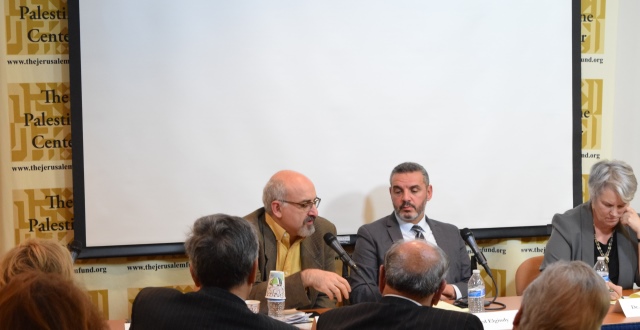
Dr. Subhi Ali:
We would like to resume our program with the second panel that I mentioned this morning. It is about policy, media and the Palestinian issue. I know of no one that can moderate it better from our team, than the Palestine Center Senior Scholar. That is Dr. Edmund Ghareeb, whom I have known probably since the early 1970s, when I was in Washington D.C. He has been with the Palestine Center Committee for a long time and has probably contributed more than most people in Washington D.C. I cannot say enough about how much we appreciate his help and his expertise. I would like to turn the microphone to Edmund, to share the next panel.
Dr. Edmund Ghareeb:
Thank you very much Subhi, for those kind words. I know that all forms of inflation are not necessary unpleasant. Good morning everyone, it is nice to see you all. I see so many friendly faces, and some new people who it is a pleasure to meet. I hope we will get a chance to meet some more later. We have had a fascinating discussion earlier. I think it was a very important one.
Clearly, this year is a very important year for many anniversaries. It is the 30th anniversary of the launching of the Intifada, which started in Gaza and later spread to all over the Palestinian Occupied Territories. It is also the 70th anniversary of the partition plan for Palestine, which never really saw the light of day. Nevertheless, this is probably the only recognition in international law for the [Palestinian state]. And of course, as Dr. Subhi mentioned, this is the 100th anniversary of the Balfour Declaration. It basically promised the Jews a homeland in Palestine, as long as it does not affect the civil and political rights of the local population. Of course, that was very difficult and we know that nothing came of that. One of the points that I want to mention, as we had a very good discussion about history, [is that] while I agree that you cannot dwell on history, it is very important that you understand history and learn from [its] lessons, so you can change the future. Unless you do that, you are not going to be able to make many changes.
Something else that I would like to mention, and I do not want to spend too much time because I am not a speaker, was a prophetic article I recently discovered. It was written by one of the Lebanese-American writers and it took me a couple of years to find out when it appeared. It appeared in 1915, by Mikha’il Na’ima, who is one of the best known and least political of the mahjar writers. He basically warned about the creation of a Jewish state in Palestine and it appeared one year before Sykes-Picot and two years before the Balfour Declaration. It was prophetic in every sense of the word. He warned about the Christian Zionists and their support for the Zionist movement – though he did not call them Christian Zionists. He warned about the role of the imperial powers (the British). He also was very critical of Palestinians for being silent. It is a very powerful piece.
In any case, we have an excellent panel of speakers, that are going to be talking about policy, the media and international law. Our first speaker will be Dr. Virginia Tilley from the Southern Illinois University. She has done a lot of work on the Palestinian question in international law. She has also done a lot of writing on ethnic and racial conflict. [This is relevant here today] as we can see the politics of identity. She has written a number of works on this issue. She was editor of Beyond Occupation: Apartheid, Colonialism and International Law in the Palestinian Territories. She coauthored a report with Richard Falk, which was commissioned by the UN’s ESCWA, a study titled “Israeli Practices Towards Palestinians and the Question of Apartheid”. Our second speaker will be Khaled Elgindy, who is a fellow at the Brookings Institution’s Center for Middle East Policy. He has done a lot of work in this area. He was an advisor to the Palestinian leadership in Ramallah on permanent status negotiations from 2004-2009. He was a key participant in the Annapolis negotiations throughout to 2008. He also spent nine years in various political and policy related positions in the U.S. government, including being a staff member of the House International Relations Committee. He will be focusing on U.S. policy. Last but not least, is a good friend, Sam Husseini. He is a journalist that practices what journalism is supposed to be, which is questioning authority, speaking truth to power and playing watchdog, which is the role that the press ought to be playing. He will be focusing on the role of media in policy.
This topic is extremely important because we have seen western policies and U.S. policies enable the occupation in the Middle East. And so has the media. Many have ignored international law and that is why we have this panel of excellent speakers, who will address these issues. Let me invite Dr. Tilley to the podium.
Dr. Tilley:
Thank you. I am really happy to be here. It is like having oxygen, because usually when we are out in the world and talking, we struggle with so much lack of knowledge on the conflict. It is just liberating to be here and I thank the organizers very much for inviting me.
I was asked to speak on two completely different topics as the debate went forward. What I am going to do is the unwise strategy of trying to do both in a lousy 15 minutes. I have learned from Ali Abunimeh to never do something like this, because he is so well organized. But you will see why I am going to try to cover both, because they are so integrally related.
The first is the climate in the U.S. in particular, but also [in] the U.K. and Europe, for pressure on principle scholarship on Palestine. I do not have much to add on that. I think it is a climate of fear. It is a great deal of intimidation going on. There are some courageous fights going on and some victories. I think what is happening in the U.K. is particularly ominous. But we have seen some recent advances, such as the decision in California against a frivolous lawsuit brought by Israeli advocates. I am not going to talk about, [will] leap over all of that, and talk about more subtle forms of censorship. [I see that these] have impacted the conflict and suffering of Palestinian people under occupation and the racist laws within Israel itself. I am specifically interested in new forms of conflict resolution, concerning the demise of the two-state solution. We now see all these formulas saying it is dead. What I would like to point out, is that this strange cusp of paradigms between the one-state and two-state solutions has been translated through rather nefarious mechanisms into a form self-censorship. I am prepared to be corrected on this, but I think [it stems] from the pressure of NGOs brought on by funding leverage. The way I see this working is through the PA.
First, we must consider that the PA is a Bantustan government. It is often called [this], but far too little has been done to explain what that really means. There is insufficient knowledge about the South African model and the use of that term in this context. The Apartheid study that I did with Richard Falk for the U.N., clarified this further for me. The specific qualities of a Bantustan in an apartheid regime is to provide the trappings of a government without meaningful sovereignty. You allow domestic civil rule to deflect the demand for political rights. Political aspirations become centered around the Bantustan, rather than the dominating power. Security becomes the condition for remaining a Bantustan, for the leadership of the Bantustan to remain in power. This leadership must, above all, sustain security for the dominant power. That is the condition for their remaining in power, and they know this. This cultivates the collective logic that its the best the people can get under the circumstances that prevail. As well as that true sovereignty is down the road. But, in fact, sovereignty is never intended – this is crucial to understand about a Bantustan. It is designed to preclude meaningful sovereignty, because the dominant power cannot give sovereignty, for reasons to do with natural resources, demographic control and so forth. This means that the dominant power must sustain the Bantustan to serve that function. That is why funding for the Bantustan leadership is contingent on sustaining the Bantustan in a way that will deprive it of sovereignty. So the Bantustan masquerades as a two-solution, in which the rights of the excluded people will be achieved through partition down the line. Yet, the Bantustan itself becomes the principal agent for the repression of dissent against the limitations inherent to the Bantustan.
This means that funding to the PA and the endorsement for funding, become entangled with these conditions. This creates an increasing dilemma for sympathetic and solidarity NGOs, because they are made dependent on funding or the authorization of the PA. They cannot step out of line with that, because the PLO is the sole legitimate representative of Palestinians, and the PA is the successor of the PLO – which is highly problematic. Which means, that the energies of NGOs, trying to work in good faith to the solidarity and respect to the dominated people, find their energies co-opted into sustaining the Bantustan. The PA cannot allow any challenge to the Bantustan. The entire cadre of NGOs, (I have experience in this having been the coordinator of the committee for Palestine NGOs in North America), cannot diverge from what the PA wants. Pressure on NGOs creates a silence around the consequences of the Bantustan and the failure of the two-state solution, even though, every knows that it is dead.
The second form of censorship I see is among my colleagues. It has two causes. One, deviating from NGO positions has major costs. We value those networks highly – as we should. So becoming the outlier in situations like that, risks becoming an outlier. The second cause is that saying apartheid state, is damaging to careers. Strategic silence is advisable, particularly for the junior scholars, who would be idiots to go against the strong feelings of their senior scholars, who hold the power of tenure [as leverage over them]. There are two forms of censorship, in other words, operating: the funding mechanism which has entrapped the NGO community, and the psychological motivation of academics who do not want to be seen as rocking the boat. This combination has rendered a great silence about the apartheid question. I have been asked to attend four different conferences, since our U.N. report was released in March. I could not help noticing that I was asked in every one to talk about the media reaction to the apartheid report; not in one case was I asked to talk about the actual apartheid report.
Now I want to talk about the original reason I was invited here, and what I really liked about this conference, which was the question of international law and how it is pertinent to this conflict. Here we get to the importance of history – not to rehash history, but to illuminate what is going on now. Presently, the dedication to the two-state solution is argued as reflecting international consensus. The presumption is that the conflict represents a case of belligerent occupation. In this paradigm, Israel’s withdrawal from the occupied territories is essential and mandatory. This tenant is tied to another tenant, which is deemed unassailable by international lawyers – the admissibility of acquiring territory by force. This was a pillar of the post WWII international order. Therefore, abandoning the legal premise of belligerent occupation is illegitimate on every level. This whole thing is based on forgetting that the two-state solution already represents a paradigm shift from the original status of Palestine as a mandate territory and as a unified proto-state. That was the entire rationale for Balfour, etc.
If you have not read the Command Paper of 1922, I strongly suggest you look it up. The Balfour Declaration was articulated in great detail and the mandate for Palestine had the same principles. It was issued in company of the Command Paper of 1922, which specified that it would not be a Jewish state. The White Paper of 1929, in which the British were challenged by the Arab revolt to clarify their position, which they clarified again, that Palestine was never intended to be a Jewish state. Most important of all, the report of the second subcommittee of the U.N. Special Committee on Palestine, which confirmed the illegitimacy of occupation, and did an exhaustive review of why the occupation was illegal. I strongly recommend you read that, if you have not already. It is very difficult to find, because I think it has been strategically buried. We all know about paranoia, don’t we? I think it is the most important document, I think, in the history of the entire conflict.
Conflict resolution today is sought through a radical abandonment of the one-state model. This shift is seen as legitimate, but it is not. It is based partly on General Assembly Resolution 181 of 1947 and General Assembly Resolution 273 of 1949, admitting Israel to the U.N. When we look at 181, we find that it recommended conditions for partition that were not attained and were not envisioned in today’s two-state model either. The claim that Israel would remain a Jewish state, was explicitly rejected by 181: 181 called for two-states in economic union, that were not ethnic states and that had ethnic equality and protection. None of that pertains in any of the diplomacy today. If you read that text carefully, it makes explicit references to a body of debates that were still ongoing. It is, therefore, inconsistent and biased to reject a second rereading that is going from two-state to one-state, is illegitimate, as a shift. Especially, when it involves returning to the status quo ante that was arguably illegally abandoned. The one-state premise was abandoned for partition for measures that were, at the time and still would be today, illegal. Yet, the shift back to that first model, rejecting the illegality of partition, is being called illegitimate.
So this shift to a one-state premise: that partition was illegal and that abandoning belligerent occupation as the model to which to interpret the conflict, is consistent with international law – as two states are not. Here comes the apartheid finding. Apartheid finding highlights that partition is unacceptable because it preserves Israel, in its present form, as an apartheid state. It says that Israel will be the same character, with the same racist laws and the same self-declared missions, within different borders. Was this admissible in South Africa? Was it okay to have a white apartheid state just with adjusted borders? It is unthinkable. In this case, that is what is being done. Sustaining apartheid is not admissible in international law, nor was it allowed in 181. The so-called international consensus of 181, must be deemed obsolete and cannot be said to provide any legitimacy in the sense of international opinion, to an apartheid regime. Apartheid is a crime against humanity, wherever it arises. Law aside, on a purely practical level, international experience is that apartheid is inherently destabilizing to international security. This has been reiterated by the General Assembly many times, based on evidence. Sustaining Israel’s apartheid state is not advisable for those seeking a stable peace, because it will preserve in one territory, the conditions for conflict, that are inherent to apartheid.
To conclude, and I am grateful to all off you for holding onto all of this, the two-state solution assumes that Israel, as a Jewish state in its present configuration, is consistent with the historical wishes of the international community and international law. But it is actually a historical deviation from precepts that were established about Palestine, up until 1947. To conflate Israel with an apartheid regime and to allow that, generates the imperative of rejecting that model, altogether. It exposes that it is fruitless and deeply offensive to sustain a state that is committing apartheid against a population. The solution, I suggest, is to remember that the first half-century of history on this conflict, was that it would be one state, that would be a state for all of its citizens. Thank you.
Khaled Elgindy:
Thank you Virgina, Edmund and you all for being here. I am always happy to be back at the Palestine Center. I, too, am going to have a slightly bifurcated presentation. I had come here with one set of ideas that I wanted to talk about; then Virginia’s presentation got me thinking in broader terms. I was going to focus on the Trump Administration’s policies in relation to past administrations, and so forth. I will still do that. But before I do, I think it might be useful to situate this particular moment, as I see it, in history.
Anyone that has followed Palestinian politics, understands that there are quite a few contradictions in U.S. policy as well as international legitimacy. But I would say that the United States has always been very ambivalent about this particular issue. Going back to Balfour, President Wilson was an enthusiastic supporter of Balfour, but the State Department would not let him publicly express that support. We see that same ambivalence carried out during the mandate period, carried by Roosevelt and Truman. Truman is most famous for flip-flopping back and forth about the issue, on the eve of the partition vote; and then subsequently, a few times afterwards. We also that same type of ambivalence in 1967, with regard to UNSC resolution 242. There was this notion of this inadmissibility of the acquisition of territory by force, but not so much. We will allow changes, we hear that echoed today in American policy, that there will be no return to the 1967 borders. So there has always been this tension inside U.S. policy. On one hand it tried to reflect an international consensus towards some sort of credible resolution. On the other hand, you had the pressures of domestic politics, which pulled American policies into different directions. I would argue that the Trump Administration is a continuation of that ambivalence. Maybe even a growing gap of official policy and unofficial policy. And certainly, there is a lack of clarity.
The second point, in terms of situating things in history, is that I see a lot of similarities between this particular moment and the eve of the 1967 war. We have a very complacent and status-quo friendly Israel and even a sense of triumphalism in the Israeli government. On the eve of the 1967 war, there was a general contentment with the status quo in Israel. You had a weak Palestinian leadership that was not fully representative. The PLO existed but, at the time, was not really representative. Groups like Fatah, had not yet taken over the PLO. Also, one very important point, which I alluded to, was the erosion of what we now call terms of reference for a peace process. These are the key pillars that underpin American diplomacy on how to resolve this hundred-year conflict between Arabs and Jews in Palestine and Israel. As we all know, today, the pillar of American and international policy on this issue, is UNSC resolution 242. But before 242 and 338, there was 181 and 194. In that period between 1948 and 1967, these were the two pillars of American policy – the partition resolution and 194 on the refugees. We see how that conflict plays out in American politics in the early 40s, how do we implement either of these? Of course, the partition plan was abandoned immediately. But there was consideration at least given to the idea of refugees, which was highly destabilizing if not just a humanitarian crisis. Fast forward to the end of this period: on the eve of the 1967 war, there was no sense at all that either of these principles had relevance. I would argue that we are in a very similar moment. There is a certain amount of lip service paid to UNSC resolution 242 and to a two-state solution, but the realities on the ground and the political realities are moving in a different direction.
Those terms of reference, that the peace process was based on for so many years, have all but disappeared. We see that reflected in the current political environment in Washington. This takes me to the next focus of my talk today: the Trump Administration. The Trump Administration has said to be working on a major peace initiative that they are going to announce early next year. Yet, we are almost a full year into this administration, and we have not heard any public announcements in favor of a two-state solution. The president wants to achieve the ultimate deal, but cannot say “Palestinian state”. At the same time, we see a Republican controlled Congress, in which that party has removed all language from its platform related to two-state. I think we are already in this period, that we are so far from those terms of reference, not just in reality, but psychologically and politically; much of Washington is already post-242 and post two-state solution.
What does that all mean? I will get to that in a minute. We see an ambivalence and a lack of clarity. We also see Congress move towards denormalizing with the Palestinian leadership. The process that began in the 1990s, in which Yasser Arafat was received at the White House some dozen or so times; there were very close relations between him and President Clinton; and budding relations at the economic and security level. We now see new legislation in Congress aimed at cutting most aid to the PA. I think it is the beginning of this process of denormalization with the Palestinian leadership. All of this is to say that we are in a moment where, on the one hand, there is a real lack of clarity, but there is also an opportunity to break with all these past failures, and create something new.
The last point that I will leave you with, in terms of my thinking on what might fill this vacuum that exists – I will make two points. The first thing is Palestinian leadership. With all that is happening and all the trend lines being very negative in the region, inside Palestinian politics, inside Israeli politics and inside American politics, I think that the real problem for Palestinians is a lack of leadership. As most of you know, President Mahmoud Abbas has very serious legitimacy issues. There is of course a division, within the Palestinian ranks in the Occupied Territories. And most importantly, there is no real political or diplomatic strategy on how to resolve these very pressing issues. I think the number one priority is not a diplomatic initiative by the Trump Administration or the international community, it is mainly to fix the Palestinian house and put it in order. Looking forward, in terms of future, what might fill this vacuum politically or diplomatically, I think we have to look beyond the traditional ideas of partition or two-state solution, particularly as it is conceived of in Washington – like the Clinton parameters.
We must think more in terms of creative solutions, not necessarily a one-state solution, as I do not see that as something that is politically viable for a number of reasons. I do not see a political constituency for this on either side; there are no political movements or parties that influence the political discourse that have embraced the idea. You have, of course, a very serious problem on the Israeli side with the idea of a one-state solution. But I do think we need to start investigating new thinking, not just in terms of alternatives to a two-state solution, but within a two-state solution. I think we need to rethink ideas of sovereignty. It is conceivable to have two nation states that exist in Israel and Palestine, perhaps with open borders, perhaps with some sort of shared sovereignty,in part or whole of the territory. These, in my opinion, are a much equitable version of the current reality of a one-state reality that is highly imbalanced, with a dominant group over another. But it is also, I think, a bit high in the sky to imagine that Israel is going to pull out settlers from what, in their view, is a biblical heartland. I think we have to reimagine the solutions that exist along the spectrum of one-state/two-state. Thank you.
Sam Husseini:
Thank you to the Palestine Center for inviting me and putting this on. I would like the thank the subtitle of this meeting: “Adversity on all Fronts”, [which] I think does speak to our current moment. I am going to try to deal with it on a policy and media realm. I am going to talk about some possible solutions, at least for the media realm. My main work for the Institute for Public Accuracy, I should say, is a bit unfair, because we put out stuff on a lot of different issues. Contrary to what you expect, I am no longer an expert on Palestine, per say, but it informs a great deal of what I do.
I would like to begin by noting the media framework of the propaganda model of Edward Herrman. He died this last Saturday, on the 99th anniversary of World War I. He wrote very specifically about the propaganda model of corporations, that is for the benefit of elites. I think I took his critique of media, too much to heart. When I learned the news of his death, I tweeted out about it and got hundreds of retweets. Then it took me 48 hours – I am going to begin on a note of self-criticism – before it occurred to me that I should tell someone in the media about this. I finally did that yesterday. Low and behold today, an obituary was written in the Washington Post. Edward Herrman was a real gentlemen, incredibly soft spoken, but also increasingly blunt. So let me read an excerpt from a piece that he wrote, that speaks to the framework on how we might see the Palestinian issue, that does not get portrayed. This is from 2006: “With Israel engaged, once again, in a major war of aggression with Lebanon, and protected once again from any effective global response by the power of the U.S. veto, it becomes clear that the central global problem of organized violence and lawlessness in the 21st century, lays in the aims, collaboration and power of the U.S.-Israeli axis. The partners in aggression and state terrorism reinforce one another’s projection of power. The out of control superpower protects its regional client’s ethnic cleansing. While the Israeli lobby within the U.S. supports the violent projection of power, by the U.S., which provides excellent cover for Israel’s escalating regional violence.” I think that is a pretty good summary of the situation. Many critics of Israel have gotten sucked into not being so blunt about it. But the ascendency of our new president demonstrates a certain hunger for blunt conversation and discussion about the world’s problems.
Part of what I think we need to be careful about is some terminology. I never tire, and not specifically to the Palestinian issue, of the euphemisms that get used. Like “defense budget”, [that] get used by people who are presumably for cutting the so-called “defense budget”. Once you use the term defense budget, you have lost half the game, by not calling it a military budget, or like Chas Freeman (a realist) calls it an “offense budget”. So once you enter into parameters of discussion of Israel’s democracy, as the United States engaged in a “peace process”, where the goal is stability, [you lose half the game once again]. This idea of states versus actual goals, is fundamental to understanding what is going on. Once you buy into the idea that states goals have anything to do with the actual goals, you become a pawn in the game; like the U.S. is actually sad at the outcomes in Syria and Iraq.
You go back to someone like Richard Perle, who in 1996 wrote the “Securing the Realm” document for Netenyahu, where they basically talk about the decapitation of relatively independent Arab states in a de facto alliance with the monarchies. This goes way back and we see it now with Saudi Arabia and Israel, far more openly, colluding vis a vis the situation in Lebanon. I think that this spells an incredible threat to the Palestinian people and the people of the region. Israel benefits greatly from the decapitation of Syria and Iraq. I don’t even know what the goal of the United States was. Was the U.S. goal regime change in Syria? Or was it simply regime deflation? I think every regime, we talked about South African, and I am certainly no expert, so correct me if I am wrong. But one of the first things he said when he went to the U.N. was thanking the front lines states around South Africa. The Baaths in Iraq were all [inaudible] among the so-called Neo-cons in the 1980s, when they were fighting Iran. This is classic colonialism, that does not get communicated. I am singling out the Saudis, although I think that they are the current dominant collaborator and need to be called out on it to ensure that it does translate into further calamities for the region.
The goal of this vision is a sea of Arabs. As Profesor Herrman says, the U.S.-Israeli axis will turn on the collaborators. Iraq was useful and they [the U.S.-Israeli axis] armed both [Iraq and Iran]. We see patterns of that vis a vis Syria. Keep the conflict going for as long as possible.Trump, in an honest moment said, to let them keep killing each other, in a Republican debate. Which is kind of funny because when he said it, I had already thought that that was the unstated policy and it was almost a relief to hear someone say it, even though he is pretending like it is not the actual policy. The media terrain is very dangerous right now. Rick Sanchez in 2014, if people recall, had a show on CNN that did not last terribly wrong. It was highly critical of the Israeli attacks on Gaza that year. Presumably, for other reasons, he was let go the following year. He has since gone onto the ADL to Israel and is now very laudatory of Israel. It is a sort of careerist path. Octavia Nasser, who was never critical of Israel, but she tweeted something reverential of a spiritual leader who was in line with Hezbollah and lost her job at CNN. Anybody, in the terrain of prominent figures, I do not see anyone that is going to ask any questions about Israeli policy. Whether now, that it is sort of on the back-burner, or whether it becomes on the front-burner, as it inevitably will.
The rubric of the dominant structure of MSNBC and Fox, that is of political gamesmanship and hackery, has further eviscerated journalism. There is a collusion there, too, when the “progressives” on MSNBC and the right-wingers on Fox, all have inherent pro-Israeli assumptions. If and when Trump allows Israel to make an explicit move on the Palestinians, one can expect that they will cooperate. Van Jones on CNN, called Trump presidential when he helped bomb Yemen. His critique on Trump in Syria, is that he did not go far enough. We saw a similar pattern with Clinton. There are openings, though. The best thing I have seen on CNN regarding Palestine, if anyone remembers about a year ago, was Anthony Bourdain. He actually went there and humanized people in Gaza. That’s it right there, what did I say? People in Gaza? The term Palestinian has diminished in time. Because Israel’s oppression differs in the West Bank and Gaza, we now talk more about the West Bank and Gaza; and less about Palestinians. I think that that is an insidious development.
Globally, various media are tied to state actors. BBC, Aljazeera, RT, Al-Manar; therefore, they can all be a part of the same proxy situation. I think what we have now is a situation where Saudi Arabia is threatening Qatar, the U.S. is threatening Iran and it might be a threat to say “back off while we do what we do”. It could be in Lebanon, in Syria or against the Palestinians. It is a combination of threat and complicity. I think that is the dynamic that we are seeing and it is incredibly dangerous. Particularly now, the great media threat is what is going to develop on social media. Whatever your stance on the whole Russia [situation], the prospects of the General Counsels of Twitter, Facebook and Google being called up to Congress [somehow gets pushed aside]. Not to say: “what are you doing that is undermining U.S. democracy, in terms of your secret algorithms. But to determine the news that each and every one of us gets, in which you have all the information on us and we have no information on you.” It is cast in a xenophobic anti-Russia [light].
Jumping ahead, can I show this video? Part of what I do is putting out news releases, but being in D.C., when I can, I like to ask tough questions of political figures. Sometimes I do that at the [National] Press Club, where I have a tiny office. I used to do that on Sunday mornings, when I would to the Sunday morning chat shows. This is a video of me, several years ago before [Vice President Pence] came to prominence, asking about one of the elephants in the room that people in this town do not want to talk about.
[Video clips plays]
I think there is a substantial opportunity in terms of solutions. I think one of them is to ask tough questions of political players. I think that that is one of the major opportunities. It could take the form of activism, by challenging people, or by journalism through a fair and professional way of asking people tough questions. It should be a huge part of what journalism is, but it is not. When tough questions are asked, [it is considered] political hackery to point out the hypocrisy of the other side. I think that this a substantial opening that can be done with minimal resources. I think that the answers to these tough questions that are asked, should be clipped and utilized through the power of the internet. I do not trust Facebook or Twitter, but we need to utilize the opening that we have. I helped get Edward Herrman’s obituary into the Washington Post, despite the fact that I think that it is an anathema. [Herrman] is a major critic of them structurally to the core. I [also] did a news release on the Hunger Strikes, and it took a long time to do that.
I think that activists can and should organize, not simply get good analysis out there. Groups like the Institute for Public Accuracy need to put a human face on the victims of horrific policies. That might not mean getting a good analyst out there. It might mean getting a family member of a hunger striker for example, who is reasonably articulate, and getting them the media prominence, rather than describing the oppressive nature of much of what Israel does. When the next Israeli strike happens, there need to be things in place: phone connections of people on the ground, back-up batteries for people on the ground, forums like this that are being live streamed, which I think is delightful. To have, in a situation like that, daily news conferences to debunk the government lies, from all sides, that are happening by serious scholars. There is a substantial opening to be doing something like that and to be using the technology that is there for better ends. One feature of Twitter that is very good, is TwitterLists, which is getting more and more buried as they update it. What I am trying to build is a web page of lists, like a list on Palestine. I want to have different lists on different issues to try and herd cats. There is a ton of information coming out, and [we need to figure out] how to distill it all and use the technology to do so in a fashion that is digestible and presentable. So despite all the obstacles, I think that there are serious opportunities. Thank you.
