
Dr. Subhi Ali:
Good morning. I am Subhi Ali, Chairman of the Jerusalem Fund and Palestine Center. It is my distinct pleasure to welcome all of you this morning, on a Friday morning in Washington D.C, the capital of everything. Today, we have a great program for you. We have three panels, two in the morning and one in the afternoon. I believe they will touch on all the issues that encompass the Palestinian struggle at this time. This is a special time in the Middle East and I believe that the panels will be most interesting. We have a stellar program. Our program comes at the occasion of the 100th anniversary of the Balfour Declaration, which everyone here is aware of.
We have three panels. The first panel is that of the “Occupation and Israel’s Human Rights Violations”. This [panel] will be moderated by the Palestine Center Treasurer, Dr. Eid Mustafa. The second panel will be “The Policy, Media and the Palestine Issue” and will be moderated by the Palestine Center Senior Scholar, Dr. Edmund Ghareeb. The third panel, this afternoon, will encompass “Jerusalem, Gaza and BDS”. It will be moderated by Palestine Center Committee Member Said Arikat. Before I pass the microphone to Dr. Mustafa, I would like to set some ground rules. Please silence your phones, I have already done mine. And in the Q&A period after each panel, please keep your questions to one per person, until everyone has had their chance. Please keep them to questions and not comments or speeches, we have had that problem before. I am going to ask Dr. Mustafa to start the first panel.
Dr. Eid Mustafa:
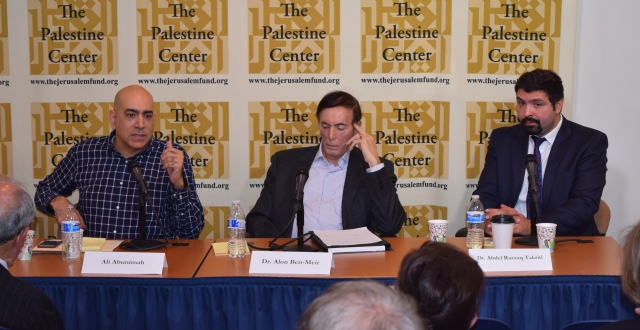
I would also like to welcome each and every one of you to this special day for us. Thank you Dr. Ali for your introduction. The first panel, as Dr. Ali mentioned, will be discussing the occupation and Israeli human rights violations. Our speakers will discuss the 50-year Israeli occupation. Ali Abunimah will discuss the Palestinian Authority’s security coordination with the Israeli occupation forces. Dr. Abdel Razzaq Takriti will discuss resistance to current colonial policy. Dr. Alon Ben-Meir will discuss Israeli human rights violations against Palestinians, the overall process and the psychological dimension of the conflict.
Ali Abunimah to my far right, is the Co-founder and Executive Director of the widely acclaimed Electronic Intifada, a non-profit independent online publication focusing on Palestine. I highly recommend it. He is the author of One Country: A Bold Proposal to End Israeli-Palestinian Impasse and The Battle for Justice in Palestine. He has been an active member of the movement for justice in Palestine for many years.
Alon Ben-Meir, in the middle of the table, is a Professor and Senior Fellow at New York University’s Center for Global Affairs and the Senior Fellow at the World Policy Institute. He hosts “Global Leaders: Conversations with Alon Ben-Meir”, a speaking series of debates and conversations with top policymakers from around the world. It is held at NYU each semester. He writes a weekly article that appears in scores of magazines and websites, including Huffington Post, Jerusalem Post, Middle East Times, Times of Israel and many others, in Arabic and in English. He has authored seven books related to the Middle East. He is currently working on another about the psychological dimension of the Israeli-Palestinian conflict.
To my immediate right is Dr. Abdel Razzaq Takriti. He is a great addition to our community in Texas, welcome. He is an Associate Professor and Inaugural Holder of the Arab-American Educational Foundation Chair in Modern Arab History, at the University of Houston. He is the author of the award-winning book, Monsoon Revolutions: Republicans, Sultans and Empires in Oman, 1965-1976. He is also the co-author and co-curator with Professor Karma Nabulsi of the Palestinian revolution website:learnpalestine.politics.ox.ac.uk. Professor Takriti holds a Doctor of Philosophy from St. Anthony’s College, University of Oxford and is a fellow of the Royal Historical Society.
Please help me welcome our speakers. Each speaker will speak for 15 minutes, followed by questions and answers. Ali Abunimeh will start, followed by Abdel Razzaq Takriti and last, but not least, Dr. Alon Ben-Meir, at his request. Thank you.
Ali Abunimah:
Thank you Dr. Eid and Dr. Ali and thank you for the Palestine Center for having me back. It is always a pleasure to be among friends, as many of you are. [It is also a pleasure] to see new faces, who I hope will find our comments beneficial. In just a few minutes, we have all been given a tall order. The question that I have been asked to discuss, the broad theme is, the occupation and Israel’s human rights violations with a particular focus on the PA. What I thought I would do is step back and take a look at the questions critically.
I think that the framing of the question “the occupation and Israel’s human rights violations” contains some assumptions that are very very common in all of our discussions about Palestine, going back many decades, which is that Israel’s human rights violations, which of course are legion and very well documented, are somehow a thing that exists separate from Israel, and can be addressed or remedied separate from Israel itself. There is a whole industry to do that. There are many human rights organizations, Palestine/Israel international [institutions], which exist to do that. Don’t misunderstand what I am saying, they do critically important work, documenting these abuses. There is of course, the European Union, which pretends to care about human rights and talks about the “human rights dialogue” with Israel, where in their model, Israel [is] this state and there are these unfortunate human rights violations. And if [the EU] gives them these incentives and rewards, they will stop their human rights violations. That is a very common framework.
I think, it’s important, especially at this moment of the Balfour centenary, to really understand that Zionism is a system that is founded on the denial of the existence of the Palestinian people. Zionism is a system that always has and still does, seek the destruction of the Palestinian people. Zionism posits that the Palestinians do not exist as a people, but it sometimes has to grudgingly accept the reality that they do exist. But because they exist, and refuse to be negated, denied and destroyed, a great amount of violence is needed to suppress that reality and try to suppress the resistance of the Palestinian people. That is what I mean by human rights violations. Really, we are talking about everything from daily abuses to genocide. All of this is foundational to Zionism and the Israeli state was founded on the destruction of Palestine, the destruction of the existing community and the expulsion of its people. This wasn’t, of course, a one-time event. It is something that has continued throughout the history of the Israeli entity.
Even yesterday, in Haaretz, was published the declassified minutes of the cabinet meetings that followed after the 1967 war. Prime Minister Levi Eshkol spoke about the need to expel the Palestinians from the occupied West Bank and Gaza Strip. So from the very first moment, the Israeli leaders understood that they intended to conquer the territory forever. The problem was how to get rid of the people. He told the ministers that he “was working on the establishment of a unit or office that will engage in encouraging Arab immigration.” He added that, “We should deal with this issue quietly, calmly and covertly. We should find a way for them to emigrate to other countries and not just over to Jordan.” He also, and in a frightening premonition of the future that Israel created in Gaza, said that “in Gaza, precisely because of the suffocation and imprisonment there, maybe the Arabs will move out of the Gaza Strip.” That was in 1967 and look at the suffocation and imprisonment that Israel has imposed deliberately on the Gaza Ghetto.
[Prime Minister Eshkol] even said “perhaps if we do not give them enough water, they will have no choice, because the orchards will yellow and wither.” Of course, we see across Palestine, that Israel systematically deprives Palestinians of water in the Jordan Valley. And where it does not deprive them of water, it poisons the water, like in Gaza. By poisons, I mean that it creates the conditions in which the water becomes toxic to human life, through the destruction of the aquifers and the systematic destruction of the irrigation and water treatment facilities. [So much so] that the sea in Gaza is now so polluted, that even Israeli beaches are having to be closed. That is the only time it gets international headlines. This is the biological warfare that Israel wages on the Gaza Ghetto.
It is almost important to note, as is illustrated in the cabinet minutes of the time from Yigal Allon. As many of you know, [he is] the author of the so-called “Allon Plan”, that has formed the basis of every so-called peace plan ever since. It is to give the Palestinians some form of minimal autonomy while Israel controls the land. He told the cabinet that it was necessary “to thin the Galilee of Arabs.” This again illustrates that this Zionist project of the destruction of the Palestinian people, makes no distinction between Palestinians in the occupied West Bank, on one hand, and Palestinian citizens of the other. There are degrees of how Israel treats them. But fundamentally, all Palestinians are viewed by Zionism as a demographic threat and an obstacle to Zionist expansion and control. The Minister of Religious Affairs at the time, said “We must increase the number of Jews and take all possible measures to decrease the number of Arabs.” This sums up the entire policy of Zionism from the beginning until now.
Jump forward 50 years and [the statements discussed above] are in no way exceptional or out of character for Israeli leaders. You do not need to look far. You can look, for example, at the Israeli Deputy Prime Minister, Sakhi Hanegbi. He threatened a few months ago, a third Nakba against the Palestinians. He was referring to 1948 and 1967 and is threatening a third. Or you could take Ayalet Shaked, the Justice Minister of Israel, who notoriously published–I am very proud that the Electronic Intifada were the first to translate, publish and give it the global notoriety it deserves–which she called for the destruction of the Palestinian people, their towns, their villages, their elderly and the killing of Palestinian mothers who give birth to “little snakes”. This is genocidal language that you could take from the worst annals of history. This is the Justice Minister, who is received all over the world with a red carpet. Moshe Feiglin, who then Deputy Speaker of the Knesset who, during the Gaza War, published a post on Facebook calling “to concentrate the Palestinians in Gaza [even more than they are now] and exterminate them.” Concentrate and exterminate, his words.
You also do not need to go very far to see that the Israeli government and we are not talking about minor figures, but from the Prime Minister on down, they have absolutely no interest whatsoever in the so-called “Two-state Solution”. Their goal remains consistent with the foundational goal of Zionism, which is to conquer the land without the people. And if the people cannot be gotten rid of physically, then they must be gotten rid of politically by denying them civil rights. [This happens] in a system that is totalitarian as far as the Palestinians are concerned. It does not just affect Palestinians in the West Bank, Gaza or present-day Israel. It affects all Palestinians refugees as well, who are denied the right to return to their country, solely on the racist basis that they are not Jews.
This is an unprecedented demand from Israel, which has not been accepted in the case of any other country or conflict. For example, in Bosnia with the Dayton Accords, the right of return was fundamental. The fact that Serbs may not have wanted Muslim Bosnians to return home, or Muslim Bosnians may not have wanted Croat or Serb refugees to return home, had no value and no regard in International Law. The Dayton Accords were guaranteed by the United States, guaranteed the right of return regardless of the racial or ethnic prejudices of the authorities controlling the land which the refugees were returning to. In fact, more than half-a-million refugees returned under International Law. Nobody paid attention to what any Serbs or Croads may have said that these returning refugees were a demographic threat, because they were the wrong ethnicity or wrong religion. This right to be racist is one that is foundational to Zionism and cannot be separated from Zionism as a human rights abuse that somehow can be remedied while keeping a Zionist project in tact.
Where does the Palestinian Authority fit into this and its so-called security coordination with Israel? This is an old story, which is that every colonial and occupation regime eventually turns to natives to assist in its program of occupation and colonial control. Without going into detail, this is the function of the PA. This is the one principle, the one PA constant, everything else can be sacrificed (Jerusalem, the right of return, settlements, everything can be sacrificed in the eyes of the PA) except the security collaboration with Israel. To the extent that Mahmoud Abbas called it sacred, that is the word he used. That is the function that the PA plays. To the point that just the other day, the House Foreign Relations Committee approved a bill to cut off funding to the PA. Everytime I see that I laugh, members of Congress say that they want to cut off aid to the PA because of their incitement all the time. It never happens because aid to the PA is aid to Israel. And as President Obama explained when he was arguing for Congress to renew their aid, the PA helps Israel to protect the settlers. President Obama was telling the truth, it was not fake news when he said that the PA helps Israel to protect the settlements.
The last thing that I want to point out is the spirit of the Balfour Anniversary. I would recommend that you read the stunning article that my friend and colleague Joseph Massad of Columbia University wrote and that we published at the Electronic Intifada, going off a speech he gave at the National Assembly in France. [It went] into the history of the Balfour Declaration that explains that it is the fruit of the collaboration between European anti-Semites and Zionists. Balfour himself and all the British leaders were Christian Zionists, who shared the Zionist goal of transporting all of the Jews out of Europe, [as well as] stopping the flood of Jewish refugees from Europe into the U.K. at the time. What I want to underscore, is [that it is] not just the historical aspect, that this poisonous alliance is still at the heart of Zionism.
We see it today manifested in the close alliance developing between the 21st century Nazis in Europe and the U.S. and the Israeli far right. I am not just giving generalizations, lets be specific. Yehuda Glick, a Likud lawmaker who is at the forefront of the Al-Aqsa destruction movement, wrote the Likud Party’s platform on the Temple Mount. He is one of the most active in mainstreaming the idea of the destruction of the Al-Aqsa mosque and Dome of the Rock, in order to replace them with a Jewish temple. He has formed a very close political alliance with the leaders of Germany’s Alternative for Deutschland, a party of anti-Semitic neo-Nazis, as well as the so-called Freedom Party of Austria. We saw here in the U.S. just last Sunday, during the Zionist Organization of America gala, in which the loudest applause was reserved for the Hungarian Nazi, Sebastian Gorka. Not to mention Steve Bannon and others.
[It’s important] to recognize two things: the continuity from the beginning of the foundational Zionist goal of the destruction of the Palestinian people; and when they can’t be destroyed, to control them under a totalitarian system where they can exercise no rights. It was “apartheid” as it was accurately called in Dr. Virginia Tilley and Richard Falk’s report. I am sure we will be hearing about it today. On the other hand, the constant poisonous alliance between the most extreme anti-Jewish and in these days, Islamophobic, anti-immigrant, racist forces in the U.S. These are and have always been Israel’s friends. The way to end Israel’s human rights abuses is to end the system of Zionism and to replace it with a system of full, equal and guaranteed rights for everyone, regardless of their race, religion, or ethnicity. That is the future we should be working towards. Thank you.
Dr. Abdel Razzaq Takriti:
Thank you Dr. Ali and Dr. Eid. Thank you to the organizers of this wonderful event. I was actually hoping to speak last, not because I think the last word belongs to me, but because I want to think about the future along Palestinian lines. So even though I am in the middle, I hope you bear in mind that we always have to go back to the original point. That is what is the way forward and how can Palestinians take things forward.
I think to go towards to that goal, we need to step back in history and understand what Balfour was really about. It is no small deal that we are living the 100th anniversary of this incredible colonial crime. One of the things that strikes me about Balfour, is not just how or why it was conceived. Was it Christian Zionists that were behind it or was it British imperial interests? Those debates matter, but what is much more interesting is why the policy was never reversed. The British came into this terrain and found that the native population overwhelmingly did not want this population of settler colonists implanted on its land. Yet, the British consistently protected the project of establishing this settler colonial presence in this land. This eventually led to the eradication of the native presence to a great extent. It led to the realities that we see today. Part of the lack of reversal has to do with the outlooks of British policymakers.
There is a quote from Churchill that I always like to appeal to when we think about this situation. In 1937, we had one of those periodic exercises where the British were confronting a major Palestinian rebellion and had to reevaluate what they were doing in Palestine. So they established the Peel Commission and were soliciting testimony from different leaders. One of them was Winston Churchill and he gave a confidential testimony in which he explained his logic for why Palestinians should have no political representation to the land and why they did not have any rights to the land. He said: “I do not agree that a dog and a manger has the final right to the manger, if though he had layn there for a very long time. I do not admit that right, I do not admit for instance, that a great wrong has been done to the red Indians of America or the black people of Australia. I do not admit that a wrong has been done to these people by the fact that a stronger race, a higher grade race, a more worldly wise race, to put it that way, has come in and taken their place”. This was not just a rhetorical exercise on his part, he was not intervening in a public debate or promoting a campaign. This is how he thought and this guy is the Secretary of the colony in the period when the British Mandate was established in Palestine. This is what we were dealing with then, and to some extent, it is what we are dealing with today.
We have a basic idea that is that Palestinian rights are inferior to Jewish rights in that land, currently Israeli rights. This has an impact on the engineering of institutions and the way political events, on the ground, unfold. So, what makes Balfour so astonishing is not that it was just a settlement program. But also, it did not recognize and omitted Palestinian political rights. It did not mention Palestinian people. Secondly, it talks about civil and religious rights, if you go back to the text, but it omits any form of political rights. In the meantime, when the British administration was set up in Palestine, they recognized the political rights of the people that were not yet there. Already, Jews in Europe had political rights there by virtue of the British government recognizing Jewish agency as a representative of that population that was going to settle that land.
Why is that relevant in the present? It is relevant because Palestinians, since that moment, have been trying to establish their own political representation and bodies that could fight this. In the Mandate period, they established several Palestinian National Congresses. Then they had bodies that developed out of that, like the Arab Higher Committee, that came in very specific contexts. The British were trying to thwart this effort throughout. In the Peel Commission reports we saw why they were trying to thwart this effort. They actually say that if we had Palestinian representation there, we would not be able to pursue the settlement program. The [Palestinians] would oppose this formally and be better organized at doing it. It was important to keep this native population fragmented. It was important to keep it with multiple leaderships that had no coherent agenda. It was important to get some of those leaderships to be involved in containment policies and so forth. We saw that throughout the Mandate.
We had the majority of the Palestinian population rebelling and then some leaders, behind closed doors, trying to quiet things down and reach miserable little deals with this project that is out there to destroy them. Well the logic was always the same, if we do not get something now, then we will get nothing at all. Meanwhile, this project continued. This grinding machine is almost unstoppable in its force because it is a very focused force. Saying, we have this small piece of land, we must take it over. And we will do anything possible to remove this tiny little people that are on it. These tiny little people that are like the so-called red Indians of America or the black people of Australia. They need to be removed.
What does this mean now, when Palestinians were expelled eventually as a result of this Balfour policy, in 1948? They were in the worst position possible when it comes to their presence on the land, because they were no longer on it. But politically, they had some opening to be able to start thinking about how to organize themselves. They no longer had the British on top of them. They had the reality of being dispersed across several Arab states, all of which, for their own reasons, were hostile to the idea of Palestinians organizing and having independent organizational capacity. That is why between 1948 and 1964, we did not see an official Palestinian body representing the Palestinian people. There was the All-Palestine Government, but it was restricted to one office in Cairo. And it did not have recognition from Arab states. Throughout that period, Palestinians had to organize in ways that were underground and clandestine. They were basically establishing revolutionary movements and Arabist parties that were seeking to overthrow the status quo across the Arab world, with an eye to liberate Palestine. I know you know that story, but is always important to bring it back to the present and think about how it fits into our world now.
Those movements eventually allowed for the creation of a Palestinian political system, centered around the liberation of Palestine. And once the Palestinian National Representative body was created in 1964, there was the capacity to have a national liberation movement, with different pluralist ideologies operating under its umbrella. But you had a representation system and a way of bringing the people together. That is what the British effectively prevented in the past and what was effectively repressed in a later period. After the exit from Beirut, the pressure of 1980 and the signing of the Oslo [Accords], we lost that political system. We lost that ability to have a major anti-colonial movement that had its own clear agenda, which is liberation and return. It was not an agenda about building a state. Some historians now write that it was a search for a state. That is not true. That period was a search for a liberation and return. If you look at all the writings, if you ask the folks from that period, they all say the same thing. We wanted to liberate the land and return to it. They had a framework for doing so like every other national liberation movement. They had a national representative body, they had political parties related to that body and they had plans and ways of deliberating policy through the Palestine National Council. Which we have lost now.
The Palestine National Council now exists but in name, not in practice. The force of having something like that is immeasurable. When you are organized and have several million people who are inspired by the existence of a national movement, and put their energy in a focused way into overthrowing this colonial reality that Ali has so eloquently described, that is when you can do something. But at the moment, what has happened is that a parallel structure has been created, the Palestinian Authority. Which as Ali rightly pointed out, has been a structure that basically acts to contain Palestinian resistance. That is a big part of its current functions. It is not the only function that it plays, but it is a major one. That structure has taken over the PLO effectively, even though it was supposed to operate under the PLO. What it did is control the space. Now the President of the PA is also the Chairman of the PLO. The former role is more important than the latter, because all the money is in the PA. All that money is European and American money, and money that comes from sources that are hostile to the agenda of Palestinian freedom. They do not want to see the return of the refugees. They do not want to see genuine self-determination. They do not want to see an end to Israeli colonization. If they did, they would step sending nuclear weapons, fighter jets and all the machinery that does the killing, to Israel. They would stop giving diplomatic protection for this project that has been going on for the last 100 years. They would not be celebrating Balfour in the British Parliament, like they so shamefully did recently.
We have a problem in our political structure now. Our political institutions have been hijacked and have been frozen in space and time. The PLO is now only a stamp in Abu Mazen’s pocket. With it, he approves policies that are not popular and not acceptable with the Palestinian people and that do not accord with the Palestinian national consensus. So, what is the solution to that? Some said that we should rebuild that national movement and forget about the PLO. That is not good, considering the PLO was born in a very specific moment. The only moment in time that you could actually have national representation for the Palestinian people was 1964. There was no other year where it could have happened. Why? Because you had Gamal Abdel Nasser there and he put his full weight behind the idea to establish Palestinian representation. Now, first of all, you do not have leadership in the Arab World that is going to back this. On the contrary, they want to disperse the Palestinian people even further, and see them as a headache and obstacle. The Arab regional situation does not allow for the rejuvenation of any other body.
Secondly, our people need to reclaim the institutions that we already have. They do not need to reinvent the wheel. We already had a very well functioning formula. It had its problems but they could be overcome. But it was basically the same formula that was used in every single anti-colonial movement. In South Africa, they had the African National Congress. In Vietnam, they had their own national bodies that were dealing with this. In Algeria, they had the FLN. You need to have that, and we had the PLO. We still do, but in name only, because it has been hijacked. We need to free and be able to engage our young people in it. We need to be able to have our parliament, the Palestine National Council, there. That will fulfill certain needs for Palestinian communities across the world and remind people that Palestinian refugees are a part of the Palestinian body politic. At the moment, they have been expelled through the creation of the PA, who has elections. But the only people that can vote are in the West Bank and Gaza. That is very shameful and says that you are not Palestinian if you are not living in the West Bank and Gaza. But what about everybody else? They need to have a say in our political system. Every Palestinian -American child needs to be able to elect their representative to the PNC. And by doing [this], they will restore their connection to the national movement as a whole. Every Palestinian should have the option of being able to contribute to this struggle to liberate their land, through this national institution.
Our political architecture needs to be reformed and that is the way forward. That is the way we can develop a coherent strategy because we do not have a strategy to deal with this Israeli machine. We always talk about how bad it is, we always talk about the horrible realities going on. We talk about the variety of tactics that we are using and some of them are inspiring, like the BDS movement and others that are achieving success. But you cannot just have solidarity movements alone. You need to have solidarity structures, a national liberation movement and you need to mobilize geopolitical forces from across the world to support it. That is the only way and we know that from every anti-colonial case. Not just from our history, but from the history of all oppressed people across the world.
Dr. Alon Ben-Meir:
Good morning to all of you and thank you for having me. Thank you Eid for the invitation and your introduction. I will deviate somewhat from what has been said before me. But I want to say, from the very outset, that I have been and continue to be a supporter and fought for the establishment of an independent Palestinian state. I want to be categorical about my position in this regard, but because how to go about it is what matters to us today. Repeating the historical account of what happened 100 years ago and rehashing that history, however instructive it may be, is not going to bring the Palestinian people one step closer to establishing a Palestinian state. For us to think in real practical terms, we have to really change our approach, attitude and perception of what exists today to formulate a strategy about what works. Or else, we, with all due respect to the speakers before me, will be preaching to the convert. You do not need to be convinced about the Israeli occupation. It is evil and must end. You do not need to know what happened 20-30 years ago, all the violations of human rights that have occurred and will continue to occur, you know that. The question today for us is how do we change the picture and create an environment that is going to be conducive to establishing an independent Palestinian state. That must be the focus, rather than being a prisoner of the past. By hashing and rehashing, we are not going to get any closer than we were fifteen years ago.
I want to remind you of something else. With the policy that Palestinians have taken, however correct it may seem to most Palestinians, what has happened in the last 50 years of the occupation? We have 650,000 settlers, which is a result of what? Certainly, it is the result of the Israeli ambition, but would that have been possible had the Palestinian strategy been different? I want to speak about that, because it is extremely important. You must recognize today that what you have done in the last 50 years has produced no result, period. In fact, it made the situation considerably worse for Palestinians. We have to understand here is that the policy of resistance did not work and still is not working. Reaching out to the world, to the U.S. and the European community and trying to convince them about the Palestinian cause, however correct it is, has not produced any results. I must tell you, no matter what you try to do, as far as the international community is concerned, you are not going to make a significant change in the attitude of the U.S. and European countries. This is the position they have taken. Israel has been getting that support for the last 70 years. I do not think that is going to change in a dramatic way, unless you change your strategy.
Secondly, the current government is center and right of center. Netenyahu and his government are against the establishment of a Palestinian state, period. But to ignore the left and the left of center is a terrible mistake. I must tell you, if you want to change to this current dynamic, do not talk about the evils of this current government. There is a lot of evil that they are currently doing. But you need to reach out to the center and left of the Israel. I go there scores of times per year. You have communities in Israel, I dare to say 50-60 percent of the Israelis, want to see an end the Israeli-Palestinian conflict and want to see a Palestinian state. But you are not appealing to them when you lumpsum all of Israel as if it is a single entity. You need address yourself left and the Israeli center. To them you need to appeal, not the U.S. They are the ones that are fighting day-in and day-out, against their government, to try to achieve a solution to the conflict. But what we have been doing here is not allow ourself to examine what really needs to be done.
I address in my various writings and books that there is a psychological dimension to the conflict that has not been touched upon at all. There is a historic narrative, a religious narrative, an ideological narrative, and that has been reinforced for over 70 years. So if you go to a boy in the West Bank, he will recall the Intifada as if it happened yesterday. If you go to Israel and go to a boy that is ten years old, he will recall the Holocaust as if it happened yesterday. What we have done, what the Israelis have done, what the Palestinians have done, is the continued victimization of their own people by perpetuating this historic narrative. That has to stop.
The second thing that we need to understand is the acceptance of coexistence. Many Israelis will say that they want all of the land. Some Palestinians, like Hamas and others, also aim for the destruction of the state of Israel. But both sides must recognize that coexistence is not one of many options. It is the only option. To suggest that Israelis will someday be able to chase out all the Palestinians from the West Bank and Gaza is a completely baseless assumption. You know why? Look at your demographic growth. In 1948, there were only 170,000 Palestinians living in Israel. Today, there are 1.8 million. That is ten times. The Palestinian community grew between seven and ten times as much in the West Bank, Gaza and Israel. There is no way any Israeli government will be able to chase out the Palestinians. They realize one thing, coexistence is a reality and that will not change. The question is how do they want to coexist. Do they want to kill each other for the next 70 years? Or do they want to create a formula whereby they can live peacefully with one another? That is the choice. It is a choice for both the Palestinians and the Israelis. I maintain that no side wants to live under these present conditions for another 70 years.
We have to consider today the changing environment in the region. I believe that Abdel Razzaq mentioned this point. The changing environment in the Middle East, primarily the Arab states, you take the Gulf States led by Saudi Arabia, Egypt and Jordan, their focus today is on Iran. From their perspective, the threat to the Arab world today comes from Iran. The Palestinian-Israeli conflict is put on the back-burner. The strategy that I am suggesting you develop as Palestinians to see inroads is to consider all these elements; the changing environment of the region, the mutually correct claims of both sides. It has been said time and again, do Jews religious claim [to the land]? If you deny that, then this conflict is going to continue for another 70 years. Is there a historical account that gives the Jews a claim to the land? If you deny that, then you are perpetuating the conflict. Israel too must recognize that Palestinians have religious rights and historical rights, just the same. There is an ideological component that strengthens this religious and historical component.
What I am saying to you today, is that I want to see peace in my lifetime. You know 33 years ago to be exact, I wrote my Ph.D dissertation and it was called “Imperatives and Choices”. I preached the two-state solution and I received Palestinians as well as Israelis. How dare you speak about a Palestinian state, the Israelis would say. And the Palestinians would say that this is our land and we cannot allow the Israelis to have their own state. I was threatened and continued to be threatened to this day. I do not take the Israeli or Palestinian side because I think both were wrong many times and both were right many times. So please understand, to repeat [history] will not move you one single inch forward, unless you change direction.
When you talk about resistance, let me define what I think resistance is. It is not knifing and killing Israelis, how about civil disobedience? I was talking to the PA and asked them if they could organize 50,000 people to go into the streets without knives and without clubs. Just sit down and the whole world will pay attention to 50,000 men, women and children and their civil disobedience. You need the means by which you can approach this conflict in a peaceful manner and prove to the world that the Palestinians are a viable, peaceful community that deserve to have their own state. And that Israel under no circumstances will be able prevent that from happening.
I will conclude too on this: today you have a strong center and left of center community in Israel. They want to have peace, [so] appeal to them. Appeal to the Israeli left, because this government today will not allow for the establishment of Palestinian state, period. You need a change of government. The only government that can make that difference is a government composed of the left and the center. To that you need to appeal, not to the United Nations. To those Israelis who want to have peace, they are able to do so as long as they get that kind of narrative from Palestinians who support their ideas. Many Israelis from the left and center are afraid to talk today because they are labeled as traitors if they talk about the Palestinians. You, the Palestinians, need to give them the opportunity to see that we the Palestinians want peace and that our resistance is going to be peaceful. Strengthen the hand of the left. There is an election in 2019, this is the time to rebuild those kinds of bridges by beginning that people to people reconciliation process. That is what you need to change the dynamic of the conflict, through reconciliation and allowing a new government to arise in Israel. Only then can we talk about the future of the Palestinian people living free in a democratic state called Palestine.
