
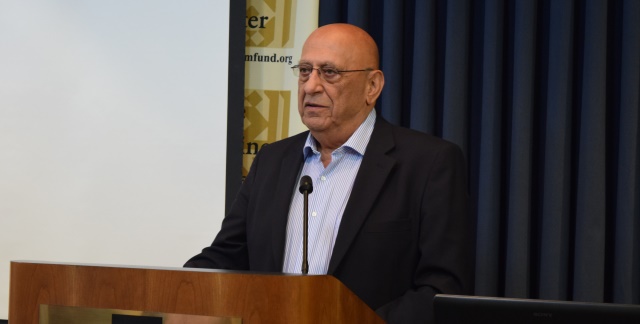
Dr. Fouad Moughrabi
Zeina:
Good afternoon everyone. Welcome to The Jerusalem Fund and our educational program, The Palestine Center. And welcome also to our online audience. My name is Zeina Azzam and I’m the executive director here. On behalf of the fund’s board and staff, I’d like to welcome you all to our annual Hisham Sharabi Memorial Lecture. A special welcome goes to Dr. Fouad Moughrabi, our distinguished lecturer today. We are so pleased to have you with us.
This memorial lecture is named after professor Hisham Sharabi, who was one of the co-founders of our organization, The Jerusalem Fund for Education & Community Development. Dr. Sharabi served as the chairman of our board of directors from 1977, when the fund was founded until his death in 2005. Through this event we honor the memory and vast body of work of Hisham Sharabi. From 1953 until 1998 – that’s 45 years – he was Professor of European Intellectual History at Georgetown University, where he also held the Omar al Mukhtar Chair of Arab Culture. Dr. Sharabi was one of the founders in 1975 of Georgetown’s Center for Contemporary Arab Studies, one of the premier institutions of its kind in the United States. We’re fortunate to have Dr. Judith Tucker and Dr. Halim Barakat who have been long associated with that center. Indeed, Dr. Sharabi devoted much of his professional energies towards building institutions of public education and advocacy for Palestine.
Hisham Sharabi was from Jaffa, the Palestinian city. In 1998, he wrote the following:
“In Jaffa, one of my favorite places as a small boy was the city’s ancient harbor. I visited the harbor when I went back in the fall of 1993. Standing where I often stood so many years ago, I felt only the bitterness and the anger all Palestinians feel, when they go back to where they were born, and where their grandparents were born, and spent their lives before becoming refugees. I tried to remind myself of what sustained all Palestinian refugees over the long years of exile. This land is not a memory. It is not lost. It is out there where it could be seen and touched, a patrimony that can never be given up or taken away.”
Today Fouad Moughrabi will be talking to us about the role of education, and the survival and flourishing of the Palestinian community. He will examine the problems facing Palestinian education under occupation and prospects for the future. Dr. Moughrabi will explore questions like what reforms are needed in the Palestinian educational system, how can Palestinian institutions cope with the problems of military occupation, what does a successful educational institution look like, and what is the role of Palestinian civil society. We will have a question and discussion period at the end, and our livestream audience can send questions via twitter to @palestinecenter. Those online and in our audience can also join in the conversation on twitter using #hsml16 – that’s Hisham Sharabi Memorial Lecture, hsml 16.
So now let me introduce our speaker more fully. Dr. Fouad Moughrabi is Emeritus Professor of Political Science and former department head at the University of Tennessee at Chattanooga. He has written extensively in the areas of Middle East Studies and political psychology. He returned to Palestine in 1999 to establish the Qattan Center for Educational Research and Development, where he served as director until 2004, and then as senior advisor. Previously he served as a Fullbright Visiting Professor at Birzeit University, and worked with the late professor Ibrahim Abu Lughod on the first Palestinian educational curriculum project. Professor Moughrabi holds a BA and an MA in Political Science from Duke University and a PhD in Political Science from the University of Grenobles, France. His works have appeared in various journals, including The International Journal of Middle East Studies, The Middle East Journal, The Journal of Palestine Studies, Theory and Society, Social Justice, and Radical History Review. In addition, he has conducted numerous public opinion polls with Gallup, the Survey Research Center, and other organizations on US attitudes towards the Middle East. He is co-author of the book, Public Opinion and the Palestine Question, which was published by St. Martin’s press.
Dr. Moughrabi’s talk is titled, “Palestinian Education for the 21st Century”. Please join me in welcoming him.
Fouad Moughrabi:
Thank you Zeina. I’m especially happy to be here today, because, for a variety of reasons, but one in particular, and I have to share it with you. When I was a junior at Duke University, sometime around 1963, one of my teachers at the time, a man called Proctor Harris, decided to convene a small conference on the Middle East. And he invited a number of people, and he invited Hisham Sharabi, who was at Georgetown [University] at the time. And they asked me to go and meet him, pick him up at the airport, show him around, and so on, which I did. And I remember sitting there in the audience, listening to Professor Sharabi, and I still remember, distinctly, I remember the feeling I had. I was so impressed, and in awe, of the brilliance that he showed in his presentation and his comments, his philosophy, and so on. And I remember saying to myself, when I grow up, that is what I’m going to be like. And years later I remember telling him this, when we became colleagues and worked on different things together. I remember telling him and he was very flattered.
The last time I saw Hisham was in Jaffa, at Ibrahim Abu-Lughod’s funeral. This is a long story which merits telling by itself, but we took the body from Jerusalem to Jaffa because he wanted to be buried in Jaffa. Two weeks before he died, he was on an oxygen tank and had tubes in his nose and so on. He called me and he said, “Can we go to the sea?” I said, “Sure.” So I went with my wife and my son at the time, and we picked him up and we drove to Jaffa. Back in those days it was easy to drive straight through with very few checkpoints. And so we got to the sea and there’s a spot where he liked to be and where he used to swim as a young man. So we sat on the ledge there and my wife and my son went and played in the water, and we chatted for a while. And then, when it was time to leave, he says, “The Muslim cemetery is right on the side, in the corner,” right next to that spot where we were. He says, “You know, my father and my brother are buried here.” I said, “Yes, I know.” He says, “And me too.” I said, “Oh, Ok.” He says,” But you have to promise.” I said, “I promise. Don’t worry about it. It will happen.” It was a fairly complicated story but in the end we succeeded in getting him buried in Jaffa. But as we were walking down towards the cemetery, I saw Hisham. And he was standing there, looking kind of distraught, so he came over and we hugged and chatted, and he walked with me. Then people who were sitting there – this is an Arab quarter, asked “Whose funeral is this?” And I said,”This is Ibrahim Abu-Lughod’s funeral.” “Oh, he’s one of us. He’s from Jaffa. He’s ibn Jaffa.” I said, “Yes.” So they all got out of their houses and they joined the funeral march. And then all of a sudden Palestinian flags emerged, and all of a sudden Israelis in the midst who were infiltrating, jumped around, started taking, snapping pictures – they were crazy, and so on. But it became an emotional, nationalist demonstration where somebody was exercising his right to return, to be buried in his hometown.
What I’m going to talk about is education, and I think it’s a nice tribute to Hisham and his memory, mainly because education was important to him but also because institution-building was important to him, and I think that is an important issue. So I’ll talk about education in general and I’ll talk a little about what I did with the Qattan Foundation in Ramallah. I begin by a quotation from the Higher Committee for Review of the Process of Palestinian Education. This is recent, a report by a ministerial committee that was set up and took two years’ deliberations to study the educational situation and the process, and to make some recommendations. The basic conclusion is the following: “Education, as it currently stands, fails to meet the universally acknowledged criteria of quality and is in dire need of reform in all of it’s aspects. It’s widely acknowledged that Palestinian education is in a state of crisis, and needs comprehensive and radical reform.”
And this was the conclusion of this ministerial committee. At the same time, everyone knows what needs to be done to improve Palestinian education and how important a knowledge society is for any meaningful and sustainable economic development. The committee, consisting of some of the best and the brightest, deliberated for two years, held hearings and reviewed data, [with] in-depth reports and studies. They made a number of concrete and innovative recommendations for reforming the educational system in all of its aspects, including, by the way, eliminating the tawjihi exam, which is a very controversial thing. Dr. Sabri Seidom, one of the acting members of this committee, a well-educated and very competent person, who was an ardent advocate for reform, was then appointed Minister of Education. The question then is, why is nothing being done?
One obvious reason relates to the political paralysis and abysmal failure that characterizes Palestinian politics under Israeli occupation. Palestinians are deeply divided, as you know, between Fatah in the West Bank and Hamas in the Gaza Strip. Despite occasional half-hearted attempts at reunification, the division appears more and more deeply entrenched. In the second place, the current leadership is now increasingly discredited and lacks any legitimacy in the eyes of its people. Predicting the collapse of the national authority, Palestinian National Authority, is now commonplace. The question is when? The PNA is faced with a declining budget and the shrinking of donor money as a result of donor fatigue, complaints about misappropriation of funds, and the lack of progress towards ending the conflict. Therefore, if ability to govern and to sustain a bloated bureaucracy is in serious doubt, it is kept on life-support mainly because Israel prefers it this way.
In the third place, the Israeli occupation is clearly moving in the direction of full-fledged annexation at the level of daily reality. Israel continues to confiscate private Palestinian land and to build more settlements, without fanfare and without making general proclamations. Step by step, Israel establishes facts on the ground in much the same way as the Zionist movement has done throughout its history. Except now it is done in broad daylight.
Finally, for a variety of reasons, the so-called International community, mainly the US and Europe, appears to be reluctant to adopt any serious measures that would force an end to Israel’s creeping annexation of Palestinian lands, the Judaization of Jerusalem, and the savage daily attacks by the settlers.
At the Palestinian level there is a realization that the faint promise of Oslo has proven to be no more than a mirage. Oslo is dead and the prospect of a settlement based on a two state solution is gone. A new era of struggle has begun and it may take some time before things begin to change. In the meanwhile, Palestinian resistance is likely to go on and may assume various forms. Some of these include sharp increase in support for the Boycott, Divestment, Sanctions Movement at the international level. These efforts are sophisticated and well managed and are already yielding significant results to the extent that Israelis are talking openly about targeted assassinations of BDS activists. Other forms of struggle include the random individual acts of violence by young people that tend to be more desperate acts resulting from deep frustration and loss of hope. All this adds up to the following: Israel is likely to pay a high price for its continuing subjugation and mistreatment of the Palestinian people and will live in a heightened state of insecurity and fear as long as the occupation persists.
Under these conditions it is difficult to see how any significant political initiatives can be undertaken. However, education does present a rare opportunity for the PNA to undertake major reforms that could significantly boost its shattered image among the population. The Palestinians in general place a very large premium on education and are willing to make huge sacrifices to make sure their sons and daughters receive an excellent education. Given declining resources and the loss of land, investing in the only available asset named the human beings becomes the most vital necessity.
It is by now well known that educational reform is absolutely critical for economic development. And there are many examples throughout the world to show that. One would have thought therefore that education and not the various security agencies would have been given the highest priority in any budget. Sadly this has not been the case.
The education budget was given a substantial boost in the early period following the Oslo Accords by various donor countries as well as international agencies. The funds were used to upgrade a decaying system or infrastructure that was ignored during the years Israel was in control to keep up with population growth, to hire and train new teachers, and to begin producing new text books.
In general and to be fair, the Palestinian National Authority record had so far been a mixture. Some notable achievements were made under extremely difficult circumstances. I recall the period of the second intifada when schools were closed for long periods, Israeli tanks and armed personnel carriers roamed the streets of the major cities. Teachers as well as students had to find alternate routes to avoid checkpoints. The Israeli army entered the ministry of education building in Ramallah and ransacked offices, destroyed computers, and so on. To his credit Dr. Naim Abu Hommos, the minister of education at the time and his dedicated staff worked tirelessly to keep the system going and to make sure that students sit for their final exams and graduate on time.
At the same, mistakes were made and opportunities were missed.The very first thing the PNA did upon assuming the control of education in 1994 was to throw out the excellent curricular recommendations submitted by a taskforce led by the late professor Ibrahim Abu-Lughod whose project was funded by UNESCO. He assembled an excellent team of dedicated professionals who were able to produce a sophisticated blueprint for a modern, secular, and innovative curriculum for Palestinian education.
Instead, the PNA appointed its own team led by a mediocre education professor who happened to be a Muslim fundamentalist. They produced mediocre textbooks that were hailed a great achievement in Palestinian education, replacing old Jordanian textbooks used in the West Bank and Egyptian textbooks used in the Gaza Strip.
The bulk of the budget, the PNA budget, was devoted to funding the huge bureaucracy that was set up to run various ministries. The security services received 28 percent of the budget while education, including higher education, received only 18 percent. Additional funding came from donor countries or agencies such as the World Bank, UNESCO, and so on. To their credit, the PNA was able to maintain the education system, and so on.
The new curriculum mandated–this is another positive thing in the new curriculum that they did, and probably the only one that I know of–the new curriculum mandated that the English language be taught beginning in the first grade. The first curriculum committee recommended that and we thought it was extremely important. In later years, other languages such as French and Hebrew were offered as well.
When I taught at Birzeit [University] it was funny because this was 95-96 when I was a Fulbright Visiting Professor, and you were supposed to teach in Arabic but all the resources students had to read were in English. There was very little translated materials. There were varied levels of competency in English. But now I imagine that students, if I were to go back and teach at this particular moment, I would find that most of them would be able to read the English material fairly well. Back in 95-96 they weren’t because they began learning English in 4th grade. So that’s a fairly significant achievement.
By the way, I have in my own school, we have an ESL program and it’s full of Saudi students. Now give me a break, with all the incredible resources, how [do] they graduate students who need to have further training in the English language before they are admitted to the university in Saudi Arabia, which has all the resources you can imagine? But we don’t have that problem.
The results are somewhat encouraging. Three in particular are worth noting. One is that the literacy rate among the population stands at 91.9 percent, which is the highest in the Arab world. And the rate is 98.2 percent among 15 to 24 year olds. The UN’s education index lists Palestine with the lowest GDP, Gross Domestic Product, at 0.88, and Qatar with the highest GDP at 0.87. So we actually do much better than Qatar with immensely more resources.
Another import criteria comes from the results of the TIMSS test, that is Trends in International Mathematics and Science Study. This is an international test that is given to a variety of countries that are willing to take it at the fourth and eighth grade levels. In 2003 Palestinian public schools scored 427 average. UNRWA schools, because there are public schools and then there are other schools run by the United NAtions relief and works agency and then there are private schools. So 427 for the public schools run by the ministry, UNRWA schools scored average 444, and the private schools 491. To put these scores in perspective, the US scored 527, while Jordan, Egypt, Saudi Arabia, and Lebanon scored 475, 421, 398. So we did significantly better than both Lebanon and Saudi Arabia. A little bit in Egypt and a little bit less than Jordan.
Palestinian graduates, in general, are reasonably fluent in English and do well in higher education. Some of the graduates of the private schools such as the Friends School in Ramallah are accepted at elite American universities, usually with full scholarships, and [they] usually distinguish themselves. By now it is fairly well established that the Palestinians have one of the highest rates of university graduates in the world.
On the negative side, Palestinian bureaucrats have become adept at using terms in vogue in order to impress international donors. They often talk about decentralization, even as they set up a highly centralized system. They talk about moving away from the banking system of knowledge. Banking, this is a term that comes from Paolo Friere’s work about how, “I am knowledge and I am filling it in the brains of the students.” This is the banking system, by memorization and rote learning, and so on.
So they talk about moving away from the banking system of knowledge and pay lip service to critical thinking and problem solving, even as they establish a curriculum based on rote learning and memorization. They talk about teacher training and development, even as they set up programs and have little to do with what teachers actually need in their classrooms. They talk about the central role of the teacher, while they set up a system of inspectors who act as if teachers are guilty until proven innocent. And in our discussions with teachers at the Qatar Foundation, this comes up over and over again. These inspectors come to the schools unannounced and they come looking for problems in order to punish and they make life hell for them. All of these contradictions emerge from extensive focus group discussions that were carried out by the Qatar Foundation for Research and Development with school teachers in the early period between 1999 and 2004, and nothing has changed since then.
The few accomplishments and important gains that characterized the Oslo period gradually began to be reversed. With the possible exception of Naim Abu Hommos, most of the ministers of education have been weak and ineffective. It seems for our practical purpose, that education was relatively ignored, and had become a heavily bureaucratized routine operation. The status of teachers began to decline even further. For a number of years teachers would go months without receiving their salaries. Many of them were forced to look for additional jobs to make ends meet. Imagine this happens over and over again – we hear stories like that all the time, imagine students getting into a taxi only to find that their teacher is driving it. It is no accident that they recently went on a long strike, demanding better wages and working conditions. The central issue was they wanted to be treated with dignity, [it was about] more than money. They just wanted to be treated with dignity. And the word “dignity” became central for their demands. The strike brought together teachers, who belong to Fatah, Hamas, independents, and so on regardless of their political affiliations. They all got together and they held fast to the strike, and the strike by the way received fairly substantial support among the public and [was] dealt with very poorly by the Palestinian Authority.
Historically, one of the unique aspects of contemporary history is that Palestinian civil society always intervened to rescue education and to make it available for the youth. For example, during the years of the Mandate—these are interesting stories—villagers would raise funds in order to add rooms to schools or to build new schools for their children as a way of compensating for the failure of the mandate authorities to invest in education. That happened over and over again.
In the years following the Nakba, it was common to see students studying under street lights, which we did, I’m sure you did too [pointing to someone in the audience], because we didn’t have electricity, and til late into the night. Furthermore, Palestinians as volunteers, set up an alternative system of education during the first intifada when the Israeli authorities closed schools for long periods of time. In fact, the full story of Palestinian struggle for the right to education remains to be told in its fullest details. Images of school children going through and around checkpoints or climbing through fences and holes in the wall at great risk to their lives to reach their schools, are commonplace. This is indeed the story of heroism, sacrifice, and determination that I think is unparalleled in the modern world.
Palestinian teachers always played a significant role in nationalist education and nation building. Well known teachers like Abdul Latif Tibawi, Khalil Sakakini, Ahmad Sameh al-Khaldi, played a key and pioneering role in educational reform. One of the things I decided to do in building the Center was to reproduce, re-publish, some of these books. We republished Ahmad Sameh al-Khaldi’s book on education. When you read that book, it was I think 1939, I’m not sure of the exact date but he put it out ‘39 maybe or even before. When you read it, it is phenomenal how progressive and how modern, and the ideas are brilliant and how, you know, influenced by people like Dewey for example, and you realize that they’re open to the rest of the world in a very very sophisticated way, and then you wonder, what the hell did happen, you know? Of course we know what happened, but if things had developed in a normal way, Palestine would be a leading place for education in the Arab world. The famous Arab College graduated teachers who played an important role in Palestinian civil society, and some of them, by the way, went on to build societies in the oil-rich countries in the Gulf during the 1950s. The first labor force, skilled man-power, came from that group, graduates of the Arab College.
In the absence of state control, much of the accomplishments made by the Palestinians often occurred in the area of civil society. This is as true now as it has been for years, since the Mandate. I will briefly examine one such effort. I agreed to return to Palestine to establish the Qattan Center in 1999, in the fall of 1999. A general conceptual framework was provided by two consultants from Oxford University’s Department of Education, and served as a point of departure. With the assistance of my friend and late colleague, Ibrahim Abu Lughod, I began to hire a small team of teachers as potential researchers who were highly recommended by various people. It was quickly obvious that there was a scarcity of competent, already qualified, people, but we decided to look for capable young men and women and try to give them the proper training and to give them opportunities – send them overseas and so on.
I met with dozens of educators and community leaders in order to identify names and problem areas. I also tried to familiarize myself with similar experiments in India, Brazil, South Africa, Namibia, and some European countries. But, in particular, India and Brazil, South Africa, and Namibia. Theoretically, our work was inspired by the rich legacy of the Brazilian educator Paolo Friere and his disciples, most notably Carlo Stores of UCLA, [and] the late Maxine Greene from Teachers College in New York. We translated her superb book “Releasing the Imagination” and made it available to our teachers. And Michael Apple from the University of Wisconsin, whose superb work on the curriculum offered us unparalleled guidance. We decided after a considerable deliberation that improving teacher performance and knowledge in substantive areas are the key components in the process of improving education. Therefore, the question became, how to organize a research center that would contribute to developing the role of teachers. It was important for us that the research agenda would flow from the bottom up and therefore we held extensive focus group discussions with teachers, with various types of teachers, in order to identify problem areas and possible solutions, and then come up with a research agenda.
Initially, we adopted action research as a key tool, and this was important for a number of reasons. In the first place, this research tool set the researcher and the object of his/her research on an equal level. And therefore, it forces them to adopt a certain amount of humility. This was a novelty in our patriarchal culture, obviously, but it was important to instil humility among the researchers. We don’t want people to say, “Ok, I have the knowledge and I’m gonna share it with you, I’m gonna give it to you,” and so on. No. We work together on an equal footing and try to identify problems and solutions.
The researcher does not come in with superior knowledge that he or she wants to impart. And the second place, it encourages teachers to begin to think of themselves and to act as research practitioners. And in the third place, which is extremely important in my opinion, it establishes a common language, a new language, among these practitioners as well as a common frame of reference.
We would videotape teachers in their classrooms who were engaged in action research, and we began to accumulate a wealth of material that we highlighted at annual conferences where teachers talked about their experiences to other teachers. So we brought these teachers together. We videotaped, we found best practices, and so on, and gave them the attention they deserved. We also published in our newsletter narratives written by teachers who were involved in action research. The Center quickly accumulated a rich archive and contains data including videotapes of teachers doing actual research in addition to hundreds of taped hours of focus group discussions and so on.
The Center has also developed a unique program in the use of drama in education. Every year, and this is I think the tenth or twelfth year that a summer school three-year program is offered for carefully selected teachers from the West Bank, Gaza Strip, within the Green Line, Jordan, Lebanon, and so on. They do it in Jerash, in a beautiful place in Jerash. A number of distinguished educators and experts in the field come from the UK, Greece, and elsewhere. Some of the graduates have become accomplished teachers and are able to conduct workshops for other teachers throughout these various areas. So, they’re now trainers for other teachers.
A few years ago the foundation received additional funding to expand the science education track and to train science teachers according to modern standards. In addition, there is an ambitious plan to establish an interactive science museum in Palestine. There are several museums now. Palestine Museum is opening May 15th. It’s a beautiful, beautiful project that you can go and see it on the website. Another museum that I’ll talk about in a minute, in Bethlehem, a botanical garden and biodiversity museum of natural history that Mazin Qumsiyeh has put together, and then this project is now fairly well along the way, and we have a team, by the way, we have a team of young men and women who are in San Francisco now at the Exploratorium learning how to make things for the museum in order to illustrate scientific concepts and so on. And they’ll be there for the rest of the summer. And we also — I was able to raise enough money to send some teachers for Masters’ degrees and to various places to study museology. I didn’t know about the existence of that specialty until we started digging. A degree in—who would have thought that you can get a degree in museology? But it’s fantastic, it’s important, you have to train people to be able to run these things and so we will have the number of people who are able to do so.
One of the young men who is directing the science education track is one of the first hires I made, and he came to the US and did his PhD at the University of Illinois and I ran into his advisor at one of the conferences and he says, “Please, please tell me more, this is a young man who made nothing but straight A’s and he is fantastic.” So he came back and he is writing the science track and one of the recent stories of some of the things— there is a young woman called Vivian Sansour, you may have seen something on facebook by her. They’re setting up a seed bank, seed bank. A lot of plants and seeds are becoming extinct, and so they’re setting up a seed bank. There was a story in the Guardian about this on April 23rd that you may want to look up. It’s a fascinating thing. But she works with this project at the Qattan center and it’s something that we’re really proud of.
Initially our work was concentrated in the Ramallah area, and of course we opened a parallel office in Gaza. After a while, however, our research team often traveled to various parts of the West Bank in order to conduct workshops and so on, and in the early period we had no problem to go to Gaza to do training and workshops and so on. But then things fell apart and it became very difficult, so we stopped doing that and we started compensating by video conferences. But it’s not the same.
Our contact with teachers through workshops began to grow. Furthermore, we built an extensive library. We have a fairly substantial library, a specialized library, in education, where teachers and graduate students as well as educators come for assistance. And it’s heavily used. Eventually, something unexpected and reassuring happened, and just something we did not expect because I was worried, [I thought,] “How are we gonna— we don’t have unlimited resources, how are we going to make it— we can’t stay in Ramallah only, and how are we going to go to Jericho and Hebron,” and so on and so on. What happened eventually is that on their own initiatives teachers established clubs – what they call a muntada in Arabic – where they gathered together to discuss issues of common interest, to discuss new books, to see new educational films, and so on. We provided them with some assistance and supplied them teaching materials, videotapes and other resources. I appointed somebody in charge of coordinating matters with them, with these muntadas, these clubs, but we tried not to interfere in their internal affairs. We just let them do their own thing, but we gave them assistance, and therefore they became reproductions of our work and various parts of the West Bank.
In addition, the Qattan Foundation inaugurated three other important programs. One is a center for the child in Gaza, which houses an extensive library for children until the age of fifteen, in addition to a computer center, arts and crafts, and so on. And then there’s a music school in Gaza as well, and these remained functioning even during the Israeli attacks. Furthermore, the Foundation has an arts and culture program that identifies talented youth in different areas: literature, music, theater, the arts, poetry, and so on, fiction, [and] holds competitions and awards prizes for excellence. We appoint committees: Kamal Bulata served on a committee; a number of distinguished people are asked to serve on these, to be the jury to choose among the competitors. And a number of young Palestinian writers and artists have emerged through this program. Recently, for example, I logged onto a website called “Words Without Borders” I don’t know if you know that. Which publishes reviews of literature from various parts of the world. I was pleasantly surprised to see a review of a new novel by a young woman called Adania Shibli. Did you see that, by chance? Adania Shibli is a young Bedouin woman from inside Palestine, and she won the first prize for fiction, one of the first competitions. Now she is on her third book I think and her books are being translated into all kinds of languages, and she lives in Berlin. And there are a number of other stories of success that I can cite as well. And they’re building a new state-of-the-art cultural center in Ramallah that will house all of these activities.
There are other no less important agencies, I can talk endlessly about our activities and our work but I just thought I’d give you a snapshot. There are other no less important agencies in civil society that are actively involved in the field of education, culture, and the arts. And one in particular is noteworthy. That’s Mazan Qumsiyeh – you have heard of him. He is one of the leading geneticists in the world, and I’m not exaggerating and this is by testimony from all kinds of people. I got to know him when he came to Tennessee to be the director of the genetics lab in Chapman. Then after that he went to Duke University to run the genetics lab and after that he went to Yale and then he decided to go back [to Palestine] in 2008. He comes from Beit Sahour, and for some reason the water in Beit Sahour is special. Everybody achieves incredibly in education, exceedingly talented people. They become famous, [and] they do wonderful things. He teaches at Bethlehem and Birzeit University. In 2014 he and his wife contributed their own funds to establish the Palestinian Institute of Biodiversity Research as well as a museum of natural history. You can see it on palestinenature.org. These centers, run mostly by local and visiting foreign volunteers, aim to explore and research the diversity of fauna, flora, and human ethnography via collections and research, to promote environmental awareness through responsible interaction between people and their environment – [this is] very badly needed I assure you – to encourage science research and spread science education, and to create a number of databases.
In contrast to the political paralyses and the lack of hope on the horizon, Palestinian civil society is very much alive, and this is actually the good story – always active and always innovative, to a large extent. You’d be pleased to know Ramallah has become a busy and thriving cultural center of Palestinian life, probably more so than any other Arab capital. If you go there and see that little publication, This Week in Palestine, the beautiful little publication about events, you would be at a loss to decide where to go and what to do. There is so much offered in theater, in dance, in music, in poetry, you name it. It is a very very busy, lively cultural scene. The result has been significant in many ways. Refusing to give up and to abandon hope, talented young Palestinian artists, filmmakers, writers, poets, and theater producers are now making a new contribution to the redefinition of Palestinian identity. Their work is making inroads throughout the world and a new Palestinian voice is now being heard. Attendance at Palestine film festivals is now quite high, and so is attendance at art exhibits or music performances. These events are well covered by the elite press in Europe and North America. Something unique has occurred as a result. Palestine is no longer simply a local distant problem of victims, refugees, and people under occupation. It has become a universal metaphor for freedom and justice.
So to try to conclude all this: what needs to be done? One cannot underestimate the need for major reforms. The bulk of Palestinian youth do not have access to the work of the various agencies actively involved in civil society. The latter do not have the resources to cover the huge needs of the educational system. Thousands of students graduate from university and cannot find employment. The universities are underfunded and declining in the their offerings as well as their standards. I think the time has come for educators and activists to agree on a time table, and I think we should not let the political situation determine what we do, for the implementation of the recommendations of the ministerial committee. The ministry cannot and should not try to do it by itself – it’s impossible. It has to enter into partnership with those in civil society who have been fully engaged in providing for the educational needs of the Palestinian people. It is a matter of survival for Palestinian society. Whether the Palestinians end up as a permanent underclass living in ghettos or whether they are able to enter the modern world as proud, active citizens will shape their own destiny in their own country. Failure at the level of politics often leads to frustration and cynical calls to dismantle the Palestinian Authority. Yet, the fact is that important structures have been put in place to manage areas of public life such as education, healthcare, and so on. These structures should be improved upon and expanded rather than dismantled.
Furthermore, educational reform cannot wait for the political situation to sort itself out. The Qattan Center, for example, for educational research and development, should aim to become a national center of advanced research and training while maintaining its total independence. In the beginning, they tried to sneak themselves in, and now I get calls on a regular basis from Arafat’s office: “The President wants to come visit your place.” No, no, no I don’t want them there, I resisted. The would try to use Ibrahim Abu-Lughod to force me to, and here I resisted. He [Arafat] never came because I did not want our work to be politicized for any reason; I could care less about his visits. Anyhow, the center should become an advanced national center of advanced research and training while maintaining its total independence and should also work closely with the ministry and others as a think tank; a place where applied research and education can lead the way forward towards establishing a true knowledge society in Palestine.
And a final note is something I’m going to do. We talked about it before and I think the time has come for us to be serious about it. And that is to launch a worldwide campaign to encourage educators and professionals in various fields to come to Palestine as volunteers in order to help improve the quality of Palestinian education. This is where Palestinians in the diaspora, as well as important centers such as this, can help lead the way. I will be submitting a detailed proposal to the Qattan Foundation recommending that we sponsor this project. I imagine something like a Peace Corps kind of thing, like Teach for Palestine where a retired principal can come and be attached to a school to help a Palestinian principal, or retired chemistry teacher or somebody wants to go spend a semester or a year attached to a chemistry teacher, that kind of enrichment and that kind of connection and opening of ourselves to the rest of the world. I think that time has come for us to do that seriously. Thank you very much.
