

The United States presidential election of 2016 has caused a lot of commotion with regards to foreign policy initiatives. This is especially true for Middle East policy, a subject on which Republicans and Democrats have outlined their strategy vis-a-vis the seemingly chaotic region. We present here the presidential candidates by party and their views on Palestine and the broader Middle East.
Republican Presidential Candidates

Source: http://www.nytimes.com/interactive/2016/us/elections/election-2016-campaign-money-race.html?_r=0
Rafael Edward “Ted” Cruz– Texas Senator
| Individual | Role | Previous Experience |
| Alice Stewart | Senior Advisor | •Mike Huckabee 2016 presidential •Mike Huckabee 2008 presidential •Michele Bachmann 2012 presidential •Rick Santorum 2012 presidential •Mitt Romney 2012 presidential |
| Jason Johnson | Chief Strategist | •Todd Staples 1999 Texas State Senate •Greg Abbott 2002 Texas attorney general •Nathan Macias 2008 Texas House •Bryan Daniel 2008 Texas House •Mark Shelton 2008 Texas State Senate •Connie Scott 2011 Texas House •Ted Cruz 2012 U.S. Senate |
| Mark P. Campbell | Political Director | •George H.W. Bush 1988 presidential •George W. Bush 2000 presidential •Rudy Giuliani 2008 presidential •Others |
- Avalon Advisors $26,000
- Ashford Hospitality Trust $20,000
- Redman Management $20,000
On the issues
Israel-Palestine:
Senator Cruz has consistently expressed his devotion to Israel. In an interview with the Jerusalem Post, Cruz voiced his opinion about what actions he intends to take once elected. In order to restore American leadership in the world, it is imperative to “stand by our friends and allies” and “stand up to our enemies.” As a great ally of Israel, Cruz contends that the U.S. ought not to “dictate matters of internal governance for the nation of Israel.” In other words, the U.S. should not have a role in determining the “terms of peace of settlement policy in Israel.” As an ally to Israel, the U.S. should approach the Arab-Israeli conflict in such a way that will be beneficial to Israel. Cruz suggests that the U.S. should reconsider its commitment to funding the Palestinian Authority (PA). Since the PA formed a unity government with Hamas, funding the organization has become a conflict of interest. “The idea that American taxpayer dollars are going to a government that is in unity with terrorists makes no sense whatsoever,” said Cruz. Simply put, funding the PA is contrary to “our national security interests,” which is why Cruz will reallocate the money and cease funding to the PA.
Middle East:
Cruz takes a conservative approach when discussing Middle East issues. He has criticized the Obama administration for not taking proper actions to defeat ISIS. Cruz thinks he can do better. If elected, Cruz intends on “utterly destroying ISIS.” In a speech he made, he implied that nuclear weapons will be utilized to destroy the Islamic State. “We will carpet bomb them into oblivion. I don’t know if sand can glow in the dark, but we’re going to find out,” said Cruz. While Syria’s situation worsens, Cruz believes that Syrian Muslims who are being persecuted should be sent to “majority-Muslim countries” because it “doesn’t make any sense for us to bring potential terrorists into this country.” On the other hand, Cruz argues that the U.S. should accept Christians because, unlike Muslims, “there is no meaningful risk of Christians committing acts of terror.” Furthermore, one of the most important things on Cruz’s agenda is to revoke the Iran deal. He argues that the Iran deal will lead to Iran acquiring nuclear weapons, which would put our ally, Israel, in an uncomfortable situation. The U.S. “needs a leader who will say to Iran, ‘either you will stop your nuclear weapons program, or we will stop it for you,’” Cruz said.
Jeb Bush– Former Florida Governor, Brother of former president George W. Bush
| Individual | Role | Previous Experience |
| Danny Diaz | Campaign Manager | • George W. Bush 2004 presidential • RNC deputy communications dir. • John McCain 2008 presidential • Susana Martinez 2010 gubernatorial • Mark Kirk 2010 U.S. Senate • Mitt Romney 2012 presidential • Ken Cuccinelli 2013 gubernatorial • Susana Martinez senior advisor • Doug Ducey 2014 gubernatorial • FP1 Strategies founding partner |
| David Kochel | Chief Strategist | • Republican Party of Iowa exec dir. • Michigan Republican Party exec dir. • Lamar Alexander 2000 presidential • DCI Group executive vice president • Mitt Romney 2008 presidential • Mitt Romney 2012 presidential • Redwave Communications owner |
| Sally Bradshaw | Senior Advisor | • Webb Franklin staffer • Haley Barbour internship • George H.W. Bush 1988 presidential • White House associate director of political affairs • House Republican Office staff director • George H.W. Bush 1992 presidential • Republican Party of Florida political director • Jeb Bush 1994 gubernatorial • Jeb Bush 1998 gubernatorial • Gov. Jeb Bush chief of staff • Foundation for Florida’s Future executive director • Jeb Bush 2002 gubernatorial • Mitt Romney 2008 presidential • Florida Republican Party senior advisor • Haley Barbour PAC general consultant • Florida state board of education member • RNC Growth and Opportunity Project • Rep. Will Weatherford senior advisor |
- Goldman Sachs $195,450
- Bank of America $104,650
- Barclays $95,100
On the issues
Israel-Palestine:
In a Fox article, which Bush wrote himself, he outlined a few of his opinions on the Arab-Israeli conflict. He contends that he will fight against the boycott, divestment, and sanctions (BDS) movement because it is “but one manifestation of this appalling anti-Israel effort.” This is one of the many steps that Bush intends to take, in order to rebuild “the trust that has been badly eroded during this administration between the United States and Israel.” According to Bush, the pathway to peace in the region requires “recognition of Israel as a Jewish state.” Additionally, the U.S. ought to demonstrate its commitment to Israel by announcing to the global community that it stands with Israel as one “in our common effort to defeat the enemies of civilization.” Bush’s determination to stand united with Israel is unquestioned. The U.S. is obliged to stand by Israel because if it fails to do so then it will no longer be “relied on to lead the world in the name of free people.” Lastly, Bush argues that the U.S. must hold Palestinian leaders accountable for official acts of incitement that honor terrorist acts against the nation of Israel. He calls upon the leaders to cease teaching “children to hate.”
Middle East:
Bush’s stance on the Iranian deal aligns very much with the Republican Party. He argues that the U.S. shows a “weakness” by negotiating with Iran. First, it creates insecurity for our allies, Saudi Arabia and Israel, because now they “no longer think we have their back.” Second, negotiating with a nation that has expressed its animosity towards the U.S. makes us seem foolish in the eyes of the international community. According to Bush, Iran believes that “we’re the great Satan,” which is one reason why the “relationship with Iran is flawed.” While he is wary of Iran, Bush is more concerned with Islamist terrorism. He believes it is the “biggest threat today,” which aims to “destroy Western civilization.” Bush told the Fox Business Network that the only way for the U.S. to defeat the Islamic State of Iraq and Syria (ISIS), is by “creating a coalition” and then instilling a “no-fly zone.” Regarding the hundreds of thousands of people being displaced as a result of the Syrian civil war, Bush suggests the U.S. only accept Christian refugees because “there are no Christian terrorists in the Middle East.”
Ben Carson– Neurosurgeon at Johns Hopkins Hospital
| Individual | Role | Previous Experience |
| Ed Brookover | Campaign Manager | •Republican National Committee •National Republican Senatorial Committee •National Republican Congressional Committee |
| G. Michael Brown | National Field Director | •Brian Munzlinger 2010 Missouri Senate |
| Ryan Rhodes | Iowa Strategist | •2008 candidate for Iowa State House •Dave Funk 2010 U.S. House •Michele Bachmann 2012 presidential |
- Logix Communications $105,830
- Northwestern Mutual $77,056
- Blue Ridge Companies $57,400
On the issues
Israel-Palestine:
In a Jerusalem Leaders’ Summit obtained exclusively by The Jerusalem Post, Carson reassured the attendees that Israel will have “a very strong friend” in a Carson administration. “Israel is certainly our friend, surrounded by enemies” which is why Carson promises to stand by Israel. To further demonstrate his commitment to Israel, Carson wrote an opinion article for the Jerusalem Post. He applauded Israel for being an example of stability in a region that is “awash with dictatorships, ruthless violence, turmoil.” Additionally, he stated that both the U.S. and Israel embody many of the same characteristics like “commitment to human rights, religious liberty for all citizens, the rule of law, equal rights for women, a free press, a robust judicial system.” If elected in 2016, Carson promises Israel will always have the “tools it needs to protect herself.” While he is a supporter of Israel, Carson believes that the Palestinians should have a land of their own. However, he does not understand why it has to be within the confines of Israeli territory. Instead, he suggests the U.S. “sort of slip that area [Palestinian area] down into Egypt.”
Middle East:
When discussing efforts to vet refugees fleeing the civil war in Syria, Carson argued that the U.S. should take precautionary measures as it would take to protect children from rabid dogs. Carson rejects the notion of resettling refugees in the U.S. because ISIS “has already said if we bring tens of thousands of people here, they will infiltrate them with their people.” He did, however, call for increased aid for the refugees and suggested that the U.S. implement a “no fly zone over these camps,” in order to protect the refugees. Moreover, Carson is not as concerned with the situation in Syria. He merely suggests that the U.S. discuss possible solutions with Putin. On the other hand, Carson is more concerned with battling jihadist groups. In order to combat ISIS, troops should not be sent into the Syrian territory of ISIS; instead the U.S. ought to focus on pushing the group out of Iraq. Similarly to the other Republican candidates, Carson opposes the Iran Deal because “A nuclear Iran is a threat not only to Israel but to the entire free world.”
John Kasich-Governor of Ohio
| Beth Hansen | Campaign Manager | •Sen. George Voinovich state director •John Kasich 2010 gubernatorial |
| Chris Schrimpf | Communications Director | •Sonny Perdue 2006 gubernatorial •Republican Governors Association, 2007–2008 •Scott Walker Governor’s Office, 2011–2012 •Ohio Republican Party |
| Sarah Nelson | Advisor | •Brian Krolicki 2006 lieutenant gubernatorial •Mitt Romney 2008 presidential •Meg Whitman 2010 gubernatorial Mitt Romney 2012 presidential •Mike Crapo 2016 U.S. Senate |
- MBNA Corp $102,250
- Huntington Bancshares $65,504
- Worthington industries $49,035
- Bank One Corp $47,000
On the issues
Israel-Palestine:
Kasich has a history of being a proponent of budget cuts regarding military aid. Earlier in his career, while serving on the House Budget Committee, Kasich is reported to have proposed freezing U.S. military aid to Israel. However, Kasich refuses to comment about his previous proposals. Instead, he currently contends that he supports an undivided Jerusalem and U.S. military cooperation with Israel, and he opposes the recognition of the Palestinian Authority. Kasich’s website describes him as “a consistent supporter of American efforts to support Israel’s military, including support through the annual Foreign Operations Appropriations Bill.” Since announcing his candidacy, Kasich has been vocal about his beliefs that America should put Israel first: “Look, anything that threatens the security of the U.S. or Israel we’re going to have to deal with, and that means everything’s on the table, nothing’s off the table,” said Kasich.
Middle East:
Kasich says that, unlike the majority of the Republican candidates, he would not ‘rip up’ the Iran nuclear deal. Nonetheless, he believes the deal is a fundamentally bad agreement on behalf of the United States, and would wait for Iran to violate the agreement before putting the economic sanctions back in place. Regarding the civil war in Syria and the fight against the Islamic State, Kasich has adopted a harsh stance. Kasich is a strong advocate for both the establishment of a no-fly zone and a regional coalition of ground troops, in order to defeat ISIS and al-Qaeda. According to Kasich, the U.S. should also attempt to spread “Jewish and Christian principles” throughout the Middle East in order to fully combat ISIS’s propaganda. Another issue that has sparked controversy is Kasich’s plan for the Syrian refugees. Two months ago, Kasich stated that the U.S. should in fact accept refugees. However, he retracted that statement and sent a letter to President Obama, urging him not to accept any refugees. Instead, he proposed the refugees be relocated to “safe zones,” which will be protected by no fly zones located in both Turkey and Jordan.
Marco Rubio– Florida Senator
| Jessica Ennis | Political Director | • Walter Jones 1998 Congressional • George W. Bush 2004 presidential • Bill Cobey 2004 gubernatorial • Mitt Romney 2012 presidential |
| Terry Sullivan (South Carolina) | Campaign Manager | • Jesse Helms 1996 U.S. Senate • Jim DeMint 2004 U.S. Senate • Kay Bailey Hutchison 2005 U.S. Senate • Mitt Romney 2008 presidential • Kay Bailey Hutchison 2009 gubernatorial • Marco Rubio 2010 U.S. Senate |
| Todd Harris | Strategist | • John Kasich 2000 presidential • John McCain 2000 presidential • Jeb Bush 2002 gubernatorial • Arnold Schwarzenegger 2004 gubernatorial • Marco Rubio 2010 U.S. Senate • Joni Ernst 2014 U.S. Senate |
- Goldman Sachs $53,200
- Microsoft Corp $33,100
- Wiley Rein Llp $25,840
On the issues
Israel-Palestine:
Rubio criticizes the lack of condemnation of Palestinian terrorism by Obama and Clinton, which he says is directly endangering the lives of Israelis. “By distancing the United States from Israel, President Obama has created an atmosphere that rewards the provocative behavior of the Palestinian Authority,” stated Rubio. He blames the Palestinian Authority for the current situation and the lack of unity in the Palestinian community. Therefore, at this point, Rubio does not believe that pursuing a two-state solution is a viable option. In fact, he has referred to the West Bank as “Samaria and Judea,” which gives biblical credence to Israeli claims to the territory. Rubio tells the Republican Jewish Coalition that “Israel has no partner for peace in current Palestinian leadership.” He condemns the Boycott, Divestment, and Sanctions movement, for it calls “for the destruction of Israel [which] is the same as calling for the death of Jews.” He concluded his speech by stating that Israel inspires because it has “stood by our nation issue after issue.”
Middle East:
Rubio believes that the U.S. should continue to be involved in Syria, and if anything, they should up their presence. This entails empowering the moderate rebel forces in Syria who are actively engaged in conflict against ISIS and providing more assistance to Jordan to secure their borders. Additionally, Rubio believes the U.S. should build a multinational coalition of countries willing to send troops into Iraq and Syria, while also expanding airstrikes in Syria and Iraq. On the political front, Rubio suggests the U.S. “counter ISIS recruitment and propaganda by broadcasting U.S. victories, showing the world that ISIS is not invincible and work with Baghdad to increase Sunni inclusion and autonomy for the provinces.” Concerning the Iran deal, Rubio was in favor of it in 2012. However, now he is criticizing the deal Obama made. “I would have never entered this negotiation unless we understood up front that Iran was going to stop enrichment activities, was going to stop their ballistic missile capabilities, and was going to stop sponsoring terrorism,” Rubio said on CNN’s SOTU 2015 interview series. Moreover, Rubio is concerned with the relationship between Iraq and Iran. If Iran helps the Iraqis fight off ISIS, then any future Iraqi government will be completely under the influent of Iran, which clashes directly with Washington’s future plans for Iraq.
Donald Trump– T.V. personality and real estate tycoon
| Chuck Laudner | Iowa State Director | •Steve King 2002 U.S. House •Chair, Iowa Republican Party 2007–2008 •Rick Santorum 2012 presidential •Sam Clovis 2014 U.S. Senate |
| Corey Lewandowski | Campaign Manager | •Republican National Committee 2001 •Bob Smith 2002 U.S. Senate •Americans for Prosperity 2008–2014 |
| Sam Clovis | Co-Chair and Policy Advisor | •Former Candidate, Republican Senator (Iowa) •Former Candidate, Republican State Treasurer (Iowa) •Field Director, 2016 Rick Perry presidential campaign |
- MDC Holdings $10,800
- Auburn Manor Holding $8,100
- Milwaukee Rheumatology Center $5,400
On the issues
Israel-Palestine:
Donald Trump is an avid supporter of Israel and has praised Prime Minister Netanyahu on several occasions, arguing that maintaining a good relationship with Israel should be the cornerstone of U.S. foreign policy in the Middle East. Trump believes that the relationship between the U.S. and Israel would flourish under his presidency, stating that “the only [candidate] that’s going to give real support to Israel is me. The rest of them are all talk, no action. They’re politicians. I’ve been loyal to Israel from the day I was born. […] The only one that’s going to give Israel the kind of support it needs is Donald Trump.” Furthermore, Trump has continuously advocated for the transfer of the U.S. Embassy from Tel Aviv to Jerusalem ever since the Jerusalem Embassy Act of 1995, which has been waived by every American President. This means that, in theory, Trump supports the idea of an undivided Jerusalem as the capital of Israel. Nonetheless, he has come under scrutiny on various occasions, maintaining that certain parts of Jerusalem still fall outside of Israel’s internationally recognized border, and asserting that the people of Israel must want to negotiate with the Palestinians in the hopes of striking a deal.
Middle East:
Donald Trump sees the Iran nuclear deal as a big mistake; he does not trust the Iranians and does not believe that they would actually adhere to any deal being made with them, especially one coming from the West. Trump places the blame on the poor negotiation tactics of the U.S., saying that Obama dealt with the Iranians from a position of desperation and that “we have a bunch of babies negotiating. […] They have great negotiators, and they’re making us look like fools.” For Trump, this deal will actually lead to nuclear proliferation and places Israel in a position of great danger, which would not have been the case had he been the one brokering the deal. “I’ve been making lots of wonderful deals, great deals. That’s what I do. Never, ever, ever in my life have I seen any transaction so incompletely negotiated as our deal with Iran.” Trump’s position on other Middle Eastern issues has been just as contentious, as the Republican candidate called for a ban of all Muslims entering the U.S. following the Paris attacks in November 2015. The billionaire has expressed similar views regarding the Syrian refugees who have already entered the United States, saying that if he wins, “they’re going back. We can’t have them.” Furthermore, Trump has publicly criticized the U.S. government for going to war with Iraq in 2003, saying that it was a bad idea then and that he predicted the abysmal outcome. “C’mon. Two minutes after we leave, there’s going to be a revolution, and then the meanest, toughest, smartest, most vicious guy will take over. And he’ll have weapons of mass destruction, which Saddam didn’t have.”
Democratic Presidential Candidates
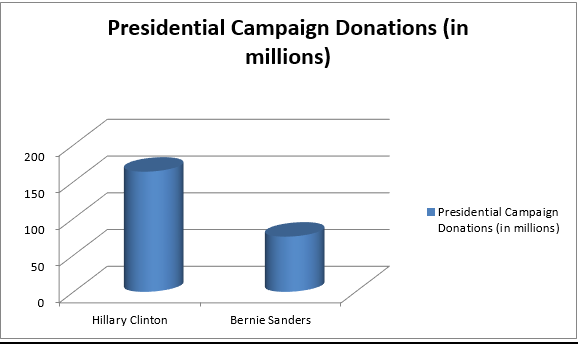
Source: http://www.nytimes.com/interactive/2016/us/elections/election-2016-campaign-money-race.html?_r=0
Hillary Rodham Clinton– Former Secretary of State, New York Senator
| Individual | Role | Previous Experience |
| Amanda Renteria | Political Director | •Legislative aide, Sen. Dianne Feinstein (D-Calif.) •Chief of staff, Sen. Debbie Stabenow (D-Mich.) •Amanda Renteria 2014 U.S. House |
| Jake Sullivan | Senior Policy Advisor | •Hillary Clinton 2008 presidential •Barack Obama 2008 presidential and White House administration •Director of policy planning, State Department •Faculty, Yale University Law School |
| Robby Mook | Campaign Manager | •Executive director and political director, Democratic Congressional Campaign Committee •Field operative, Hillary Clinton‘s 2008 presidential •Campaign manager, Jeanne Shaheen 2008 U.S. Senate •Campaign manager, Gov. Terry McAuliffe of Virginia |
- Soros Fund Management $7,037,800
- Walt Disney Co $3,077,667
- Paloma Partners $2,505,400
On the issues
Israel-Palestine:
Clinton wrote an article for the Jewish Daily Forward, stating her intentions to “reaffirm the unbreakable bonds of friendship and unity” between Israel and the U.S. She also promised to combat international efforts to isolate Israel from the global community, such as the Boycott, Divestment, and Sanctions movement. She has “spoken out against BDS in the United States and at the U.N., and will continue to do so.” The BDS movement, as she explains, “delegitimizes Israel” and compares Israel to South African apartheid, which is why the campaign should end. On January 6th, 2016, Clinton wrote yet another article, outlining her concerns about “new wave of violence inside Israel itself.” She called upon the Palestinian leaders to “condemn and combat incitement in all of its forms.” In order to further protect Israel from external and/or internal enemies, it must continue to “maintain its qualitative military edge.” Thus, Clinton promised to bolster Israeli air defenses and help improve tunnel detection technology.
Middle East:
Clinton has stated repeatedly that the U.S. should be cautious when it comes to Iran. “I don’t see Iran as our partner in implementing this agreement.” She argues that the U.S. ought to “send Iran an unequivocal message.” If the Iranian leaders violate the deal and attempt to develop nuclear weapons, the U.S. will take military action to stop them. Another concern of Clinton’s is radical jihadism. In a speech to the Council on Foreign Relations, Clinton argues that is quite difficult to defeat a group that has an “ideology with deep roots.” It is a “worldwide fight, and America must lead it.” Clinton, then, presented her three-prong plan: one, defeat ISIS in Syria and Iraq; two, dismantle the facilities of fighters; and three, harden defenses against threats. Clinton contends that both airstrikes and ground troops are necessary to fully destroy ISIS. Furthermore, she discussed the idea of laying the “foundation for a second ‘Sunni awakening,’” to encourage both Iraqis and Kurds to help the U.S. troops in defeating ISIS. She criticized the Republican candidates for their suggestion to implement screening procedures for Syrian refugees. “We’ve seen a lot of hateful rhetoric from the GOP. But the idea that we’d turn away refugees because of religion is a new low,” Clinton said.
Bernie Sanders– Vermont Senator
| Individual | Role | Previous Experience |
| Jeff Weaver | Campaign Manager | •Bernie Sanders 1986 gubernatorial •Bernie Sanders 2006 Senate |
| Michael Briggs | Communications Director | •Spokesman Sen. Paul Simon (D-Ill.) •Spokesman Sen. Carol Moseley-Braun (D-Ill.) •Press Secretary Sen. John Edwards (D-N.C.) •Communications director Rep. Brad Sherman (D-Calif.) •Communications director Sen. Bernie Sanders |
| Tad Devine | Senior Advisor | •Michael Dukakis 1988 presidential •Bernie Sanders 1996 U.S. House •Al Gore 2000 presidential •John Kerry 2004 presidential •Bernie Sanders 2006 Senate |
- Alphabet Inc $98,810
- Microsoft Corp $31,148
- Apple Inc $28,442
- Amazon.com $18,846
On the issues
Israel-Palestine:
Currently, Sanders is being cautious in speaking out against Israel and its occupation of the Palestinian people. However, in the past, Sanders has been consistent in his stance on the Arab-Israeli conflict. For example, during the first intifada in the late 1980s, when Yitzhak Rabin ordered Israeli troops to harm Palestinians, Sanders said: “The sight of Israeli soldiers breaking the arms and legs of Arabs is reprehensible,” and he added that it “must be condemned.” For the most part, he is still opposed to and is speaking out against the violent attacks against Palestinians. On his website, it clearly states that Sanders is in favor of a two-state solution that “recognizes Israel’s right to exist in peace and security, and the Palestinians’ right to a homeland in which they control their political and economic future.” He hopes to reduce military aid given to Israel and replace it with economic aid. “There is a lot of economic misery within the Palestinian community. The recent war in Gaza made a terrible situation even worse. They need help and I would hope that we could move in that direction.”
Middle East:
As the former Chairman of the Senate Committee on Veterans’ Affairs, Senator Sanders understands the cost of war. Therefore, he considers “his vote against the Iraq War to be one of the most important he has cast.” In fact, at a rally, Sanders criticized former President Bush by saying he was “very, very, very tough, but not very smart!” Sanders hopes not to make the same mistake as Bush, who pursued a unilateral approach. He does not want the U.S. to be involved in perpetual warfare in the Middle East. Therefore, when discussing ISIS, he calls for an international effort to defeat it. The U.S. will lead the effort, but nonetheless, it should be a multilateral operation. Additionally, Sanders declared that the U.S. “will not succumb to Islamophobia” and thus “will not turn our backs on the refugees who are fleeing Syria.” Since Sanders believes war should be a last resort, he is in favor of the Iran deal. According to his website, Sanders hopes the deal will peacefully ensure Iran does not develop a nuclear weapon. If Iran “does not live up to the agreement, sanctions may be reimposed. If Iran moves toward a nuclear weapon, all available options remain on the table,” Sanders asserts.
