
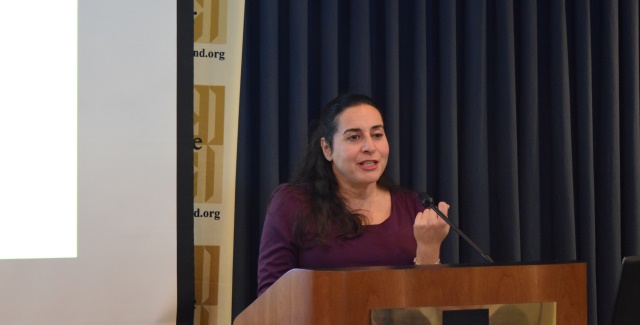
Video and Edited Transcript
Dr. Faedah Totah
Transcript No. 449 (November 5, 2015)
Zeina Azzam:
Good afternoon, everybody. Welcome to the Jerusalem Fund and, our educational program, the Palestine Center. Welcome, also, to our online viewers. My name is Zeina Azzam and I’m the executive director here. We are so delighted to have Dr. Faedah Totah here with us from Virginia Commonwealth University. She’s an associate professor of political science there. As you know, the title of her talk is “The Plight of Palestinians in the Syrian Conflict.” The Palestinians have been caught in the middle of the fighting among the various factions in Syria. Some fighting on the anti-regime side, but most of them preferring to remain neutral, in what they consider a Syrian domestic affair. Dr. Totah’s presentation will discuss this latest predicament of the Palestinian refugees in Syria. And she’ll also examine how, once again, the conflict has highlighted the vulnerability of Palestinian refugees in civil wars throughout the Middle East. She will also look at the future of the Palestinian community in Syria. I’ve asked her to talk for about 40 minutes, after which we’ll open up the floor for discussion and questions. Those of you who are online can tweet your questions to us at @PalestineCenter.
Let me introduce our speaker more fully. As I mentioned earlier, Dr. Faedah Totah is an associate professor in the political science department at VCU, Virginia Commonwealth University in Richmond, Virginia. She teaches courses on gender, development and politics of the contemporary Middle East, including political Islam. She has a PhD in Cultural Anthropology from the University of Texas at Austin and an MA degree in Arab Studies from Georgetown University where I met her when she was doing her MA some years ago. Over the past decade, and before the civil war in Syria, she explored the social and economic impact of gentrification on the old city of Damascus. The results of this research were the subject of the book titled, Preserving the Old City of Damascus, published in 2014 by Syracuse University Press. Currently she is working on a manuscript that examines the political role of Palestinian urban refugees in Damascus. Welcome, Faedah Totah.
Dr. Faedah Totah:
Thank you, Zeina, for that wonderful introduction and it’s always a pleasure to be here at the Jerusalem Fund. As Zeina mentioned, I was a student at the Jerusalem Fund when I first encountered the Center, so it’s always great to come back in different ways and forms. And I want to thank Zeina for arranging this talk and Samirah for taking care of all the logistics. Samirah is great, she’s a pleasure to work with, she’s so efficient, and it makes it a pleasure to want to come here and talk. And finally, I would like to thank all of you for taking time out of your busy schedules to come here this afternoon and hear me talk [about] the plight of the Palestinians in the Syrian conflict.
But let’s go back in time: Tel Al Zaatar in Lebanon [1976], home to approximately 50,000 Palestinian refugees. Lebanese civil war is in full swing and anywhere from 1,500 to 3,000 Palestinians were killed during the fight between Lebanese forces and PLO forces in the camp. Six years later [1982], also in Lebanon, Sabra and Shatila, also during the ongoing civil war but this time after the Israeli invasion of Lebanon and when the PLO left the country. Phalangist forces, with cover of the Israeli forces, entered the camp and massacred another disputed number that could be as low as 400 or as high as 3,000 dead. And now, Yarmouk. This time in Syria anti-regime forces and the regime battling it out in Yarmouk with dozens of casualties and 1,800 people still living in the camp under siege. So this is a partial history of how spaces that are designated as Palestinian during proxy and civil wars become vulnerable and deadly for those who live in them. Yarmouk being the latest Palestinian space to become the site of battles and sieges in the region.
What we see from the example of Yarmouk is that the neutrality of Palestinians and Palestinian spaces in any civil or proxy war is always questioned and their civilian status always undermined by the fact that they are refugees. The killing and starvation continues to highlight the vulnerability of Palestinians, especially Palestinian refugees living in refugee camps outside of historical Palestine. Of course, this is not to say that within historical Palestine, camps are safe spaces but we still remember the Israeli invasion of Gaza and the attacks on camps in Gaza, but it also highlights the ineffectiveness of Palestinian political leadership to protect or assist Palestinians who live in refugee camps. But what we also know from history is that the horrific images of dead bodies, starving bodies, crying children will soon be relegated to the archives as more distressing images from the eastern Mediterranean, or other parts of the world, vie for international attention.
The camps in Lebanon were strictly Palestinian, but Yarmouk, an unofficial camp in Syria, had a mixed population where Palestinians and Syrians lived side by side in a relatively well-to-do Damascene neighborhood. Before the war, it was estimated that 150,000 Palestinians lived there, as well as 650,000 Syrians. So, it’s important to emphasize that it was not exclusively Palestinian; actually it was overwhelmingly Syrian, but during times of conflict, these distinctions are rendered meaningless. So today I will talk about the plight of Palestinians in the Syrian conflict, as exemplified by the latest camp under siege. This will include a discussion of the place of Palestinians in Syrian society and how the horrific conflict affects Palestinians doubly; they are twice victimized, twice displaced, twice forgotten. Not that Palestinians have a monopoly on being victimized when looking around the world, but in an old twist of irony, their plight seems to be repeated for each generation and not even. Because of the celebrity status of the Palestinian cause, it is something that is never far from the headlines. Though the headlines seem to be the same, they have different dates, different massacres, different attacks, different sieges, and a different number of people dead. I will also mention the role of the Palestinian Authority and conclude with how the situation in Syria will only get worse for Palestinians until a fair and just solution is negotiated. And this will entail the role of Israel in having a fair and just negotiation.
Alright, so Palestinians in Syria, according to UNRWA estimates there are around half a million Palestinians registered as refugees living in Syria and I want to emphasize the word registered, because this means they have official status within the country. There are also a number of Palestinians who are not registered, therefore they are not really in any official count. The registered Palestinians came mainly from 1948. However there have been other wars in the region, which led to more waves of Palestinians coming into Syria, whether it’s from Jordan in 1970 as a result of Black September, the civil war and Israeli invasion of Lebanon in 1982, from other Arab countries. So there’s a number, and it could be as high as one thousand, this is where statistics are not really available, of Palestinians who are not registered and therefore are not included in the official count by UNRWA. Some people do not have papers; they lost their Jordanian passport if they were involved in Black September, which meant Syria did not grant them any form of official recognition.
Palestinians in Syria are not a homogeneous group, they are not a monolith. Rather than claiming a distinct Palestinian national identity, there are a lot of differences. There are Palestinians who live in urban areas, there are Palestinians who live in camps. In Syria, you have nine official camps, and three unofficial camps. You have Palestinians who are educated professionals, and you have those who are laborers, or some that are unemployed, and of course you have the registered and unregistered. The situation for registered refugees in Syria meant that they were granted residency almost short of full citizenship within Syria. So their rights were included, but not limited to, access to education, employment opportunities, ownership of property, although ownership was restricted like in the number of houses they could own. They could reside anywhere in the country, [but] they could not vote, but if you know Syria’s history and its political process, not voting is not a serious thing. In Syria, the Palestinians in Syria have, I think they still have, their own security agency, Mukhabarat, it’s known as the Palestinian Mukhabarat. It has its own hierarchy and they deal exclusively with Palestinians within Syria. The Palestinians in Syria were relatively integrated within the country, within the society, they were not considered a political liability because they were two percent of the population at most, so there wasn’t the number.
So if you compare them to Jordan and Lebanon, Palestinians of Syria had it much better, it’s only relatively. For instance, in Lebanon, we all know that Palestinians were confined to the camps; the camps are semi-autonomous Palestinian spaces, which means that who comes into the camp, who leaves the camp is carefully monitored. But also in Lebanon you have a restriction on where Palestinians can work and there are seventy occupations in Lebanon which Palestinians cannot hold for political reasons. In Jordan, for instance, you have almost 70 percent of the population Palestinian, but they’re Jordanian with distinction on their passports that they are of Palestinian origin. Now although Palestinians in Syria were relatively well integrated into society, they were always treated with suspicion by the paternalistic state and their loyalty to the regime always tested. This was especially the case under Hafez Al Assad who used Palestinians, willingly, unwillingly, wittingly, unwittingly, for his own political gains in the region. What’s also important to note about Hafez Al Assad is that he had a personal hostility with Yasser Arafat so that did not help the Palestinians living within Syria and it also led to the split of the PFLP-GC, it’s kind of a mouthful, under Ahmed Jibril who remains loyal to the Syrian regime. He’s against Oslo and was also against Arafat, and I’m sure has his own issues with the Palestinian Authority.
So Palestinians in Syria, their neutrality was not always a given, they had to demonstrate their loyalty and support to the regime and sometimes to demonstrate their opposition to the PLO and to Fatah especially. The war in Syria affected Palestinians as it did Syrians. You have displacement, you have internal displacement, you have people who left the country, you have kidnapping, you have deaths. The UK-based group Action Group for Palestinians in Syria estimated 3,000 Palestinians have been killed since the beginning of the war in 2011, 303 killed in the first half of this year alone. It’s estimated that 250 have been kidnapped, kidnapped for ransom, and according to Jafra Foundation in Yarmouk, at least 30 leaders have been assassinated. According to UNRWA sources, 280,000 Palestinians, almost half of the [Palestinian] population in Syria officially recognized, has been displaced internally, 80,000 left Syria, and it’s estimated that about 43,000 left for Lebanon, and about 16,000 left for Jordan. Ninety-five percent of Palestinians in Syria are dependent on humanitarian aid from UNRWA.
So if you look at the experience of Yarmouk, and the experience with Palestinians at the border of Jordan and Lebanon, it exemplifies how Palestinians are doubly affected just because they are Palestinians during conflict, where all forms of national solidarity are abrogated and where Palestinians are once again rendered vulnerable due to their political status that lacks a clearly defined nation state affiliation. Syrians belong to Syria, Palestinians do not have and never did have a nation state that can claim them. And we see this with how it played out in Yarmouk, and I’m not going to go into much detail about what happened in Yarmouk. We all know that there was the fighting between regime forces and anti-regime forces in Yarmouk. At first you had the Free Syrian Army that entered the camp which then allowed, well it was kind of like a green light for the regime to drop barrel bombs on the camp, which led to the fleeing of most of the population. And so you had 800,000 people, Palestinians and Syrians living in this space that dwindled down to 18,000 people, and those people remained in the camp while the battles were raging between the regime and anti-regime. Al Nusra managed to come into the camp, and then it kind of paved the way for Daesh or ISIS as it’s known in the West, and the fight continued. The 18,000 people that remained during these battles include 3,000 children, anywhere between 1,000 and 4,000 Syrians. Therefore today Yarmouk has reverted to becoming, largely, a Palestinian space. Where did these people go? Well some of them are displaced internally, a lot of Palestinians seem to rely on the social networks they have with family and kin, throughout the region in Lebanon, in Syria, even in Jordan, so many of them left and moved in with relatives which led to crowded conditions.
The camp since 2013 was under siege and that led to a lot of hardships: typhoid broke out in the camp among the people who remained there, there was the issue of starvation because humanitarian aid was not allowed into the camp, there was a lack of heating or cooking fuel, electricity, so Palestinians and Syrians who remained in the camp were either freezing in the winter or sweltering in the heat of the summer. There have been attempts to end the siege and appeals to allow humanitarian aid, some of them have been partially heated. Interestingly enough, the UN last July declared Yarmouk no longer a besieged area in Syria. The UN defines a besieged area as one that is surrounded by armed actors with the sustained effect that humanitarian assistance cannot regularly enter, and civilians, the sick and wounded cannot regularly exit the area. Nidal Bitari, who I believe was one of your speakers, noted on the Middle East Institute website last September that, based on this definition, the camp is still under siege. Civilians inside the camp aren’t able to move in or out of the camp with regularity, with multiple armed factions controlling checkpoints in the area. Since April 2015, no emergency medical case has received permission to be evacuated, only a small number of students were allowed to exit the camp to sit for school exams in Damascus. And this exceptional case, those leaving required permissions from both parties to the conflict on both sides of the checkpoint. For anybody who has been in the Middle East and had to cross checkpoints, it’s a challenge under normal circumstances, so you can only imagine what’s it’s like for these Palestinians trying to leave Yarmouk with all these different factions having their own checkpoints and they’re not talking to one another either.
So Palestinians are also being used by their own leaders and others for political posturing and I think that is the real human tragedy where they are pawns in political leaders’ games. Israel claims that it will allow Palestinians from Syria into areas controlled by the Palestinian Authority, but only if they forgo the right of return, which was of course rejected by the Palestinian Authority. And Ramzi Baroud, who wrote in the Arab news in April 2015, says “Israel knows that the memory of the refugees is its greatest enemy, so when the Palestinian leadership requested that Israel allow Yarmouk refugees to move to the West Bank, Israeli Prime Minister Benjamin Netanyahu had a condition that they renounce their right of return, Palestinians refused. History has shown that Palestinians would endure untold suffering and not abandon their rights in Palestine.” The fact that Netanyahu would play such a condition is not just a testimony to Israel’s fear of Palestinian memory, but the political opportunism and sheer ruthlessness of the Israeli government. The Palestinian Authority was established in 1994 based on a clear charter where a small group of Palestinians “returned” to the Occupied Territories, set up a few institutions, and siphoned billions of dollars in international aid in exchange for abandoning the right of return for Palestinian refugees and ceding any claim on real Palestinian sovereignty and nationhood. So when it comes to what’s happening in Syria, the Palestinians are pretty much left on their own. There have been appeals that the Palestinians should not be involved in the fight against Daesh or the regime. There are some Palestinians who did not listen to that call, but again, Palestinians are not allowed to remain neutral in any conflict. So, that’s Palestinians in Syria.
Now let’s look at Palestinians who tried to leave the country, the 80,000 Palestinians who left the country. They either went to Jordan or Lebanon, some to Turkey and beyond. Leaving the country itself is fraught with hardships because people are Palestinian. It’s easier if you are Syrian, but you have many mixed families who are both Syrian and Palestinian, so you’d have one part of the family leave and the other part would have to remain behind. And Palestinians need permission from the Syrian government to leave and permission from neighboring countries to enter. Permission entails amount of money to be exchanged, a deposit, or paying for visas, and of course there’s the issues of bribes there’s a lot of corruption in this process just to leave.
If we look at Jordan and Lebanon, Syrians, at the beginning of the conflict, were granted a six month residency permit, Palestinians were only given one week, and then they had to renew it every month, which required money. In Jordan, there was the case where it was returning a lot of Palestinians back. Those without valid visas or papers, or those who were not sent back, were taken to a special camp called “Cyber City,” and it’s this walled industrial complex town near Ramtha in the desert and housed in apartments that were built for foreign workers who were working in this industrial complex. It included some Palestinians who had Jordanian citizenship withdrawn from them for political reasons, they probably had a role in Black September or were anti-king. There is fear in Jordan of another wave of Palestinians coming in because it seems that every war in the region sends a wave of Palestinians to Jordan. Human Rights Watch issued a report in 2012 on the bias on the Syrian border describing the arbitrary practice by Jordanian authorities in dealing with Palestinians fleeing the war in Syria; some were deported, some were detained. And although many Palestinians in Syria had relatives in Jordan, the policy to release asylum seekers to relatives was stopped for Palestinians. So there was a splitting of families; who was allowed to come back, who was allowed to carry on further into Jordan, but Jordan as a sovereign nation can determine what constitutes a security threat and act accordingly. Jordan has not signed nor ratified the 1951 Refugee Convention and in that convention it prohibits countries from sending anyone back to a country where their life or freedom would be threatened or where they face a real risk of torture or inhumane or degrading treatment or punishment. When Jordan is called on this, they would insist they are acting on their national security interest and they’re exercising their sovereignty. Jordan eventually closed the borders for refugees from Syria.
Lebanon, refugees going to Lebanon, another story. Half the refugees entered in 2013 but by August of that year, restrictions were put into place. And then by 2014, the border also closed, at least for legal refugees. The border with Lebanon is pretty porous. A vulnerability assessment conducted by UNRWA and AUB showed that 33 percent of Palestinian refugees from Syria went to Sidon in the south, followed by Beirut. Some lived in camps, some lived outside of camps. And those who entered Lebanon legally have let their visas expire and part of the reason is that they could not afford the 200 dollar fee to renew the permit. There’s no work, because there are restrictions on employment in Lebanon; they’re living on donations and UNRWA assistance. There’s this huge toll on health and hygiene and rent is expensive in Beirut. There were cases where people were renting out garages for 400 dollars. There’s an increase in unregistered births, an increase in school dropouts. So for Palestinian refugees from Syria, it is estimated that 80 percent have exhausted their savings, 90 percent have been forced to sell assets, 60 percent are living in crowded and poor conditions, and 93 percent have limited work opportunities. So UNRWA concludes that the tensions will rise between Palestinian refugees from Syria and Palestinians who are already living in Lebanon and who don’t really have it easy.
But there’s also friction between the Lebanese populations, especially from Lebanese politicians who have used the Palestinians as scapegoats for the problems facing Lebanon for decades now. Memories of the civil war and the role of the PLO, and by extension Palestinians, have continued to resurface. But once again, spaces designated as Palestinian have become the target of local warring factions. Ain Al Helweh, near the city of Sidon in the South, hosting more than 10,000 Palestinians from Syria, has become a sight of contention. In June of 2013, a Salafi cleric called on all Sunni Muslims, including Palestinians in Lebanon, to fight against the Lebanese Army and Hezbollah. Following the call, members of Fateh El Islam and other militant groups – [such as] Jund Al Sham – fired on a Lebanese military checkpoint near Ain Al Helweh. And then last August there was more fighting between Islamist groups and this time Fateh in Ain Al Helweh that led to six being killed, 70 injured and 3,000 displaced. So this theme of displacement seems to be a recurring one, like how many times can you be displaced in a lifetime.
Palestinian factions in Sidon outside the camp were determined to not take part in attacks against the Lebanese military but of course, neutrality is never an option and never holds. Moe Ali Nayel noted in an article for the Electronic Intifada that the phalangist or the Kataeb party cite claims that Jubhat Al Nusra, a group linked to Al Qaeda, is active in Ain Al Helweh. The article claims, citing anonymous sources, that there is an intention by fundamentalist groups in the camp, to create a branch for Jubhat Al Nusra in order to destabilize security in the camp and its surroundings. So there is this incitement by Lebanese politicians against Palestinian refugees, especially those coming from Syria. But in this article, Nayel also goes on to note that despite his party’s antipathy towards Palestinians, Mahmoud Abbas, during a trip to Lebanon in July 2013 found time to meet with the Kataeb leader, Amine Gemayel. And he goes on to say that, apart from telling Palestinians not to take part in the violence, Abbas has shown little regard for the concern of his people in Lebanon. He did not visit any of the camps, he was rather criticized for staying at the Phoenician Intercontinental Hotel in Beirut and he did have time to meet with the Lebanese pop singer, Ragheb Alama, and did have time to present him with a Palestinian passport and honorary citizenship, while Palestinians in Lebanon from Syria are just languishing a few miles away. So, again, being let down by the Palestinian Authority is a common theme.
So there have also been protests against UNRWA because UNRWA keeps announcing it will suspend its emergency and humanitarian aid because of fund shortfalls, which means that Palestinians are going to be placed under more hardship. Palestinians from Syria and Lebanon, especially those without papers are arrested and detained if they are caught by the Lebanese forces. It’s leading to many of the Palestinians to take to the sea in rickety boats to cross the Mediterranean and try to go to Europe.
So, the future of Palestinians: you can’t really rely of the PLO or the Palestinian Authority. This is a cartoon by Nidal Al Khairy, some of you know Naji Al Ali, who really was very precise and harsh in his criticism of Palestinian leadership and it looks like Nidal Al Khairy is kind of carrying that banner of Palestinians criticizing their own leadership so it just shows how ineffective the Palestinian Authority is in the region but most importantly what now. And I think this image really summarized the plight of Palestinians, period, not only Palestinians from Syria. Where to go from here? So to conclude, the plight of Palestinians in Syria is not separate from what is happening to Syrians, but Palestinians do magnify the human tragedy in Syria because of their political vulnerability and their lack of political leadership. UNRWA has been calling for donors to increase their support to the Syrian Crisis. They claimed that they only received 34 percent of funds needed for 2015 and they estimated, as I mentioned earlier, that 95 percent of Palestinians in Syria now rely on UNRWA to meet their daily needs of food, water, and healthcare. Palestinians are vulnerable because they are stateless. Conflicts in the Middle East directly affect Palestinians. The Gulf War in 1991 led to half a million Palestinians being expelled from Kuwait and many of them ended up in Jordan. The U.S. invasion of Iraq in 2003 led to the expulsion of 10,000 to 30,000 Palestinians who were seen as allied with Saddam. Many of them, nobody wanted; Syria didn’t want to take them in, Jordan did not want to take them in, so they languished in no-man’s land for a while in makeshift camps until third party countries took them in. I think many of them ended up going to Brazil and other countries in Latin America. In 2011, Libya expelled its Palestinian population who were also trapped on the border with Egypt who did not want to take them in, and they also languished in no man’s land.
So what will the future of Palestinians in Syria be? If Assad is removed from power and Syria is divided into the different warring factions, known as the Balkanization of Syria, chances are Palestinians will be expelled, as happened in Kuwait, in Iraq, in Libya, ecetera, ecetera, for their perceived complicity with the regime. If Assad remains in power while a transition process is underway, Palestinians will still be treated with suspicion and their loyalty will be constantly tested, like what happened in Jordan after Black September. What is likely to happen is that more Palestinians will continue to leave, and unlike Syrians who seek to leave, returning will not be an option. We’re already seeing many Palestinians seeking asylum in Europe and many have family members there and that’s one thing we have to remember, that Palestinians are such a diasporic community that they have these social networks. So there could be family unification and European or even countries beyond, here in the United States, Canada, Australia. And Palestinians will find new homes outside the region, but it is another form of displacement, like how far removed can you be from historical Palestine.
But there are also this group of Palestinians who are considered dangerous and who are marked by security agencies in different countries around the world that they are undesirable, either because of their affiliation with Hamas or because of their affiliation with the PFLP-GC, so there’s going to be a group that are not going to be welcomed anywhere. But of course there’s going to be Palestinians who will remain in the region and their situation is not going to be great by any stretch of the imagination. Lebanon – I don’t see things changing for Palestinians in Lebanon. Lebanon is going to remain tricky. And Jordan doesn’t want any more Palestinians. We’re dealing with two countries that are not domestically stable, who have their own political problems, and Palestinians are just going to add to that mix and Palestinians are going to be easy scapegoats for political problems that these countries face. What we know for sure is that the Palestinian Authority, as the PLO before it, are unable to do anything to help, they have no political leverage, they are too corrupt, and also pretty much split [among] the Palestinians: between those that are now, more or less, secured in the territories, the West Bank being much better than Gaza, and those who are outside. And there seems to be no attempt to bridge the two groups, outside and inside and so there needs to be a final solution, a just and fair solution, I don’t even know why I’m talking about this, that includes a right of return, which is not likely to happen anytime soon with the current Israeli government and the conditions that are now taking place in both Gaza and the West Bank. But this also means that with no change in sight, we will probably see a repeat of massacres, of sieges, of more hardship for Palestinians in Syria and beyond. Thank you.

1 thought on “The Plight of Palestinians in the Syrian Conflict”
Comments are closed.