
by Zeina Azzam
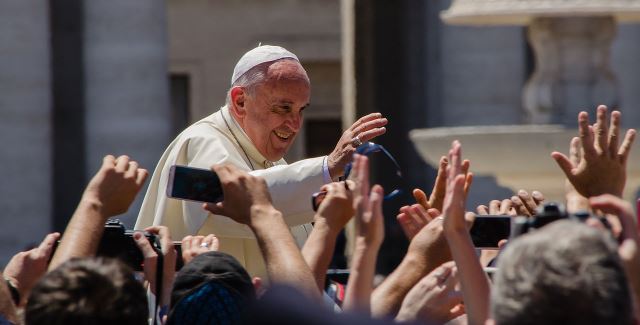
The first visit of Pope Francis to the United States coincides with the autumnal equinox, when days and nights all over the world are equal in length. Such auspicious timing resonates with the Pope’s message of global parity in all arenas, including human and economic rights, environmental conservation, and protection of the vulnerable.
Pope Francis’s populist religious and international persona puts him in a unique place in terms of encouraging and supporting work for what he called, during his White House speech, “the path of reconciliation, justice and freedom.” Indeed, he is credited with helping to facilitate the recent rapprochement between the United States and Cuba.
Last November Pope Francis stated, “We cannot allow the Mediterranean to become a vast cemetery… The boats landing daily on the shores of Europe are filled with men and women who need acceptance and assistance.” He then issued an appeal earlier this month for all Catholic institutions—parishes, monasteries, and the like—in Europe to take in families of refugees, starting with two parishes within the Vatican. It would be a positive gesture if the pontiff would ask the same of Catholic institutions in the United States.
President Obama has committed to accepting 10,000 refugees from Syria over the coming year. Secretary of State Kerry’s statement that he would like the United States to accept up to 100,000 refugees by 2017 would be a more generous step, though it is unknown whether Congress would approve the plan.
Many of the families fleeing Syria come from the 12 Palestinian refugee camps there, including the largest one, Yarmouk Camp. The experience of displacement is familiar to them; most fled Palestine decades ago, in 1948, when the state of Israel was established. About three-quarters of a million Muslim and Christian Palestinians fled for their lives, many forced to do so as a result of armed conflict. Generations have been born and raised in the camps. Some of them continue to carry the keys to their homes in Palestine, even as they flee from the dangerous situation in Syria at present. For them, “It is 1948 all over again.”
There are 560,000 Palestinian refugees in Syria registered with UNRWA (UN Relief and Works Agency for Palestine Refugees), 95 percent of whom are in constant need of humanitarian aid. Half of the total are now internally displaced. Lebanon and Jordan host approximately 44,000 and 15,000 Palestinian refugees from Syria, respectively.
Despite the laudatory efforts of Europe and the incipient efforts of the United States, the vast majority of refugees from Syria continue to remain in the region—mostly in Turkey, Lebanon, and Jordan. A political solution in Syria is sorely needed. Pope Francis, President Obama, and Arab and European leaders must have this as their overarching goal.
Like their co-religionists, Catholic Christian Arabs regard Pope Francis as the supreme leader of the Catholic Church. Christian Arabs (approximately 10-12 million) in general, as well as non-Christian Arabs, have a special and deep respect for the Pope. And at this crucial time in history, they look to him to help in providing solace and relief for those fleeing war and danger. They also hope he will enlighten others in the world in the principles of equality and peace with justice for all, especially the refugees.
Zeina Azzam is executive director of The Jerusalem Fund. The views in this essay are hers and do not reflect those of the Fund.
