
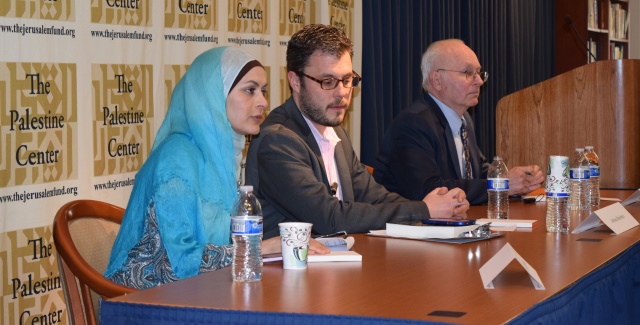
Video and Edited Transcript
Laila El-Haddad, William B. Quandt, and Joshua Ruebner
Transcript No. 431 (21 April 2015)
Zeina Azzam: Welcome to the Palestine Center and Jerusalem Fund. Welcome to our audience here, and welcome to our online audience. My name is Zeina Azzam and I am the executive director at the Jerusalem Fund.
I’m going to go right into the program because we have a lot to cover. Let me just say that in light of Benjamin Netanyahu’s recent re-election and his pronouncement that there will be no Palestinian state during the time that he’s Prime Minister, many in Washington are re-examining U.S. policy toward Israel and Palestine. For the first time in many years, a U.S. administration is looking at Washington’s relationship with Israel with more critical eyes: some see changes ahead, and others are more cynical and see this as a passing phase. Our panel discussion today will consider the current situation from different perspectives and assess the short-term and long-term implications of Washington’s evolving policy in the region.
We’re very fortunate to have three experts with us today – one of whom is on her way but she should be here any moment. Each of them have vast experience in affairs that deal with Palestine, Israel and U.S. policy in the region. They often write political analyses and speak in various media outlets.
I’ll ask each one of them to speak for about twelve minutes, and then we will open the floor for discussion. Those of you who are online can tweet us so we can see your questions at @palestinecenter.
Let me introduce our distinguished guests. William Quandt (who’s here on my right) is Professor Emeritus of politics at the University of Virginia. Previously he was a Senior Fellow in the Foreign Policy Studies Program at the Brookings Institution. In the seventies, he served as a staff member on the National Security Council (1972-1974, 1977-1979) and was actively involved in the negotiations that led to the Camp David Accords and the Egyptian-Israeli Peace Treaty. He has many books and I’ll just mention two of them: Peace Process: American Diplomacy and the Arab-Israeli Conflict since 1967 (Brookings, 2005, third edition), and Between Ballots and Bullets: Algeria’s Transition from Authoritarianism, (Brookings, 1998).
Josh Ruebner is the Policy Director of the U.S. Campaign to End the Israeli Occupation, which is a national coalition aiming to stop the occupation and supporting justice and human rights. He is a former Analyst in Middle East Affairs at Congressional Research Service and is the author of Shattered Hopes: Obama’s Failure to Broker Israeli-Palestinian Peace. This is a book that is now in paperback and updated through 2014, and in its second edition.
Our third speaker is Laila El-Haddad. She is an award-winning writer and social media activist from Gaza City. She served as the Gaza correspondent for Al Jazeera English, as a regular contributor to the BBC and the Guardian online as well as radio correspondent for Pacifica’s Free Speech Radio News. Laila is the author of Gaza Mom: Palestine, Politics, Parenting, and Everything in Between. And she is a co-author of the The Gaza Kitchen: A Palestinian Culinary Journey.
Please join me in welcoming our speakers.
William Quandt: Thank you, Zeina, and thanks to all of you for coming today. I wish I had an upbeat message. I have been talking about this topic for so long I have a feeling I’m a “prophet of gloom” every time I stand up to talk about the obstacles in the way of seeing this conflict brought to a decent end. Although there are some intriguing tones in the current atmosphere after Prime Minister Netanyahu’s very offensive comments at the time of his election, subsequently I don’t think it’s justified to conclude that this is going to change attitudes in Washington to the point where we should expect dramatically new policies. What I want to do is try to talk a little bit about the broad regional context which I see President Obama and his foreign policy team trying to shape – whatever they can – of their legacy with respect to the challenges facing the Middle East, which are quite considerable. I want to do this by taking a very short look back (maybe this will encourage you to buy Josh’s book so you can get more of what went wrong and why the hopes were shattered in the past six years to date), and then talk about where we stand today.
It’s instructive to look at how quickly Obama – as president in early 2009 – did set out a Middle East agenda, a fairly ambitious one for himself and the country. Of course it was meant to differentiate what he was going to do versus what his predecessor had done. Not unusual – presidents come in and campaign on doing things differently, and certainly Obama had opposed the war in Iraq – rather egregiously and consistently so – but it wasn’t the only item on his Middle East agenda. He talked in the beginning about changing the basic relationship between the United States and the “Muslim world” based on this posture of mutual respect – interesting language meant to design and differentiate him from his predecessor. He talked about getting American troops out of Iraq and out of Afghanistan in a responsible way but clearly on a time-schedule that would be reasonably accelerated. And he talked about diplomacy with one’s adversaries, including Syria, Iran and presumably, nobody was “off-limits” from the policy of more diplomacy and less use of force. Then he talked about the importance of peace between Israelis and Palestinians. So it was a pretty ambitious agenda.
Without going into details of “what went wrong”, it’s pretty clear that not much of it worked out the way he would have expected; some bits of it have – I want to try to be fair-minded about this. The reasons it didn’t work out, first of all, was perhaps it wasn’t very well-designed or well-strategized from the outside, but also things happened that just could not have been anticipated. One of the things that happened right away was that Netanyahu became Prime Minister in Israel – I think that very quickly would have coerced any president to wonder how realistic it was to think that with this Prime Minister, he was going to be able to get very far on his commitment to Israeli-Palestinian peace. You have to remember when he first made that statement, it looked as if it might not have been Netanyahu: the outgoing Olmert regime had made some kind of offer to the Palestinians that was at least closer to the idea of a two-state solution than seen previously. But Netanyahu was, of course, completely against anything like that. Then there were other things that happened in the Middle East that distracted the Obama Administration from what its initial agenda might have been: the Arab Spring/uprisings which had not been foreseen (perhaps they should have been) and required a complicated set of reactions which were not very well-designed and ended up taking a lot of attention away from other items on the agenda; then recently, the emergence of ISIS in Iraq and Syria, of course which forced some rethinking of American policy in that region as well.
Where does that leave us now? Let me just go through quickly where I think we now stand with his larger Middle East policies. I think it’s still true that this president is very unlikely to respond to the pressures to re-engage militarily in the Middle East on a large scale. There are people (John McCain) who would just send troops back in – “more boots on the ground” – seems as if they haven’t learned anything. I think that Obama really will resist that, although not entirely: you can see already in Iraq there’s a little bit of missions creeping back. But I don’t think we’re going to see any large-scale commitment of ground troops.
Secondly, I think that after two attempts – one, where Obama himself was involved and the other his Secretary of State, John Kerry, was involved – at Israeli-Palestinian negotiations, I don’t expect any in the remainder of his presidency that he’s going to make another major effort. We can talk about that a bit more.
I do think that he has made progress on another of his agenda items which is relations with Iran. I think he and his Secretary of State deserve credit for getting a much better framework agreement than I expected, and I think he’s going to get it through. It’s not a foregone conclusion. There are weeks of difficult negotiations ahead, but I think when we get some distance from this presidency, this one thing may stand out as an achievement and as a fundamental breakthrough in the relationship with Iran, and it’s not just about nuclear weapons (although that is important) but it’s also about bringing a beginning to ending the poisonous relationship that has existed between the United States and Iran. I know there are people in the Middle East who don’t like this; they actually thrive on the polarization between the United States and Iran. But it’s been bad for the region and any move to better US-Iran relations will effectively ease over time the poisonous sectarianism that has worked its way into Middle East politics. That may be the one achievement that he has.
It is, however, a kind of odd legacy in its impact on other issues because he is going to have a fairly curious fight with the Israelis over this and I think he’s going to win it, which shows you can occasionally stand up to the lobby and its supporters. But I think it’s going to take so much time and so much political capital that there’s not going to be much left for him to devote to Israeli-Palestinian issues, even if he were to want to.
So what might he do on Israel-Palestine – which is the topic most of you probably care about: I don’t think an awful lot. He meant it when he said that he thought that Netanyahu was not going to be a partner for a kind of political settlement that the United States has advocated, which, in many cases, many people don’t think is realistic any longer in any case (the two-state approach). So what else might happen if not the classic “two-state” paradigm being negotiated? There is a body of opinion in Washington that almost got its voice last fall after the collapse of the Israeli-Palestinian effort Kerry had made – there was some opinions on how this ought to be resolved. We’ve heard everybody’s points of view and maybe a clear statement of “Kerry or Obama parameters” to, in some sense, supplement or take place of the old Clinton parameters: to put forward in the Middle East and other communities what would be a sensible and reasonable outcome? The problem is that once they started drafting, some people thought “it’s so general and it’s not going to impress anybody” or if you start filling in the blanks and start getting detailed you’ll get into the typical argument of everybody arguing over little details and not keeping any focus on the larger picture. So they shelved the proposal last fall – as I understand it, Josh may know a little more about this than I do – but it’s still there in the background. If we can’t get the parties to negotiate, maybe there is still some value in trying to put forward a reasonable outline and get as much international support from Europeans, the UN Security Council, the Arab League to leave a marker for the future. Whether this would do any good can lead to discussion – but it’s one of the thoughts some people are having.
Another idea we’ve seen hints of – including some public hints recently – is that the United States will no longer block things in the United Nations if initiatives are taken to, for example, have a resolution saying “settlement activity should be considered illegal under international law” (which most people think it already is – but the United States has typically tried to block those types of initiatives) – maybe it won’t [block it] anymore, maybe we’ll just abstain or if statehood resolutions come up in the United Nations we might either abstain or heaven forbid, perhaps even vote in favor of it. I wouldn’t get my hopes up too high, but I do think there’s a slightly different tone about not being bound automatically to use our veto power every time Israelis get nervous about what’s happening in the UN. They’ve lost their right to make that claim on us when they opted-out of the peace process.
The problem with the period we’re entering into is that Obama, obviously, is running out of time. It may be true that he can count on another eighteen months or so before he really has to shut down, but politically he has the remainder of this year – in which he can say to himself that he needs to get the Iran deal done and implemented. If that doesn’t work, it’s a real mess. He has to do the most he can with least risk in containing and pushing back the ISIS threat, which means more use of airpower or drones, not boots on the ground. Then he has to deal with the unforeseen crises that periodically pop up. I sense the administration is trying to manage a lot of these issues without any overarching strategy: they want the deal with Iran but they feel they have to appease the Saudis on Yemen, even though the judgement on Yemen doesn’t make a lot of sense. The domestic politics of all these situations is crazy – it’s as if Congress simply wants the President to fail no matter what the issue is. He can’t count on much bipartisanship and that affects the mood of the country to some extent. You’ve heard a lot of the terrible things said on television about the Iran deal “paving the way for Iran to have a nuclear weapon”. It’s as if people haven’t paid any attention to the actual content of this deal.
American public opinion is more sensible than Congress – they will go along quite supportively with the Iran deal, but not on many other issues, such as finding a new approach to Israeli-Palestinian peacemaking. I’m afraid that for the issue that is high on our agenda – finding some way to bringing Israelis and Palestinians to peaceful coexistence in historic Palestine – there is no good alternative in sight in the near future. It is probably the case that the two-state paradigm, which I have supported for a long time, is at the end of its useful life and is not going to be revived any time soon. I say that with some regret because there was a certain amount of legitimacy accorded to it over a period of time, but we have to be realistic and say that’s pretty much gone. The problem is that I don’t see the alternative: I know there are enthusiasts who say the one-state solution, and I think there are outcomes that could be described as one-state “outcomes”, but they are not solutions in the sense that they will not be achieved any time in the near future as negotiations – I just don’t see it as realistic, although some of you may and we can discuss it in discussion.
I’m afraid the near-term prospect is more of the same. That is, continued occupation, continued siege of Gaza, periodic outbreaks of violence: not a very happy prospect to say the least. With hindsight, looking back on various moments in American diplomacy on this issue, we had one opening. And when you have an opening you should not squander it and it really began with the Madrid Conference with the first Bush Administration with the very abled stewardship of James Baker and it lasted through the 1990’s. By the end of the 1990’s, the opening that began with Madrid and the negotiating framework that existed at the time pretty much came to an end. We’ve seen efforts made subsequent to that, but the period when this conflict was ripe for being resolved through diplomatic efforts was basically the 1990’s, and since then it’s been harder and harder almost year by year to imagine a peaceful negotiated settlement.
With those not very encouraging comments, thank you for listening and I’ll be happy to take questions later.
Joshua Ruebner: Good afternoon. Thank you to the Palestine Center for inviting me to this panel, it’s an honor to be with such distinguished colleagues for this event.
I’d like to start my remarks with remembrance of how exactly Israeli Prime Minister Mr. Benjamin Netanyahu won reelection last month. As you remember, he was neck-and-neck within the polls with the center-left Zionist Union and as he was in danger of being defeated, he made a very clear play to, I would say, expose the realities of his position which included justification for Israel’s illegal colonization of Palestinian land, included blatant and gross appeals to racism against Palestinian citizens in Israel. He said that his government was “in danger” because Palestinians were actually exercising their democratic right to vote “in droves”, Netanyahu said. Of course, most famously, Netanyahu won this election by repudiating the notion that there would be a Palestinian state in even its most truncated form under his watch. This drew significant opposition from the Obama Administration, which said that the United States will reassess its relations with Israel because of the state of Israel’s repudiation of Palestinian statehood.
We haven’t seen much in terms of actual policy initiatives or policy changes as the result of this so-called “reassessment” just yet. I would expect that we’re not going to see anything until the Iran nuclear negotiations are concluded. So what can the Obama Administration do in the very short time frame that’s left to reassess these policies, to change these policies in a more positive and fruitful direction?
In the hopes that there are some people here today from the State Department or maybe watching online, I’m going to first offer up some very small-scale, very pragmatic steps that the Obama Administration can actually do to reassess these relations, and I actually wrote about this in The Hill a few weeks ago, and I’ll conclude by saying these small-scale steps that I’m proposing are nowhere near enough in terms of where we are today.
For the benefit of official Washington, here are my policy recommendations for the Obama Administration and its reassessment:
One, U.S. military aid to Israel should of course be ended, because of the grave human rights violations that we are implicated in through these weapons, but we know that’s not a political reality for the Obama Administration, as I discuss in my book, Shattered Hopes. For six years, we’ve seen sanctions not even on the table as an option no matter how egregious Israel’s policies are toward the Palestinians, and I wouldn’t expect that sanctions (in a real way) would be on the table in Obama’s remaining two years. But he could, nevertheless, clog the arms pipeline without publicly announcing that he’s slowing down the delivery of weapons to Israel. This would be very significant and be a very sharp indication to the state of Israel that it wasn’t “business as usual.”
Two, the Obama Administration could send a report to Congress documenting Israel’s copious violations of the Arms Export Control Act and getting some sanctions placed on the delivery of particular weapons systems. This is something that the Reagan Administration did twice back in the 1980’s: they froze for six years the delivery of cluster bombs to Israel and they froze the delivery of F-16s to Israel as well for punishment to Israel for misusing these weapons. This is something Obama could do; we heard rumors of him doing it with Hellfire Missiles during Israel’s horrific attack on Gaza last summer. And related, the Obama Administration could place sanctions on Israel under what’s known as the Leahy Law. This specifically targets individual units of military, forbidding them from receiving U.S. training or equipment for their participation in human rights abuses, and it also prevents individual soldiers who have engaged in gross human rights violations from receiving visas to come to the United States for any reason.
These two options of reporting on Israel’s violations of the Arms Export Control Act, reporting on Israel’s violations of the Leahy Law are even more imperative today because of the recent report that was issued by Defense for Children International Palestine, and I know Brad Parker was here last week – I hope he discussed this new report that DCI-Palestine released – which shows that during Operative Protective Edge when Israel besieged the Gaza Strip last summer, Israel literally and deliberately targeted for killing hundreds of Palestinian children. Deliberately targeting for death Palestinian children (which I’m sure Laila will talk about more later). This necessitates these laws invoked when it comes to our policies toward Israel.
When it comes to Israel’s ongoing colonization of Palestinian land, there are also measures that the Obama Administration can take that don’t involve congressional permission which, of course, would never happen.
One, would be to declare Israeli settlements national emergency under what’s known as the National Emergencies Act. This act gives broad powers to the Executive Branch to implement financial sanctions and to permit dealings in foreign currencies to sustain a situation leading to an emergency. The president could declare Israeli settlements to be an emergency and make sure any U.S. dollar-flows that would directly or indirectly support Israeli settlements would be made illegal. This would be a major step and this relates to my fifth recommendation to the Obama Administration for how they should reassess this policy. In the United States, we have a gross situation where there are dozens of so-called “charitable” organizations in the United States literally funneling tens of millions of dollars every single year to support Israel’s settlements. The IRS could easily shut down these charities and do so under the guideline of the IRS that requires these 501C3s not to engage in discrimination. Israeli settlements are obviously and clearly discriminatory because Palestinians can’t live in there, etc.
These are my very “mild” suggestions to the Obama Administration. But we are at a historical turning point and clearly, tinkering around the edges of what has been failed policy for so many decades is clearly not enough. What we need instead of tinkering and pretending that the status quo can continue is a fundamental and whole-scale reevaluation of the premises of U.S. policy toward Israel and the Palestinian people. I say this because really for the first time ever we had an admission and a total congruence between the United States and Israel that a “two-state resolution” to the Israeli-Palestinian issue is not achievable.
Now we have heard and know Netanyahu’s remarks, to that effect, very well. But actually U.S. officials have said the same thing as well. Secretary of State, John Kerry testified to Congress that there exists this one to two year window of opportunity for there being a Palestinian State. That even he recognizes that because of Israel’s ongoing colonization of Palestinian land, the idea of establishing a contiguous and sovereign entity will not be possible. But John Kerry didn’t make this prediction of a one to two year window after Netanyahu’s election. In fact, he made this prediction to Congress in April of 2013. Exactly two years ago. So even according to John Kerry’s own admission, the one window for a two-state solution has been shut. And in fact, after the collapse of the recent round of Israeli Palestinian negotiations, last April, April 2014, the lead negotiator, a fellow by the name of Martin Indyk, a fellow who is certainly no friend to the Palestinian people by the way, Martin Indyk used to work for the American Israel Public Affairs Committee, the leading pro-Israel organization, and he founded its sister think tank, the Washington Institute for Near East Policy. Martin Indyk is a dyed in the wool zionist, self admittedly. What Martin Indyk said, actually to the Washington Institute on Near East Policy, after these negotiations collapsed in April of last year, is that Israel’s policies of colonizing Palestinian land is creating “an irreversible binational reality”. So there you have it, senior U.S. policy officials admitting that the paradigm for resolving this issue, that has been the official U.S policy, since at least President Clinton’s administration formally, has now closed. And has now in fact, virtually every proposal to resolve the Israeli Palestinian issue since 1947, since the original partition of Palestine has been premised on the notion of partitioning the land into two states. We are now, in many respects in a situation where we were before 1948. Before the Nakba, before the establishment of the state of Israel. Where partition of Palestine is widely recognized by both the United States and Israel as not a realistic resolution anymore. What’s especially interesting to me is that U.S policy makers from the get go, before Truman’s recognition of the state of Israel in 1948, recognized all the fundamental problematics of dividing the land like we’ve seen over the past seven decades. So I want to draw your attention before I close to two memos that were received by Franklin Roosevelt back in 1943. He commissioned delegations to go out to the Near East and report on what’s doable about the question of Palestine. One fellow he sent was a guy by the name of Brigadier General Hurley. This is what Hurley reported back to FDR in 1943.
“The zionist organization in Palestine has indicated its commitment to an enlarged program for one, a sovereign Jewish state which would embrace Palestine and probably trans-Jordan; and two, the transfer of the Arab population from Palestine to Iraq” Hurley furthermore said that “there is little to no anti-Jewish sentiment as we ordinarily use the term, neither is there a serious opposition to the concept of a Jewish national home (as opposed to a sovereign state). Notwithstanding these factors, deep seated Arab hostility to any immigration program intended to create a Jewish majority in Palestine and to establish a Jewish sovereign state.
The other came from lieutenant Hoskins who in 1943 wrote to FDR, that “it is important for the American people to realize that Arab feelings remain uncompromisingly against the acceptance of a political Zionist state in Palestine. It should be very clear to the American people therefore that only by military force can a zionist state in Palestine be imposed on the Arabs.” So instead of partitioning the land and establishing a Jewish sovereign state in it, what Hoskins recommended was the existing population of one million Arabs, this is back in 1943, and half a million Jews in Palestine, not to be moved and that this population is to form a binational state within a proposed Levant federation. So why do I conclude my remarks here today with what are the Obama administration’s policy options moving forward in this reassessment by citing these long forgotten memos that are gathering a lot of dust in the libraries of the State Department? The reason I do so is because I think they articulate quite well the realization by the United States that the idea of zionism, the idea of establishing a Jewish sovereign state in Palestine necessarily involves the disposition of the indigenous inhabitants of the land, involves the implacable opposition of the indigenous inhabitants of the land because who in their right mind would agree to be colonized and be disposed in their own home? And that the zionist project to establish a Jewish state in Palestine necessitated on-going military force to maintain. These are the clear and logical conclusions that can be drawn from these memos in 1943 and in many respects, what President Obama finds himself in a position of today in 2015 is the exact same position that FDR found himself in 1943. Except here instead of the idea of establishing a Jewish state, now from 1967, we have a Jewish state establishing its hegemony over all of historic Palestine. And this situation whereby one people dominates the other through this apartheid system of government in which Palestinians are treated with lesser or no rights, is clearly untenable. So what we need is not just a tinkering around the edges of what’s possible, but a fundamental and wholesale reevaluation and creative thinking on how to move forward. Thank you.
Laila El-Haddad: Hi, good afternoon everyone. I’m here I guess to give everyone a reality check and some perspective about what’s going on, on the ground, especially in Gaza. I want to start with what’s missing from all this. I want to start just by reading a few brief sentence-long poems by a young Palestinian student in Gaza. The first one is simply “For sale. Gazan passport, never used”. The second one is “They killed her. Something changed. Numbers”. And the third one is “Let’s study. The power went out”. The fourth one is “She decides to rot in bed.”
The reason I just started is because I try not to be a cynic but it’s very difficult when you look at what’s happening on the ground now and especially as it relates to young people. The reality is the Palestinians are in survival mode right now. Speaking to a lot of friends and family in Gaza on a daily basis who, like millions of others are stuck there for going on a hundred days, I think the Rafah crossing which is the only entry way in and out of Gaza has been opened only five days this entire year and has been closed continuously since I think last September or so.
So when we’re talking about opinions on Obama’s reassessment of foreign policy and so forth, whether they think there’s any hope in following the elections or what they think about Netanyahu’s reelection, it just doesn’t register at all. It’s such a hypothetical issue, such an abstract issue for most of them. It’s sort of like asking someone who’s drowning in a county pool what their thoughts are on the state taxes or approving a new building permit. Everyone is really just distracted with the daily business of survival, and these larger political issues certainly exist but they form a backdrop to all of that. Unless it affects the household economies directly then again it just doesn’t register.
Josh mentioned the Defense for Children International report that just came out about the deliberate targeting of I think 540 children last summer. And yet we’re still hearing about how this was intended to demolish the tunnels or deter the rocket attacks. I also just recently saw that something like 400,000 children are still shell shocked after last summer. At the end of the day we’re talking about these household economies. We’re talking about men and women without access to markets. Access is really the key word here. Farmers without access to land. A fisherman without access to water because of the continuous naval blockade. This is all important because Palestinians in Gaza really thought things would change in some small way. At least their lives would improve somewhat after last summer’s assault, which was the third assault, by the way, in five years, just to put things in perspective. I think it’s something like the twelfth since 1948 for that particular population. Things didn’t get better at all – and better here is between quotations. We’re not talking about the end of the occupation here, we’re just talking about the border being opened or the fishing zones being expanded or the farming land along the buffer zone would no longer be besieged. But that hasn’t been the case. And to compound matters, something like thirty thousand government employees in Gaza haven’t been getting their salaries. It’s this long complicated chain related to authority in Ramallah not getting the tax revenues from Israel because of the PA’s decision to join the ICC and so on, then of course some internal squabbling between Hamas and Fatah, but at the end of the day they’re the ones that haven’t gotten their salaries. They’re the ones who are paying. Those 30 thousand support like a quarter of Gaza’s population. So in addition to having something like 80 percent of the population now food insecure, reliant on food aid in order to feed their families. It’s a situation that the U.N. calls man-made; we shouldn’t be under any illusions that this is just something that happened by accident. It’s a deliberate situation that we all are funding. So in addition to that, these employees aren’t getting their salaries.
One Palestinian on twitter was sort of joking that in Gaza the problem is one of a lack of salary. Where in Ramallah it’s quite the opposite, it’s that the government employees are bound by their salaries. That’s why we hear about Palestinians not speaking out more in the West Bank. A lot of them who are government employees are subject or bound or enslaved by those salaries they’re getting. So she was saying that it was economic slavery at its worst: enslaving some people and starving others.
We’ve been talking a lot about Oslo and how it’s dead and it’s ironic because senior Palestinian officials have said repeatedly including last year that the Oslo Accords are dead, yet they derive their legitimacy from it so it’s never really quite dead if that makes sense. So Gaza still, since last summer, is under a chokehold. I’m talking about imports and exports. Dual use items are still forbidden from entering. This includes things like water disinfectant materials, so that 90 percent of Gaza’s water is not drinkable anymore; the components for factories, cement, drills, all these kinds of things that would enable the population to rebuild after last summer’s assault. It disables NGO’s as well such as ANERA from building things like cancer clinics. The head of ANERA was telling us they had an entire project to build a new cancer clinic in southern Gaza because of the increasing rates of cancer and they weren’t able to because the materials required to build it weren’t allowed in. The water treatment plant in Gaza has been inoperable for years now. Those materials, the water disinfectants aren’t allowed in. Farmers are having to rethink strategies of how they plant because fertilizers aren’t allowed in. Those are all very basic things so what do you do? You have to sort of rethink an entire shift in the way you’re planning on a governmental scale. But in the end, this is all not really, in the words of Israel, about stopping terror, and it’s all about making Israel less secure and not more secure. In 2010, Israeli senior officials very clearly stated that this U.S.-supported blockade is preventing the prosperity and development of the Palestinian people, as well as continuing the fragmentation of the Palestinian people from one another in Palestine, the West Bank and Jerusalem, and restricting their movement. So if that’s the case, it’s actually quite disturbing then that this administration would support a blockade that very specifically intends to forestall not only the political prospect but also stall the prosperity of the Palestinian people. They’re very specifically targeting the productive sector, farming, industry, fishing, education sector and so forth. Again the way that’s done is through restricting access to certain goods to be allowed, in as well as restricting the movement of people out of Gaza such as students. The problem is you’re leaving a population in Gaza of almost two million people, half of those students, two thirds of them under the age of 25, festering until the next time Israel decides to mow the lawn in Gaza. And that’s something that after what happened last year just shouldn’t happen. We shouldn’t have to reach that scenario, but again speaking to friends and family saying it’s incomprehensible, it’s hard to imagine how things would’ve gotten worse and people are really angry right now. They’re just angry at whoever, whether it’s Egypt or Israel or the U.S. It’s a population that is literally stewing and at any moment is going to explode and who knows what that means.
Going on to the Palestinian authority, talking about them deriving their legitimacy from the very accords that they claim, and we all want to believe, is dead – but at the end of the day how do you then change that paradigm or reframe it? So there seems to be a lack of clarity within the Palestinian leadership itself. Concerns about Palestinian solidarity movements and Palestinians on the ground are like I said in survival mode. Very few are aware, they might be aware but not in a way that they’re connecting or networking with these movements except with the young English speaking students networking with those abroad are now beginning to actively support initiatives like BDS. And in terms of a one-state or two-state solution, I think by now it’s very clear to most Palestinians that a two-state solution or a separate independent Palestinian state is not feasible, but again, it’s not on their radar right now, it’s not what people are discussing. They’re just discussing “how can I get my next meal?” Eighty percent of the people are trying to find their next meal. That’s what they’re discussing. That shouldn’t be the case right now.
Ending with a few practical steps, if there can be any. The aid to Gaza, the seven billion dollars pledge has not yet made it to Gaza and that’s a serious problem. There’s all these hurdles and red tape and somebody was telling me this morning you have to go through four or five different agencies and get it in the course of five months. It’s so complicated. So that aid needs to get to where it was pledged. More importantly, and Josh talked about this so I won’t dwell on this too much, there needs to be this mechanism in place that needs to ensure that this doesn’t happen again. I can’t emphasize that enough. At the very least, if you don’t want to work towards ending the settlements or towards a changed U.S. policy at its core, at the very least put some mechanism in place, hold Israel accountable. [So that] an assault like last summer’s or the one before that or before that doesn’t happen again. A message needs to be sent, a very clear message to the Palestinian people that their lives and their rights matter too. A good example of a military unit it can apply to is the Golani Brigade which was responsible for the massacre that happened in the Shaj’ye neighborhood in Gaza that I’m sure you have all read about. In terms of weapons, I had read a statistic the other day that about two bullets were fired for every man, woman and child in Gaza, which is astounding, almost four million bullets. Four thousand mortars were fired into Gaza just in those 55 days. So it needs to be emphasized I think that Palestinians also need security. It’s not just about addressing their basic humanitarian needs, which is very important obviously. But we also need to reframe that paradigm. We always hear about it from State Department officials that Israel needs its security, Palestinians need their economic incentives. But it’s like the issue of freedom and security for the Palestinians is never discussed. Then speaking of humanitarian concerns, those do need to be addressed and so the population can move beyond the food insecurity and towards self-sufficiency, [addressing] issues like fishing, farming, eliminating this aid dependency. I remember the director of the UN field operation in Gaza told me a couple years ago that the common refrain in Gaza is “the hand that feeds us is the hand that strangles us” because you’ll frequently see U.S. missiles made in Pennsylvania or Caterpillar bulldozers razing an entire farmland, then you’ll see a sign propped up a couple months later saying “reconstruction of this farm is paid for by the U.S. people or the American people.” Clearly the message that’s sending to the people is not a good one. And finally ensuring access very significantly for both people and goods. I remember in 2006 after the disengagement when Condoleezza Rice was negotiating the Access and Movement Agreement, she recognized at the time that this was a critical issue, that Palestinians need to have their freedom of movement. We’ve never moved beyond that or towards achieving that goal. Analysts and Palestinian economists have warned unless following the disengagement, access isn’t guaranteed for people and goods, there’s going to be a catastrophe and that’s exactly what happened. In terms of people, I’m talking about the young that make up two thirds of Gaza [who] are categorically banned from moving in and out specifically to study. So you have a lot of Palestinians who are getting U.S. approved scholarships or in exchange programs or so forth…One of them whom I’m in contact with, Ghada Haddad, received such a scholarship then she was denied exit. She wasn’t allowed out. She had the U.S. visa, and of course to obtain the U.S. visa you have to obtain an Israeli permit because there isn’t an embassy in Gaza. Again, that’s something very simple, ensuring the ability of students to move freely and access their higher education.
Thank you.
Laila El-Haddad is an award-winning writer and social media activist from Gaza City. She is the author of Gaza Mom: Palestine, Politics, Parenting, and Everything In Between and co-author of the critically acclaimed The Gaza Kitchen: A Palestinian Culinary Journey. From 2003 to 2007, El-Haddad was the Gaza correspondent for the Al Jazeera English website and a regular contributor to the BBC and the Guardian online as well as radio correspondent for Pacifica’s Free Speech Radio News. She has been published in the Baltimore Sun, Washington Post, International Herald Tribune, The New Statesman, The Daily Star, Le monde diplomatique, and has appeared on CNN, NPR, and Al Jazeera. Since November 2004, she has authored a widely recognized blog now known as Gaza Mom. A graduate of Duke and Harvard, she currently makes her home in Columbia, Maryland with her husband and their three children.
William Quandt is Professor Emeritus of Politics at the University of Virginia. Prior to this appointment, he was a Senior Fellow in the Foreign Policy Studies Program at the Brookings Institution, where he conducted research on the Middle East, American policy toward the Arab-Israeli conflict, and energy policy. Dr. Quandt served as a staff member on the National Security Council (1972-1974, 1977-1979) and was actively involved in the negotiations that led to the Camp David Accords and the Egyptian-Israeli Peace Treaty. His selective bibliography includes: Peace Process: American Diplomacy and the Arab-Israeli Conflict since 1967, (Brookings, 2005, third edition), Between Ballots and Bullets: Algeria’s Transition from Authoritarianism, (Brookings, 1998); and The United States and Egypt: An Essay on Policy for the 1990s, (Brookings, 1990) among many others.
Josh Ruebner is the author of Shattered Hopes: Obama’s Failure to Broker Israeli-Palestinian Peace (Verso Books, 2013). He is the Policy Director of the U.S. Campaign to End the Israeli Occupation, a national coalition of more than 400 organizations working to end U.S. support for Israel’s illegal 47-year military occupation of the Palestinian West Bank, East Jerusalem, and Gaza Strip, and to change
U.S. policy toward Israel and the Palestinians to support human rights, international law, and equality. Ruebner is a former Analyst in Middle East Affairs at Congressional Research Service, a federal government agency providing Members of Congress with policy analysis. He holds a graduate degree in International Affairs from Johns Hopkins University School of Advanced International Studies in Washington, DC. Ruebner’s analysis and commentary on U.S. policy toward the Middle East appear
frequently in media such as NBC, ABC Nightline, CSPAN, Al Jazeera, USA Today, Los Angeles Times, The Hill, Detroit Free Press, Huffington Post, Middle East Report, and more.
U.S. policy toward Israel and the Palestinians to support human rights, international law, and equality. Ruebner is a former Analyst in Middle East Affairs at Congressional Research Service, a federal government agency providing Members of Congress with policy analysis. He holds a graduate degree in International Affairs from Johns Hopkins University School of Advanced International Studies in Washington, DC. Ruebner’s analysis and commentary on U.S. policy toward the Middle East appear
frequently in media such as NBC, ABC Nightline, CSPAN, Al Jazeera, USA Today, Los Angeles Times, The Hill, Detroit Free Press, Huffington Post, Middle East Report, and more.
