
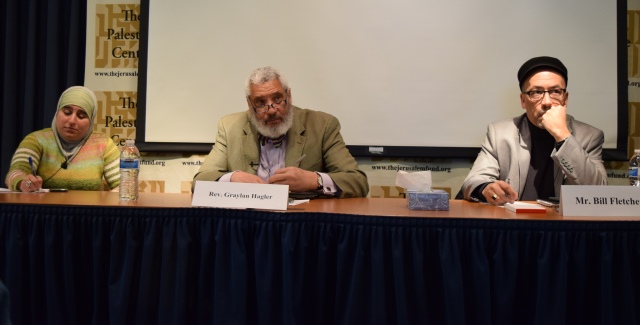
Video and Edited Transcript
Bill Fletcher, Ramah Kudaimi, Reverend Graylan Hagler
Transcript No. 425 (24 February 2015)
Samirah AlKassim: Welcome to this Palestine Center panel titled, “On Ferguson and Palestine: The Issue of Repression and Race.”
Much has been said about the similarities and links between Ferguson and Gaza since the events of summer 2014: the shooting of Michael Brown in Ferguson, Missouri, and the latest Israeli operation, Operation Protective Edge in Gaza, with their respective global protests. But what do the similarities and connections mean with regard to the question of repression and the subject of race? What must be done to address and redress the core issues at hand? How can we turn these understandings into useful actions and lessons for the future? These questions and more will be addressed by the speakers on this panel.
We will start today with Bill Fletcher, who is the former president of TransAfrica Forum and currently a Senior Scholar with the Institute for Policy Studies, an editorial board member of BlackCommentator.com and in the leadership of several other projects. He is the co-author (with Peter Agard) of The Indispensable Ally: Black Workers and the Formation of the Congress of Industrial Organizations, 1934-1941, the co-author (with Dr. Fernando Gapasin) of Solidarity Divided: The crisis in organized labor and a new path toward social justice; and the author of ‘They’re Bankrupting Us’ – And Twenty other myths about unions. Fletcher is a syndicated columnist and a regular media commentator on television, radio and the web. He has worked for several labor unions in addition to serving as a senior staff person in the national AFL-CIO.
Following Bill Fletcher will be Reverend Graylan Hagler who is the Senior Minister of Plymouth Congregational United Church of Christ, Washington, DC, and the Immediate Past National President of Ministers for Racial, Social and Economic Justice (MRSEJ). Reverend Hagler has served on the Steering and Administrative Committee of United for Peace and Justice, a national coalition working to oppose aspects of U.S. foreign policy that contribute to war and aggression. Reverend Hagler is the former Development Director of the Neighborhood Assistance Corporation of America (NACA), which helps people become homeowners, and has served as chaplain to UNITE HERE Local 25, the labor union representing hotel workers in the Washington Metropolitan Area. He is also the Executive Director of Faith Strategies, an organization of clergy he founded in 2012 that organizes efforts to improve the lot of working people, protect human and civil rights and develop strategies for movements to embrace the faith community.
And lastly, we will have Ramah Kudaimi who has worked at several grassroots activist organizations including CODEPINK, the Washington Peace Center, and the Arab American Action Network. She has a Master of Arts degree in Conflict Resolution from Georgetown University and a B.S. in Journalism from Northwestern University. Her writing has been published by Al Jazeera English, The Progressive, Truthout, among other outlets.
So we’ll start now with Bill Fletcher.
Bill Fletcher: Thank you and good afternoon. When this panel was being put together, we were asked what we wanted to speak on. These words sort of came to me, which is the racialization of repression. I want to start by telling you when I really started thinking about this. As a high school activist, which was a while ago, there were these student demonstrations in May 1970 around the Kent State killings. Virtually every campus and college shutdown and high schools shut down. I was one of the leaders in my high school of shutting down the school in protest over the murders of the Kent State students.
A few weeks later, there was a murder at Jackson State, a historically black college, and there were students who had been protesting both Nixon’s aggression in Vietnam and Cambodia, but also the Kent State killings. When that took place, there was nothing that resembled the response to Kent State. In my high school, for example, there were a number of us that tried to lead a walkout and we were met with this sort of blank look by many of the students. Around the country I’d hear similar such stories. It really started me thinking, “How is it possible to explain this distinction?” That’s part of what I want to get at today.
The nature of repression is obviously both physical and psychological – I don’t want to spend time on the physical – but the psychological is aimed at both the oppressed and the oppressor populations. You can see this in a number of interesting ways: whether the way that the Nazis perpetrated oppression or right-wing Hutus in 1994 in the genocide. The victimized population must be demonized, rendered less than human before you can carry out the actual genocide. There’s an interesting moment in a tremendous Kenneth Branagh film called Conspiracy, which if you have never seen, it’s very much worth seeing. It’s about the Wannsee meeting where the Holocaust was planned in 1942; it’s all based on transcripts that they’ve discovered. In one of the scenes there’s a discussion about how best to exterminate Jews and one of the things they said is that you can’t simply just line up people and have regular soldiers shoot them down, because its demoralizing for the troops – which I thought was really a fascinating thing – it’s demoralizing for the troops to shoot down men and particularly women and children. So they had to find a different means in which to carry out the genocide. Part of that is certainly psychological and part of it is technical.
In the case of both Palestinians and African Americans, those who are to be repressed must first be deprived of their humanity reminding us of that famous statement, “Those whom the gods wish to destroy, they first make mad.” What race offers is a way to explain away the reality and the humanity of the oppressed. Now, I want to just take you to a moment looking toward the United States and the issue of police lynching: consider for a moment the ratio 21:1. You may or may not have heard this ratio in the context of police lynching. African American men in their early twenties are 21 times more likely to be shot and killed by the police than white men of the same age. Twenty-one times. Not twice – 21 times. When one stares at this ratio you can’t easily explain this away. You either have decided that blacks deserve it or, simply, that you’re not going to put an equal value on the lives of African Americans. Much of the same has been done in the case of Palestinians. Any act by a Palestinian (whether it’s military, terrorist or the result of insanity) is transformed – generally by the mainstream media and certainly by the Israeli media – into the worst act in human history. The focus is always on the identity of the Israeli victim; we’re made to identify with the victim while the alleged or actual assailant is always in every case criminalized. So we understand the individual – whoever it is that is killed – but we don’t understand anything else beyond that. The reverse is also as stark. Rather than reference the Palestinian or African American situation, I take you to the Chapel Hill executions.
In the case of the Chapel Hill executions – what’s really amazing – is had it not been for the Twitter uprising, which is the way I refer to it, the mainstream media simply would never have covered it. Then when it does get covered, we get no White House declaration about how this is a hate crime; we get words coming out of the White House that actually made no sense, we have an explaining-away of it. There’s very little overall coverage about this, nor is there much attention to the history of either lynching against Arabs or particularly what’s been going on since 9/11. It’s just brushed away as if it’s not that important, and in fact for the mainstream it isn’t important. But then, a matter of days later we have the shootings in Copenhagen and within nanoseconds this is all over the media. This discrepancy is very important. We saw another tremendous example of this in response to the Oklahoma City massacre where in the immediate aftermath the assumption was that it was a Muslim terrorist that had carried it out – once they discovered that it was a good old white boy then the entire discussion changed to this fascinating examination of, “What would have motivated this good white man to have carried out such a horrendous act?” Nothing like that has ever been conducted when the perpetrator of an act is African American or, certainly, Palestinian or Arab.
So the racialization of repression makes the repression acceptable or, at least, turns it into a non-event as far as the oppressive population is concerned. In that sense, it’s consistent with the way that race changes and distinguishes the experience of people of color as opposed to those that are not.
As an example, although nothing to do with repression but something that I’ve found quite fascinating, was the response in the media to the tsunami that took place in South Asia a number of years ago. In that tsunami, hundreds of thousands of people died, most of them from Indonesia, Malaysia, Sri Lanka, Burma, Somalia, Kenya – however, you had no sense of the individuals, no sense of what this was meaning for people as a whole. The victims were by and large a brown mass in the background. The devastation was almost always explained by someone white and when the mainstream media really wanted to describe the catastrophe of the tsunami, they focused on 2,000 Swedes who also lost their lives in the tsunami. Now, this is nothing against Swedes – I like Sweden, it’s a great country and everything else – but 2,000 Swedes: we’re not focusing on the impact on Burma or on Sri Lanka or on Somalia. So we see that play out in the case of repression.
The racialization of repression smooths down any rough edges – it’s always a matter of collateral damage. Thus, we had the Israeli bombing of Gazan civilians – blamed, by the Israelis, on Hamas – but if Gazan civilians were killed, the Israelis always claimed that it wasn’t their intent. If a Palestinian carries out an attack, it doesn’t matter, it is always an act of terrorism regardless of what the target is.
This is why this question of race must be surfaced in both conflicts: it’s not about pinning a label of “racist” on one or another individual or one or another act, it’s actually about understanding the way that the system works. The system works as a way of justifying a larger form of oppression, not simply repression. Thank you very much.
Reverend Graylan Hagler: Good afternoon, everybody. I want to thank Bill Fletcher for what he shared with us, and one of the things that me and Bill – we actually go back, just so you know, quite a ways for how many years – but we started in Boston, and I’ve been in DC 23 years so, date that back a little bit – I was a baby, he was older. But Bill has always been a political theorist and a political historian in our midst and I want to give thanks for Bill Fletcher. In fact, it was a year ago this past January that, with Bill, we were in Palestine looking at the situation on the ground and meeting with numbers of groups that were working on resisting the occupation and years of oppression. What was interesting for me was that I had been in Palestine in 1974, so was literally 40 years difference to the year; so it was interesting being able to compare what I remembered 40 years ago to what I saw at this particular historical juncture on the ground. Things had clearly become much more oppressive, the land had become much more divided, people had become much more villainized, particularly by the dominant force there in the area which is the Israeli government. So my travels there opened my eyes in a new way because I had something to compare it to even though that “something” to compare it to was 40 years prior but it opened my eyes and engaged me as another place where the struggle against racism, racialism, cultural oppression, segregation and ultimately, genocide must be waged and we must find ways to feed it and turn it around.
It should be obvious to most of us the renaissance on the parts of governments to admit their paradigms of racism exists. The reason I lift that up is because it’s easy, somehow, to paint a picture – even though the picture is a group you have to distinguish and oppress, but at the same time you can create a different kind of paradigm that allows you to justify carrying out genocidal policies against the people. For example, we remember the minority government in South Africa that said, “We went to a country and we caused it to bloom,” as if the people who were indigenous to the land didn’t enjoy the “blooming of nature.” Or in this case, the Zionist argument of saying, “Palestine is a land without a people, for a people without a land.” Or we could date that back to Christopher Columbus and the Europeans somehow “show up” and all of a sudden “discover” America in spite of people who are already on the land and then put in place ways and methods and a philosophical framework that takes the personhood of an individual away from them and allows an economic paradigm to exist that takes over land, that destroys culture, that ignores history, that ignores who people are. That’s what we’re dealing with. When we really understand this in terms of a historical and almost universal nature, it has happened every single place where there has either been Western or colonizing powers that have gone in and taken over a geographical setting for their own ends, their own power, their own resources, and their own wealth usually at the destruction of those who already live on the land.
My eyes were opened. My eyes were opened to see that this racism that exists is something that is not just inherent to the United States of America – even though in other parts of the world we may not talk about it as racism. Why don’t we talk about it as racism in other parts of the world? In a sense, the fact is folks have to admit there is something that racist in its characterization: that means, somehow, there’s a relationship with the racism that exists in the United States, and, heaven forbid, if folks think that they’re black. In a sense, we have to divorce that and try to say, “Oh no! it’s really something else – it’s really greed on the part of these folks who have come in and taken over.” We can’t get down and touch racism.
I remember I was at a conference of Muslims in the United States and there was a youth caucus and the head of the youth caucus got up in the convention and said, “I’m really upset, I’m really angry because our parents deny that it was racism going on and then we went in schools and all the white kids treated us like we were the black kids.” All of a sudden the revelation of racism begins to emerge – folks in the world have been conditioned into this framework in order to continue to enhance the wealth in one group while denying the other group and at the same time putting in policies but denying that there’s anything really discriminatory that’s taking place: “Palestinians were there, they didn’t develop the land. Indians were there, they didn’t develop the land. Black South Africans were there, they didn’t develop the land. It’s their own fault.” Right? Or today, in Washington, DC as gentrification takes place, folks come in and say, “Well, black folks didn’t care of it politically or economically so it’s their own fault they’re being pushed out.” What I’m getting at is there’s nothing new under the sun: the arguments here in Washington, DC was the argument in white rural South Africa, is the argument today in Palestine and Israel, and we are called to take off our “blinders” and see reality how it really is.
Life in the southern United States post-reconstruction and into the era of Jim Crow. As we stood and traveled in Hebron and other places, the comparisons could not be ignored: the restriction of movement, the non-personhood, the second- and third-class status of Palestinians basically codified and carried out by the Israeli government – all kinds of restrictions. It cannot be lost on us that when you look at what was going on in Ferguson, Missouri – and you saw the military equipment lined on the streets – for those of us who had been there, it looks so much like Gaza. It looks so much like what takes places in the Occupied Territories every single day. It cannot be lost – the comparisons. The comparison cannot be lost when police chiefs from many police forces have been trained by the IDF in terms of police tactics. Police Chief Ramsay who is now up in Philadelphia was in Washington, DC, he went to Israel and all of a sudden, he came back and turned on all the squad cars’ lights – that was a tactic he learned from the IDF in Israel. The jump-outs that have gone on and the young people that have been killed in Washington, DC – brother Briscoe who was shot down here in Washington D.C. by one of those jump-out squads perfected in Israel against Palestinians. Again, as an occupying tactic that continues to be carried out and manifests itself all over the country. One can understand the comparisons: the tear gas that’s used in the West Bank was the tear gas that was used in Ferguson, Missouri, which was the tear gas that was manufactured in Pennsylvania. We cannot forget that there is this continued relationship – Israel carries out a public relations paradigm by bringing Ethiopian Jews into Israel to stand there and point guns at Palestinians so you can continue to confuse the issue in terms of race. Those Ethiopians are still at the bottom of the rung when it comes to civilian work – it is not different than what it means to work in any part of the world under a white paradigm. You’re second-class, you’re third-class citizens. All the Africans that have showed up there as refugees – that the Israeli government refuses to call refugees – are called infiltrators instead, which is a military term as if somebody has broken through your ranks and has infiltrated your forces to destroy them. When we were there, there was a march that was going on by folks who had come out of prison where they were being held. They were marching, in a sense, to assert their rights.
There is this continued racism that exists. At Plymouth Congregational United Church of Christ, we try to lift up the issues so people get clarified on that. In fact, while I’m here today, they’re looking at a movie called The Attack – I don’t know if you’ve seen it – and they looked at a movie last week called Omar, they’ve been looking at movies around the Palestinian theme trying to understand at a different emotional level how this continues to manifest itself. Everybody who sees it relates to it out of their own person – it’s interesting the connections that exist in terms of people really feeling alienated as black people in the United States can look at these movies and understand what is going on there. There is a commonality, there is a relationship and that relationship continues to be spelled out in a very racist paradigm. We are trying to push this issue even more because one of the things we’re struggling with in the church – there’s a few ministers in here who recognize – we are struggling with Christian Zionism. Folks, as liberal as they are, fall back into this fundamentalism that says, “But the Bible says it’s their land! The Bible says they can do what they want to do because God has ordained it.” Or, as somebody said and this is sort of horrifying stuff that we have to deal with theologically, “Israel has to deal with the Palestinians today because Israel disobeyed God.” I asked the guy, “What do you mean by that?” Now listen to this crazy logic: his argument was that Israel was told by God to destroy every man, woman, child and even the livestock, and they refused to do it so now they have to deal with the [Palestinian] problem today. I’m telling you, there is a destructive theology that’s afoot. Those of us who are in the church or the faith community, we have got to take it on, we have got to stand toe-to-toe with folks who really pervert the words of the scripture and we have to turn it around and get folks to understand that God is about liberation and God is self-empowerment and God is about protecting the folks who are indigenous to the land, that there is a call of justice that we have to stand for and push. It doesn’t matter if somebody looks like me or doesn’t look like me, speaks my language or doesn’t speak my language, or comes from my faith group or not, it doesn’t matter. The mandate is, as Amos put it, “Let justice roll down like water and righteousness like an ever-flowing stream.” We have to push the battle forward. God bless you.
Ramah Kudaimi: Hello everybody. I selfishly asked to be last so I could follow Bill and Rev. Hagler, mostly because I wanted to hear what they were saying, and now I may regret it. I’m going to be focusing on what both Rev. Hagler and Bill discussed: what does that mean for us as Palestine activists working to end U.S. support for Israeli apartheid or occupation, those of us who are committed to human rights?
I’m going to start with what the U.S. Campaign is itself and many different organizations and how we’ve mobilized around events that took place in Ferguson and why we felt the need to mobilize. Back in October, there was a call by local Ferguson activists that there’d be a weekend of resistance to point out why what happened to Mike Brown was wrong, how this was a bigger issue of police brutality in this country, and how this was not just a one-time thing and how it plays into the bigger issue of racism and the history of racism within this country. So we did a lot of organizing, and as you can see from this picture, we had so many people turn up. Again, it was the U.S. Campaign, people from the local Palestine Solidarity group, people from the U.S.-Palestinian community network that all came together to show that solidarity with what was happening in Ferguson. Before I get into the details, I do want to make a very important point that this is not something new. Activists say, “We are using these words like ‘solidarity,’ we use these words like ‘joint struggle,’ we use these words like ‘intersectionality,’” and we think, “Oh, we’re finally understanding these struggles are all connected and we need to make these connections.” Actually, this is something that has a long history: we’re not new to this. It’s our fault we don’t learn our history more to understand we’re actually part of a longer struggle.
If you look at the history of the Palestinian struggle there’s a lot of linkages between, say, the PLO and the Black Panther party. We just commemorated the fiftieth anniversary of Malcolm X’s assassination – Malcolm X was a big proponent of internationalism and talking not just about racism in the U.S., but imperialism in general. Community and grassroots organizing, again, a long history of what that means to be working together as communities, making those linkages and understanding what is the same about our struggles and what is different about these struggles. If you look at the history, we’re talking about COINTELPRO, the War on Drugs, today, continuing those things, we also have the PATRIOT Act, the War on Terror, counter extremism programming: these are all part of the same history of what it means to racialize oppression and make sure you’re shutting down any sort of grassroots organization against the bigger power structures. Political attacks on Palestine organizing: it’s not all of a sudden, there’s a history of political repression. I want to bring up the Palestine Organization because I want to quickly mention Rasmea Odeh, she’s the latest example of what it means to be in the United States and struggling against systematic oppression and facing that repression.
So why did we decide to do a Palestine contingence at the weekend of resistance in Ferguson back in October? Mike Brown, as we all know, was killed right in the midst of the Gaza war so a lot of our attention had been on Gaza and, as has been mentioned, the images coming out of Ferguson were, “Where are we looking? Are we looking at the Occupied Territories? Are we looking at the United States? What’s going on?” The tear gas being used, the story Rev. Hagler mentioned came out we’ve had police training in Israel. The former county police chief of St. Louis was one of fifteen American officials who participated in a week-long training in Israel three years ago that was put on by the Anti-Defamation League (ADL). A former St. Louis police chief also had participated in the Law Enforcement Exchange Program, which is an exchange program between Israeli national police. The ministry of internal security, Shin Bet – the security agency, to strengthen American law enforcement, especially with counter-terrorism. The media distortions – watching the media try to vilify Mike Brown and explain away his death like, “Oh no, it has nothing to do with racism, he was just in the wrong place at the wrong time and Wilson was just doing his job,” the same media distortions we see when we’re talking about Palestine and how Palestine is represented in the U.S.
It’s also very important for us to think about what it means for us if we are so committed to fighting against Israeli state violence and terrorism – well what does that mean when the U.S. itself is engaged in state violence? Can we continue to ignore what’s happening in our own backyards? I’m going to assume most of you are based in the DC area and Rev. Hagler brought up Raphael Briscoe. How many of us know who Raphael Briscoe is and his case and the fact that just last week the jury decided the police was not responsible for his death? Or the tactics of jump-outs, that Rev. Hagler also mentioned, which is DC’s version of stop-and-frisk. How many of us know that and think about what that means for us when we talk about “violence over there” and how we need to end U.S. support there and not really pay attention to what is going on right here in the U.S.
The Palestinian Movement, the U.S. branch, explained it very beautifully, I’m just going to read this, “This call to action in St. Louis inspires us to continue challenging and exposing the brutality happening everyday in our own backyard whilst connecting the systematic racism and subjugation happening in Occupied Palestine. We see incidents like that perpetrated against Michael Brown as an ongoing outcome of the racist structures that were founded on indigenous erasure and slavery and continue the repression and policing of black and brown communities. We carry on a mutual struggle to subvert the same colonial logics of supremacy and exclusion that are inherent to the Zionist colonization of Palestine. We will no longer stand by and watch while this relentless epidemic of brutality continues to be unleashed onto black and brown bodies here in the U.S. or in our homelands. We stand with you and Ferguson as we know too well that our freedom is incomplete without the freedom of black and brown sisters and brothers in the U.S.”
Beyond that weekend of resistance and showing up to be there in solidarity with the struggle that was happening and continues to take place in Ferguson, it’s also important to think about the campaign work we do. And the campaign work we do especially around boycott, divestment and sanctions (BDS) and are working to make sure that U.S. companies and institutions no longer support Israeli occupation and apartheid. How can we make choices that also strengthen other movements? A lot of these corporations that BDS activists target are very complicit in other forms as well. It’s very important to think through that. When we’re talking about G4S – for a lot of Palestine activists we know that it’s complicit in Israeli occupation in that it helps imprison Palestinians and many times, political prisoners who have done nothing wrong other than resist their occupation; where Palestinian prisoners tend to be tortured, even killed – and so this is a company that is high up on a lot of BDS activist list because of their role. And yet, G4S is the largest private prison company in the world which means they profit off of systems of mass incarcerations globally.
So what does that mean for us when we’re thinking through our campaigning and who we do outreach to and how we’re messaging? We know mass incarceration is a problem. For example, John Legend just two days ago at the Oscars: everyone is going on about what he said about how there are more black men are under correctional control today than were under slavery back in 1850. People were saying, “Oh my god, this is such a new fact,” – anyone who works in mass incarceration has been saying this for several years. So how do we think through that and build up campaigns to ensure we know this is an issue and we work for both Palestine and against mass incarceration? Elbit Systems has a $145 million contract to provide surveillance for the U.S.-Mexico Wall that the U.S. government is building to, again, keep out those “people” – the people who we stole their land from. Then also, when we’re thinking about racialization of oppression, why is a wall being built on the southern border not on the northern border – thinking through that. We know that immigration “reforms” have been very deadly – it’s estimated about 2,000 people have been killed in the past two, three decades on the border due to violence; Obama has two million people deported – thinking through that. The joint police trainings we explained. Bill brought up Chapel Hill – there’s so much connection between Islamophobia networks here in the US and Zionist groups providing funding to these groups. Folks definitely need to look up Fear Inc.: The Roots of Islamophobia Network in America, which tracks all that funding and where it goes – there are so many more examples, you can go on and on.
Israel developed drone technology that the United States now uses in its War on Terror worldwide. Israel, of course, experimented with drones on who? The Palestinian people, especially in Gaza. Think about how the U.S. actually funds all this research – we provide billions of dollars in military aid to Israel; a total of $121 billion since the state of Israel was founded; and how Israel also uses that money to also continue its military industry. G4S just recently signed a contract with Guantanamo Bay – again, examples go on and on. It’s very important that we are doing our research and choosing targets to think about which communities we want to connect with and why it’s important.
One interesting thing on the police training – usually the focus is “Israel is training cops here” and it seems we are kind of placing the blame on Israel for the militarization of the U.S. police, which is not true. Long before Israel was created, the United States was brutal against people of color in the U.S., but it goes both ways. For example, a lot of U.S. police go and train in Israel especially post-9/11 and counterterrorism, but, there’s also Israeli police who come and train here in War on Drugs enforcement – it’s very collaborative and we need to think it through when we’re talking about bringing down whole systems. We need to focus on any angle we can because it will be a long and hard process.
The last thing I just want to share with you guys happened last month. There was a delegation to Palestine that was led by Dream Defenders and involved leaders from the Black Lives Matter Movement as well as Ferguson leaders and they went to Palestine to learn about what’s happening there as well as make those connections. One of the organizers of the trip, a Palestinian name Ahmed Abouzeid, said, “In the spirit of Malcolm X, Angela Davis, Stokely Carmichael and many others, we thought the connections between the African American leadership of the movement in the U.S. and those on the ground in Palestine needed to be established and fortified.” It was a very beautiful trip, I highly recommend people if you’re on Twitter to go search #DDPalestine or Google any articles or images from that because as this movement for Black Lives Matter is continuing to grow, and as our people on the ground here are making connections while they were protesting Ferguson what was happening in Palestine at the same time, figuring out how to continue making both movements feed off each other and work together is necessary and very important. This is a very good example of activists who are involved with both bringing other activists to learn.
Bill Fletcher is the former president of TransAfrica Forum; a Senior Scholar with the Institute for Policy Studies; an editorial board member of BlackCommentator.com; and in the leadership of several other projects, including serving as host of The Global African on Telesur-English. Fletcher is the co-author (with Peter Agard) of The Indispensable Ally: Black Workers and the Formation of the Congress of Industrial Organizations, 1934-1941; the co-author (with Dr. Fernando Gapasin) of Solidarity Divided: The crisis in organized labor and a new path toward social justice; and the author of ‘They’re Bankrupting Us’ – And Twenty other myths about unions. Fletcher is a syndicated columnist and a regular media commentator on television, radio and the web. He has worked for several labor unions in addition to serving as a senior staff person in the national AFL-CIO.
the Washington Peace Center, and the Arab American Action Network. She has a Master of Arts degree in Conflict Resolution from Georgetown University and a B.S. in Journalism from Northwestern University. Her writing has been published by Al Jazeera English, The Progressive, Truthout and more.
Corporation of America (NACA), which helps people become homeowners, and has served as chaplain to UNITE HERE Local 25, the labor union representing hotel workers in the Washington Metropolitan Area. He is
also the Executive Director of Faith Strategies, an organization of clergy he founded in 2012 that organizes efforts to improve the lot of working people, protect human and civil rights and develop strategies for movements to embrace the faith community.
