
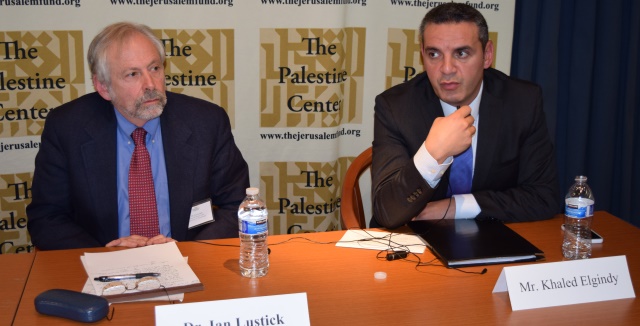
Video and Edited Transcript
Ian Lustick and Khaled Elgindy
Transcript No. 420 (14 November 2014)
14 November 2014
The Palestine Center
Washington, DC
Moderated by Dr. Subhi Ali, Jerusalem Fund Board Chairman
Khaled Elgindy: Thank you and thank you to The Palestine Center for inviting me. Let me start off maybe by framing the issue with a fundamental paradox that I think will cover not just my presentation but I think Professor Lustick’s also. And I think you’ll find that our remarks are very complimentary. The basic paradox, essentially, as far as the U.S. role in this process is concerned, is that on the one hand, you have the United States generally recognized as the only party that can bring the parties together, the only actor that can bring the parties together to bring about a deal. And also at the very same time, it’s the only party that won’t do what is actually needed to get us there. I think we all know what is essentially required and there are a whole host of reasons why the United States can’t take certain steps.
It’s not just a matter of current behavior of the Obama administration. I think the trend lines are clear as far as both the administration and the Congress. You find a very, I think, increasingly hostile environment on Capitol Hill to almost anything Palestinian, much more indifference to the idea of a two-state solution, used to be sort of the litmus test. And now I think it’s like as in many places, it’s sort of passé to talk about the two-state solution. So certainly in Congress you see this trend. You see much less tolerance for Palestinian perspectives on Capitol Hill. But I think it’s also very much true of the administration, as well. And even though there were a lot of high hopes for the Obama administration, I think at a minimum, the administration has not lived up to those hopes and I think there’s actually quite a bit of disappointment. I would argue that, in fact, there’s been an erosion and a regression in many ways as far as U.S. policy is concerned. And we saw an example of that during the Gaza war when there was enormous reluctance on the part of the administration to speak out on the civilian casualties, the overwhelming civilian casualties. Even though there was very well established precedent by both the White House and the State Department under both Democratic and Republican administrations, where there was much more kind of forthcoming criticism toward Israel, including by, none other than George W. Bush who famously told Ariel Sharon, “Enough is enough.” And the scale of destruction and killing a decade ago or more during the Second Intifada was nothing like what we saw in Gaza and in a very short period of time.
So there’s this increased reluctance to criticize and I think increased reluctance to do what’s needed. I think if they continue on this track, the Obama administration, I think, may very well be the first administration in 40 years or more that has not moved the needle even a bit. It has not broken any new ground in terms of Israeli-Palestinian peace. Of course that’s maybe arguable, depending on how you define, but in my understanding, in my analysis, there’s not been anything groundbreaking. Even George W. bush, again, not known for his sympathies towards the Palestinians was at least the first to make the idea of a Palestinian state official U.S. policy and there were presidents going all the way back to the Nixon administration and Carter and so on. And yet Obama is in something like a holding pattern. It’s also not a problem just of failed negotiations. Yes, it’s true the Annapolis Process failed and not surprisingly, many of us wrote, that the latest round of negotiations would also fail, just as they failed in 2010. In fact, they failed back then before they even got off the ground.
It’s really a much more holistic failure than that. You know, we used to talk about all peace and no process. That was the sort of main critique of the U.S.-led peace process but today there’s not even a process to speak of so there’s no peace and there’s no process. By that I mean that the entire infrastructure or the architecture, if you will, of peace, has been eliminated bit-by-bit from the Oslo committees on incitement. In the 1990s into the 2000s you had kind of a continuation of the process under a new heading called the Road Map, the road map for peace that was designed by the international quartet and we had certain expectations of the two sides. There were via a settlement freeze, there were via cessation of violence by both sides, there was built in this notion of mutuality. An inherent understanding that things like settlements and home demolitions contribute not only to a lack of confidence in the process or as signs of ill will but also as harmful and actually as causes of violence in and of themselves. And I think for all of its flaws, and there are many, many, the Road Map at least recognized this fundamental connection between ongoing settlement activity and all that goes with it: Land confiscation, home demolitions, denial of residency rights and the gradual dispossession of Palestinians in order to essentially replace them with Israeli Jews. That process would lead to violence and at least the Road Map understood that.
So all of that doesn’t exist, you know, not that the Oslo and the Road Map were the panacea and nor am I advocating that we go back to the Oslo or the Road Map. I think we’re well beyond that. They were deeply flawed to begin with and are at this point, completely outdated. But there’s simply nothing to take its place. At a minimum, the parties were at a certain point, at least invested enough in the process and at least, again, at a minimum, those mechanisms that existed at least had established some sort of a baseline for which to measure progress, even if only in aspirational terms. Today we have nothing like that. We have simply the pleadings of an American secretary of state; I think it was rather striking during the Gaza War to watch Secretary Kerry as he was carrying out his shuttle diplomacy, traveling all over the region and essentially shut out of the process in a way that I think was quite humiliating, certainly just as an observer. It was difficult to watch. I felt embarrassed for him as an American. He was cut out of the process by the two main actors who could have brought this to a quick close: the Egyptians and the Israelis. They also sort of heaped insults upon him when he tried to intervene.
So you have this kind of waning American influence, which is a common theme across the Middle East and in American foreign policy, in general. And so the U.S. doesn’t have the kind of cache that it used to, the kind of influence that it used to and I think it’s kind of self-perpetuating. The reality comes down to this: that there is really nothing to constrain the two parties from doing whatever they want. Mahmoud Abbas will go to the UN, Israel will build more settlements, it can deploy its military whenever and however it wants. There’s almost a limitless capacity to rely on the military and there are no constraints. It really just comes down to basic power dynamics and it should be no surprise that the reality is much more unfavorable to the Palestinians than to the Israelis just given this power dynamic.
I’ll just end with this point, and that is, I don’t necessarily have the solution and again, I’m not advocating that we go back to defunct and essentially ineffective and bankrupt mechanisms from Oslo or the Quartet or the Road Map, but it’s clear there’s something that needs to be inserted in this vacuum, and this is where American leadership is essential and I think one way forward is that instead of having an American monopolized process which is what we’ve had for most of the last twenty years, with some window dressing called the Quartet and other things, but essentially, American dominated peace process, I think the United States’ role is essential but it can no longer attempt to dominate this process. It needs regional support. Clearly, it can’t do much without regional partners but also I think there are key roles for both the United Nations in terms of reinserting the whole notion of international legitimacy and international law as a standard by which to hold parties accountable. I think this is essential. And in that respect, I think the United States can do quite a bit if not directly by commission, at least by omission, by not standing in the way of the pursuit of initiatives at the Security Council or the International Criminal Court and other forms. Not that I think that’s likely but I do think that it’s possible even in this very charged political environment. With that, I will look forward to hearing Professor Lustick.
Ian Lustick: Thank you and I want to thank the organizers of what for me also has been a wonderful, informative and stimulating conference and I look forward to the discussion. I know we have a generous or adequate question and answer period. For myself, I don’t insist on questions and I don’t claim to have all the answers so if you just have a comment on what I have to say, I’ll retain that as well but you’ll get a response. Some of you may know about fourteen months ago I published a piece in The New York Times about the two state illusion. One of the main thrusts of that piece was that the Kerry negotiations were going to fail and that was a very easy prediction to make, as we’ve heard. But I’m going to make another easy prediction and that is that they’re going to start again. Not necessarily Kerry but there’s going to be another round. I want to try to explain in my presentation, why? Why is this going to happen, we are caught in this hamster wheel and once we arrive at a deeper understanding of that, what can we make of it?
So, I want to tell a story that Aleksandr Solzhenitsyn tells about the 1930s in the Soviet Union. Some of you may know it if you read the Gulag. It’s a story about a Communist party meeting in Georgia in which there was a whole hall of Communist functionaries including several up on the stage. And Stalin’s name was mentioned and everyone rose and started clapping and they were clapping for three and four minutes and five minutes and 20 minutes and finally they were getting exhausted, one of the men on the stage who ran a factory in the area, sat down and everyone immediately sat down, stopped clapping and they started to do their business and that night the man who sat down was arrested by the KGB. He was interrogated, sentenced to five years in the Gulag. According to this story, before he was sent away, the interrogator said, “I have one piece of advice for you: never be the first to stop clapping.”
When I told this story in Ramallah, Nabil Shaath was in the audience and he said, “Yes, we are all still clapping” and I said, “Yes, you understand exactly why this hamster wheel turns.” It’s called in political science a Nash equilibrium. If you saw the movie A Beautiful Mind, well that was about John Nash who discovered and invented this idea of Nash equilibrium. They don’t do a very good job in the movie of explaining what this is but I’m going to try to do it very quickly. It’s basically everybody is doing something which is the bet is terrible for them, but it’s the best they can do given that everyone else is also doing what’s best for them and although everyone would like to escape from this, nobody can be the first one to do it.
That’s a Nash equilibrium and it’s very common, but what we see here is we have four actors. Four key actors. And none of them like this hamster wheel. They would all prefer something else. But the Palestinian Authority would love a two-state solution with East Jerusalem as its capital, it would love it. But given that’s not going to happen and they don’t want it to lose $500 million in salaries and support, they will participate in this hamster wheel. The Israeli right wing governments would love to have the Palestinian problem just go away and have the world stop bothering them about it. Let them do whatever they want in the West Bank and in East Jerusalem and not have to talk about this two-state solution. Of course, they don’t believe in it but if the right wing government has to expose itself as opposed to what most Israelis want and what the entire world wants, as opposed to pretending they’re endorsing a two-state solution, well they’ll jump on the hamster wheel too. The United States and the administration of the United States, and I’m going to go into this in detail, would love to have the end of this problem, especially an American brokered version, where there are two viable states and they don’t have this thing constantly coming on top of them but that’s not going to happen and the main thing for the administration is to not have AIPAC on your back constantly.
Well, if there is an active and semi-active diplomatic process with the Israelis then they can just turn to AIPAC and say, “Wait a minute, we’re working with the Israeli government, you can’t criticize us now, you’re criticizing the Israeli government.” Of course, we’re not always in diplomatic negotiations as we just heard, but the cycle matches the negotiations. The cycle is the buildup, the demand for negotiations because isn’t this horrible? We have to start the negotiations again. And then, pressure will build up and some very self-confident American lawyer will be in charge of some part of the government and will say the only reason this problem has not been solved yet is I have not been given the responsibility for solving it and we’ll be off to the races again.
We’ve left out one other player and that’s the peace process industry, which benefits enormously. Of course, they would love a solution. I don’t think about them cynically, I’ve been a part of this industry. We would love to have a solution but we if we don’t have a solution, the hamster wheel could work for us because it’s constantly giving us the reasons why people should give us money. Either because now is the last chance so if not now, when? And if we don’t start the negotiations we will never be able to have peace so we got it now more than ever. So, everybody is still constantly clapping. Everyone knows, absolutely knows, there’s no hope for diplomatic process toward a two-state solution under current circumstances but that doesn’t mean they’re going to not continue to clap for the reasons that that prisoner figured out.
Now, let’s ask: why? Why are we caught in this? I agree that the United States is not the only actor, any future successful process will have to enlist the UN, the Europeans but I don’t know any path from here to there that’s going to get those things to happen without the United States pushing it. But I agree in principle. But you need to understand why the most important actor in this quartet, the quartet I just described, is unable to change, why? And that’s a structural feature of American politics. It’s a deep structural feature of American politics.
Now, I’m sure many of you if not most of you are aware of the book by Mearsheimer and Walt, The Israel Lobby. I am a great fan of the two of them and of the book, but it’s not a perfect book. There’s a lot that is actually wrong in it and one fundamental thing that is wrong in it is the horror that they express on the basis of, “Can you believe it? In this situation? American interests are not driving American policy! Wow! How could that happen? Must be this Israel lobby, which if not for the Israel lobby, of course U.S. national interests would be in the driver seat.” So tell me, John, tell me one area in world politics, one, just one, where American policy is actually in your view, driven by real American interests. At that particular moment, he couldn’t think of one. The fact is that’s not how foreign policy is made in the United States. It never is driven by some national interest disembodied from political interest.
Let me just prove this in one minute. We know that American foreign policy towards the Arab-Israel conflict is a three standard deviation from the world mean. It’s really weird. Three standard deviations means you should never see it unless you live about fourteen lives.
There is one other policy that the American government pursues that is like that, that is at least three standard deviations from the mean of the international community. There is one other. I can’t think of only one other. Not climate change. What is that other one? Cuba! Exactly! Hmm… what do these two issues have in common? Oh I know. Both of them have to be against boycotts. No, that doesn’t work. What do they have in common? There’s a single issue, political lobby, in the United States that matters domestically. In Cuba’s case, it just matters in a couple of states. In the Israeli case, it matters more but it doesn’t take much. The Israeli lobby could be weak than what it is and you’d still have Cuba. Every October they take a vote in the UN on Cuba. It’s 180 to two on whether to end the embargo. The two are the United States and Israel. It’s just an interesting factoid. The votes on Israeli and Arab stuff are usually 150 to five or 150 to seven.
In this particular case, the national interest is overridden by a particular group. That is not to understand just how difficult this problem is. The problem is much deeper than that and here’s where I’m going. In order to explain this about the structure of U.S. policies, I have to teach you another couple of social science concepts. Not just Nash equilibrium but type 1 versus type 2 errors. Have you ever heard of that in statistics, in social science? A type 1 error is an error of commission. You act when you should not have acted. You’ve accepted the hypothesis is true when it’s really false. A type 2 error is an error of omission. I should have acted but I didn’t. You got that? Type 1 error is “Oh my God, I shouldn’t have done that.” Type 2 error is, “Oh, I should have done that!” Two different kinds of errors. Our founding fathers, when they set up this country, were mainly afraid of type 1 errors. They did not want a strong government that would go and do things and express its power by affecting the property or the lives or the beliefs of the people who formed the government. They were thinking about King George but they were also thinking good liberals. They wanted a weak central government. If you read Federalist Ten, it’s about dividing power so agonizingly that nothing will ever get done.
See what a great job they did? That is exactly how they gerrymandered everything. If anything did get done, it would have to be something that almost everyone wanted to do. That’s how they set up domestic American politics. Don’t make any type 1 errors but of course you’re going to make many type 2 errors. The government is going to pass up a lot of situations where it should have acted but it didn’t. But, at least we’re not going to have any type 1 errors. What is not often understood is that foreign policy is different. In foreign policy, in Vietnam, think about how many Vietnamese voters there were in the 1960s, here in the United States to strike back against those who were hurting their interests in Congress by fighting the war. There were none. Foreign policy is an area where a president and an administration can finally be free of these shackles, of these Lilliputian shackles that otherwise make him feel like he has no power even though he’s supposed to be the most powerful person in the world. Foreign policy you can actually make a statement, have a policy and the tradition of bipartisanship, has been a tradition of bipartisan in foreign policy, gave you a much greater freedom. In the twentieth century, something else got added to that and that was a huge and growing, now it’s utterly spectacular, the gap between the amount of power the United States has to project its military force and the amount of power that others have. And because of that gap, it seems very easy for presidents to get involved because there’s no opposition at home, nobody really cares about foreign policy and knows even less, and you’re never going to lose an all-out battle overseas. You might get hurt later but you’ve got so much power, it looks like a little investment in say 40,000 people getting annihilated in Libya.
This shows that what we’re going to do is a lot of type 2 errors. A lot of type 1 errors are going to get committed in foreign policy. We’re going to go out and do a lot that we shouldn’t be doing but here at home, we’re going to not do a lot that we should be doing and it’s all because of the deep structure of American politics. Now, how does this relate to our case? Tragically, the Arab-Israeli conflict gets the worst of both worlds. Because it’s a foreign policy issue, there always seems to be for these powerful confident lawyers, an opportunity to make a name for yourself and a seeming opportunity to do what nobody has ever done before, play the role that the United States should play in the world, lead to peace in the Middle East. It’s just an open door and it’s hard to refuse it and it’s hard to refuse diplomatic opportunities even if they’re hopeless, for that reason. But because of the other side, the way American politics is constrained domestically, although we’ll get involved in a lot of things, we’ll never be able to implement them seriously because that will get caught up in the domestic, “Don’t make any type 1 errors, we don’t mind if you make type 2 errors.” That is, “We don’t mind if you don’t do what you should do to make what you did work.” So, I wanted to show you how the structure of American politics plays out in this weird way in Arab-Israeli sense. Because Israel is involved and it’s so closely tied in to the United States in so many ways, it is in one sense, treated like a foreign policy problem and that gets us into all these things that we can’t really bring to conclusion. We can’t do the heavy lifting but we can do a lot of posturing and that’s what you will get. Posturing and no heavy lifting and you’ll get it again and again. I know we have very little time left and we can go into this in the Q&A but I did want to say something that wasn’t totally hopeless about what I’m saying.
What is the first order result of this situation? First order result is the diplomacy under current circumstances will not bring peace at all. It has no real chance of that at all. So what are the second order consequences? Well some are good. What are the consequences of having this hamster wheel? Some are bad. One of the bad ones is that when people think that the two state solution can be arrived at diplomatically, they are constantly not thinking about other possibilities. So, it sucks the political oxygen and the intellectual oxygen out of the atmosphere and prevents people from thinking in new ways about how the alchemy of politics could move the situation in Palestine and around Palestine beyond it. It also trains the world to believe that the United States does not mean anything it says and that’s not good. I do not believe that’s a good thing.
What can we take advantage of? Number one, it ensures that every president, no matter where he starts, will eventually get disgusted with right-wing Israeli governments because he’ll withsawed over and over and over and humiliated. So that’s a good thing. Another thing, from a Palestinian point of view, well you’re getting half a billion dollars a year to help Palestinians live in the West Bank at least. So, there’s a smooth aspect of this that if you compare it to the absence of the hamster wheel, it could be much worse. You take one specific place: E1. This is the area between East Jerusalem and Ma’ale Adumim, which the Israeli government is constantly wanting to settle, repeatedly the United States has slammed that shut. If it’s done quietly, it’s done it over and over and over again, including this administration. And that wouldn’t occur without this expectation of an ongoing relationship. It gives time for slow demographic changes to transform Palestine and Israel in a variety of interesting ways that we can go into later. Finally, because it provides a certain kind of time and churning, it allows for changing targets of Israeli governance that is, I argue, what you have is not a one state solution but a one state outcome there. It’s not a very nice state but there is one and only one state between the river and the sea and I don’t count the PA as that state. And the question then can gradually become in many different domains: Is this a democratic state? Is this state operating the way it should? How could it be changed? How could the values that Americans stand for be used as a metric for evaluating these policies? Now that means as eventually people become more and more understanding of how meaningless the diplomatic process is, this will be an agenda that people will start to think about more seriously. Thank you.
Ian Lustick is a recipient of awards from the Carnegie Corporation, the National Science Foundation, the National Endowment for the Humanities, the Social Sciences Research Council, and the United States Institute of Peace. Before coming to Penn, Professor Lustick taught for fifteen years at Dartmouth College and worked for one year in the Department of State. His present research includes the politics of Jewish and
non-Jewish migration into and out of Palestine/the Land of Israel and on prospects for peace between Israelis and Palestinians. He is a past president of the Politics and History Section of the American Political Science Association and of the Association for Israel Studies, and a member of the Council on Foreign Relations.
Khaled Elgindy is a Fellow with the Saban Center for Middle East Policy at the Brookings Institution in Washington, DC. He previously served as an advisor to the Palestinian leadership in Ramallah on permanent status negotiations with Israel from 2004-2009, and was a key participant in the Annapolis negotiations of 2008. He is the author of numerous publications on Arab-Israeli affairs, Palestinian politics, Egypt’s transition, and related subjects, including: “The Middle East Quartet: A Post-Mortem” (Brookings Institution, Feb. 2012); “Palestine Goes to the UN: Understanding the New Statehood Strategy,” Foreign Affairs (Sep./Oct. 2011); as well as “The Impact on the Peace Process: Peacemaker or Peacebreaker?” (with Salman Shaikh) and “The Palestinians: Between National Liberation and Political Legitimacy,” both in the recent Brookings volume, The Arab Awakening: America and the Transformation of the Middle East (Nov. 2011).
This transcript may be used without permission but with proper attribution to The Palestine Center. The speaker’s views do not necessarily reflect the views of The Jerusalem Fund.
