
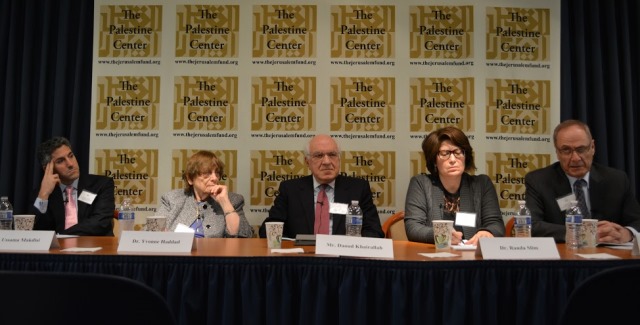
Video and Edited Transcript
Dr. Randa Slim, Dr. Yvonne Haddad, Mr. Daoud Khairallah
and Dr. Ussama Makdisi
Transcript No. 394 (15 November 2013)
15 November 2013
The Palestine Center
Washington, DC
Moderated by Dr. Edmund Ghareeb, Palestine Center Committee
Edmund Ghareeb: Thank you, Dr. Ali. It is a pleasure to be here with you today, and we have as, Dr. Ali mentioned an excellent group of speakers who are extremely knowledgeable about the issues we are talking about today. They have been working, many have been working, actually, all of them have been working on this topic and other related topics in the region for a long time. Basically as Dr. Ali mentioned, the Middle East has in recent years has witnessed some of the most violent sectarian, ethnic and, tribal, conflicts in recent memory. Weather it is in Iraq after the U.S. invasion or Syria today, to Lebanon and Egypt, Lebanon in fact we should not forget, and maybe this is something that we will be talking about later. Lebanon probably witnessed one of the most violent conflicts in recent history, sectarian and it had other dimensions as well. Lebanon lost something like 144,000 people who were killed, something like close to 200,000 who died and 17,000 people who went missing or disappeared. And if you take these figures for a small country like Lebanon of three and half, or four million people, you can see the devastating impact that this conflict had.
Clearly what we are seeing is that sectarianism and sectarian narratives are coloring politics in very significant ways. Yesterday, for example, there was a report about the Islamic State of Iraq and Syria, they executed a person who they believed was an Iraqi Shiite fighting on behalf of the regime, they cut off his head and they took pictures with him. However, it later became known that this guy was actually a member of another opposition group, and it shows to a certain extent the extreme violence and hatred perhaps, that we are seeing in this conflict. We are seeing bombings of churches, of mosques, and we are seeing the killing of people based on their sectarian identity, and this is happening in Syria and Iraq. Iraq also witnessed huge losses as a result of the war that took place in 2003, I’m not going to go back to the 1990-91 war, but about close to one million people died, there are about two and half million internal refugees, displaced people, and two to two and a half million who are external refugees in neighboring countries and other places in the world.
Today in fact what we are seeing is that the number of people dying in Iraq, and I am sure that this is something that will come up later, is close to the highest period of violence that Iraq witnessed around 2006-2007. Something like 12,000 people have already been killed in Iraq. In addition to these conflicts and these violent and terrifying events that we are witnessing, there is another danger; this is the danger of fragmentation of the states that emerged in the post-World War I period. I was being interviewed yesterday on a program on Iran, and about negotiations and about Israeli policy, but in the middle of that interview, the correspondent asked a question about Syria; is Syria going to survive as a country. Have we reached the point where the country is going to fragment? Are we seeing a new Sykes- Picot? By the way, this is not the first time that I’ve heard this, I have heard this from a number of people in the region who are now worried that as a result the countries which were established after Sykes-Picot are now going to be further divided, and in fact this is one of the real concerns that many people have. Whether that is going to happen or not is not what I am going to be talking about, but what I am talking about is the high level of violence; we are talking about militarization of the opposition, and of course, the regime (which) has used extremely repressive tactics as well, so it is not just one side that has been involved. One of the other things that we are going to be discussing is that, this phenomenon of sectarianism, this ethnicism or ethnic conflict that we are witnessing in the region and we have as I said an excellent panel, and I will just briefly introduce them to us.
One of the questions that I would like to ask is, what is the nature of the ethnic and sectarian conflict in the Middle East? What are the causes behind the rise of sectarianism this time?
Daoud Khairallah: Well, usually sectarianism is associated with internal conflict between communities of different groups, different sects, it is associated with violence and discord in the society. For our purposes, I think I would like to define it this way, this definition is the conclusion of observation of all my life, I grew up in a political system that breeds sectarianism: that is Lebanon. And having observed what is going on, and what has been going on in the Arab world, and how the sectarian culture has taken roots and is the forefront of whatever struggle now in the Arab world, I think I can define it this way: it is the promotion and exploitation of religious and denominational affiliation, with whatever religion, for the purposes of achieving political objectives, the promoting and exploiting this relationship, for political objectives. If we look at the way sectarianism has acted everywhere from the internal level to the more general level, if we look at the nature of what sectarianism in this kind of conflict, what did it do, and how can it be exploited, one of its characteristics is that it leads to some kind of tearing apart of society. So any party that has an interest in tearing apart a society would try to promote sectarianism, and the reason it has been around for a long time, I mean, belonging to a certain sect, on its own does not create violence, but when it is exploited, when it is promoted and guided to do that, then it will.
If we try to identify certain factors in recent time that have contributed to the culture of sectarianism, if we start from the outside, we look at for example the U.S. experience in Afghanistan. When the U.S. went again to Afghanistan after September 11, they found pamphlets that were printed, published by the USAID, quoting verses from the Quran, inciting Afghanis to Jihad. So this shows us that it has made a contribution. In Iraq the U.S. has tried or supervised sectarianism, institutionalizing sectarianism in Iraq. We see the divisions and we see what the American democracy had brought in terms of peace and harmony in society. And we look also at the inclination of the U.S now in supporting political Islam and how did this work in Egypt, we see how it is torn apart, and in Syria we know what is going on now, all over practically.
If we take another example, Israel has every interest in seeing any Arab unity dismantled, any strength, any cohesion done away with, and Israel has done a lot, take for example the civil war in Lebanon. It has supported one side against another, it has interfered via military and every other way, and not only that, even until today , Israel has fought a war against Hezbollah until 2006, and didn’t achieve what it wanted to achieve, i.e., disarm Hezbollah. But it achieved very well, the ability of having a sect for those who associate themselves with Sunni Islam in Lebanon, adopting what is an Israeli dream: disarming Hezbollah and depriving Lebanon of the ability of defending itself. If we look at the other factor, if we look at Iran, the Islamic Revolution in Iran has brought to the picture this Shia identification that is well spread now in Lebanon, it is another very important factor in the promotion of sectarianism. The great prize in my opinion, goes to some countries of the Gulf, Saudi Arabia among others. Especially in the present times, if we look at the way things are working in Syria and Bahrain, and other places, we see that certain countries use what I would call corruption, and corruption has been used in the most despicable way in this case. The corrupting agent sees a need in the corruptible and tries to meet this need. This need could be material; money or otherwise, this is one thing, or weapons or whatever, and it could be spiritual. And in this case this is what makes it despicable, having clergy or whatever, or ulama or whatever, providing an authoritative fatwa that will incite people find a shorter way if they go kill and die in a different country, and this is happening now.
And the worst kind of corruption, all kinds of human needs have been exploited in this respect. Take for example in certain parts of Syria they have invented the Nikah-al-Jihad, they justify religiously that young women could go and have temporary marriages, one hour or two with those who are holding guns because they need this kind of outlet. So in every way, corruption has been used to create a havoc and capitalize on this sectarian affiliation given some authoritative sources, those who can interpret reliably the will of god on earth, go to a certain believer and tell him that the way to go to heaven is to do A,B, or C, go kill yourself and someone else, and so on.
Edmund Ghareeb: What are the real causes behind sectarianism, maybe Ussama or Dr. Haddad?
Ussama Makdisi: So what I would say about sectarianism, I think the most important thing to say is that there is no such thing as sectarianism with a capital “S”. Each country, each location has its own, this is what historians believe, each country has a specific historic, political, economic, social context within which what we describe as sectarianism is occurring or manifesting today. So that’s the first point. The second point is to say insofar as we talk about sectarianism, it’s a function of diversity. The fact of the matter is that the Middle East is a religiously pluralistic place, has been, and just like any other society, some of the cleavages are economic, some are political, some are sectarian, religious, communal. And that is an inescapable part of the social, political, economic, religious fabric of society.
But I think if we’re going to talk about sectarianism today then we talk about specific political, historical, economic conflicts. So you mentioned Saudi Arabia, the other thing to bear in mind is that when we talk about sectarianism today, we’re not talking about religious, medieval violence despite the fact that there are protagonists in the Middle East who invoke Sunni/Shia divides that go back centuries and despite the fact that Reuters and the BBC and The Guardian and many other Western newspapers always, almost always preface an article about a sectarian bombing or an incident by talking about the original schism between Sunnis and Shias, although they never mention that when they talk about Ireland, for instance. They don’t say that in Ireland there’s a conflict because it goes back to the Reformation or the Counter-Reformation. I think it’s important to bear in mind that the sectarian problems we’re dealing with today are a function of a nation-state form. In other words, we’re talking about a history, you mentioned Sykes-Picot, that really begins in the late nineteenth century and continues until today.
The very term “sectarianism” in Arabic, al ta’ifiyeh, is in fact, as far as I can tell, is a word that has come into usage only in modern contemporary Arabic to refer to the opposite of a secular idea, or a national ideas, which is also very modern as well. So these are modern conflicts about resource allocation, about citizenship rights, about state policies and discrimination, about Western intervention of course, about the map that the Western countries that the British and the French drew, and about how different groups inside different Arab countries react and manipulate these troubles. So in other words, I think we should be very specific about which country we are talking about. Otherwise, it gets into this massive general discussion about sectarianism, with a capital S which does not exist. There is no one sectarian problem across the region.
Randa Slim: I also would say that, based on what Ussama said, that there is not only Sunni-Shi’a schism, and that is how we have come to look at things. But if you look at Egypt, there is a Sunni-Sunni schism, you know. If you look at Iraq, the schism between Muqtada Al-Sadr and Bedawa people, so what I am afraid of, I think we in the West and in the media have helped with this that the sectarian narrative has shifted the attention way from the democratization. The sectarian narrative has shifted the focus away from the democratization narrative. When the Arab Spring started, we were talking about the hopes for democracy, and now what we are talking about more and more is Sunni killing Shi’a, does not mean it’s not happening, but I agree with Ussama that it’s also very much a reaction to the upheaval that the region is going through. If we look at group dynamics in social psychology, this kind of intra-group division within Islam, as he said, has happened throughout history, within Christianity, you know, other religions. And usually they happen in times of social stress, at times of social upheaval. It is a natural inclination of human beings to revert to a primary affiliation group, to a primary identity group as a source of security. But also in this case, it is a reality that you have states, you have governments, you have political parties that are using a sectarian agenda, there are many blatantly sectarian identities to keep this whole focus on democratization away from their countries and to keep the whole issue of change and political change, away from their countries.
Yvonne Haddad: I think one of the things that we are missing is the fact of the fall the Soviet Union. So we are no more talking about ideologies between West and communism. So, we are beginning to be divided, especially in the Arab world, and it has hit them very strongly because there were several authors that wrote that America is now going to potentially fight Islam. Islam is the ideology and I think that there are people building this up and it fragmented the area, especially because Saudi Arabia is being pitted against Iran. I think that as long as the scare of communism was there, there was more holding together because the enemy was identified as something outside and now the enemy is inside; it has shifted.
Edmund Ghareeb: One of the things that we need to talk about is what are some of the factors which have contributed, especially at this time? Some of you have mentioned the rise of sectarianism, there is no doubt with the emergence of the nation-state system after the First World War, after the collapse of the Ottoman Empire, the collapse of the Persian Empire to a certain extent because those states were pluralistic states, they were polyglot states in many ways, that have many ethnic and religious groups. But at the same time there was the millet system, it was based on the millet system. After the collapse of these states, we saw a new identity emerge on as the rise of the Turkish state, the Arab nationalist states in Iraq and Syria. And to a certain extent, why is that after these experiments, why are we seeing today the failure of those states? How much does it have to do with the failure of these states to deal with the social, economic problems that are confronting their own population? How much does it have to do with the external threats that are coming from the outside, the perception that the Arab states have failed to stand up to Israel, the Arab states have failed to stand up to Western domination and hegemony, whether is military, economic hegemony, or cultural hegemony? Anybody wants to take that? I would like to hear from some of you.
Ussama Makdisi: I would say, it is interesting that you raise the question of Turkey. Of course Turkey, and the Arab states in the Levant were all the Ottoman Empire, but Turkey emerges as a secular republic, but the secular republic in Turkey was predicated on what happened to the Armenian genocide and of course the campaigns before the genocide in the 1890s and then of course with the Greek-Turkish population exchange, where a million Greeks were expelled from Turkey and 400,000 Muslims were expelled from Greece and this forced population exchange.
And so the secularism of Turkey is predicated on the elimination of at least one major aspect of religious diversity in Turkey. Of course there are issues of Alevis and Kurds that continue in Turkey; these problem did not go away, but the secularism there is predicated on this, what we would call today ethnic cleansing, but also a systematic state policy, but also finally a strong government, a very powerful government. And the Arab world on the other hand, is not the Arabs who created the Arab world, it was the British and the French, Sykes-Picot, and the French and British in Iraq and Palestine is very interesting. On the one hand, the French create Syria, divide Syria, but they create Syria; they take Lebanon away as a Christian country. Furthermore, they divide Syria into Alawites, Druze, and the state of Aleppo and the state of Damascus, and after the Revolution of 1925, they put it back together. And the French are doing what the British are doing in Iraq, which was creating a state, wanting it to be a functional state, but not an anti-colonial state. And so, it is an extraordinary paradox, plus what happened in Palestine, which we talked about in the first panel, the catastrophe of 1948, the Nakba, and the consequences. Put all those together and you have an extraordinary situation, which is quite unlike the situation of Turkey.
Edmund Ghareeb: I think what you mentioned about secularism and Turkey is very interesting. Also one of the things we have to remember is the role of the military in Turkey. But something very interesting came out in the last couple of weeks. One of them is what Kilicdaroglu, who is the leader of the largest opposition party in Turkey, said about Erdogan. He said that Erdogan and this, Kilicdaroglu, is probably one of the most secular leaders in Turkish politics today. He said Erdogan has to remove the Yezid that lives inside of him, which is quite interesting for a secular leader to go back to that Ummayad era and killing of course of Iman Hussein and use that example. But I think in a way, he was also responding to what Erdogan said during the elections because Erdogan was talking about trying to point out the fact that Kilicdaroglu is an Alevi as Turks call it, and he would say that to Sunni audiences during the election. Kilicdaroglu was not following closely the teachings of Haji Bektash, who is one of the saints of the Alevis in Turkey. Even in secular Turkey, we see these types of terminologies and the point that I would like to ask you all, since Ussama you brought this up, about what happened to Armenians, but there was also a massacre of Assyrians for example in the 19th century and of Armenians in the latter part of the 19th century, of Assyrians and Armenians again in the early part of the 20th century and the issue that is emerging now–what is happening to the minorities?
There many minorities including some minorities that are facing extinction, one of them is the Sabean community in Iraq is facing extinction and would not survive for ten more years. The Ahl-e Haq may also be facing existential problems. The Christians, Iraq used to have 1.2-1.3 million Christians before 2003, if there are 500,000 today there that might be high. We are seeing what is happening in Syria, we are seeing what is happening in Egypt, is a perfect example. Dr. Haddad, do you want to take that and if anyone else wants to, please go ahead.
Yvonne Haddad: When I was in Beirut last summer, there were signs all over Beirut that said “Who would protect the Christians?” So they were always looking for protection. I was doing some research, trying to find out, and all these massacres came because they were seeking protection. In each one of them, some missionary or some foreign country has gone in and given support to Christians and then they pulled out. To me the most interesting thing, because I had not followed Lebanon before, what happened during the War of Mountains, in which the Israelis told the Christians “You come help us, we’ll get the Druze out” and then they left them and the Christians were massacred. In each case, they sought protection from the outside.
But this idea of protection comes from the concept that was invented in Europe, which is that there are minorities, which is where the sectarianism comes from. Before that, under the Ottoman Empire, there was no concept of minorities; there was the concept of Dimmah. If you look at what Christians are fighting for right now: they are asking for citizenship, they do not want to call less than a citizen, they are against Dimmah, against the idea of Aqalliyat, which is minority, absolutely. Everything you read in Egypt, even in Syria and Iraq, the Christians are saying “We do not want to be considered as minorities.” When you have elections as they had in Egypt and what the Muslim Brotherhood said “We won, so we have the power.” Just like in the United States when the Democrats win, they put Democrats, so you lost. In a sense, what has happened is that you identify the religious groups as minorities and some of them are still seeking that. I mean for example, the Pope in Egypt still wants Copts appointed, a certain number of Copts to be appointed to Congress. So they say we do not want to be treated as minorities, but they insist to be treated as a special group and that is contributing to this idea that Christians do not belong there. Increasingly, if you look at the material that the Salafis and the Muslim Brotherhood are publishing about Christians, and even some of the material that Al Azhar has published, is that the Christians belong to the West. And therefore they are fifth column.
Edmund Ghareeb: Just to follow up quickly, to what extent do you think that American interventions in the Middle East particularly, whether is in Afghanistan or in Iraq, influence (although many Christians have nothing to do with the West, in fact many of them oppose them), but to what extent do you think that has been a factor? They identify, for example Christians with the West, with the United States, is there anything to that?
Yvonne Haddad: Absolutely. And the other thing that you have to keep in mind is that the Muslim Brotherhood was adopted by American policy during the Cold War. And Muslim Brotherhood people came to the United States because they were given asylum and then it was some of these same people raised in the United States. I remember going to a panel in which the head of the Muslim community was looking at one of the Muslim Brothers saying this is one of us. He had come from Egypt. These are people who had been raised in the United States. I am writing a book on Sayyid Qutb and I found out that his book was translated by the CIA, published by the Franklin Institute, which was a CIA affront. It was translated into every Islamic language, distributed throughout the Muslim world.
Ussama Makdisi: Which book is this?
Yvonne Haddad: Social Justice in Islam. The person who translated it into Farsi is Khomeini. Right? So, If you look at the writings of Khomeini you will see he quotes Sayyid Qutb. So the idea of Islam being a political policy or a political ideology comes from Sayyid Qutb, who was in the U.S. for a while, but also his ideas take in some of the Christian political theologies, incorporate them into Islam. For example, he is the first one who wrote about establishing the kingdom of God on Earth and this is a Christian concept; I have never seen in any Islamic text before. But now we have a book by Ghindi saying establishing the kingdom, Mamlak Allah a’la el Ard, you know. So it has been absorbed as a Muslim concept.
Randa Slim: Well, when the Americans went into Iraq, they were allied with the Shi’a and not with the Christians. I worked in Iraq on national reconciliation issues between 2006 and 2009. The narrative I got when I was there is that the Christians were mainly targeted because they had good houses. The militias were coming after them to get their houses, they were coming after them to get their shops. In fact, in one area in Bagdad, in 2009, there was a whole street where Christian businessmen had their shops. You go there and it is totally abandoned. The Christians fled because what happened is that they killed one Christian merchant and then everybody else fled. But they went in because they wanted that street; they wanted those shops. Granted, there are legitimate fears that Christians are feeling in the Middle East about being persecuted, about being kicked out. Look at the demographics, look at the numbers. You also have a lot of immigration that is happening from the Christian community, particularly Lebanon. But here let me be controversial, let me be a devil’s advocate and for example talk about Christians in Syria. I do not get it, to be very honest, that a group that is feeling as a minority, allies itself with the regime that is opposed by 70 percent of the population. I mean that decision of standing with the Syrian regime, with the Assad regime, at a time when you know there is no future for this regime in the long term. That for me is political suicide, political stupidity. And the same thing in Lebanon, I mean instead of Christians, as they have always been, playing the role of king maker of the pivot role in the different communities. They are in fact entrenching themselves in this minority mindset and missing a major opportunity by their internal divisions of really coming and playing the role for example that the Kurds have been playing between Sunni and Shi’a in Iraq. I think there is an opportunity in Lebanon, if they were to unite, to play that role between the Sunni and the Shi’a. And they are missing this by very much embracing this minority mindset and moving away from the citizenship mindset. And that is where I agree with Dr. Haddad is that the criteria should be citizenship mindset and not a minority mindset.
Daoud Khairallah: I do want to make some comments. I have some difficulty accepting that this sectarian feeling is a normal thing or sectarian organization or sectarian conflict is a normal thing when there is stress in society. The danger in this is that it deviates attention from roles that are being played in fomenting this feeling and creating conflict. Now with respect to the minorities, if religion, if sectarianism would become part of the political system, part of the constitution, everyone (Christian or non-Christian) would feel that I do not belong to this ideology, would feel alien, would feel not belonging, would not be able to participate a lot. Now talking about the Syrian Christians—why did they side with the regime? Well, when you have seen your priest and your church being destroyed and when you see a fatwa from Da’ish, it started with Nusra, that allows the expropriation of any Christian property. So I think there would be good reasons for the Christians to feel the way they feel, to associate themselves the way they associate themselves. I am not suggesting that in Lebanon the Christians were a beacon of wisdom and enlightenment and all that stuff; I know all their weaknesses. First, they are divided among themselves and instead of playing a positive role between Sunna and Shi’a, they divided themselves, half went to Shi’a and half went to Sunna and they contributed to the chaos. In my judgment, the real brain—if someone asked me who is the chief architect of this sectarian conflict invading the Middle East—I say it must be a media specialist. Those who can make someone feel that “the other” is the enemy. You notice now, even some newspapers that would report simple things, I read for example Al Arabiya in the mornings, there is hardly an event that is reported where you do not read the Shi’a have attacked, the Alawites have attacked this village which is majority is Sunni.
Ussam Makdisi: That is new reporting? It is a new kind of reporting.
Daoud Khairallah: Oh yeah. For someone who is not paying particular attention and he has a collective memory throughout history, all kinds of fears, apprehensions, he would think well, there is danger and the only way is to hide is to go to my community, thinking that this would be a hiding place. Lebanon is an example of countries where the sects thought they would settle a political problem through a sectarian conflict and we have seen a country that has come apart and then come together again and it is still a failed state for all practical purposes. I think the issue of minorities is sought only when there is an inclination, when there is an awareness of a need to have the society come together and to do away with anything that divides society by necessity. For example, the concept of umma, among all Islamists, Muslim Brothers and others, is completely different from the concept of umma by the Arab nationalists. And notice one thing, when in 1958 there was a union between Syria and Egypt (The United Arab Republic), the constitution of the United Arab Republic did not make reference to the religion of the state, did not make reference to the religion of the head of the state, did not mention that Sharia is the source of legislation. The Arabs were at a certain comfort and were trying to get together. Whoever has an interest in tearing apart the society, would have an interest in promoting sectarian feeling.
Ussama Makdisi: Okay, but can I say on this point, in the spirits of devil’s advocacy, let me say a couple of points. First you are absolutely right that, you keep saying those who have an interest in dividing up, and that is absolutely true, there is no question about that, but then I think it sort of takes away from the fact that, there is nothing to be ashamed of or embarrassed by to acknowledge that the Arab world, the Middle East is diverse. Diversity constitutes a problem in the modern nation state form. We keep talking about the Ottoman system, I mean it’s true that in the Ottoman system there was diversity, but there were not rights. Let’s not romanticize the Ottoman system, the millet system was not a system of rights, it was a system of privileges on a very sectarian course basis. I am curious if in 1958 in the Arab United Republic or in Egypt before, or in Syria, the Baathist Syria, were there personal status laws or not? Because then the issue of sectarianism is not just violence is also Ahwal el Shakhsiya, personal status laws. So the question is not just Western interventions also the fact that there are real issues that people have to grapple with; they are not just Western impositions without in any way, shape or form, apologizing or ignoring the fact that the West, Britain and France especially and then the U.S., have played a catastrophic role in shaping the Middle East that we have today. There is no question about that.
Daoud Khairallah: I do not want to give the impression that sectarian culture does not exist in the Arab world. It is the idea of exploiting what exists in the most vicious way. I know, for example, just before the civil war, they used to gather students in Lebanon.
Ussama Makdisi: Which one?
Daoud Khairallah: Which one? You are right, so many of them. And students and intellectuals, they wanted to scratch the sect from their identity card. This was their feeling at the time and look at Lebanon now, after 30-40 years from that. Where are we now? Belonging to a sect existed and it is a part of the culture, in 19th century, it started probably around the Medina agreement, some kind of arrangement with communities other than Muslim communities. But what we have now is a very dangerous phenomenon. It is a problem, even if it was a natural problem in civilized society in rational societies. They adopt laws and institutions to overcome these problems. What we do? We try to make a problem much worse.
Randa Slim: I think you put your finger on the major problem here that has contributed to all of this—it is the failing state institution, the very weak state institutions that have not been able to negotiate and manage political conflicts and that has contributed to the state of affairs. This has been the case all along since independence in the Arab region. And so I, very much again like Ussama said, outsiders definitely played a role in the region but also let’s not keep our sides away from our own failings as people. And also the different movements that have taken place in the Arab world, including the secular movement and how it has failed, in my opinion, the secular cause and the democratization cause in the Arab region.
Yvonne Haddad: I just wanted to respond to questions of where the Syrian Christians are. We did an interview with Patriarch Hazim before he died and that question was raised—how could the Christians of Syria support of Assad regime? And what he said, “We consider ourselves to be Arab Christians unlike the Lebanese, who might think they are Phoenicians or the Copts who might think they are a sort of…
Randa Slim: The concept of Phoenicians is very old.
Yvonne Haddad: Whatever. But basically, the Orthodox Church thinks of itself as the Arab Christians of the Middle East. And he said, “We have survived all these various regimes because we are not taking sides. Whenever there is a change in leadership, we support whoever is in power,” that was his response.
Randa Slim: But I disagree with you, they are taking sides in Syria.
Yvonne Haddad: Now they are, of course, because their churches are wiped out.
Randa Slim: And they are siding with the wrong power in my opinion in the long term.
Yvonne Haddad: Who should they side with?
Randa Slim: I think they should side with where the majority of the Syrian people are. Christians in the Middle East have always played an enlightening role in the region. I think it is their role in Syria is to side with the democratization agenda, whoever the people pick eventually.
Yvonne Haddad: But they are not picking right now, they are still figuring it out with their churches falling right and left.
Edmund Ghareeb: Let’s take one final comment on this from…
Daoud Khairallah: The democratization by al Nusrah, Jabhat al Nusrah, or Da’ish, is the future that the Christian should support in Syria. Well, the only thing that the West fears now in Syria is elections, even if Assad wants to run again, supervised elections internationally, they feel he might win. This fellow who 70 percent of the population want to get rid of him, they fear that he might win. When we start with some premises, with some facts that have nothing to do with reality, very different.
Randa Slim: Well, what I want to say is that I agree with you. The increasing role Jihad al Nusrah and Da’ish is a worrying trend in the Syrian revolution. But also, we have to remember the people who started the Syrian Revolution; people who were killed by the Syrian regime, the non-violent activists. And we are where we are in Syria mainly because of the security approach that the Syrian regime has adopted from the get go. And there were many opportunities where a political solution could have been achieved, where a different approach by the Syrian regime could have prevented this catastrophe that we are seeing unfolding in front of our eyes. However, you know, we are where we are and eventually I agree with you, there will be a political solution. The only way to settle this conflict is through a political solution and Assad might have a role to play in this political solution, but in the long term Assad has to end the cord around him, like Da’ish like ISIS, have to pay a price for the crimes and atrocities they have committed.
Ussama Makdisi: Randa, can I ask you, on the last comment, since you raised this point. When you say the Christians should do x or y, take a position, ‘the Christians’ take ‘a position,’ isn’t that precisely the issue that is problematic? I mean why are you making an entire community, or an entire group, people, who presumably have different tendencies, why do you say that they should take x or y? And you talk about Syria, as if Syria is only 70 percent Sunni with a capital S as if there is nothing else going on. I mean you sort of contradict your earlier point, which is that it began as a civil, democratic uprising against a dictatorship, which is like in Iraq where the dictator happened to be Sunni and here he happens to be Alawite.
Rand Slim: Correct. My point was building on what Dr. Haddad said in terms of minorities and the political decisions that minorities make in a country like Syria or in a country like Lebanon. I tend to look at them as definitely citizens, I am a member of a minority group when you put it in the whole prism of the Arab region, you know? I’m a Shi’a so as a Shi’a, I am a member of a minority group in the region. However, my point that in Syria from the get go, the Christian community, especially the Christian religious leadership has made many statements that were viewed by the people of the revolution as being in support of the regime, from the get go, from the beginning.
Ussama Makdisi: So you are comparing again, Christian religious leadership with the Christians.
Randa Slim: I agree with you, but we did not see many Christians like the likes of Michel Kilo rising up in the ranks of the opposition. I mean, for all practical purposes, the statements that are coming out of the Christian religious leadership in Syria…
Yvonne Haddad: Which ones?
Randa Slim: The Orthodox mostly, which is the largest Christian group in Syria, the Greek Orthodox is being viewed by the rest of the population…
Yvonne Haddad: Syrian Orthodox or Greek Orthodox?
Randa Slim: Greek Orthodox. The Greek Orthodox are being viewed by the people in the revolution, being viewed by a large group of the Sunnis, as being anti-them. And that does not bode well for the long-term, for the spirit of coexistence that has always existed in Syria.
Edmund Ghareeb: If anyone wants to respond quickly, thirty seconds…
Daoud Khairallah: I wish we had time to dissect each and every word that my colleague has said because I don’t think that there is anything related to reality. Either in the positions of the Christians or where the Syrian people want to go, what are the perceptions, who is at fault and who justified using weapons, and how the Syrian uprising has been kidnapped and guided by outside forces, all this would require more time than we have in this panel.
Randa Slim works and publishes on regional and international issues of the Middle East as well as issues of democratization in the Arab world. A former vice president of the International Institute for Sustained Dialogue, Slim has also been a senior program advisor at the Rockefeller Brothers Fund, a guest scholar at the United States Institute of Peace, and a program officer at the Kettering Foundation.She has consulted for a number of international and US governmental and private sector organizations including USAID, UNDP, and the Swiss Federal Department of Foreign Affairs.
Yvonne Haddad is Professor of the History of Islam and Christian-Muslim Relations at the Center for Muslim-Christian Understanding.Professor Haddad’s fields of expertise include twentieth-century Islam; intellectual, social and political history in the Arab world; and Islam in North America and the West. Currently, Professor Haddad is conducting research on Muslims in the West and on Islamic Revolutionary Movements. She also teaches courses on Muslim-Christian Relations and Arab Intellectuals.
Daoud Khairallah was adjunct professor at the School of Advanced International Studies (SAIS) at Johns Hopkins University, has been a long-running adjunct professor at the Georgetown Washington Law Center at Georgetown University, and an occasional lecturer on project finance at the International Law Institute. He is Of Counsel at the firm of White & Case LLP. Professor Khairallah was Deputy General Counsel for five years at the World Bank and prior to September 1994 he was Deputy General Counsel at the International Finance Corporation Legal Department, an affiliate of the World Bank. He has also lectured on international law and international organizations at the Lebanese University.
Ussama Makdisi is Professor of History and the first holder of the Arab-American Educational Foundation Chair of Arab Studies at Rice University. He is the author of Faith Misplaced: The Broken Promise of U.S.-Arab Relations, 1820-2001 (Public Affairs, 2010); Artillery of Heaven: American Missionaries and the Failed Conversion of the Middle East (Cornell University Press, 2008); and The Culture of Sectarianism: Community, History, and Violence in Nineteenth-Century Ottoman Lebanon (University of California Press, 2000). He has also published in the International Journal of Middle East Studies, Comparative Studies in Society and History, and in the Middle East Report.
This transcript may be used without permission but with proper attribution to The Palestine Center. The speaker’s views do not necessarily reflect the views of The Jerusalem Fund.
