
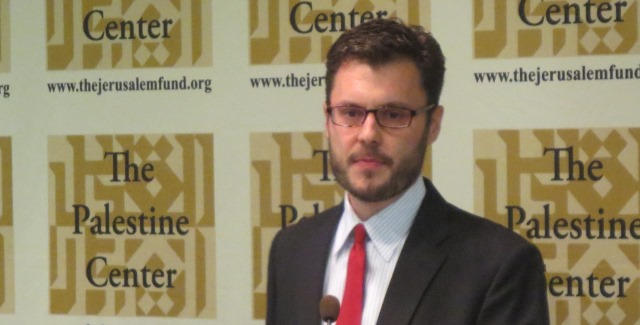
Video and Edited Transcript
Josh Ruebner
Transcript No. 389 (17 September 2013)
17 September 2013
The Palestine Center
Washington, DC
Josh Ruebner:
Good afternoon. Thank you very much for your kind introduction Yousef, and it’s really honor to be able to launch my book here today at the Palestine Center, Shattered Hopes: Obama’s Failure to Broker Israeli-Palestinian Peace.
Undoubtedly, the most complex international negotiations that ever took place were in the aftermath of World War I, what became known as the Paris Peace Conference. And at the Paris Peace Conference more than 32 nations and countries gathered, hundreds of causes were represented, and in the course of just one year, entire empires that had existed for centuries were obliterated and new nations arose in their place. And in the aftermath of the Paris Peace Conference, virtually the entire map of the world was redrawn as the Allied, victorious powers assumed colonial mandates over portions of Africa, the Middle East and Asia. Now, don’t get the wrong impression: lots of decisions that were taken at the Paris Peace Conference were terrible ones. And if you look at the Middle East, a lot of the decisions made before, during, and after World War I, the results are still reverberating today in the type of border conflict and sectarian conflicts that we’re seeing today, based on the borders drawn there. But my point in raising this, is that all of this was done, and the entire map of the world was redrawn, in the span of just one year, from 1919 to 1920.
In South Africa, there were 350 years of racial discrimination. And forty-plus years of formalized, institutionalized apartheid against black South Africans. When a decision was taken to end the system of formalized, institutionalized racism, and to negotiate an end to the apartheid system in South Africa, negotiations between the government and the African National Congress took three years, leading to South Africa’s first ever national elections which were won by the African National Congress and Nelson Mandela just one year later. A four-year process in total. In Northern Ireland, the Good Friday Agreement, brokered in 1998, capped two years of negotiations over what was an 800-year struggle for power.
Now why do I raise these three historical examples (and certainly we can point to others as well)? As many of you know, last Friday marked the 20th anniversary of the signing of the Declaration of Principles, or more commonly known as the Oslo Accords, between Israel and the PLO launching what was supposed to have been a five-year interim negotiating process that was supposed to have led to a peace treaty and an end to the Israeli-Palestinian conflict. If everything could be rearranged in the entire world following World War I in the span of one year, if apartheid could be ended in South Africa in the span of three years, and if an end to the conflict in Northern Ireland could be brokered in two, certainly, there is no reason why the Israeli-Palestinian conflict should take more than 20 years for peace to be brokered.
Now we hear quite a lot, and especially from those people who perpetuate what I like to call the “peace process industry,” that there is something about the Israeli-Palestinian conflict in particular, that is so complex and so difficult to fathom and that if you don’t have this insider expertise that the peace process industry players have, well then you simply don’t understand how difficult the situation is to resolve and why it’s taking so long. Well, I would humbly disagree with the notion that the Israeli-Palestinian conflict is intrinsically more complex or difficult than the aftermath of World War I, than apartheid in South Africa, than the decolonization and independence of Algeria, and the power sharing in Northern Ireland. All of these were extremely difficult and complex to resolve as well. So let’s take a few minutes to step back from the so-called complexity of the Israeli-Palestinian conflict to simplify it.
Since the late 1800’s, the 1880’s, the Zionist movement has been engaged in a project to buy and purchase land in historic Palestine for the exclusive benefit and use of the Jewish people. And since World War I, and in the aftermath of World War I, as we all know, Britain got a mandate to govern Palestine, the Zionist movement and Britain worked hand in glove to prepare Palestine to become, according to the Balfour Declaration, a Jewish homeland. As Britain withdrew from its mandate in the aftermath of World War II in 1947, as we know, at a time when Jews owned seven percent of the land in historic Palestine and Palestinians inhabited 93 percent, and at a time when Jews made up one-third of the population and indigenous Palestinians made up two-thirds, the issue was moved to the newly created UN. And the UN in its infinite wisdom said, “Let’s partition this land, and let’s create a Jewish state in 55 percent of this land, even though within this 55 percent, there will just be a bare majority of Jews as compared to Palestinians. And let’s reserve the 45 percent of historic Palestine for its indigenous inhabitants.” And of course as we all know, the partition plan was never implemented, and as a result of the 1948 war, Israel ethnically cleansed roughly three quarters of a million Palestinians from their homes; demolished, and razed between 400 and 500 Palestinian villages; and exiled approximately 750,000-1,000,000 Palestinians from their homes, lands, and properties. When an armistice agreement was signed by Jordan, Syria, Lebanon, and Egypt, the newly created state of Israel found itself in control of 78 percent of historic Palestine, with the remaining 22 percent, being the Gaza Strip and West Bank, under the control of Egypt and Jordan. And as we know, since 1967, Israel has placed under a belligerent military occupation those remaining Palestinian territories, that 22 percent of historic Palestine: the Gaza Strip, the West Bank, and East Jerusalem.
And so what we have today is a situation in which Israel exercises control over 100 percent of historic Palestine, with Palestinians relegated to either minimum human and political rights, or none whatsoever, based one where they live. If you are one of the one and a half million Palestinian citizens of Israel, yes, you do enjoy some individual democratic rights, like the right to vote and the right to form a political party, but you face widespread societal discrimination. You face discrimination in terms of budgetary allocations from the state, you face severe restrictions on how, and if, and whether you can build and expand on your land. The discrimination faced today by the Palestinian citizens of Israel is analogous in many respects to the conditions it obtained here in the Jim Crow South. If you are one of more than five million Palestinians that are registered as refugees, then you have been denied your internationally guaranteed right of return to your homes and properties now for more than 65 years and are now forced to languish in refugee camps, because Israel will not allow the right of return to be implemented even though it was an explicit agreement and agreement as part of Israel joining the UN in 1949. And if you are one of the four and a half million Palestinians living in the West Bank, East Jerusalem, and Gaza Strip, you have been subjected to the most brutal military occupation imaginable for almost the last half century.
And this is the condition that remains. It’s a condition that is not that difficult to understand. It is a condition in the situation of apartheid. It is a condition where Israeli Jews have their individual and national rights in full, and Palestinians enjoy extremely circumscribed or limited political rights, or none whatsoever. And these rights are differentiated based on one’s national identity, based on one’s religious affiliation, and this is the very definition of apartheid. Apartheid is legal discrimination based on one’s nationality, ethnicity, race, religion, etc., and in the 1970’s, the international community made it a crime against humanity to establish and perpetuate systems of apartheid. So when you boil it down, the Israeli-Palestinian conflict is not all that complex or difficult to understand. There is a situation where you have an oppressor and an oppressed; a people with their rights, versus a people without their rights, and this is a situation that must be remedied.
Now the second reason why I raise these examples, and especially the one of Northern Ireland, is because it is especially pertinent for the discussion of the Obama administration’s approach to broker Israeli-Palestinian peace. Many of you might remember that George Mitchell was the U.S. mediator who brokered the Good Friday Agreement, paving the way to the end to the conflict in Northern Ireland, and this had ramifications when he was appointed Special Envoy for Middle East Peace by President Obama in 2009. I want to read a little section of my book to illustrate the influence Mitchell’s thinking on his experiences in Northern Ireland had for his policies as Special Envoy:
“Mitchell himself would often rely on his experience in Northern Ireland to explain and guide his approach to the Israeli-Palestinian conflict. When he was appointed Special Envoy, Mitchell noted that his job, like his previous mediation role, would require patience and perseverance.
In negotiating peace in Northern Ireland, Mitchell remarked, ‘we had 700 days of failure and one day of success. For most of the time progress was nonexistent, or very slow, so I understand the feelings of those who may be discouraged by the Middle East.’ And he relates this story how after speaking to an audience in Jerusalem about his role in brokering peace in Northern Ireland. ‘An elderly gentlemen came up to me. And he said, “Did you say 800 years?” And I said, “Yes, 800.” He repeated the number again, and I repeated it again. He said, “Oh, such a recent argument. No wonder you resolved it.”’”
So this was the experience that Mitchell had in mind when he was appointed as Special Envoy for Middle East Peace on Obama’s second day in office. But before getting to the role that Mitchell played from 2009 to 2011, we have to ask ourselves: why has the United States consistently and repeatedly failed in its efforts to broker Israeli-Palestinian peace, predating Obama? Because I don’t want to give you the wrong impression, my critiques of U.S. policy are not restricted to what has taken place in the last five years, even though this book does focus on those events.
Well, I think that the participants of the peace process for the U.S. side speak best for themselves.
Here is what Dennis Ross, who was the key peace process player in Bush I and Clinton eras, and came back for Obama eras, said about the U.S. methodology in trying to broker Israeli-Palestinian peace. He called what he did “selling.” “Selling became part of our modus operandi, beginning a pattern that would characterize our approach throughout the Bush and Clinton years. We would take Israeli ideas or ideas that Israelis could live with, and work them over, trying to increase their attractiveness to the Arabs [“notice he won’t call them Palestinians, but they are the undifferentiated Arabs”] while trying to get the Arabs to scale back their expectations.” This is what the prime U.S. peace process mediator says about how these negotiations actually work.
So is it any wonder that with that biased mentality that is self-admittedly pro-Israel, that the US has failed to be an honest broker and resolve the Israeli-Palestinian conflict? I don’t think that any rational person would think that that is a fair way for a broker to behave. More succinctly, this mentality was encapsulated by Aaron David Miller, another prime peace process player during the Clinton and Bush II administration, when he simply referred to the U.S. role as being “Israel’s lawyer.” And this is indeed how the United States has functioned for the last two decades, if not more. And, as I argue in my book, it is exactly how the Obama administration perpetuated this policy despite some potential movement away from it at the outset, which we will discuss in just a few moments.
One of the questions I asked myself as I was writing this book is, “Was Obama any different in his approach to broker peace than his predecessors”? And, to an extent, I think that he absolutely was.
Here is what he said out on the campaign trail when he didn’t think there were any people from the media listening to his conversation. This is what he said to an activist that I interviewed named Sue Dravis, who is a member of the Muscatine Country Democratic Central Committee.
She asked Candidate Obama back in March of 2007, “What will you do that will be different that will address the humanitarian as well as the human rights crisis for the Palestinians now?” And Obama had a very long, very nuanced, very well thought out response. And as part of that response he said, “Nobody is suffering more than the Palestinian people from this process.” And now when this leaked to the media, David Axelrod, his campaign advisor, immediately clarified Obama’s remarks to mean that, “Well of course Palestinians are suffering due to the terrible leadership of Hamas. It’s all their own fault.” Well Obama said nothing of the sort in his initial comments, and it was clear that he had a certain understanding and empathy for the Palestinian narrative of suffering and disposition that no other person inhabiting the White House, including President Jimmy Carter, had.
I think this is made quite clear even after he was president, when he went to Cairo in June 2009. You will remember the so-called attempt to reset U.S. relations with the Muslim world. And I thought that President Obama said something very profound in this speech in Cairo.
He said “it was undeniable that the Palestinian people, Muslims and Christians have suffered in pursuit of homeland. For more than 60 years, they have endured the pain of dislocation in many ways in refugee camps in West Bank, Gaza and neighboring lands for life, peace and security that they have never been able to leave. They endured the daily humiliations, large and small, that come with occupation.” This I thought was a path-breaking statement because it recognized, maybe for the first time ever on behalf of the sitting U.S. president, that not only are Palestinians suffering indignities of human rights violations at the hands of Israeli military occupation, but it also paid homage to the fact Palestinian refugees have been dispossessed for more than 60 years, and that they too are suffering. This I took as an indication that yes, President Obama came at this issue from a different place than any of his predecessors.
Number two, the reason why I think Obama was, to an extent, different from his predecessors, was because he appointed George Mitchell as his Special Envoy for Middle East peace. There had been a long standing tradition of appointing individuals during the Bush I administration, during the Clinton administration, during the Bush II administration of individuals with self-admittedly and obvious pro-Israeli ideological baggage. This was no secret, as you can see Denis Ross bragged about the pro-Israel orientation that he brought to the so-called peace process. The fact that Mitchell was appointed, who had none of these connections, none of this ideological baggage, clearly riled the Israeli lobby.
Number three, for the first six months of his term, President Obama and his foreign policy team were so vehemently insistent on Israel freezing its colonization of Palestinian lands. This was not a joke. The Obama Administration was absolutely serious and vehement in its denunciations of Israeli colonization to an extent, again, not seen since the Carter Administration.
So to an extent, yes, Obama did have a different approach. But, was Obama different? Well, to another extent, no. Because at the very same time that Obama was expressing sympathy for Palestinians killed in Israel’s horrific attack on Gaza in December 2008 and January 2009, Operation Cast-Lead which massacred more than 1400 Palestinians, at that very same time, Obama was allowing for the shipment of 300 containers full of ammunition to go to Israel. This was at a time, when Human Rights Watch put out a report, saying that Israel’s use of U.S.-provided white phosphorous was a war crime and that those exports should be ended immediately. This was at the same time Amnesty International put out a report for an international arms embargo against Israel. And here you have President Obama, sending more weapons to Israel only three months after the bombs had stopped falling. This was a prelude to what became the most intensely escalated policy of military aid, military coordination and military cooperation between U.S. and Israel of any president.
Now as we all know there have been a lot of policy disagreements between the Netanyahu government and Obama administration and a lot of them have obviously been very public, we all know that. But there is one thing that every single Israeli and American politician can agree upon, and that is that under Obama, there has never been more or greater military cooperation between the two countries. And I think this was stated best by Andrew Shapiro, who was at the time, Hilary Clinton’s Assistant Secretary for Political Military Affairs. He spoke at the Saban Center, which is the part of the Brookings Institute, named after an Israeli-American who self-admittedly donates his money to help Israel. And he gave incredible speech there back in 2010. And what Shapiro said was this, he said, “The U.S.-Israeli military relationship is broader, deeper, more intense than ever before.” And undoubtedly it is.
Another reason why Obama hasn’t been as different as he may have appeared from his rhetoric is the fact that when faced with pressure coming from the Israel lobby for the positions he articulated, he was absolutely unwilling to stand up to these challenges and capitulated completely to the Israel lobby as so many other U.S. presidents have done. Now I think the key moment to understanding the beginning of Obama’s switch on this issue are a series of events that took place in the summer of 2009. In the summer of 2009, Dennis Ross who I quoted before, was moved from a very obscure position in the State Department over to the National Security Council where Obama said that from now on, Ross was a “quarter-back” on all Middle East issues.
This was the clearly the start of a huge policy shift on the part of the Obama Administration. Because what Ross said after his appointment that “the ‘problem’ with the Obama Administration’s policy on freezing Israeli settlements, was that it put the emphasis on one issue when it wasn’t the only or even most important issue and in any case needed to be put in context.” This is a direct quote from Dennis Ross on assuming this position. And from this perch where his “quarterbacking” on Middle East issues, he proceeded methodically to undermine George Mitchell at every opportunity, to undermine the Obama administration’s insistence that Israeli freeze all colonization of Palestinian lands.
And you can see the effect of this move already by July 2009 when President Obama holds a closed-door meeting with very high ranking individuals from high profile Jewish-American organizations. And I love this, Abe Foxman, the head of the Anti-Defamation League, had just a few months before publicly criticized the Obama Administration for “neutrality”, by appointing George Mitchell as a special envoy. So, in this July 2009 closed-door meeting, here you have the self-same Abe Foxman expressing concern that the Obama Administration was not being “even-handed” anymore. And instead of defending his position that, yes, Israel should freeze its colonization of Palestinian lands because it is illegal and because Israel had already committed to doing it three or four times in the past. This is what Obama told Abe Foxman behind closed doors, “Abe, you’re absolutely right, and we are going to fix that”. Noting that “the sense of even-handedness has to be restored.”
But what Obama did was not to restore even-handedness, what he did was to forget about the pretense of trying to assume a policy of even-handedness, what he instead meant was that I am going back to the status quo, I am going back to the way things were of coordinating my positions with Israel and then tag-teaming to try to force these positions on the Palestinians. And you can see very clearly this process at work within the Palestinian negotiating team, thanks to the leaks to Al Jazeera and Palestine papers.
Let me just read you a couple of quotes. In May 2009, President Abbas met Obama for the first time, and it was an incredibly upbeat meeting. And, what happened behind this closed-door meeting was that Obama reassured Abbas, “the establishment of the Palestinian state is must for me personally. In an expeditious manner we will get to the two-state solution”. And Obama was telling Abbas that everything that he was hearing from the President, he was saying the same exact thing to Israel.
In a report back to the Palestinian negotiating team, the lead Palestinian negotiator, Dr. Saeb Erekat, marveled at this changed atmosphere that was coming out of the Obama administration. And he told his team, I love this, “Much of what I say to you today is just between us,” not realizing that this was going to get leaked. “The Washington I went to last week isn’t the Washington I knew before.” So this is how Palestinian negotiating team was feeling in the May of 2009 that maybe they were actually finally going to get a fair shape from the United States.
Fast forward to the after Ross’s move to the NSC, towards after this flip-flop where Obama says he is not going to insist on Israel freezing its colonization to a meeting, a very contentious meeting held between U.S. and Palestinian negotiating teams in September of 2009. By this time it was already crystal-clear to the Palestinian negotiating team, that what the United States was going to do was go behind the Palestinians’ back, and cut a deal with Israel, that would be a fig leaf on the halting of settlements and to pressure Palestinians back to the table on this basis.
And so, I love this quote, I wonder sometimes if when people are in these meetings, they wonder if their words are sometimes were going to get leaked. Because if I were David Hale who was George Mitchell’s assistant, I would be quite embarrassed by this reasoning. What David Hale said in this meeting was he said he understood Palestinian “misgivings” regarding the quality of the package with Israel referring to the so called settlement freeze. “But,” he noted, “We will not be able to meet all expectations of all parties. In aggregate, it’s a good package.” And he added that Palestinians should not hold out for a comprehensive freeze of Israeli colonization of their lands, because after all, “a freeze is a flexible concept.”
And so, at this point, Saeb Erekat, the lead Palestinian negotiator, gets livid. He says, “You spent eight months with the Israelis, no time with me. We at least need to spend some more time to build a political framework. May be you don’t have a plan, if you do, you have to lay it out.” And then Erekat says, “I hope we will not be put in this position, except or else, like previous U.S. administrations. It’s not that we don’t want to, we can’t. So please don’t put us in this position. To allow us to help you, need to help us.” But of course that’s exactly the Obama administration did. They put the Palestinians in a position where they were forced to the negotiating table under this fig leaf of a Israeli settlement moratorium, or be risked seen as being the rejectionist party who weren’t willing to negotiate.
Another way, a third way, that Obama was no different and perhaps even worse than his predecessors on this issue is how he dealt with the Israeli-Palestinian conflict in international fora like the UN. And I spent the better part of a chapter in here, detailing thanks to Bradley/Chelsea Manning’s leaks through Wikileaks, all of the sordid details how the U.S. worked in collision with Israel to kill the Goldstone Report. The Goldstone report being the internationally mandated report in the aftermath of Operation Cast-Lead that found that both Palestinian and Israeli armed groups committed human rights violations, violations of international Law, war crimes and possible crimes against humanity in Operation Cast-Lead.
And this is a very sordid tale; I can’t go through all of the details here. Suffice it to say that one of these leaked documents from Wikileaks is from a meeting between Israeli foreign minister Avigdor Lieberman and U.S. ambassador to the UN Susan Rice, where Lieberman thanked Ambassador Rice for the U.S. position on the Goldstone Report. And Rice beamed about, “the positive U.S. engagement with the Israeli missions in New York and Geneva” to blunt the effects of the Goldstone Report in those fora.
So, behind the scenes, even though Obama was getting awarded the Nobel Peace Prize, for what I don’t know, he was working hand-in-glove with Israel to make sure that he was not held accountable for the war crimes and crimes against humanity that it committed. And there are many, many examples of this that I don’t have time to get into today. But they are detailed in the book. The Obama administration did the exact same thing to kill international accountability efforts after Israel attacked the flotilla in 2010. And of course when Palestine was tried to join the UN, a very similar thing took place.
Now in addition to Obama failing for all of those reasons, which I think are quite extensive enough to understand why this policy didn’t work, there were other problematic aspects to the policy, including the fact that when negotiations were finally convened in 2010, George Mitchell publicly said, “There is no terms of reference.” In other words, throw out 20, or 18 years ago at the time, years of history of negotiations, throw out UN resolutions, throw out international law, none of that matters, because when the parties came to Washington, they are going to sit down and they are going to determine the terms of reference for these negotiations by themselves. For me, this was a monumental mistake by George Mitchell who surely knew better than to allow a stronger party to the conflict to try to impose terms of reference on negotiations in the absence of any reference to international law.
Now, where are we today? Hope springs eternal for those who believe in the peace process. And we all know that Obama went to Jerusalem in March of this year. We all know that Secretary of State John Kerry engage in intensive and extensive rounds of shuttle diplomacy to bring the parties back to the table, yet again, at the end of July, this month promising that after 20 years of failing negotiations, they finally are going to get it right in the frame work of nine months this time around.
Well, I would like to be optimistic about these negotiations but I cannot, because Obama in his second term is even worse than he was in the first term on this issue. In the first term at least you have the pretense of the Obama administration giving lip service to a freeze on Israel’s colonization of Palestinian land. This time around, you have Secretary of State John Kerry publicly saying that we know that Israel is going to be expanding settlements during these negotiations and it’s not a problem from our perspective. This is what John Kerry said, not in those exact words but that’s the gist of it. And since these negotiations were relaunched in July, Israel has in fact announced the expansion more than 3000 settlement units.
Number two, why Obama is worse in his second term than his first, is that at least Obama tried in his first term to appoint an individual who is not encumbered by this ideological baggage of coming from the pro-Israel lobby. Well, in Obama’s second term, he’s appointed Martin Indyk as his special envoy for Israeli-Palestinian negotiations. This is the same Martin Indyk who used to work for American-Israel Public Affairs Committee, the same Martin Indyk, who then went to work for its sister think-tank, the Washington Institute for Near East Policy, and the same Martin Indyk who tweeted after John Kerry resumed negotiations by Jove, he’s done it, peace is at hand, or something nonsense like that.
Now, these negotiations have been going on since July, as I mentioned. What’s actually taken place? Well, they have been mostly tight-lipped, the negotiators, but already the Palestinian negotiating team has become so frustrated that they’re leaking to the press about how ridiculous these negotiations are. Here is Yasser Abed-Rabbo who has been one of the primary Palestinian negotiators since Oslo in 1993. He said on Voice of Palestine earlier this month, these negotiations are futile and won’t lead to any results. And indeed just two days later, the Palestinian negotiating team leaked the details about what Israel is proposing in these negotiations to the AP. And what Israel is proposing is that it annex 40 percent of the West Bank, that it keep every single Israeli settlement in place, and then it keep the control of the border with Jordan and military bases throughout the Jordan River Valley.
This is obviously not a serious negotiating position. This is not a serious negotiating stance for a real and legitimate two-state-solution, if such a thing still exists. This is clearly a delaying tactic. This is clearly a process in which Israel is engaged to deflect international pressure from its ongoing colonization and apartheid policies toward the Palestinians. For as long as there is the pretense of these negotiations and as long as Secretary of State John Kerry can get up and credibly say that the parties are talking and they are talking seriously and they are getting close to agreement, it fends off the pressure on Israel. Well, what I’ve learned from the process of writing this book and working with the U.S. Campaign to End the Occupation, is that you cannot rely on the politicians. The politicians are not going to bring about a just and lasting peace. They are not going to bring about self-determination for the Palestinian people. Only we can help do that, and the mechanism through which we can do that is by joining the Palestinian civil society call for Boycotts, Divestment and Sanctions against Israel, and against corporations and institutions that complicit and profiting from its apartheid policies toward the Palestinian people.
Thank you very much.
This transcript may be used without permission but with proper attribution to The Palestine Center. The speaker’s views do not necessarily reflect the views of The Jerusalem Fund.
