
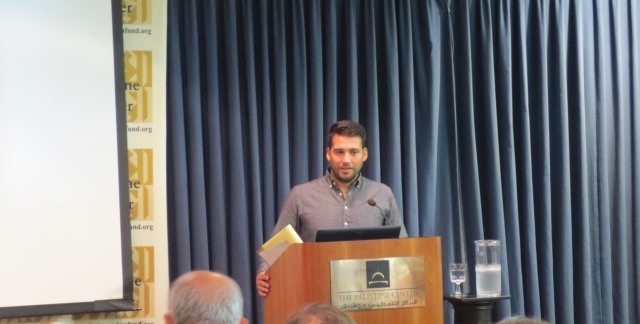
Video and Edited Transcript
Brad Parker & Ivan Karakashian
Transcript No. 390 (30 September 2013)
30 September 2013
The Palestine Center
Washington, DC
Brad Parker:
I am Brad Parker, I work for Defense for Children International Palestine, a Palestinian local human rights organization. We are the only Palestinian organization that works specifically for child rights. We are affiliated with the international movement Defense for Children International but we are autonomous and raise our own funding, set our own priorities and set our own programming for this specific context children that face within East Jerusalem, the West Bank and Gaza. So, we have our main offices in Ramallah, we have an office in Hebron, and we have an office in Nablus. We have attorneys, social workers and field researchers working out of both monitoring and documenting human rights, providing legal aid to kids charged in military courts but also in Palestinian Authority courts. We work with the Palestinian Authority to increase protections for kids within the juvenile justice system. So we have trainings, capacity building with police, judges, defense attorneys, prosecutors, probation officers, anyone who comes in contact with kids that are in conflict with the law and are charged with the Palestinian Authority system, we also cover those issues. We have field workers that work out of Gaza, so we also cover issues particular to the context in Gaza, related to the blockade, whether it’s violence, right to education, right to health, all kinds of different issues.
Ivan and I work in the Advocacy Unit. We also work closely the legal aid unit and the monitoring and documentation unit. Monitoring and documentation unit is exactly what you could expect, we monitor document human right violence, all through the East Jerusalem, West Bank and Gaza, anything related to children rights, anything related to violence against children, settler violence, soldier violence, violence related to military offensives. We document those cases and try to use different UN mechanisms, different advocacy tools to reach the international community in an effort to put pressure on Israeli Authority to change its policies that affect children, through the occupation.
So, we have some more information about Defense for Children International Palestine [refers to brochure]. I won’t talk much more about our organization. I would like to spend the forty minutes that we have talking about the issues that we work on and the situation for Palestinian kids living in the Occupied Palestinian territory. I’ll focus a bit mainly on the Israeli Military detention system and the experience the kids have within that system. I’ll talk about the systematic ill-treatment that we’ve been documenting for about ten to twelve years now where we can say based on our documentation that the ill-treatment that kids face during the arrest, transfer and interrogation phases of the arrest process, at least within the West Bank is systematic and wide-spread. And we can little bit talk more about that.
So, first we’re a child rights organization. Our principle as a child rights organization is our guiding standard is best interest for the child. That’s what informs and under rides everything that we do. Generally in a juvenile justice system, detention is always a last resort, pretrial detention, even detention as part of custodial sentences. That is never in the best interest of the child in most cases.
So what you have with the Israeli military court system, which has been established since 1967 when Israel occupied the West Bank including East Jerusalem and Gaza, they instituted military law. So, there is military commander who has executive, judicial and legislative authority over the Occupied Territory and currently there are about 1725 to 50 military orders that exist. Military orders are the law that applies to the Occupied Territory. So, military laws created the system of military courts where Palestinians, whether you are a man, woman or child, are automatically persecuted in those courts for violation of military law which applies to them. If you are an Israeli citizen living in the West Bank, or if you are Israeli settler, even though military law technically applies to everybody located in the territory, Israeli civilian laws are applied to you, even though you are in the occupied territory.
I’ll talk about more specifically around detention, detention of kids, and some of the differences between protection for Israeli kids versus protections for Palestinian kids within the Israeli military justice system.
A couple of important points about the military law: So, kids could be arrested without warrants. Soldiers have the authority to arrest anyone they suspect of violating the security provisions, the order regarding the security provisions. So, there is no judicial oversight over arrests. There is no real investigation process prior to an arrest. Most of the evidence gathered for an arrest comes after the arrests through, at least for kids, coercive interrogations where kids don’t have access to counsel and they are denied really basic and fundamental fair trial guarantees and protections.
I’ll just talk briefly about the different offenses included in military law, because it gives a sense of how military law is used as part of the occupation in an effort to control the population. So you have Military Order 1651 is the main military order that include most of the criminal law provisions, a lot of them are similar to a domestic criminal code that we would have here in U.S., that you would have in any other country any other legal system. You have homicide, you have man-slaughter, you have assault, you have offenses for damage to property, but you also have more occupation-related offenses. There is a specific charge for throwing stones; not assault with an object, not battery with an object. It’s a specific charge for throwing stones. If you throw stones at a military installation say, a stationary object at a building, imaybe the separation wall. That is potential ten year maximum sentence under military law. If you throw a stone at a moving object or into traffic, if you throw stones at a car, that is a potential 20 year maximum sentence under military law.
So the sentences give you a sense of the degree to which military law, I think at least inherently, exists to legitimize the control aspects of occupation. There are other charges aside from the generally applicable criminal charges. You have specific charges that deal with conduct toward soldiers. So you have a specific charge that is threatening a soldier, it could come up to potential seven to ten year sentence. Threatening a soldier could come up to three year maximum sentence. You also have a lesser charge that is insulting a soldier or doing something to harm the honor of a soldier, which comes with a potential one year maximum sentence. I mean, if anybody is an attorney, but if anybody can think about things objectively and try to understand what insulting a soldier might mean, in practice, I think it’s pretty vague. It’s very open-ended, it could justify any type of arrest, I think, in most situations. That kind of gives you a sense of what the military law, what’s included in the military law, at least when it comes to security offenses. The main charge that kids, about 60 percent of the kids charged in the Israeli military court system, are charged with throwing stones. That’s the typical charge, there are other charges like being a member of banned organization, it’s also an offense under military law. Organizing a protest, being part of a protest, that’s an offense under military law. You see how the more conflict-related, occupation-related offenses find their way into the criminal law through the military law.
Since 2000, we estimate that around 8,000 kids, Palestinian kids have been arrested in the West Bank by the Israeli army and charged in the military courts. We estimate that 500 to 700 kids each year, between the ages twelve and 17, are arrested and processed through the system. The Military courts have jurisdiction over any child above twelve years old. Any person above twelve, really. If you are a twelve-year-old, you could be charged in the military court which is a pretty drastic measure right? Israel is the only country in the world that automatically and systematically charges kids in the military courts. You know in the U.S. we have Guantanamo, we have held, as a government, at least two people that I know of that were below the age of 18, I am not sure we actually charged them but that in itself is an exceptional case. Kids generally are not persecuted in military courts anywhere around the world. And they are definitely not automatically and systematically charged in the military court anywhere in the world.
I’ll talk a little bit about the process of arrest, and work through the arrest, the transfer and the interrogation phase from a child’s perspective based on the documentation that we obtain. So we have attorneys that work in both military courts, there is one in the north in the West Bank, it’s Salem Military Court, and one near Ramallah which is Ofer Military Court. So we gather affidavits based on the children that we represent before the military courts. We do prison visits to collect affidavits from both children and eye witnesses. And so in any year we have between 150 and 250 case that we document and that’s where all the information and all the statistics and data that I provide today, that’s the foundation and that’s the basis for everything that I am talking about.
Just one note, everything I’ll talk about is related to the West Bank. East Jerusalem following 1967, even though it’s considered Occupied Territory and part of the West Bank, Israel has always treated it as annexed land and applies Israeli civilian law there. So the Palestinian kids arrested in East Jerusalem are charged within the Israeli justice system, not in the military court system. So, everything is very specific to the West Bank that I’ll be speaking about. Kids are arrested in Gaza but since 2005 when Israel removed the settlements, the military presence is obviously different, it’s a blockade and soldiers are on the outside. Sometimes there are incursions, sometimes kids are arrested from fishing boats and detained but generally everything I am talking about is the West Bank.
So, an arrest: About 50 percent of kids are arrested from their homes in the middle of the night. So, anywhere from 12 am, 5 am, 6 am, soldiers come into the village, come into the town, bang on their front door, maybe your mother goes down, maybe father opens the door, maybe it’s your older brother or your younger brother. Soldiers, they don’t storm in, they usually filter through the house, some begin searching others, others ask for IDs if you are on their list. If you are not on their list, they see your ID, you’ll be arrested. If you are arrested, you are generally taken out the front door, your hands are tied behind your back with the single plastic cord. And then you have a blind fold placed on your face, over your eyes. You’ll be in certain cases during the arrest, you’ll suffer some kind of physical violence whether punching, slapping, kicking, being hit with the stock of rifle in some cases, being hit with a soldier’s helmet in some cases. As Samirah said in the introduction, based on our documentation, 74 percent of kids suffer some kind of violence during the arrest, the transfer or the interrogation phase. There is also verbal abuse, insults, threats that happen during an arrest but also during a transfer process. So, once you are out of the house, you are bound, you are blind-folded, you usually are escorted, walked, maybe pushed, shoved into a military jeep where in 45 percent of the cases, kids are made to seat on the metal floor. So you’ll have the back of the jeep, you have two benches on the side, you have a metal floor in the middle. Soldiers will sit on the benches and kids are usually placed on the floor in the middle. You know, if you can imagine that context, kids sitting there between benches of soldiers heavily armed, they are vulnerable, right? You are bound, you are blind-folded, you are a child in this particular situation.
So the detentions system structurally consists of military camps, military bases throughout the West Bank but also settlements, police stations and settlements. Really what we see based on our documentation, the kids are arrested near areas where the occupation really has its teeth. So, near military bases, near settlements. If you are a child whose your family has land that borders the security zones around the settlement, that is highly problematic area for you as a young child, teenage boy, a young kid, whatever it is. So, that’s what we see. Kids are arrested near these specific places where the occupation has its roots. They are also arrested near roads that are used by Israeli settlers, Israeli Army. They arrest you in checkpoints, through checkpoints. So think of anywhere where there is a soldier presence, anywhere where there is a settler presence, those are the communities most affected from arrests.
Once you are in a jeep, you are usually transferred to one of these military bases. If you are arrested at 2 am, you might arrive there at 3 am. When you arrive, the Israeli soldiers will pull you out of the jeep, maybe they’ll leave you in the jeep, they can pull you out, put you on the ground, put you inside of a building and you usually youjust sit there for hours. If you are lucky, the sun comes up, 9 am, 8 am, when a police interrogator arrives to the settlement nearby and begins his day, you’ll be brought and transferred to the police station where you end up in an interrogation room. Generally the transfer period could take anywhere from a few hours depending on when you’re arrested, it’s up to 24 hours or even longer. Kids usually don’t have access to food, they are usually are not provided water, they generally are denied access to a toilet. Kids ask for those things and they get laughed at. You can imagine the different types of responses occasionally they’ll be brought to a bathroom, they usually don’t have their hands untied, if they are, the blind-folds are usually taken off and then replaced directly after that.
About eight percent of the cases, at some point either when they are being transferred, sometimes they see not necessarily a doctor but somebody will ask them general medical questions about their health. Really just a medical background from a child. During that, kids usually still have their hands tied, blind-folds can be taken off but generally, hands tied. Whether its during this transfer process or later on after they’ve been transferred to a detention facility, about eight percent of kids are completely strip-searched. Some kids are strip-searched multiple times. So when they first arrive in a military camp, they might have questions about their health, and then they’ll be strip searched immediately before that or after that. So, it’s humiliating. Kids, no matter how old you are, I think If any of us were strip searched would feel a bit humiliated in that context.
So, once you arrive at a police station, you generally walk into an interrogation room with an Israeli police interrogator. And they have different styles, I’ll say. Some tend to be more aggressive, louder, bang on the table, they’ll shout at you, shout in your face, really try to intimidate you. And what we find based on the documentation is that interrogations are really built around obtaining a confession. If you can obtain a confession, as an interrogator, what we see based on the documentation is that you’ll try to obtain some type of statement that in some way implicates the child in something. It’s important to remember that it’s not for us as an organization, it’s not about guilt or innocence, it’s about respect for human rights, respect for international law and respect for human dignity.
What you have in Israeli military court system, it’s not a justice system. It’s a system set up to really implement an occupation and when you look at the law, when you look at the process of arrest, you find that it’s not necessarily about guilt or innocence. It’s really a tool of an occupation, it’s maybe used to legitimize it but it’s not about justice. So, kids in that room whether they throw a stone or not, tend to confess. If they don’t confess and they deny the accusations, they could still end up with the statement that’s drafted by the interrogator that some way connects them to something. Confessions are used as the main source of evidence for cases involving kids charged in military courts. Other pieces of evidence include statements from other children.
So if I’m Brad, I’m fifteen, and I’m from the tiny village called Azun, my friend was arrested two months ago, I’m a bit worried the next time the Israeli army comes in at night, I’m going to be arrested. Because I know that my friend Ivan has been detained for the past two months, I know he has been interrogated, he might have given my name. If he didn’t give my name, it might have found its way into a statement. Then that will be used to arrest me, so Ivan’s statement will be used as evidence against me to charge me in the military court, whether I confessed, whether I have thrown a stone, whether I have done anything. That is really the general context that kids walk into an interrogation room with. The other piece of evidence that is usually present in that interrogation room, so if the interrogator does not have Ivan’s statement, he has a statement from a soldier and this generally happens in most cases. There is a statement from the soldier, who arrested the child and that is the initial piece of evidence, or the justification for issuing a warrant after the interrogation process. Soldiers sign statements, statement goes into the file, and then that is part of the evidence used to charge in the military court.
More extreme interrogations can be violent, you might be punched, you might be slapped, you could be hit with a metal rod, some type of stick. Really, you wouldn’t be surprised by anything after reading the hundreds of affidavits that we have collected. I am rarely surprised. When I see the more extreme cases that really do rise to the level of torture, but the general case—systematic ill treatment—is really shouting, intimidating, threats. Kids are often told that they will be released very soon if they just confess, we will call your mom, they can come pick you up, and it will all be over. That never happens, right? Kids rarely have access to counsel, 99 percent of cases, kids do not have access to counsel prior to an interrogation. It is the same number for kids who have access to counsel during interrogation. It just does not happen. It does not exist.
Parents are hardly informed, if ever, where their child is being taken. They are not notified of the reason for an arrest, they are not notified where that child is going. Usually falling on arrest, that child essentially disappears until they show up in a military court within 24 to 48 hours after the arrest. That period, that 24 to 48 hours after an arrest, is where the ill treatment happens. It’s where the arrest happens, following the arrest, where the transfer occurs, and where kids are vulnerable, they are bound and blindfolded, and then they show up in an interrogation room without having access to counsel. They have not made a phone call to their parents; they are not able to make a phone call to their parents. There is no contact with the family.
DCI attorneys generally first see a child and it is usually the first time the child has seen an attorney is when they appear in the military court, either at Salem or Ofer. If you are twelve to thirteen, under military law, you have to appear before a military court judge within the first 24 hours after an arrest. If you are an Israeli child in the Israeli justice system, that period is 12 hours. So the international standard and the international law is 24 hours, but you still have disparity between Israeli law and Israeli military law that is applied to different populations strictly on birth and identity. If you are an Israeli citizen, Israeli law, if you are a Palestinian is Israeli military law. If you are a fourteen to fifteen year old, you have to appear before military court judge in 48 hours. The corresponding time period, for Israeli kids, Israeli citizens, is 24 hours. You still have that disparity. If you are a 16 or 17 year old Palestinian kid under Israeli military law, you are treated as an adult. The time period before you have to arrive before a military court judge is 96 hours. And that is the same for adults under military law. The time period for Israeli kids, same age, is 24 hours. That is a huge disparity in itself. But then you add in the denial of access to counsel, coercive interrogations, we tend to think that if you deny access to counsel for a child, anything that happens in that process, if they are not informed properly of their right to silence, they do not have access to counsel, just the fact that the child is being interrogated, that is a coercive interrogation. You are creating a situation that is manipulative; you have a professional interrogator who is trained. If I was in an interrogation room with them, with any interrogator, the power imbalance would pretty drastic to myself. And then you put a child in that room, and I think we call imagine the drastic difference in power in that situation is huge. Then you add on top of that, the child has probably experienced some form of physical violence already. It’s probably not very difficult as a professional interrogator to really coerce, manipulate that situation.
So I talk about the evidence, you have confessions, 16 percent of the confessions from the cases that we document are drafted in Hebrew. Palestinian kids do not speak Hebrew, generally. They do not know what those confessions include, what they say; they cannot read them. Even if a statement or a confession is in Arabic, children usually do not have the ability or the time to read and understand what is in that statement. Generally, you’ll have a table. Say Ivan is the interrogator; you have the child sitting on the other side of the desk, he has a computer and a printer, he types up the statement as he is interrogating the child, the confession as he is interrogating the child, prints it out, puts it in front of the child, and says sign it essentially. The kid does not sign it, he says sign it a little bit stronger, he uses threats and intimidation, the kid signs it, and then takes it back. There is really no opportunity for the child to read what is included in that statement and then these confessions/statements form the basis for the military prosecutor to charge the child in a military court. Once you are in the court, we already talked about the timing—24, 48, 96 hours depending on your age—it is the first time you see your family, the first time you see an attorney. What happens in that first hearing is almost automatically, detentions gets extended to the end of legal proceedings. So you have automatic pretrial detention for kids. With detention, under pretty much international humanitarian law and international human rights law, the international consensus is that, that is against the best interest of the child. You should, to the extent possible, explore any alternative means to detention. That is not even a consideration within the Israeli military courts.
I should say that Israel has signed the UN Convention on the Rights of the Child, the UN Convention Against Torture, the UN Convention on Civil and Political Rights, which all relate to justice systems, protections for prisoners, protections against ill treatment, and Israel has obligated itself to prevent those abuses. But it is not implemented in the West Bank, it is not implemented in the Israeli military court system.
So sentences: so you get into the court, you have your attorney; the attorney cannot do much for you because you are going to be automatically detained until the end of legal proceedings. In about 85 percent of cases, bail is denied. Bail never comes up in that first hearing, you have to make a second hearing, you have to make a motion for bail after it has already been decided that they will stay in pretrial detention. That happened in the first hearing. Kids are generally brought in.
So, in 2009, the Israeli military law created a new juvenile military court. The idea was that if the international community, if Defense for International Palestine, if civil society is complaining about the protections, in the military courts for kids, will create juvenile military court specific for kids. On paper, in law, it looked great but in practice it didn’t change anything. So you have military courts, now you have juvenile military courts. If you are under 18, in theory you go through a juvenile military court. What that means is not much. They use the same infrastructure, the same court staff, same judges. The only thing in the military law is somewhat differentiated the adult military court versus the juvenile military court, is that judges have to have some kind of special training. That’s essentially what the military law says, it doesn’t say what type of special training, that they need to be trained on juvenile justice standards, maybe they have to do courses around the international child rights law. It’s really vague and we don’t really see the difference. So, if you are a DCI attorney, working on an offer of asylum, you’ll see kids brought in with adults to the same court room, the same judge will dispose of both cases on that day. There is really no difference since that 2009 military orders issue.
So, the military court system when it comes to detention, it’s really all boys. Almost 100 percent are boys. Numbers are an issue. We know that around 500 to 700 kids are arrested each year. And that’s based on, the Israeli prison service provides numbers but it’s only a snapshot. So at the end of the July, we know, on the last day that there were 195 kids in detention, Israeli military detention. We don’t know how many kids were in detention the day before or the day after. We only get that snapshot at the end of the month and we estimate that it’s about 500 to700 kids.
So at the end of the July, the last time when we got the numbers, there were zero girls in detention. Previously, throughout the past seven or eight months, there was one girl serving the sentence and she was the only girl in detention. And so the cases of girls tend to be outside of the systematic ill-treatment, outside of the systematic process of arrest. That’s specifically to boys. Case with the girls, they’re usually trying to, at least based on the cases that we’ve documented that we know, Cases for the girls tend to evolve, tend to be a girl trying to escape some terrible situation at home, whether it’s sexual violence, domestic violence. They know if they can walk through a checkpoint with a knife, they could get arrested and they’ll be removed from that situation. So you have really terrible things happening when it comes to girls but it’s not on the systematic level that affects boys.
So, if you talk to a DCI attorney that works in the military courts, and you ask them what their role is, what do they do? How can they help kids? They’ll generally say that they don’t feel like they practice law in the military courts. They are set up in the system that isn’t necessarily to achieve justice, it really is about an occupation and control. So when you have confessions, generally coerced, you have statements from other kids that tend to be coerced. And then you have statements from soldiers that implicate your client, the child you are representing, in some type of criminal activity under the Israeli military law. It’s really difficult to go to into a court that’s operated by that same occupying force and challenge those charges. You have military court judges that are active duty or reserve officers in the Israeli Army. They are responsible for implementing the military law as part of an occupation against population that exists in that territory.
So it’s really difficult. Most kids plead guilty, because it’s the fastest way out of the system. Just to give you a sense, I have said military courts aren’t really about justice. The military courts produce an annual report ever year. I think in 2011, the conviction rate included the Israeli military courts’ own report was a 98 percent conviction rate. If a justice system convicts 98 percent of the people that’s brought before it, there are probably serious and fundamental flaws within that system. It’s pretty insane. So, that gives you a sense of everything that I am talking about, it’s not a justice system. And to think about it like that is just not accurate.
So kids plead guilty. It’s the fastest way out. If you don’t plead guilty, there is a bit of time you might spend within the Israeli military court system. So, following an arrest, the Israeli army military prosecutor has 188 days to charge you. If you are an Israeli child, an Israeli citizen under Israeli law, you have to be charged within 40 days. If you are Palestinian child under Israeli military law, you can be denied access to an attorney for up to 90 days under Israeli military law. So that 180 day period where kids have to be charged, or released, say you are charged on five months 20 days, from that day that you are charged Israeli military court system has one year to finish legal proceedings against you. If you are an Israeli child, in the Israeli system, legal proceedings have to be finished within six months after you’ve been charged. Do you see the disparity between those protections?
So what happens when kids plead guilty, there is usually an agreement between the military persecutor and military judge, a plea agreement that comes up with sentence, generally a fine as well and then a certain probationary period with the suspended sentence. So if Ivan throws stones, he is fifteen, he’ll probably, if it’s one stone throwing charge, the plea agreement most likely would be anywhere from five to seven months, he would probably have 1000 shekel fine, it’s like 350 dollars. But he’ll also walk away with a suspended sentence, probation essentially, where there could be anywhere from one year up to five years, even if he is fifteen, that five year probationary period can take him passed 18, that doesn’t necessarily matter. So if he gets arrested, if it’s a stone throwing charge, if he gets arrested for throwing stones, at some point within that five years, he gets an automatic sentence, whatever that sentence was. Let’s say it’s six months. He gets that suspended sentence that kicks in, he goes back straight, serves that time. So, you don’t have that initial four or three months’ pretrial detention that usually gets rolled into a plea agreement and it all magically works out. If you are fifteen you are going to have pretrial detention for about five months then everybody is going to come together, the judge and military persecutor will agree on a plea agreement that magically tends to be about five months. And then you get time served, and then you get the fine and you spend the sentence. That’s generally the process.
If you are twelve to thirteen, there is a maximum sentence. So, that ten year, twenty year potential stone throwing charge, if you are twelve or thirteen, that’s not applicable to you. You have a maximum sentence under military law for six months for twelve and thirteen year olds. If you are fourteen and fifteen, there is a maximum sentence of twelve months but it comes with a huge exception. Under the military law, if you are fourteen or fifteen, and you are charged with a crime that has a maximum sentence above five years , say stone throwing, which 60 percent of kids charged with, that twelve month maximum sentence disappears and you could be sentenced up to the full extent of the maximum for that particular charge. Does that make sense?
So say Ivan is arrested, charged with stone throwing, he’s fifteen. If he is a fifteen year old that’s charged with something else that has a one year maximum sentence, that’s it right? Say he has a three year maximum sentence, the most he can be sentenced to twelve months. But if he’s charged with stone throwing and he’s fifteen, that twelve month maximum disappears and he can be charged and sentenced to something above twelve months. You are 16 or 17, there is no special protection, you are treated as an adult, that’s it. So even though in 2011, Israeli military law included a provision that raised the age of majority from 16 to 18, it didn’t change anything. The only thing it affected was if you are 16 or 17 and you are arrested, you’ll be charged in a juvenile military court. That’s essentially it. It didn’t affect sentencing provisions, so 16 or 17 year olds are still subject to the same sentencing requirement as adults. It didn’t affect the change and the time before you have to be brought to a military court judge, that’s still the same as adults. So, you have serious issues still with recognition of special protections for children in addition to the huge disparity between Israeli military law and international human rights standards. So, I think that generally gives you a sense of the situation for kids that are charged in this particular military court system.
Ivan Karakashian is Advocacy Unit Coordinator at Defense for Children International Palestine. He leads DCI-Palestine’s advocacy and communications to raise awareness of grave violations against Palestinian children in an effort to challenge impunity and grow a movement demanding respect and protection of Palestinian children’s rights. An expert in Middle East issues, he has accumulated 10 years of experience reporting, writing and editing news about the region. He holds law degree from the University of Nottingham and studied at Columbia University Graduate School of Journalism, where he concentrated in magazine writing.
This transcript may be used without permission but with proper attribution to The Palestine Center. The speaker’s views do not necessarily reflect the views of The Jerusalem Fund.
