
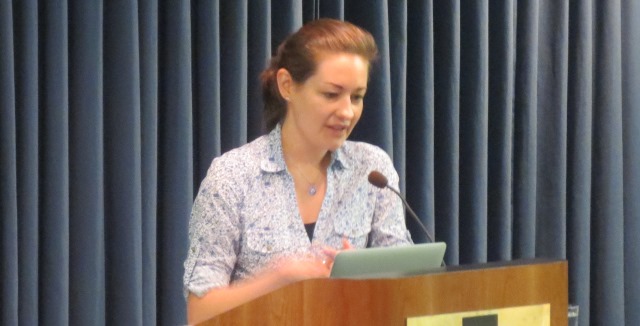
Video and Edited Transcript
Pamela Olson
Transcript No. 384 (7 May 2013)
7 May 2013
The Palestine Center
Washington, DC
Pamela Olson:
Thanks very much and thanks everybody for coming, it’s really an honor to speak at the Palestine Center. When I first came back from Palestine in 2006, I moved to Washington and I came to some events at the Jerusalem Fund and the Palestine Center. They were always such a little thread of hope in this city, which, as you all know, is very allergic to these truths. So I really appreciated this community when I was here.
I open the book with this quote, or a part of this quote, partly because when I got back from Palestine the very first time in 2003, this quote resonated with me because you know, Orwell, George Orwell, when he was first reporting on and then participating in the Spanish Civil War, he says, “I only saw what was happening in my immediate neighborhood. But I saw and heard quite enough to contradict the lies that had been circulating.”
And I felt the same way the very first time I got back from Palestine; I’d only been there about five weeks. At that time, I wasn’t working as a journalist, I had just stumbled in almost by accident and I still needed a lot of catching up to do, I had to do a tremendous amount of research to be able to speak intelligently and come back from the talking points that were thrown at me as soon as I would tell people what I had seen. Or the simply, “Oh you’re naïve, you must have been brainwashed. You know, I watch CNN, I know what the conflict is like, it’s not like that.” I realized that the facts that I had picked up and the things I had learned had essentially no effect on the people I was talking to. And it took me a long time to realize why or what to do about it. And the reason is because Americans tend to have an entire framework that they absorb from the news and from the media and from movies. I watched the Ten Commandments with Charleston Heston every single Easter growing up and so of course, everyone has read the Bible, or a lot of people have read the Bible or at least been given a summary so they have that whole narrative in their minds. And then the framework is built on that narrative of “oh they survived in Europe and they came to this empty land and for some reason the Arabs were violent and they had to overcome it and this is also familiar from our frontier days.” And then of course after 9/11, which is when I first got involved, you have this whole other framework on top of that which is “Arabs are terrorists, they hate freedom” and so all of that together. And so there’s nothing for the Palestinians, there’s no framework, there’s no story, there’s no narrative. So it’s a vacuum and that vacuum can be filled with whatever nonsense people want for their own interests to put into that vacuum. And I was unfortunately was one of those Americans who kind of generally bought the framework. I figured there were some holes in it but it was essentially a sound framework until I wandered into the Middle East myself.
The reason I did that was because after college in 2003, two things happened: one, I started dating a Lebanese guy, and the other, the Iraq war was getting ramped up. So on the one had you have somebody telling me, “Oh yeah Lebanon, the beaches are amazing and women are gorgeous and the food is the best food in the world,” and all these things, like it was Club Med or something. And then you hear from the news, “Oh no the Middle East is a vast desert full of bearded maniacs who want to kill you for your freedom.” So there was a lot of cognitive dissonance going on. I wanted to, you know, I’m not good at learning things abstractly, I kind of knew I’d have to sort of see it first and then start building on that so when I had a chance to backpack from Cairo to Istanbul to meet a friend in Cairo and then do Egypt and sort of go off on my own, I was excited about it and by then I had been studying Arabic just because it drove me crazy when my boyfriend spoke Arabic and I didn’t understand.
So I was excited to see the Middle East. And I planned to skip Israel/Palestine because it just seemed intimidating and dangerous and complicated and you know, who wants to get in the middle of that? It’s been going on for 2000 years, as everybody always says. But then when I got to Amman, Jordan, I met a couple of guys who were doing work in the Palestinian territories and their stories weren’t just poking holes in the framework. They were demolishing the framework. They were like, “No, your framework is completely wrong.” And even at that point after I’d spent that much time in the Middle East, I remember how painful it was to feel the sort of framework in my mind crumbling because somehow, psychologically when you build stories in your mind and you start to identify with them as if they’re part of you and then they get attacked and you feel attacked. It’s a weird thing but it causes a lot of problems that don’t necessarily need to happen because people are so identified with the stories in their heads, they can’t deal with reality anymore.
So I was one of those people and I was kind of primed, by this time, to accept that things aren’t always as you’ve been told and so I decided to follow them into the West Bank and check it out for myself. First we went through the Israeli border and that was its own kind of trauma because everywhere I’d been in the Middle East people were so welcoming and so kind and so you know, “Oh what do you need, where do you need to go, would you like some dinner,” all this kind of thing and then you get to the Israeli border and they’re like, “Why are you here, what are you doing, what do you want,” and you’re just like whoa, that’s a new thing.
In any case, I got through, I lied of course. I didn’t mention I was going to Palestine. We had to go on a settler road to get into this village, Jayous, which is in the northern West Bank. If we didn’t go on the settler road, it would have been about six hours to get down to Jerusalem and then through to Ramallah and then up to the bus and then you take the service taxi and then it’s a mess. So a friend took us through the settler road, dropped us off on the side of the road and said, “Okay you have to climb over this roadblock,” which is a pile of dusty garbage to get to the Palestinian road. And I’m thinking, “My God, the entrance to Palestine is a pile of garbage,” like what is behind it? And I just imagined this kind of smoking hellscape full of angry people shouting “Death to America” or something. The minute I crossed the roadblock, I felt more at ease than I had in a long time. I felt like, “Oh I’m back in the Arab world, this is familiar again and people were, “Oh welcome to Palestine. Ahlan wa sahlan, what do you need, where do you need to go, do you need a ride?” And so they took us into this village Jayous, didn’t even charge us anything. Even by this point, I’m still kind of on the defense a little bit because I wouldn’t blame them, frankly, for looking upon me as an enemy or at least with suspicion.
I’m just going to read quickly my first evening: “So the driver dropped us off in front of a house where half a dozen men were sitting on the porch in a circle of white plastic lawn chairs sharing an ornate arguileh, hookah. Youssef, the British guy I was traveling with, gathered everyone and introduced me. The house belonged to Amjad, a barrel-chested mechanical engineer with a neatly clipped black moustache. One of the other men asked in English where I was from. Oklahoma, I said. ‘Ah,’ he looked confused. ‘You are Japanese?’ I smiled and shook my head, ‘No, not Yokohama, Oklahoma.’ ‘So, you’re from America?’ Amjad asked.” And forgive me, I tend to speak the way I that I hear their voices in my head, so forgive me if I butcher the Arabic accents.
“Amjad had a booming voice and his question might have sounded like an accusation if not for the amused expression on his face. I paused. ‘Yes?’ He laughed, ‘You are ashamed?’ I wasn’t ashamed but it seemed wise to keep a low profile until I had a better idea what was going on. ‘Do not worry,’ he said reassuringly. ‘It is a good country. Good people. Just your government is bad. Arab people, we understand. Our governments are very bad.’ Youssef shook his head, ‘It seems like the nicest people have the worst governments.’ ‘Ah, Oklahoma!’ The other man said, finally putting the pieces together. ‘Yes, Oklahoma City. It is dangerous place.’ I couldn’t imagine what he was talking about. Cowboys? Indians? Dangerous? ‘Wasn’t there a bombing?’ ‘Oh, yeah, uh right. Well there was one bombing.’ ‘But it was a very big bomb, yes? Many people killed.’ ‘I’m sure it was very big, but it was one bombing almost ten years ago.’ We were in occupied Palestine and this guy was worried about Oklahoma being dangerous? I guess that’s what happens if you know nothing about a place except its bombings.”
So that was literally my first five minutes in Palestine and already, sort of five different preconceptions are already destroyed. It just got better from there; people were so kind and so educated. The fact that everybody was speaking perfect English was pretty amazing to me. And a lot of them also spoke Hebrew and some of them spoke Russian and I was thinking, this is the same size and my town in Oklahoma and half the people in Oklahoma don’t even speak English very well, much less, a second or third or fourth language. (I’m from Oklahoma, I can say that). All of these preconceptions were being disintegrated one by one and there was nothing I could do, because you’re seeing it. So unless you’re going crazy, it is what it is.
The next morning, it was right in the middle of the olive harvest, it was in October. So we all got up the next morning and I just sort of tagged along, you know, I was going to check out the olive harvest. And just as we got down to the bottom of the hill that the town was on, we come across thing [refers to slide], which is like a twenty foot high fence with electronic sensors, two army accesses on either side, two trenches on the other side of that, and then razor wire rails with a message that makes it pretty clear, you know, if any unauthorized approaching of the fence, you forfeit your life, essentially.
I was pretty shocked to see this and everybody else just gathered around the gate to wait as if it’s something normal. And you know this is 2003, it had just been built less than a year earlier. Of course it wasn’t something normal but one of the things you hear Palestinians say a lot in very inappropriate moments is, “Don’t worry, it is normal”, and you’re like, “Dude sorry, that is not normal.” But you have to get used to these things or you just give yourself an ulcer for no reason.
Here’s an example [refers to slide] of one of the gates that’s kind enough to post opening times. A lot of them don’t even post the opening times. So you just show up and you hope the soldiers are going to show up and let you through. You don’t know when or whatever. And of course even if they post the times, there’s no guarantee they’ll actually show up, or if they show up, that they’ve remembered the key or if they’ve remembered the key, that they feel like letting you through.
Then of course there’s the whole system of permits where even if you own land on the other side of the fence, you have to have a permit from the Israeli authorities to access that land. And what’s interesting is that if you’re under Israeli law… so they call this area between the fence and the green line or the border with Israel, they call it the “seam zone”. And Palestinians require special permits to access the seam zone. Any person in the world is eligible to immigrate to Israel under the Law of Return, which means any Jewish person in the world can access this same land without a permit. So when I learned that, I had never heard anything like that, I was pretty shocked.
So we gathered around the fence to wait and finally after about two hours, the soldiers arrived and let us through. So you can see here [refers to slide] this is the fence, this is all Jayous land and it includes green houses, almond trees, olive trees, of course, mangos, avocados, cucumbers, tomatoes, green houses, and all of its water resources. They have seven water wells and all of them are isolated from its owners by the wall. And this is the map [refers to slide] of what it looks like. The map has actually changed slightly. The Israeli army admitted to the Israeli high court that at least this section was routed; this is an area that was on an Israeli map designated for settler expansion, or a new settlement to be built. The people of Jayous had a court case against them for it. And of course, the entire thing is illegal according to the International Court of Justice, you’re not allowed to build a wall on occupied land, much less isolate people from their land. But the Israeli army admitted to the Israeli high court that yes, this section was routed based solely on settlement expansion considerations, not on security. So they ended up demolishing this segment of the wall and rebuilding a segment right here [refers to slide]. So most of their land is still isolated from them but they got a little bit of it back.
This dark blue thing [refers to slide] here is a settlement already built on Jayous land and this is another area. It’s nothing except for designated on an Israeli map as a settlement expansion area. And in 2004 the Israeli army came in and bulldozed 650 olive trees in this area and they belonged to the father of a friend of mine. It was a huge trauma for the family of course and there’s no way to… it’s almost impossible to describe what it means to lose any trees much less that many that your family has tended for centuries. Some Israeli and Palestinian peace activists came together over New Year’s Eve and planted olive seedlings in this area as a symbolic protest and it was a beautiful scene, very inspiring and very hopeful despite this terrible thing that had happened. And of course settlers came and uprooted the saplings the next day.
But despite all of that that I was learning and it was kind of traumatic to see it and learn it, we had an amazing time harvesting olives that day. I describe it in the book. It reminded me of some of the best times in my childhood in Oklahoma with kids running around and telling jokes and playing games and picnics, and the sound of olives falling on tarps in stereo all around you, like a rich olive rain. It’s something that I had never experienced before and it was really fantastic.There’s a picture here [refers to slide] where everybody’s laughing because they told the kids to say “cheese” and the little kid said “teez”, which is a bad word in Arabic if you don’t know.
Just a lot of great humor and great times. Needless to say, by the end of the five days I had set aside to visit Jayous before going on, I didn’t want to leave. I was just getting my feet wet and just starting to meet some people and Ramadan was starting. Every night I had five invitations to dinner at different people’s homes and I felt like a movie star, I had to keep a careful social calendar and not slight anyone or whatever. And you know, “Enshallah, enshallah, maybe I’ll be able to go,” and I don’t know, it was kind of ridiculous but it was really fun. And so I made an excuse to stay for an entire month, the entire month of Ramadan, which was a… a Palestinian woman was teaching English in the community center in Jayous and her co-teacher, who was a Canadian woman, had just left so I was like, “Oh I can take her place until I need to go.” So that was my excuse to stay and not feel like a free-loader.
And so I did that and of course every day… you know, when you think of Ramadan you imagine a sort of austere, depressing you know, fasting and everything else. In my case, it was watching music videos all day and then feasting and partying every single night. I gained so much weight during Ramadan. But in to that, I was out of money, I had to catch a plane to Istanbul but I still didn’t want to go and it killed me to leave and all I could think about when I was traveling to the other countries and when I got back home was wanting to go back. But as I said, as I mentioned, when I got back to California which is where I went to college, I was just going to everyone, “Oh my god, you won’t believe what I just saw in Palestine, there’s this crazy stuff happening and the wall,” and then this and then that and they’re like “Sweetie, calm down, I’m sure that it’s not that bad, I’m sure… maybe you think you saw it but whatever.” And other people would literally say these horrifically racist things about Arabs and Muslims without even thinking about it, that they would never dare say about any other race or religion. To see my friends turning into different people around this issue, I almost started to question my own sanity and I just wanted to get back to a place where you can live in reality world with people who know what’s going on because they live it every day.
By the time I got back, the English teaching program was discontinued in Jayous and I kind of wanted to go to the bigger city anyway to check out the bird’s eye view of what’s going on. I had seen kind of what it looks like on the periphery and I wanted to get a more clear-eyed, you know, larger-scale view of what was going on and my excuse to go to Ramallah was Dr. Mustafa Barghouti came and spoke at Stanford in the spring of 2004 and I liked what he had to say. It was very, you know, secular nonviolent resistance, peace via international law, all of these great things that you would think, the West would want in an Arab leader. So I was thinking, great, if it works, I’d love to be a part of it. If it doesn’t work for whatever reason, you know, what are the forces preventing this kind of leader from emerging in the Arab world, and I would certainly find that out.
But… yeah, just some pictures from Ramallah [refers to slide] which gets a lot of flak and justifiably so, because it’s kind of a Potemkin village of foreign aid being splashed around everywhere without really making a sustainable economy and you got foreigners all over the place jacking the prices up. I like to think I wasn’t one of them because I lived on about ten dollars a day while I was there. Still, it’s easy to sit in the middle of Ramallah and sip your cappuccino and forget about what’s happening to everybody else and people get frustrated about that, and I don’t blame them at all. It’s kind of like as long as Ramallah stays happy, that’s where the Palestinian Authority is, then… they act like they’re the voice of the Palestinians when they’re not suffering the way the Palestinians are, so I understand why it gets a bad reputation. But other than that political reality, it’s a beautiful city and… this is a church near the office where I worked and there were concerts and film screenings all the time and plays. This is a musical group [slide], an improv comedy group [slide] at the Ramallah Cultural Palace. The famous Sangria’s Beer Garden [slide] in Ramallah where I first learned about a wonderful thing called Taybeh beer [slide], which I had never imagined Palestine had a beer especially because my first entrée into the place had been Jayous, where beer is not something anybody even mentions, it’s a very conservative village. But I went to Sangria’s and everybody’s ordering beer and I’m like, “Oh where’s the beer from?” And they’re like, “Oh it’s from just over the hill in this town called Taybeh,” which is a Christian village fairly close to Ramallah and every fall, I also learned, they have a celebration called Oktoberfest where they have beer and non-alcoholic beer if you swing that way and musical groups and dancing and street food and arts and crafts and I always go there to load up on Christmas presents when I have a chance.
And this is a group called Culture Shock [slide], Palestine’s rock-rap band they call themselves. And everybody had a crush on one or the other lead singers and it was unfortunate that they were dating each other but….That’s the lead singer [slide]. This is a café in central Ramallah [slide], most likely a copyright violation [referring to Stars & Bucks Café]. My guess is Starbucks lawyers don’t want to deal with the Israeli borders or checkpoints so they just leave it alone.
I went to lunch here [refers to slide] almost every day when I was working. They had a really nice Italian chicken sandwich when I wanted to splurge and not just have falafel. I wanted to post this on Facebook with the caption I found him [name of restaurant: Osama’s café] back in the day when that would have been funny but it’s too late now. This is just some scenes from main street Ramallah [refers to slide]. A man selling turmous, the little seeds, and foul.
I make the joke in the book, there’s a few weddings in the book, you know, it’s such a quintessentially Palestinian thing to experience because even in the conservative villages where everybody dresses fairly conservatively and wears the head scarf for the most part, for weddings all of a sudden everybody’s like painted and glittered and spaghetti straps and whatever. And I make the joke, for one day everyone looks Lebanese. So these are some of those fancy dresses [slide]. And God knows how they can afford them but…
Plaza Mall north in El-Bireh…. Birzeit University, north of Ramallah, the top university in Palestine and I’m going to take another quick break to read something.… So back in Jayous, at the end of my first week in the village, somebody new had come to the porch where I was now spending all of my evenings, Amjad’s porch in Jayous. Somebody new came and I poured a cup of tea for him and he says “Poseeba” which is Russian for “Thank you” and I said “Pojalsto” which is Russian for “You’re welcome” and he’s like, “Wait a minute why are you speaking Russian?” And I’m like “Why are you speaking Russian?” And it turned out he had just come back from studying in Russia for a year and a half and he spoke fluently like he was perfect. I had spent some time in Russia as an undergraduate and then studied the language afterwards and I was conversational but not as good as he was. So he was kind of like good –looking and confident and all these things and so I was thinking he would be kind of cocky about speaking way better than this American girl but in fact, he was very helpful and calm and if I didn’t understand something, he would switch to simpler vocabulary or even switch to English if he needed to and so we ended up kind of having this shared language in this conservative village where we’d never had a chance to be alone together because we were unmarried young people.
And we just kind of bonded over this and then when I came back to Ramallah, not long afterwards we kind of became an item. Though we couldn’t do much about it for various reasons, one – it had to be kind of a secret even though everybody knew because rumors travel in the West Bank at a speed that would confound Albert Einstein but so it was an open secret but just to be polite, you had to kind of pretend it was a secret. Other than that, he was also studying in Jenin. Every weekend he went home to his father’s house to help with the land in Jayous and by this time, after about three months of volunteering with Dr. Mustafa, I was offered the job as head writer and editor of the Palestine Monitor, which itself I was like, “Are you sure I’m qualified to run a news organization, you know I’m a physics major, ex-bartender, volunteer, backpacker,” but they’re like “Don’t worry, you’ll figure it out.” So once I started that job it was like drinking from a fire hose; until that time everything was just experiences and anecdotes.
And now all of a sudden I had a systematic view of everything happening every day and I had to catch up on what the trends were and catch up on what each village was like, because when something happens in a village, it means something if it’s in this village or in that village. So there’s just a huge amount of local knowledge to pack into my head, at the same time I’m learning the skills of being a journalist itself so I was incredibly busy in Ramallah and he was busy at school. And we can never hang out except for sort of in Jayous on his porch occasionally and even that you know, I said that it takes up to three hours or even much more, sometimes there’s a flying checkpoint or the checkpoints are closed or whatever to get all the way there just to talk on the porch for a while then to go back home.
So we were thinking maybe this isn’t going to really work out but then one day he called [reading from book], “’I’m coming to Ramallah on Saturday morning enshallah.’ My eyes widened, the coming weekend would be last before classes started again and he wanted to spend it together. Maybe there was hope for us after all. He called again on Saturday morning and said he was on the bus and would arrive in forty minutes if there were no checkpoints. I happily began cleaning the house, buzzing with energy, humming with possibilities. By the time I finished and looked at a clock, I was startled to realize nearly two hours had passed. I called Qays’ number. He rejected the call. Feeling some mixture of alarm and irritation, I texted, ‘Big checkpoints?’ Several minutes later he texted back, ‘They booked my ID and the bus went. I don’t know what will happen. I am stopped with somebody else. Don’t try to call. I will call when they leave me.’”
“My blood runs cold. This is how it starts. The soldiers take them off their bus, off the street, out of their house and they disappear, maybe for hours, maybe for days, maybe for years. Palestinians can be held in Israeli jails for up to three months without charge or trial, a practice known as administrative detention. The three month sentences can be renewed indefinitely. I’ve heard stories of innocent people being held for years in Israeli prisons, of people being destroyed by the experience. No warrant, no charge, no phone call, this isn’t an arrest in any sense I recognize. This is government-sponsored kidnapping. If the soldiers are just harassing him, he’ll call in a couple of hours. If they’re taking him for days or months, I’ll have to sit here as dreadful minutes drag into unbearable hours waiting for his call, my imagination getting worse as time goes on. I can’t concentrate enough to do anything but stare at my silent phone. By the time four hours have passed, I’m a basket case. Yasmine, my roommate from the Gaza Strip, shows up half an hour later with a cheeseburger and fries from the Checkers on Main Street. She says reassuringly, ‘Don’t worry habibti, they do this all the time. One time they took me off my bus at a checkpoint and made me stand in the sun for ten hours.’ ‘Why?’ ‘There is no reason, they just do it to humiliate us. He’s not politically active, is he? He’s just a student. Maximum, they will beat him and throw him in prison for a few days.’”
“I hope to God she’s right. But even that is more than I can bear imagining. He’s never been in prison before. If they keep him more than two days, he’ll miss the beginning of class. Even if he misses a single hour of his life, a day with his family, a week of class, it’s more than I can bear. Anything worse is beyond imagination. But I imagine it all the same. Once when we were sitting on his porch in Jayous, Qays told me about a cousin who’d been in prison for two months in unsanitary conditions and was suffering from terrible hemorrhoids and back pains, neither of which he’d suffered before. I think of Qays sitting next to me on the porch, whole and perfect, telling me about his poor cousin. Now maybe it’s his turn. My mind and stomach are spinning. I’m reminded of a time when I was fifteen and my mother asked me if I knew how to drive a stick shift. ‘Sure’, I said. ‘How do you know how to drive a stick shift,’ she asked, ‘if you’ve never tried?’ ‘I read a book about it.’ They all laughed at me and sure enough, when I tried to drive my brother’s little Honda Civic, I nearly dropped the engine out of the bottom of the car. It’s the same difference it turns out between reading a thousand human rights violations reports and then having someone you personally care about disappear.”
So that was kind of a progression of events that happened more than once: you hear about something happening and then you report on it happening, and then it happens to someone you cared about and through the course of the book, of course it gets worse, it’s a relatively minor thing in the scheme of things. And just not to leave you hanging, ten hours passed, 20 hours passed, 30 hours passed. I was going out of my mind, I was calling everybody I knew, I was trying to figure out what to do. No word from anybody. Finally after 32 hours, I get a call from his number and I’m thinking, oh my God it’s his family telling me God knows what. But thank God it was him and he was fine. They just tied him up, threw him in an army Jeep, blindfolded him, took him to a settlement, tied him to a chair and interrogated him for twenty hours. Now they can do this to whoever they want, whenever they want, and there’s nothing you can do about it. It doesn’t matter if you’re innocent, guilty, thought crime, no crime, whatever, it just happens. The punch line to the story is, the next day I was talking to Yasmine, my roommate, and her friend Osama and I was saying, “You won’t believe what a horrible weekend I had, it was the worst weekend of my life,” and they’re like, “He was only taken for 32 hours?” “Well yeah… sorry.” “And he wasn’t tortured? No?” And they’re like, “Sweetie, don’t worry about it, this is normal.” I’m like, “No, not this is normal!”
But that’s sort of halfway through the book. By the time, my parents come for a visit, sort of three-quarters of the way through the book, I’m telling them, “Don’t worry guys, it’s normal.” And they’re like, “What, that’s not normal?” So it’s funny what it does to your brain to be in this situation for a prolonged period of time; they say you have to learn to deal with whatever’s happening in the healthiest way you manage, and this is not easy.
So just a few more pictures [refers to slide]… this is the Qasr al-Masri, up in the hills above Nablus and this is a church in Nablus, the church of Jacob’s well. There’s a story in the book comparing this European non-Muslim presence in Nablus to a nearby European non-Muslim presence in Nablus called Joseph’s tomb, which has a very different history. Instead of purchasing the land and leasing it and being a respectful neighbor, settlers came years ago, took it over by force and turned it into a yeshiva, a Jewish religious school slash military base. And from this base they would attack the refugee camps and there would be attacks back and eventually there was a shootout and the place was evacuated and the Palestinians destroyed it. So it just goes to show that it’s not necessarily [that] Palestinians won’t accept a European non-Muslim presence in their midst, it depends on how you behave.
Then to bring it full circle in this same church, settlers came in 1979 and told the priest to get out. They said Jacob is our patriarch, this is our holy site, get out of here. He refused and later the settler came with some other men and murdered the priest. And of course, as usual nobody was punished for the crime. So … some of these stories you almost wouldn’t believe if you hadn’t seen them for yourself or heard eyewitness reports from people that you trust but the church itself makes it clear what happened, so it’s an interesting story.
And by all rights, regardless of anything else this should be a major Christian tourism and pilgrimage site because the church of Jacob’s well, is where, according to the Bible, Jesus revealed himself as the Messiah, so it’s a big deal. But you go there and you’re the only one there because of the situation and the checkpoints. I’m not sure what the number is now, last I checked it was about 500 checkpoints roadblocks, gates, fences, you know, different ways of keeping… And most of them are inside the West Bank, so they keep cities from other cities, towns from villages, villages from other villages, villagers from their land, from school, from the hospital, and these are just a few more examples.
This is of kids [refers to slide] trying to get to school and one unfortunate reality of this is a lot of kids have actually dropped out of school, disproportionately women and girls because you know, if the soldiers don’t show up and you’re stuck at this checkpoint, sometimes overnight, God knows what’s going to happen. And there’s nobody there to protect you. The soldier is there to protect the settlers, not the Palestinians, so it’s a pretty terrible situation.
In a couple of cases in the book, when I couldn’t get to Nablus, I had to hike over these hills for two hours to bypass it. And it’s a lovely hike if you’re young and if you have time on your hands; if you’re old or sick or pregnant or trying to get to school on time, it’s a different story. And of course, especially if you look Palestinian, you run a chance of being beaten or shot for trying to bypass the checkpoint because people know what the routes are.
Dr. Mustafa… so about three months after volunteering, I got the job as a journalist. When I was finally starting to settle in with the journalism job and looking forward to a winter of just working forty hours a week and not exactly relaxing, but having time and mental energy to enjoy life in Ramallah, which I really was enjoying, Yasser Arafat died and Dr. Mustafa called a meeting and said, “So I’ve decided to run for president against Mahmoud Abbas.” And I was like, “Good for you, you know I have a movie to watch, I was planning to get some Chinese take-out, you know, go for it.” But I was stuck in this meeting and he kept going on, “I’m going to need somebody to volunteer to be my Foreign Press Coordinator, it’s going to be essentially a full-time job on top of your other full-time job, you’re going to represent me to the world’s press, right now you need to stay in the office for five hours and compile the information of all the correspondents in Israel Palestine.” And I’m like, “Yeah, whatever.” And then I looked around and I realized I was the only native English speaker who wasn’t leaving for the Christmas holidays. So I was like, “Oh God, he’s talking to me.”
So I’m like, “Okay I can do it.” But the thing is, after I got over the shock of having to work a lot extra, I was like, “My boss is running for president, this is awesome and I’m going to be right in the middle of it.” So yeah we had a whole two months of just complete insanity. It was working all the time, traveling all the time, campaign stops, campaign posters,… and everywhere you go in Ramallah, one shop would have like fifty Mahmoud Abbas posters and the next one has fifty Mustafa Barghouti posters and the next has the communist guy and the next one has whatever. It was really exciting and really interesting for many reasons, in many ways. One was of course, Ariel Sharon, the prime minister of Israel at the time, said, “Oh yes of course we’re going to allow the presidential candidates to move freely while they’re campaigning and of course we’re going to allow the voters to get to the voting booths when it’s election day, we want them to be a democracy like us,” and that’s what they were saying.
And on the ground, yeah they’d taken out a few fixed checkpoints but they added more flying checkpoints which are even more nerve-wracking. And yeah, Mahmoud Abbas could go wherever he wanted but all the other candidates were arrested at different times, prevented from going to East Jerusalem, prevented from going to Gaza. This is Dr. Mustafa prevented from going to the Hebron Old City. It just kind of put the lie to the sham of what kind of democracy do you have when an outside power tells you where you can travel. It’s not easy to reach four million people in two months anyway much less when somebody’s preventing you from moving.
At one point, Israeli soldiers even dragged him and all the people that were in his car out of their vehicle and beat them to the ground and made them stay on the ground for an hour and fifteen minutes in the cold in December. As bad as it is to be beaten, it’s almost worse to risk getting sick when you’re in the middle of a campaign or risk losing your voice. So after over an hour, they let him go, took everybody to the hospital to get them checked out, it was only minor injuries. But still it’s a pretty big deal for a foreign army to beat up a presidential candidate and then I expected, you know I wrote the press release, and then expected the next day to open the New York Times and [to find] a whole story. And of course it was relegated to an unrelated article about a girl in Gaza who’d been killed. It essentially said, elsewhere Dr. Mustafa Barghouti claims to have been in a tussle with Israeli soldiers, the soldiers said they checked their ID for twenty minutes and allowed them to pass and denied the men had been hit. And that was kind of the end of that. So the whole thing was that kind of shenanigan. You watched who Israel clearly favored and I don’t have time to go into why but I talk about it in the book.
I’m just going to end really quickly … there’s plenty to be miserable about, about what’s happening in Palestine or depressed about. But almost everybody I know who goes there, the overwhelming impression they come back with is more actually inspired and hopeful than before. In my case, I never realized how strong human nature could be until I spent time in Palestine. And so my whole conception of not just that conflict and not just my country but human nature really changed. And I really can’t repay Palestine enough for that. But here’s just a little passage that kind of hints at that:
So this is during the olive harvest in Jayous in 2004, the second one when I came back to Ramallah. By the way, I only took the journalism job on condition that you have to give me ten days off to harvest olives because I had had so much fun I couldn’t stand the idea of not doing it again. So:
“Monday morning I packed a small bag for three days of camping with the mayor’s family on their land. They were tired of dealing with the wall every day and so was I. The days passed pleasantly and time seemed to move along at just the right speed. Hours of clean work with our hands, under the sun, were interspersed with heavenly drinks of cold, clear water in the shade of an olive tree and picnics of pickles, yogurt, hummus, tuna, fried potatoes and eggplant, boiled eggs, halaweh, and sweet black tea. Occasionally, a cousin would bring a platter of ma’loubeh or a garlicy green stew called mlokhiyeh from town and we’d eat like kings. We harvested each day until we couldn’t see anymore. Then we’d take tea, watch the last lights of sunset fade, chat or just think our thoughts while the stars broke out of the crystal sky one by one. In these moments, we knew against an ever-growing pile of ripe olives, breathing in the deep, rich subterranean scent of a hard day’s work, I felt completely content and at peace. My nerves were mellowed and my spirit refreshed in ways words couldn’t describe and money couldn’t touch. On evenings like this in a world like this, it seemed downright ungracious ever to despair. It was after all absurd to hate the slaughter and waste and hardship and destruction without acknowledging the flip side that life was here. That the whole reason we hated waste and destruction was because we loved life in this world so much.”
So thank you very much.
Pamela Olson lived in Ramallah for two years, during which she served as head writer and editor for the Palestine Monitor and foreign press coordinator for Dr. Mustafa Barghouthi’s 2005 presidential campaign. She’s published stories and articles in CounterPunch, Electronic Intifada, Mondoweiss, Israel’s Occupation Magazine, and The Stanford Magazine, and she also wrote an essay about disputed holy sites for the Encyclopedia of the Israeli-Palestinian Conflict. She lives in New York City.
This transcript may be used without permission but with proper attribution to The Palestine Center. The speaker’s views do not necessarily reflect the views of The Jerusalem Fund.
